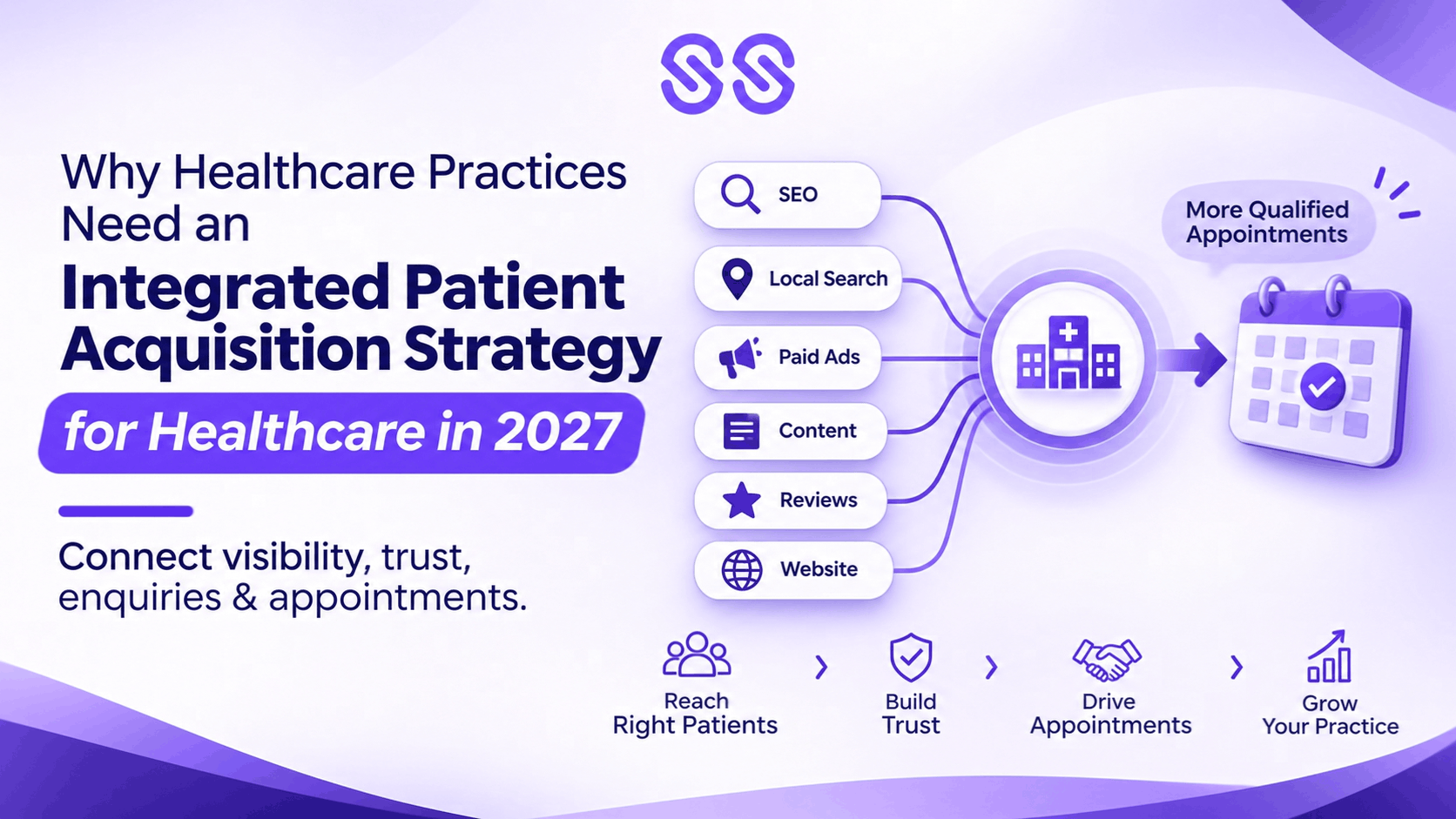
Attracting new patients is one of the most important challenges for healthcare practices. However, generating website traffic, receiving social media enquiries, or running paid advertising campaigns individually does not always translate into consistent patient growth.
A clinic might rank well on Google but struggle to convert visitors into appointments. Another practice may generate enquiries through advertising but lose potential patients because of delayed responses or an unclear booking process.
These challenges highlight the need for a more connected approach to healthcare marketing.
In 2027, healthcare practices need an integrated patient acquisition strategy for healthcare that brings together search engine optimisation, local visibility, paid advertising, educational content, reputation management, and conversion optimisation.
Rather than treating every marketing channel as a separate activity, an integrated strategy connects them around one objective: helping the right patients discover a practice, build confidence in its services, and take the next step towards an appointment.
Also Read About - Best Digital Marketing Strategies for Ophthalmology Clinics
What Is an Integrated Patient Acquisition Strategy?
An integrated patient acquisition strategy is a coordinated marketing approach that uses multiple channels to attract, engage, and convert prospective patients.
It considers the complete journey, from the moment someone searches for a medical condition to the point they contact a clinic or book a consultation.
For example, a patient researching persistent knee pain may:
Search Google for information about knee pain.
Read an educational article published by an orthopaedic practice.
Visit the clinic's treatment page.
Check the doctor's qualifications and patient reviews.
Find the clinic through Google Maps.
Contact the practice to arrange an appointment.
Each interaction contributes to the patient's decision-making process.
An integrated strategy ensures that the website, search visibility, advertising, reputation, and enquiry management work together rather than operating independently.
Why Healthcare Practices Need an Integrated Patient Acquisition Strategy in 2027
1. Patients Use Multiple Channels Before Choosing a Clinic
Patients rarely make every healthcare decision after seeing a single advertisement or website page. They may compare providers, research treatment options, read reviews, and look for professional credentials before contacting a clinic.
This means healthcare practices need a consistent presence across the platforms patients use.
A clinic that invests only in Google Ads may miss patients researching medical information through organic search. A practice that focuses exclusively on SEO may miss opportunities to reach high-intent audiences through paid campaigns.
An integrated approach helps maintain visibility at different stages of the patient journey.
2. Competition for High-Intent Healthcare Searches Is Increasing
Healthcare practices compete for visibility across general search results, local listings, paid advertisements, and emerging AI-powered search experiences.
Broad keywords may attract considerable traffic, but not every visitor is looking to book an appointment.
For example, an orthopaedic clinic should distinguish between searches such as:
- What causes shoulder pain?
- When should I see an orthopaedic specialist?
- Orthopaedic surgeon near me.
- Shoulder surgery consultation.
The first search may indicate an informational need, while the last two suggest stronger commercial or appointment-focused intent.
A connected patient acquisition strategy maps different search intents to suitable content, service pages, and conversion opportunities.
3. Relying on One Acquisition Channel Creates Risk
Depending heavily on one marketing channel can make patient acquisition unpredictable.
For example, a clinic relying only on paid advertising may experience higher acquisition costs or reduced lead volume when competition increases. A practice depending entirely on organic search may be affected by ranking fluctuations or changes in search experiences.
Diversifying patient acquisition channels creates a more balanced marketing system.
Important channels include:
- Organic search and healthcare SEO.
- Local SEO and Google Business Profile.
- Google Ads and relevant paid campaigns.
- Social media marketing.
- Educational healthcare content.
- Online reviews and reputation management.
- Referral and professional networking opportunities.
- AI-powered search visibility.
The objective is not to invest equally in every channel. It is to identify the channels that reach the practice's target patients and coordinate them effectively.
Also Read More - AEO vs GEO vs SEO: What Healthcare Brands Need to Know in 2026
The Core Channels of an Integrated Healthcare Patient Acquisition Strategy
1. Healthcare SEO for Long-Term Patient Discovery
Search engine optimisation helps healthcare practices reach people actively researching medical conditions, treatments, and specialist services.
A strong healthcare SEO strategy should include technical optimisation, keyword research, service-page development, educational content, internal linking, and authority building.
Instead of publishing content around unrelated keywords, clinics should organise their websites around their core specialties and treatments.
For example, a physiotherapy practice could create a central physiotherapy service page supported by relevant pages about sports injury rehabilitation, back pain, post-operative rehabilitation, and mobility concerns.
This structure helps search engines understand the website while giving patients relevant information.
2. Local SEO for Location-Based Patient Acquisition
Local SEO is especially important for clinics that serve patients in specific cities, neighbourhoods, or geographical areas.
Patients often search for nearby doctors, specialists, diagnostic services, and medical practices.
A local SEO strategy should focus on accurate Google Business Profile information, relevant local landing pages, genuine patient reviews, consistent business details, and location-specific content.
For multi-location practices, each location should have accurate contact information and useful details about the services available there.
Local SEO helps clinics connect with patients who are actively looking for healthcare providers within their service area.
3. Paid Advertising for Immediate Visibility
Paid advertising can help healthcare practices reach relevant audiences without waiting for organic rankings to develop.
Google Ads can target patients searching for specific services, while suitable social advertising campaigns can support awareness and engagement.
For example, a dental clinic may run search campaigns for dental implants, while a physiotherapy centre may promote consultations for sports injury rehabilitation.
However, advertising success should not be measured by clicks alone.
Clinics should evaluate:
- Cost per enquiry.
- Qualified lead percentage.
- Appointment booking rate.
- Consultation attendance.
- Cost per acquired patient, where measurable and appropriate.
Advertising campaigns should also comply with applicable healthcare advertising regulations and platform policies.
4. Educational Content to Build Patient Confidence
Healthcare content helps patients understand conditions, available services, treatment processes, and when professional assessment may be appropriate.
It also gives clinics opportunities to demonstrate expertise and answer common questions.
Useful content formats include:
- Medical condition guides.
- Treatment and procedure explanations.
- Doctor-led educational articles.
- Frequently asked questions.
- Recovery and aftercare information.
- Short educational videos.
Content should be clinically accurate, reviewed by appropriately qualified professionals, and written in accessible language.
Educational content can support both organic discovery and the decision-making process after a patient reaches the clinic's website.
5. Online Reputation Management to Strengthen Trust
A clinic's reputation can influence whether a prospective patient chooses to make an enquiry.
Patients may review ratings, read feedback, check doctor profiles, and compare publicly available information before selecting a provider.
A consistent reputation management process should encourage genuine feedback, monitor reviews, respond professionally, and keep important clinic information accurate.
Clinics must protect patient confidentiality when responding to public reviews and avoid disclosing private medical information.
6. Conversion Rate Optimisation to Turn Enquiries into Appointments
Generating traffic and enquiries is not enough if the website makes it difficult for patients to take the next step.
Conversion Rate Optimisation (CRO) focuses on improving the experience that turns website visitors into enquiries and appointment requests.
Important elements include clear service descriptions, visible contact details, mobile-friendly layouts, simple enquiry forms, accessible appointment options, and relevant doctor credentials.
Clinics should also review how quickly enquiries are handled.
A well-designed website combined with a responsive enquiry management process can reduce friction in the patient acquisition journey.
Read More - Digital Marketing for Doctors: Complete 2026 Guide to Patient Acquisition
How to Connect Patient Acquisition Channels into One Strategy
An integrated strategy requires more than using several marketing platforms. Each channel should support a defined role within the patient journey.
| Patient Journey Stage | Marketing Channel | Primary Objective |
|---|---|---|
| Awareness | Educational SEO, social media, video | Introduce the clinic and its expertise |
| Research | Blogs, treatment pages, AI search visibility | Answer patient questions |
| Consideration | Local SEO, doctor profiles, patient reviews | Build confidence and credibility |
| Enquiry | Google Ads, service landing pages, contact forms | Generate qualified enquiries |
| Appointment | Call handling, booking systems, follow-up | Support appointment conversion |
| Retention | Appropriate patient communication and feedback | Maintain engagement and improve experience |
For example, a patient may discover a dermatology clinic through an educational article, visit its treatment page, check its Google Business Profile, and then submit an appointment request.
The clinic's marketing system should make this journey consistent, informative, and straightforward.
The Role of AI in Patient Acquisition in 2027
AI is changing how people discover information and how marketing teams manage campaigns.
Healthcare practices should prepare for AI-powered search experiences while maintaining strong foundations in traditional SEO.
Important opportunities include:
AI search optimisation: Develop accurate, structured, expert-led content that clearly answers relevant patient questions.
Marketing analysis: Use AI-assisted tools to identify keyword opportunities, review campaign performance, and organise marketing insights.
Enquiry automation: Automate appropriate administrative communications, such as enquiry acknowledgements and appointment reminders.
Content planning: Identify recurring patient questions and develop educational resources around relevant treatment and service topics.
AI should support marketing efficiency, not replace clinical judgement or human communication. All medical information must be appropriately reviewed, and patient data must be handled in accordance with applicable privacy requirements.
Read more - Best Website Features for Modern Dental Clinics
How to Measure the Performance of a Patient Acquisition Strategy
A healthcare marketing strategy should be evaluated by the quality of patient acquisition, not just the volume of marketing activity.
Clinics should establish a measurement framework that tracks performance across the complete acquisition journey.
| KPI | What It Measures |
|---|---|
| Organic traffic | Visitors arriving through organic search |
| Local search visibility | Discovery through location-based search |
| Qualified enquiries | Enquiries relevant to the clinic's services |
| Cost per lead | Marketing spend required to generate an enquiry |
| Lead-to-appointment rate | Percentage of enquiries that become appointments |
| Appointment attendance rate | Percentage of booked appointments attended |
| Channel contribution | Performance of individual acquisition channels |
| Conversion rate | Percentage of visitors completing a desired action |
It is also important to distinguish between total enquiries and qualified patient enquiries. A campaign generating fewer but more relevant enquiries may deliver greater business value than one producing a high volume of unsuitable leads.
Healthcare practices should configure analytics and tracking carefully, particularly where sensitive patient information is involved.
Common Patient Acquisition Mistakes Healthcare Practices Should Avoid
Even clinics investing in multiple marketing channels can struggle when their activities are disconnected.
Common mistakes include:
- Investing in advertising without improving landing pages.
- Publishing blogs without connecting them to relevant service pages.
- Depending entirely on one source of patient enquiries.
- Ignoring Google Business Profile optimisation.
- Measuring traffic instead of qualified leads and appointments.
- Using generic healthcare content without clinical expertise.
- Failing to respond to enquiries promptly.
- Running campaigns without clear conversion tracking.
Avoiding these mistakes requires a coordinated strategy, clear ownership, and regular performance reviews.
Also Read About - Orthopedic Marketing: The Complete Guide to Patient Acquisition, SEO, PPC & Digital Growth for Orthopaedic Surgeons
How Socialsect Helps Healthcare Practices Build an Integrated Patient Acquisition Strategy
Socialsect helps healthcare practices develop digital marketing strategies that connect visibility, credibility, and patient acquisition.
Our approach considers the complete patient journey rather than focusing on isolated marketing activities.
Depending on the practice's requirements, the strategy can include healthcare SEO, local SEO, AEO, GEO, paid advertising, healthcare content marketing, website optimisation, reputation management, and conversion rate optimisation.
By connecting these channels with meaningful performance tracking, Socialsect helps clinics identify growth opportunities, improve lead quality, and build a more structured approach to patient acquisition.
Conclusion
Healthcare practices in 2027 need more than individual marketing campaigns to generate consistent patient enquiries. They need an integrated patient acquisition strategy that connects search visibility, local discovery, paid advertising, educational content, online reputation, and appointment conversion.
Each channel plays a different role, but the real value comes from how effectively they work together.
Clinic owners who invest in a coordinated marketing system can improve patient discovery, make better use of their marketing budgets, and create a clearer journey from initial research to appointment enquiries.
The objective should not simply be to attract more website visitors. It should be to reach the right patients, provide useful information, build trust, and make it easier for them to connect with the practice.