Healthcare search is changing.
Patients no longer rely exclusively on traditional Google search results to find information about doctors, treatments, clinics, and healthcare services. Search behaviour is increasingly influenced by AI-generated answers, conversational search, voice assistants, local search, and increasingly sophisticated search engines.
For healthcare brands, this creates an important question:
Should your healthcare marketing strategy focus on SEO, AEO, or GEO?
The answer is not to choose only one.
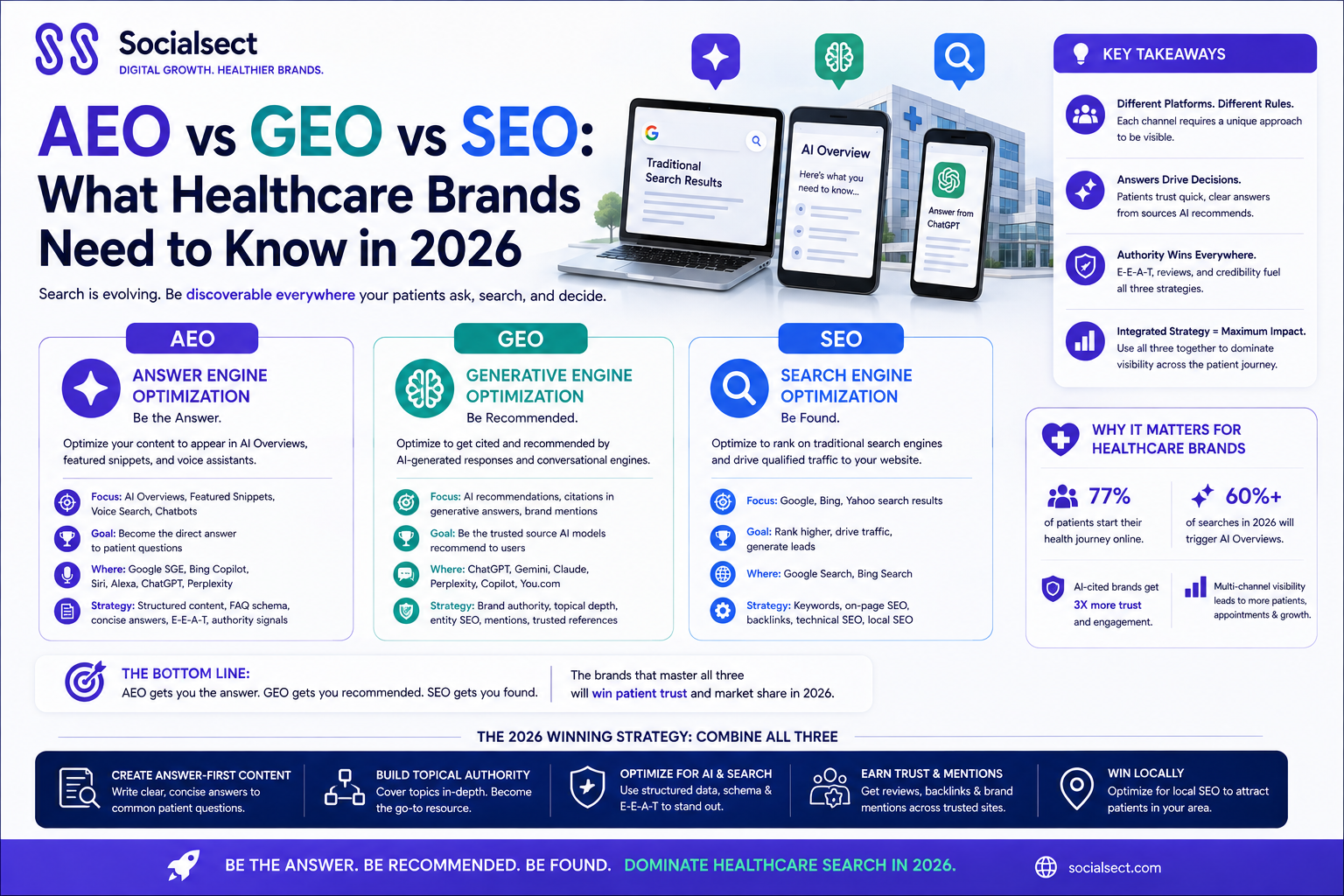
A successful healthcare search strategy in 2026 needs to understand how SEO, AEO, and GEO work together.
SEO helps healthcare websites become visible in traditional search results.
AEO, or Answer Engine Optimization, focuses on making information easy for search engines and answer engines to understand and use when responding to questions.
GEO, or Generative Engine Optimization, focuses on improving the likelihood that a healthcare brand, organization, physician, or website is represented accurately and prominently within generative AI search experiences.
These approaches overlap, but they are not identical.
For healthcare organizations operating in a competitive digital environment, understanding AEO vs GEO vs SEO can help create a more future-ready patient acquisition strategy.
What Is SEO?
Search Engine Optimization (SEO) is the practice of improving a website's visibility in organic search results.
Traditional healthcare SEO focuses on helping pages rank for relevant searches such as:
- Cardiologist near me
- Best orthopedic surgeon
- Dermatologist in New York
- Cataract surgery specialist
- IVF clinic near me
- Back pain treatment
- Dental implant specialist
Healthcare SEO typically includes:
- Keyword research
- Technical SEO
- On-page optimization
- Content creation
- Internal linking
- Local SEO
- Website architecture
- Link acquisition
- Structured data
- Page experience
- Conversion optimization
The goal is to help search engines understand your website and connect your content with relevant searches.
What Is AEO?
Answer Engine Optimization (AEO) focuses on optimizing content so it can provide direct, concise answers to questions asked through search engines, voice assistants, and answer-oriented search experiences.
Healthcare users frequently search in question form:
- What causes knee pain?
- How long does cataract surgery take?
- What are the symptoms of sleep apnea?
- When should I see a neurologist?
- Is physical therapy effective for back pain?
- What happens during a colonoscopy?
AEO helps structure content so important answers are easy to identify and understand.
A well-optimized healthcare page may include:
- Direct answers
- FAQ sections
- Clear headings
- Definitions
- Step-by-step explanations
- Concise summaries
- Structured information
- Supporting evidence
The purpose is not simply to rank a keyword.
It is to answer the user's question effectively.
What Is GEO?
Generative Engine Optimization (GEO) is focused on visibility within generative AI search experiences.
Instead of only asking:
"How do I rank this page?"
GEO considers questions such as:
"How can my healthcare organization become a credible source that AI systems can understand and reference?"
Generative search can synthesize information from multiple sources to produce an answer.
For healthcare organizations, this means reputation, expertise, content quality, consistency, and authoritative information can become increasingly important.
GEO may involve:
- Building topical authority
- Publishing original healthcare content
- Demonstrating professional expertise
- Maintaining accurate organization information
- Creating strong physician profiles
- Supporting claims with credible sources
- Developing comprehensive topic coverage
- Improving technical accessibility
- Maintaining consistent brand information
GEO should not be viewed as a replacement for SEO.
It builds upon strong search fundamentals.
AEO vs GEO vs SEO: The Key Difference
The simplest way to understand AEO vs GEO vs SEO is to look at what each discipline is primarily trying to accomplish.
Strategy
Primary Focus
Typical Search Experience
SEO
Organic search visibility
Traditional search results
AEO
Direct answers
Answer engines, snippets, conversational queries
GEO
AI-generated visibility
Generative search and AI answers
However, these strategies overlap significantly.
A technically strong website benefits SEO.
Well-structured answers can support AEO.
Authoritative, comprehensive content can support GEO.
Therefore, healthcare brands should not build three completely separate marketing strategies.
They should create one integrated search strategy.
Why Healthcare Brands Need All Three
Healthcare is a high-trust industry.
Patients want reliable answers before contacting a healthcare provider.
Someone searching for:
"What are the symptoms of a rotator cuff tear?"
may first want information.
Later, that same person may search:
"Shoulder specialist near me."
Finally, they may search for a specific doctor or clinic.
This creates a journey:
Information → Evaluation → Provider Discovery → Appointment
SEO, AEO, and GEO can support different stages of that journey.
SEO
Helps the patient discover your website.
AEO
Helps your content answer the patient's questions.
GEO
Helps your healthcare brand become part of broader AI-generated information experiences.
How AEO Can Help Healthcare Websites
Healthcare websites contain enormous amounts of information that patients may search for in question format.
For example, a cardiology clinic could create content answering:
- What does a cardiologist treat?
- What is high blood pressure?
- When should chest pain be evaluated?
- What happens during a cardiac stress test?
- How often should cholesterol be checked?
These questions can become sections within service pages, condition pages, and educational resources.
Use Clear Question-Based Headings
Instead of writing:
"Understanding Cardiac Health"
consider specific patient questions such as:
"When Should You See a Cardiologist?"
This makes the purpose of the section immediately clear.
Give Direct Answers
Start with a concise answer and then provide additional context.
This helps users who want a quick explanation while still supporting readers who need more detail.
How GEO Can Help Healthcare Brands
Generative AI systems need reliable information to formulate useful answers.
Healthcare brands should therefore focus on becoming credible sources of information.
A strong GEO strategy can include:
Original Content
Publish useful information that provides genuine value rather than rewriting competitors.
Expert Information
Clearly identify physicians, specialists, authors, and medical reviewers.
Strong Physician Profiles
Include:
- Credentials
- Specialties
- Professional experience
- Areas of clinical focus
- Relevant qualifications
Comprehensive Topic Coverage
Build content around conditions, treatments, symptoms, procedures, specialists, and locations.
Consistent Information
Keep your organization name, physicians, locations, services, and other important details accurate across your website and relevant external platforms.
Why EEAT Matters for AEO and GEO
For healthcare websites, Experience, Expertise, Authoritativeness, and Trustworthiness (EEAT) should be a central part of the strategy.
Healthcare content can influence decisions about diagnosis, treatment, and medical care.
Therefore, content should demonstrate appropriate expertise.
Experience
Address real patient concerns and practical questions.
Expertise
Show who created or reviewed the content.
Authoritativeness
Build credibility through high-quality resources, expert contributions, and appropriate references.
Trustworthiness
Provide accurate information, transparent contact details, privacy information, and genuine professional credentials.
A healthcare website should never manufacture expertise.
If medical content is reviewed by a qualified professional, communicate that clearly.
SEO Remains the Foundation
One of the biggest mistakes healthcare brands can make in 2026 is assuming that GEO or AEO means traditional SEO is no longer necessary.
It isn't.
Search engines and AI-powered search experiences still need to discover, crawl, understand, and evaluate web content.
Healthcare organizations should therefore continue investing in:
- Technical SEO
- Mobile optimization
- Internal linking
- Page speed
- Indexation
- Canonicalization
- XML sitemaps
- Structured data
- Search-friendly architecture
- Quality content
Without a strong technical foundation, even excellent healthcare content can struggle to achieve visibility.
Build Topic Clusters for SEO, AEO and GEO
A topic cluster can support all three strategies simultaneously.
Consider a spine clinic.
A central page could target:
Spine Surgery
Supporting content could include:
- What is spine surgery?
- When is spine surgery recommended?
- Spinal stenosis treatment
- Herniated disc treatment
- Spine surgery recovery
- Minimally invasive spine surgery
- Questions to ask a spine surgeon
- Spine surgery risks and benefits
The pages can link to one another naturally.
This creates topical depth while giving patients multiple ways to discover useful information.
Local SEO Still Matters
Healthcare decisions are often geographically driven.
Patients typically need a provider they can physically access.
This means local SEO remains critical in an AEO and GEO strategy.
Healthcare organizations should optimize:
- Google Business Profiles
- Location pages
- Physician profiles
- Local service pages
- Reviews
- Contact information
- Directions
- Opening hours
For multi-location healthcare groups, each location should provide unique and useful information rather than simply duplicating the same content with different city names.
Healthcare Content Should Be Written for Patients First
One common SEO problem is excessive optimization.
A healthcare article may contain the same keyword repeatedly but fail to answer the patient's real question.
A better approach is:
Patient intent → Accurate information → Expert review → Clear structure → SEO optimization
For example, instead of repeatedly using:
"orthopedic surgeon marketing"
a healthcare marketing article should naturally discuss:
- Orthopedic search behaviour
- Local patient acquisition
- Specialist pages
- Treatment content
- Physician profiles
- Google Business Profile optimization
- Appointment conversion
Search engines increasingly understand context.
Healthcare content should therefore prioritize meaning over repetition.
AEO vs GEO vs SEO: Content Strategy Comparison
SEO Content
Designed to rank for relevant searches.
Examples:
- Service pages
- Location pages
- Condition pages
- Treatment pages
- Specialist pages
AEO Content
Designed to answer specific questions.
Examples:
- FAQs
- "What is..." pages
- "How long..." questions
- "When should..." questions
- Step-by-step guides
GEO Content
Designed to establish broader topical and organizational authority.
Examples:
- Expert healthcare guides
- Original research
- Comprehensive specialty resources
- Physician expertise pages
- Detailed treatment resources
The strongest healthcare content can satisfy all three objectives.
How to Build an Integrated Healthcare Search Strategy
Healthcare organizations can follow a practical framework.
Step 1: Research Patient Intent
Identify what patients search before, during, and after choosing a provider.
Step 2: Build an SEO Foundation
Fix technical issues and create a logical website architecture.
Step 3: Create High-Value Pages
Develop strong specialty, treatment, condition, physician, and location pages.
Step 4: Add Answer-Focused Content
Answer common patient questions directly.
Step 5: Strengthen EEAT
Show relevant credentials, authorship, expertise, and sources.
Step 6: Build Topical Authority
Create connected content around important healthcare subjects.
Step 7: Strengthen Local Visibility
Optimize location information and local profiles.
Step 8: Measure Performance
Track:
- Organic impressions
- Organic clicks
- Rankings
- Search visibility
- AI search visibility where measurable
- Local actions
- Leads
- Calls
- Appointment requests
Common AEO, GEO and SEO Mistakes Healthcare Brands Should Avoid
Creating Content Only for Search Engines
Healthcare content should solve patient problems rather than simply target keywords.
Publishing Unreviewed Medical Content
Medical claims should be fact-checked and appropriately reviewed.
Creating Hundreds of Similar Location Pages
Every location should provide genuine value.
Ignoring Physician Expertise
Patients want to know who is providing their care.
Overusing AI-Generated Content
AI can support content workflows, but low-quality mass-produced content can undermine trust and usefulness.
Treating GEO as a Shortcut
There is no reliable shortcut that guarantees inclusion in AI-generated answers.
The strongest foundation remains useful, accurate, trustworthy content.
Measuring Success in 2026
Healthcare SEO measurement is becoming broader.
Traditional metrics still matter:
- Organic traffic
- Rankings
- Impressions
- Click-through rate
- Local visibility
- Backlinks
But healthcare organizations should also measure business outcomes:
- Qualified leads
- Phone calls
- Appointment requests
- Consultation bookings
- Cost per acquisition
- Patient acquisition by service
- Patient acquisition by location
As AI search reporting evolves, organizations should also monitor visibility within relevant generative search experiences.
The goal is not simply to appear somewhere in search.
The goal is to generate meaningful patient engagement.
Why Socialsect Uses an Integrated SEO, AEO and GEO Strategy
At Socialsect, we view AEO vs GEO vs SEO as complementary disciplines rather than competing strategies.
Our healthcare search strategy can combine:
- Technical SEO
- Healthcare content strategy
- AEO
- GEO
- Local SEO
- Physician SEO
- Enterprise SEO
- Topic clusters
- EEAT optimization
- Conversion optimization
- Healthcare website optimization
- Patient acquisition strategy
This creates a unified approach designed for the way patients search today and the way search is evolving.
The Future of Healthcare Search
The future of healthcare search will not be defined by a single optimization method.
Traditional search results will continue to matter.
Answer-focused experiences will continue to evolve.
Generative AI will continue changing how people research healthcare information.
Healthcare organizations that adapt early can build stronger digital visibility by focusing on the fundamentals:
Be discoverable. Be useful. Be authoritative. Be accurate. Be trustworthy. Make it easy for patients to take the next step.
That is the real connection between AEO vs GEO vs SEO.
Rather than choosing one, healthcare brands should build a unified search strategy where SEO creates the foundation, AEO makes information accessible, and GEO helps the brand participate in emerging AI-powered search experiences.
With the right strategy, healthcare organizations can build visibility that extends beyond traditional rankings and supports the entire patient journey.