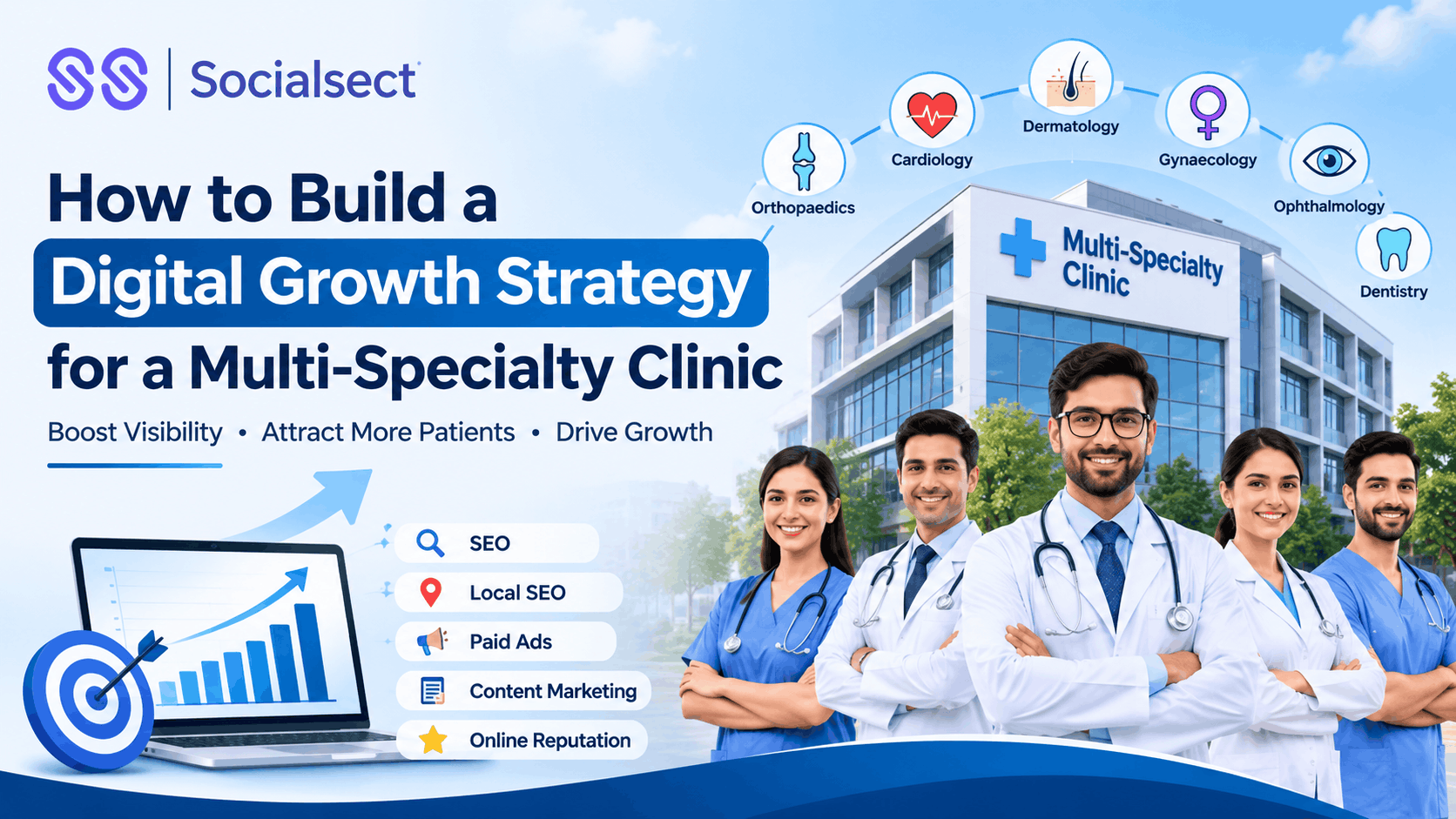
Managing the digital growth of a multi-specialty clinic requires a different approach from marketing a single-specialty medical practice. A clinic offering orthopaedics, cardiology, dermatology, gynaecology, physiotherapy, and other medical services needs to attract different patient groups while maintaining one consistent healthcare brand.
Each department has its own audience, treatment priorities, search behaviour, and appointment requirements. A generic marketing campaign may increase overall visibility but fail to generate enquiries for the individual specialties that matter most to the clinic.
This is why a well-planned multi specialty clinic marketing strategy is essential.
In 2027, multi-specialty clinics need a coordinated digital growth strategy that combines healthcare SEO, local search optimization, paid advertising, educational content, reputation management, and conversion optimization. The objective is to build visibility for individual departments while strengthening the clinic's overall brand and patient acquisition system.
Why Multi-Specialty Clinics Need a Dedicated Digital Growth Strategy
A multi-specialty clinic operates across several healthcare categories. Each department may compete with different providers, target different patient needs, and require a distinct marketing approach.
For example, a clinic's orthopaedic department may need to attract patients searching for joint pain treatment, while its dermatology department may focus on acne, pigmentation, and other skin concerns.
A single homepage campaign cannot effectively address every one of these requirements.
A dedicated digital growth strategy helps clinics:
- Improve visibility for individual medical specialties.
- Attract patients searching for specific treatments.
- Promote priority departments and services.
- Build a consistent brand identity.
- Generate more relevant appointment enquiries.
- Measure performance across departments.
- Identify opportunities for sustainable growth.
The key is to balance the visibility of the overall clinic with the individual marketing requirements of each specialty.
Also Read About - Best Digital Marketing Strategies for Ophthalmology Clinics
1. Define the Clinic's Growth Objectives and Priority Specialties
Before investing in digital marketing, clinic owners should identify what they want to achieve.
Not every department will have the same growth requirements. Some specialties may already receive consistent patient enquiries, while others may need greater visibility or a stronger appointment pipeline.
Start by evaluating each department based on its current performance, available capacity, business priorities, and target patient audience.
For example:
| Specialty | Potential Marketing Focus |
|---|---|
| Orthopaedics | Joint pain, sports injuries, fracture care, and specialist consultations |
| Cardiology | Cardiac consultations, heart health assessments, and diagnostic services |
| Dermatology | Acne, pigmentation, skin conditions, and aesthetic treatments |
| Gynaecology | Women's health consultations and reproductive health services |
| Physiotherapy | Pain management, rehabilitation, and mobility support |
| Ophthalmology | Eye examinations, cataract consultations, and vision correction services |
| Dentistry | Dental implants, cosmetic dentistry, and preventive care |
The clinic should prioritise departments where marketing can address a genuine demand and operational need.
This creates a clear foundation for resource allocation and campaign planning.
2. Build a Strong Website Architecture Around Medical Specialties
The clinic website is the central platform connecting its digital marketing activities. Its structure should make it easy for patients to identify the services they need and find the relevant department.
A common problem with multi-specialty websites is that all services are placed on a single page or buried under generic navigation.
A better approach is to create a clear hierarchy.
Recommended website structure
- Homepage: Introduces the clinic, its location, major specialties, and overall healthcare offering.
- Specialty pages: Dedicated pages for orthopaedics, cardiology, dermatology, and other departments.
- Treatment pages: Detailed information about individual conditions, procedures, and services.
- Doctor profiles: Qualifications, expertise, experience, and consultation information.
- Location pages: Accurate information about each clinic location, where applicable.
- Educational resources: Articles and FAQs addressing common patient questions.
Each specialty page should have a distinct purpose, relevant keywords, clear treatment information, and an appropriate appointment pathway.
For example, the dermatology department should have its own landing page supported by relevant treatment pages for acne, pigmentation, and other services.
This structure improves navigation and creates more opportunities to rank for specialty-specific searches.
3. Develop a Specialty-Based Healthcare SEO Strategy
SEO is one of the most important long-term components of a multi-specialty clinic's digital growth strategy.
Rather than targeting only broad keywords such as "clinic near me" or "best medical clinic", the website should address the search behaviour associated with individual specialties and treatments.
Create separate keyword groups for each department
Keyword research should consider three important categories:
Specialty keywords: Searches related to a medical department or healthcare professional.
Examples:
- Orthopaedic clinic in [location]
- Cardiologist near me
- Dermatology clinic in [location]
Treatment keywords: Searches related to specific services and procedures.
Examples:
- Knee pain treatment
- Acne scar treatment
- Cataract consultation
Informational keywords: Searches from people researching symptoms, conditions, and treatment options.
Examples:
- What causes persistent knee pain?
- How is acne treated?
- When should you see a cardiologist?
Each keyword group should be mapped to the most relevant page.
Build supporting content around each specialty
Educational blogs can support specialty pages by answering patient questions and connecting relevant information to the clinic's services.
For example, an orthopaedic department may publish content about knee pain, shoulder injuries, arthritis, and sports rehabilitation.
The content should be medically accurate, useful, and reviewed by appropriately qualified professionals.
Avoid creating multiple pages that target the same search intent. A clear keyword-to-URL mapping helps prevent keyword cannibalisation and keeps the website organised.
Also Read More - AEO vs GEO vs SEO: What Healthcare Brands Need to Know in 2026
4. Strengthen Local SEO for Every Clinic Location
For healthcare providers, local visibility can directly influence patient discovery.
Patients often search for medical services within a particular city, neighbourhood, or nearby area. A multi-specialty clinic should therefore make it easy for search engines and prospective patients to understand where its services are available.
A local SEO strategy should include:
- Complete and accurate Google Business Profile information.
- Correct clinic addresses, phone numbers, and opening hours.
- Relevant primary and secondary business categories.
- Accurate service descriptions.
- Genuine patient reviews and professional responses.
- Consistent business details across relevant directories.
- Location-specific website content.
If a clinic operates from multiple locations, each eligible location should have its own accurate business profile and useful location page.
Avoid creating location pages with identical content and only changing the neighbourhood name. Each page should provide genuinely useful information about the relevant facility and available services.
5. Use Paid Advertising to Promote Priority Departments
Paid advertising can help multi-specialty clinics generate visibility for services that need immediate attention.
However, running one campaign for every specialty under the same advertising group can make targeting, messaging, and performance measurement difficult.
A better approach is to organise campaigns around individual departments and their specific services.
For example:
| Campaign | Target Audience | Campaign Focus |
|---|---|---|
| Orthopaedics | People searching for orthopaedic care | Joint pain and specialist consultations |
| Dermatology | People researching skin treatments | Acne, pigmentation, and dermatology services |
| Cardiology | People seeking cardiac consultations | Specialist appointments and relevant diagnostics |
| Physiotherapy | People seeking rehabilitation support | Pain management and physiotherapy consultations |
| Ophthalmology | People researching eye care | Eye examinations and specialist services |
Each campaign should direct visitors to a relevant landing page rather than the general homepage.
Monitor qualified enquiries, appointment bookings, and acquisition costs instead of relying only on clicks and impressions.
Healthcare advertising must also follow applicable local regulations and advertising platform policies, particularly around sensitive health information and medical claims.
Read More - Digital Marketing for Doctors: Complete 2026 Guide to Patient Acquisition
6. Create a Unified Brand with Specialty-Specific Messaging
One of the biggest challenges for multi-specialty clinics is maintaining a consistent brand while communicating the expertise of different departments.
The clinic should have a recognisable overall identity, but its specialty pages and campaigns should address the specific needs of their audiences.
For example, the main brand message may communicate comprehensive healthcare services, while the orthopaedics page focuses on musculoskeletal care and the dermatology page addresses skin health.
A consistent approach should be maintained across:
- Website design and messaging.
- Doctor profiles and department descriptions.
- Social media communication.
- Paid advertising creatives.
- Educational content.
- Patient-facing information.
This helps the clinic develop a recognisable brand without making every department sound identical.
7. Build Trust Through Doctor Profiles and Medical Expertise
Patients often want to understand who will be providing their care before making an appointment.
Doctor profiles are therefore important elements of a healthcare website.
A useful profile should include the doctor's qualifications, professional experience, areas of expertise, relevant credentials, and consultation information.
Where appropriate, clinics can also publish doctor-led educational articles, interviews, and videos.
These resources help communicate expertise and make the clinic's information more transparent.
Healthcare content should be accurate and appropriately reviewed. Avoid unsupported claims such as guaranteed outcomes or unverified descriptions of a doctor as the best specialist.
8. Use Content Marketing to Support Every Department
A multi-specialty clinic has opportunities to develop educational content across several medical categories.
However, content planning should be organised around departmental objectives rather than publishing random health topics.
A specialty-based content calendar can help ensure consistent coverage.
For example:
| Department | Suggested Content Topics |
|---|---|
| Orthopaedics | Common causes of knee pain, shoulder injuries, and joint health |
| Cardiology | Heart health assessments, common cardiac symptoms, and preventive care |
| Dermatology | Acne causes, pigmentation concerns, and skin treatment options |
| Physiotherapy | Back pain management, rehabilitation, and mobility exercises |
| Gynaecology | Women's health assessments and common gynaecological concerns |
| Ophthalmology | Cataract symptoms, eye examinations, and vision care |
Content should answer real patient questions and provide appropriate pathways to relevant department pages.
A structured content strategy also gives clinics opportunities to reuse educational insights across suitable channels, including blogs, social media, newsletters, and short videos.
9. Improve Patient Enquiry Management and Appointment Conversion
Marketing performance does not end when a prospective patient submits a form or calls the clinic.
The enquiry management process is equally important.
A clinic may generate a high volume of enquiries but lose potential appointments because calls go unanswered, responses are delayed, or patients cannot easily identify the appropriate department.
To improve the process, clinics should:
- Make contact details easy to find.
- Provide clear appointment booking options.
- Route enquiries to the relevant department.
- Establish a consistent enquiry response process.
- Use secure systems for patient communication.
- Track enquiries through to appointment outcomes.
Website forms should collect only necessary information, and any sensitive patient data should be handled securely.
A well-organised enquiry process helps connect marketing activity with the clinic's actual appointment operations.
10. Use Analytics to Measure Growth Across Departments
A multi-specialty clinic should not evaluate its entire marketing strategy using one overall traffic or lead figure.
Performance should be reviewed at both the clinic and department levels.
For example, total organic traffic may increase while enquiries for a priority department remain unchanged. Department-level reporting helps identify this difference.
Important performance indicators include:
| KPI | What to Measure |
|---|---|
| Organic traffic | Search visits to the website and specialty pages |
| Keyword visibility | Rankings for priority specialty and treatment searches |
| Local visibility | Discovery through local search and Google Business Profile |
| Qualified enquiries | Relevant enquiries received by each department |
| Cost per lead | Marketing expenditure required to generate an enquiry |
| Appointment conversion | Enquiries that become booked appointments |
| Consultation attendance | Booked appointments that are attended |
| Department performance | Marketing contribution across individual specialties |
Clinics should also compare performance by channel to understand whether SEO, paid advertising, local search, or other activities are generating the most relevant enquiries.
11. Prepare for AI-Powered Healthcare Search
Patients are increasingly using conversational and AI-powered search experiences to research medical conditions, understand treatment options, and discover healthcare providers.
Multi-specialty clinics should prepare for this change by making their website information accurate, structured, and easy to understand.
A practical AI search optimisation strategy includes:
- Publishing expert-reviewed medical information.
- Creating clear answers to common patient questions.
- Maintaining detailed doctor and specialty profiles.
- Using appropriate structured data.
- Strengthening the clinic's online reputation.
- Building credible references and mentions across relevant platforms.
- Keeping business and service information consistent.
Answer Engine Optimisation (AEO) and Generative Engine Optimisation (GEO) can complement traditional SEO by helping make the clinic's expertise more accessible across evolving search experiences.
Read more - Best Website Features for Modern Dental Clinics
A 90-Day Digital Growth Roadmap for Multi-Specialty Clinics
A structured implementation plan helps clinic owners move from strategy to execution.
| Timeline | Key Activities | Expected Focus |
|---|---|---|
| Days 1–30 | Website audit, specialty keyword mapping, local SEO review, analytics setup, competitor analysis | Establish the baseline and identify growth opportunities |
| Days 31–60 | Optimise priority specialty pages, improve conversion paths, launch selected campaigns, publish supporting content | Strengthen visibility and generate relevant enquiries |
| Days 61–90 | Expand successful campaigns, improve internal linking, review lead quality, optimise underperforming pages | Improve efficiency and support sustainable growth |
The roadmap should be adjusted according to the clinic's existing website, available resources, marketing budget, and department priorities.
How Socialsect Helps Multi-Specialty Clinics Build Digital Growth
Socialsect helps healthcare organisations develop digital marketing strategies that connect specialty visibility with patient acquisition goals.
For multi-specialty clinics, the approach begins with understanding the individual growth requirements of each department. This includes evaluating the website structure, search opportunities, local competition, patient search intent, and existing lead generation performance.
Our healthcare marketing services can include:
- Healthcare SEO and technical optimisation.
- Specialty-specific landing pages.
- Local SEO and Google Business Profile management.
- Healthcare content marketing.
- AEO and GEO optimisation.
- Paid advertising campaigns.
- Website conversion optimisation.
- Online reputation management.
- Analytics and performance reporting.
By connecting these activities under one strategy, Socialsect helps clinics build a stronger digital presence while maintaining a clear focus on qualified enquiries and measurable growth.
Also Read About - Orthopedic Marketing: The Complete Guide to Patient Acquisition, SEO, PPC & Digital Growth for Orthopaedic Surgeons
Conclusion
Building a digital growth strategy for a multi-specialty clinic requires more than promoting the clinic as a single healthcare brand. Each department has its own audience, services, search intent, and patient acquisition requirements.
A successful strategy brings these elements together through structured website architecture, specialty-based SEO, local visibility, paid advertising, educational content, reputation management, and conversion optimisation.
In 2027, clinics that connect their marketing channels and measure performance at the department level will be better positioned to identify opportunities and make informed growth decisions.
The ultimate objective is to build one strong healthcare brand while ensuring that every specialty has the visibility and patient acquisition support it needs.