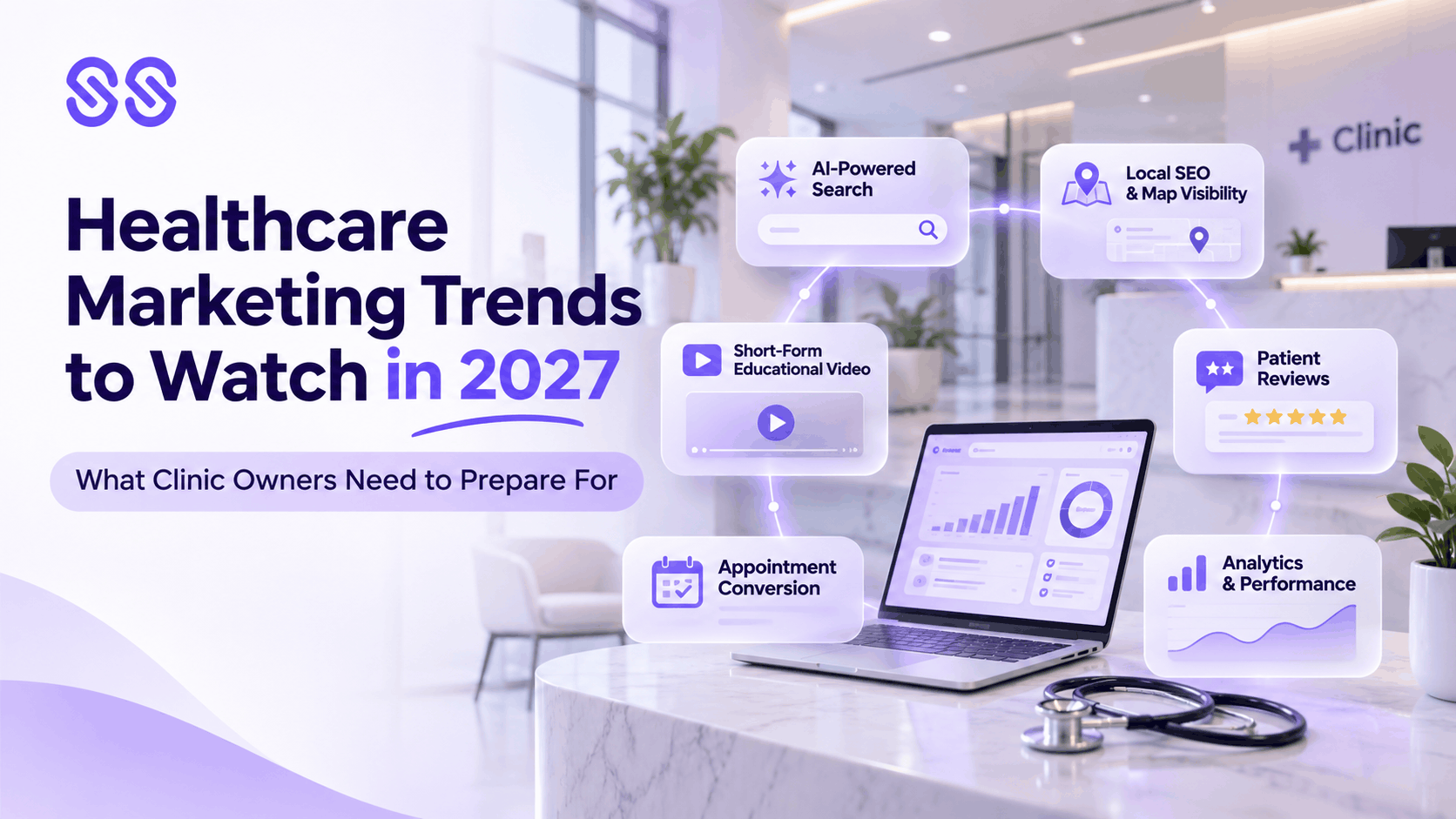
Healthcare marketing is entering a new phase. Patients are becoming more informed, digital platforms are changing how people discover medical services, and competition among clinics is increasing across both local and specialist markets.
For clinic owners, maintaining a website and publishing occasional social media posts may no longer be enough to build a strong online presence. Marketing strategies need to connect patient discovery, credibility, engagement, and appointment conversion.
In 2027, healthcare providers should pay particular attention to artificial intelligence, changing search behaviour, local visibility, patient experience, and data-driven marketing. These developments are influencing how people find healthcare information and decide which providers to contact.
Understanding the healthcare marketing trends 2027 can help clinic owners prepare their marketing investments, strengthen their digital presence, and build more consistent patient acquisition strategies.
1. AI Search Will Become an Important Patient Discovery Channel
Patients increasingly use AI-powered platforms to ask health-related questions, understand treatment options, and identify healthcare providers. Search experiences are also evolving through AI-generated summaries and conversational search interfaces.
This creates an opportunity for clinics to improve how their expertise is represented across digital platforms.
Traditional SEO remains important, but healthcare practices should also consider Answer Engine Optimisation (AEO) and Generative Engine Optimisation (GEO).
Clinics can prepare by:
- Publishing accurate, expert-reviewed healthcare information.
- Creating clear answers to common patient questions.
- Strengthening doctor profiles and professional credentials.
- Structuring service pages around specific treatments and conditions.
- Maintaining consistent business information across relevant platforms.
- Building credible mentions and references from reputable sources.
AI visibility should complement, rather than replace, traditional search optimisation. Clinics should monitor how their brand and medical expertise appear in AI-generated answers while continuing to build organic search visibility.
Also Read About - Best Digital Marketing Strategies for Ophthalmology Clinics
2. Search Intent Will Matter More Than Keyword Volume
Healthcare marketing strategies have traditionally relied heavily on keyword research, search volume, and ranking positions. These metrics remain useful, but they do not always reflect whether a search represents a genuine appointment opportunity.
In 2027, clinics should place greater emphasis on patient search intent.
Consider the difference between these searches:
- What causes persistent shoulder pain?
- When should I see an orthopaedic specialist?
- Orthopaedic surgeon near me.
- Shoulder surgery consultation in Dubai.
Each search represents a different stage of the patient journey. A clinic should provide educational information for early-stage searches and relevant service pages for patients actively looking for professional care.
Mapping keywords to the correct pages can improve content relevance, reduce keyword cannibalisation, and help clinics attract more qualified enquiries.
3. Local SEO Will Remain Essential for Patient Acquisition
Most clinics serve patients within a specific geographical area. This makes local search visibility an important part of healthcare digital marketing.
Patients often search for services using location-based phrases such as "dermatologist near me", "physiotherapy clinic in Dubai Marina", or "orthopaedic surgeon in Miami".
Clinics should strengthen their local presence through:
- Complete and regularly updated Google Business Profiles.
- Accurate addresses, phone numbers, opening hours, and service information.
- Consistent business details across trusted directories.
- Genuine patient reviews and appropriate review responses.
- Location-specific service pages with useful local information.
- Local citations and relevant community references.
For multi-location practices, each location should have accurate information and a distinct purpose. Publishing multiple pages with almost identical content and only changing the location name is unlikely to create a strong local experience.
4. Patient Reviews and Online Reputation Will Influence Trust
Patients often evaluate a clinic beyond its website. Reviews, doctor profiles, professional credentials, and publicly available information can all influence how they perceive a healthcare provider.
Online reputation management should therefore become a continuous marketing activity rather than an occasional task.
Clinics can develop a structured approach to:
- Encourage genuine patient feedback without pressure.
- Respond professionally to reviews.
- Monitor recurring feedback and service concerns.
- Keep doctor biographies and qualifications accurate.
- Maintain consistent information across healthcare directories.
- Address inaccurate public information through appropriate channels.
Patient privacy must remain a priority. Clinics should never disclose confidential medical details when responding to reviews or discussing individual patient experiences.
5. Short-Form Educational Video Will Become More Important
Video content gives healthcare professionals an opportunity to explain medical topics in an accessible format. Short educational videos can introduce doctors, answer common questions, explain procedures, and help patients understand what to expect during consultations.
For example, an orthopaedic clinic could publish videos explaining common causes of knee pain, while a dermatology clinic could address frequently asked questions about acne treatments.
Effective healthcare video content should focus on patient education rather than exaggerated claims or promotional promises.
A practical video strategy may include:
- Doctor-led educational videos.
- Frequently asked patient questions.
- Treatment and procedure explanations.
- Clinic introductions and facility walkthroughs.
- General recovery and aftercare education.
- Short myth-versus-fact discussions.
The same video can be adapted for suitable social platforms, the clinic website, and relevant service pages.
Also Read More - AEO vs GEO vs SEO: What Healthcare Brands Need to Know in 2026
6. Personalised Patient Communication Will Become More Data-Driven
Patients expect clear and timely communication when interacting with healthcare providers. Generic messages and delayed responses can create friction during the appointment journey.
Marketing automation can help clinics manage enquiries and maintain consistent communication.
For example, a clinic may use automation to acknowledge an appointment enquiry, share consultation preparation information, or send an appointment reminder.
Useful applications include:
- Automated enquiry acknowledgements.
- Appointment reminders.
- Follow-up communication where appropriate.
- Educational email campaigns.
- Patient feedback requests.
- Enquiry tracking and lead assignment.
However, automation should support human interaction rather than replace it. Healthcare providers must also follow applicable privacy, consent, and data-protection requirements when collecting or using patient information.
7. Conversion Rate Optimisation Will Receive Greater Attention
Generating website traffic is only one part of healthcare marketing. A clinic also needs to make it easy for visitors to take the next step.
A website may attract relevant visitors but still generate few enquiries because of unclear service information, confusing navigation, slow loading times, or difficult appointment processes.
Conversion Rate Optimisation (CRO) focuses on improving the experience between the first website visit and the enquiry or appointment request.
Important areas include:
- Clear appointment booking options.
- Visible contact information.
- Mobile-friendly website design.
- Easy-to-understand treatment descriptions.
- Doctor credentials and relevant experience.
- Clear explanations of consultation processes.
- Simple enquiry forms.
- Trust signals and genuine patient feedback.
Clinics should monitor meaningful actions such as calls, appointment requests, form submissions, and qualified enquiries rather than evaluating website performance through traffic alone.
Read More - Digital Marketing for Doctors: Complete 2026 Guide to Patient Acquisition
8. Healthcare Content Will Need Stronger E-E-A-T Signals
Healthcare content can influence decisions involving personal wellbeing and medical treatment. As a result, accuracy, expertise, and trustworthiness are particularly important.
Publishing large volumes of generic AI-generated articles is not a substitute for reliable medical information.
In 2027, clinics should focus on developing content that reflects genuine clinical expertise and provides useful answers to patient concerns.
A strong healthcare content strategy should include:
- Author and medical reviewer information where appropriate.
- Accurate doctor qualifications and professional biographies.
- Clear explanations of medical conditions and treatments.
- References to reliable medical sources where relevant.
- Regular reviews of important clinical information.
- Transparent descriptions of treatment limitations and risks.
- Original insights from qualified healthcare professionals.
AI tools can support research, drafting, and content organisation, but qualified human review remains essential for medical accuracy.
9. Paid Advertising Will Need Better Lead Quality Measurement
Paid search and social media advertising can help clinics reach patients actively researching medical services. However, a high number of enquiries does not necessarily translate into more appointments.
Clinics should move beyond measuring campaign performance only through clicks, impressions, and cost per lead.
A more useful measurement framework tracks the complete lead journey:
Advertising impressions and clicks.
Website visits and landing-page engagement.
Enquiry submissions and phone calls.
Qualified patient enquiries.
Appointments booked.
Consultations attended.
Relevant business outcomes, measured appropriately.
This approach helps clinics understand which campaigns attract meaningful enquiries and where potential patients drop out of the process.
Advertising claims, targeting, and healthcare-related content must also comply with applicable platform policies and local healthcare advertising regulations.
10. First-Party Data and Privacy-Conscious Marketing Will Become More Important
Healthcare organisations handle sensitive information, making responsible data management a fundamental part of digital marketing.
Clinics should understand what information they collect, why they collect it, where it is stored, and which systems or service providers can access it.
A privacy-conscious marketing strategy includes:
- Collecting only necessary information.
- Obtaining appropriate consent.
- Reviewing website tracking and analytics configurations.
- Restricting access to sensitive information.
- Using secure enquiry and appointment systems.
- Following applicable data-protection requirements.
Marketing teams should avoid sending identifiable patient information to advertising platforms or analytics tools unless the activity is legally permitted and appropriately configured.
Read more - Best Website Features for Modern Dental Clinics
11. Integrated Marketing Will Replace Isolated Campaign Thinking
SEO, paid advertising, social media, email, reputation management, and website optimisation are often managed as separate activities. However, patients may interact with several channels before choosing a clinic.
An integrated strategy connects these channels around shared patient acquisition and communication goals.
For example, a clinic may publish an educational article, use short videos to distribute its key insights, run relevant search advertising, and direct visitors to a focused service page.
This approach creates a more consistent brand experience and allows marketing teams to understand how different channels contribute to enquiries and appointments.
What Clinic Owners Should Prepare for in 2027
Understanding trends is useful, but implementation requires clear priorities. Clinic owners should focus on the foundations that support sustainable patient acquisition.
| Priority | Recommended Action | Business Objective |
|---|---|---|
| AI search visibility | Strengthen expert-led content and structured information | Improve discoverability across AI-powered search |
| Local SEO | Optimise Google Business Profile and location pages | Increase relevant local enquiries |
| Website performance | Improve mobile usability and appointment journeys | Reduce conversion friction |
| Online reputation | Build a consistent review management process | Strengthen patient trust |
| Content strategy | Publish clinically reviewed, intent-focused content | Attract relevant search traffic |
| Paid advertising | Track qualified leads and appointments | Improve marketing efficiency |
| Marketing automation | Improve enquiry handling and communication | Support patient engagement |
| Analytics | Measure the full patient acquisition journey | Make better marketing decisions |
How Socialsect Helps Healthcare Practices Prepare for 2027
Socialsect helps healthcare organisations build digital marketing strategies around visibility, credibility, and patient acquisition.
Rather than focusing only on website traffic or social media engagement, the objective is to connect marketing activity with meaningful business outcomes.
Our healthcare marketing approach can include technical SEO, local SEO, healthcare content strategy, AEO, GEO, paid advertising, conversion rate optimisation, and online reputation management.
By combining these activities, clinics can strengthen their presence across traditional search engines and emerging AI-powered discovery platforms while creating clearer pathways from patient research to appointment enquiries.
Conclusion
Healthcare marketing in 2027 will require clinics to think beyond individual campaigns and traditional search rankings. AI-powered discovery, patient trust, local SEO, educational video, privacy-conscious automation, and conversion optimisation will all play important roles in shaping digital growth.
Clinic owners who prepare early can build a more organised marketing foundation, improve patient discovery, and make better use of their marketing budgets.
The most effective strategy will not be the one that follows every new trend. It will be the one that combines relevant technology, clinical credibility, patient-focused communication, and measurable performance.