Patients increasingly use search engines to find doctors, clinics, hospitals and healthcare services. Whether someone is researching symptoms, comparing treatment options or looking for a specialist nearby, search often becomes an important part of the healthcare decision-making process.
For medical practices, simply having a website is no longer enough. The practice needs to be visible when patients are actively searching and provide enough useful information to encourage them to take the next step.
This is where SEO and Google Ads for healthcare can work together.
Healthcare SEO can build long-term organic visibility, while paid search can place relevant services in front of potential patients when they are actively searching for them. When both channels are planned as part of one patient acquisition strategy, they can support different stages of the patient journey instead of operating as disconnected marketing campaigns.
The objective is not simply to generate website traffic. It is to attract relevant patients, build trust, generate qualified enquiries and create a clear path from search to appointment.
Why Healthcare Practices Need a Search-Based Patient Acquisition Strategy
Healthcare searches are highly varied.
A potential patient might search for:
- Symptoms of a particular condition
- Treatment options
- A specialist
- A clinic in a specific location
- Treatment costs
- Reviews
- A nearby healthcare provider
- Whether they need medical attention
- What to expect from a procedure
These searches represent different levels of intent.
Someone searching "what causes knee pain" may still be researching. Someone searching "knee specialist near me" is likely much closer to choosing a provider.
A successful patient acquisition strategy should account for this entire journey.
SEO can help capture informational and commercial searches over time, while Google Ads can provide immediate visibility for selected high-intent searches.
What Is SEO for Healthcare?
Healthcare SEO is the process of improving a healthcare website's visibility in organic search results for relevant patient searches.
It can include:
- Keyword research
- Technical SEO
- On-page optimisation
- Healthcare content marketing
- Service page optimisation
- Doctor profile optimisation
- Local SEO
- Google Business Profile optimisation
- Internal linking
- Structured data
- Authority building
- Conversion optimisation
The goal is not simply to rank for a large number of keywords.
The goal is to become visible for searches that are relevant to the services, locations and patient groups the practice actually serves.
Read More - Best Digital Marketing Strategies for Ophthalmology Clinics
Why Healthcare SEO Has Long-Term Value
Organic visibility can continue generating relevant traffic after individual content assets have been published and optimised.
For example, a well-developed service page targeting a treatment may attract patients searching for that service months or years after its initial publication, provided it remains accurate, relevant and competitive.
SEO can also help build topical authority through connected content.
A practice specialising in orthopaedics, for example, could develop content around:
- Joint pain
- Sports injuries
- Shoulder conditions
- Knee conditions
- Hip conditions
- Orthopaedic treatments
- Specialist consultations
This creates a broader information ecosystem around its services.
What Is Healthcare PPC?
Healthcare PPC refers to paid advertising campaigns where healthcare organisations pay to appear for selected search queries and other targeted placements.
Google Ads is one of the most commonly used paid search platforms.
Unlike SEO, which generally takes time to build organic visibility, PPC can provide visibility shortly after campaigns are launched and approved.
This can be particularly useful when a practice wants to promote:
- High-value treatments
- Specialist consultations
- New services
- Specific locations
- Seasonal services
- Appointment-driven searches
However, paid traffic alone does not guarantee enquiries. Campaign structure, keyword selection, landing pages, messaging, tracking and lead handling all influence performance.
SEO vs Google Ads for Healthcare: Why Use Both?
SEO and Google Ads serve different purposes.
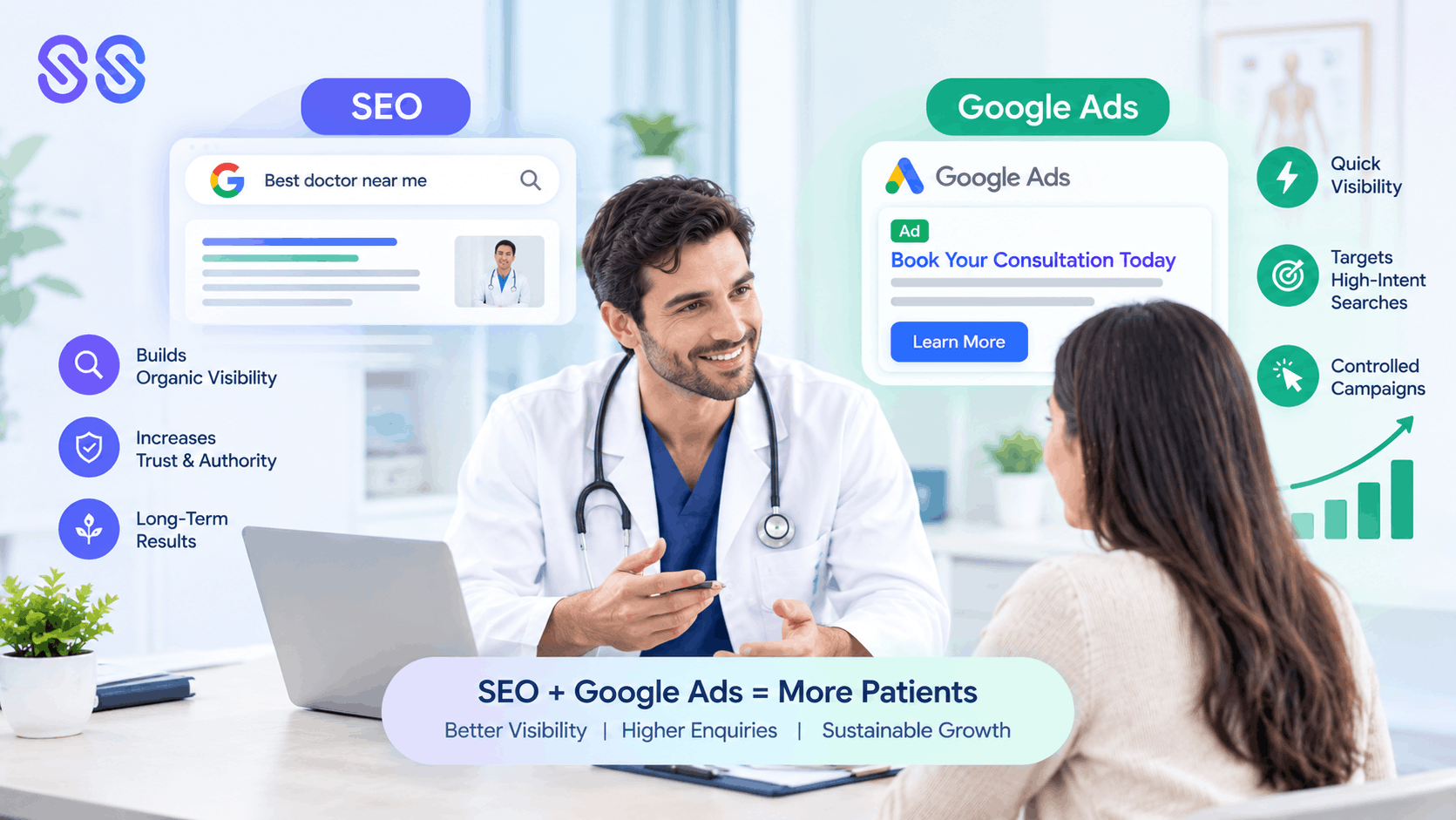
Healthcare SEO and Google Ads serve different but complementary purposes. Healthcare SEO focuses on building organic visibility and long-term search presence, supporting informational searches, strengthening topical authority, and generating traffic without paying for every click. In contrast, Google Ads provides faster paid search visibility and is particularly effective for selected high-intent searches, while allowing controlled campaign targeting. SEO requires ongoing optimisation to maintain and improve rankings, whereas Google Ads requires a continuous budget along with campaign monitoring and optimisation. Using both strategies together can help healthcare businesses achieve immediate visibility through paid campaigns while building sustainable organic growth through SEO.
The strongest approach is not necessarily choosing one channel over the other.
Instead, healthcare organisations can use both strategically.
For example, Google Ads can target high-intent searches for a priority service while SEO builds organic visibility for the same service and the broader questions patients ask about it.
Build Your Strategy Around Search Intent
Search intent should sit at the centre of SEO and Google Ads for healthcare.
A useful framework divides searches into three broad categories.
Informational intent
Examples:
- What are the symptoms of sciatica?
- How does laser eye surgery work?
- What causes tooth sensitivity?
- How long does ACL recovery take?
SEO and educational content are often particularly useful for these searches.
Commercial investigation intent
Examples:
- Best treatment for chronic back pain
- Dental implant options
- Shoulder specialist consultation
- Physiotherapy vs surgery
These searches indicate that the person may be comparing options.
Detailed service content, treatment guides, specialist pages and educational resources can help address this stage.
Transactional or high-intent searches
Examples:
- Dentist near me
- Orthopaedic doctor in Miami
- IVF clinic near me
- Book dermatologist appointment
- Private physiotherapist [location]
These searches may be more closely connected to an enquiry or appointment.
Service pages, location pages and appropriately targeted Google Ads campaigns can be particularly relevant here.
Create Separate Google Ads Campaigns for High-Value Services
One of the most important aspects of healthcare PPC is campaign segmentation.
Instead of sending every paid search visitor to the homepage, organise campaigns around specific services or treatment areas.
For example:
Campaign: Orthopaedics
- Knee specialist
- Shoulder specialist
- Hip specialist
- Sports injury specialist
Campaign: Dental
- Dental implants
- Invisalign
- Cosmetic dentistry
- Emergency dentist
Campaign: Dermatology
- Dermatologist
- Acne treatment
- Skin consultation
- Mole assessment
This structure makes it easier to align keywords, advertisements and landing pages.
Read More - Best Website Features for Modern Dental Clinics
Match Every Ad to the Right Landing Page
A common problem in medical practice marketing is sending paid traffic to a generic homepage.
If someone searches for a specific treatment, the landing page should provide information directly related to that service.
A strong landing page can include:
- Clear service heading
- Explanation of the treatment
- Relevant benefits and considerations
- Doctor or specialist information
- Appropriate trust signals
- Location information
- FAQs
- Clear contact options
- Appointment CTA
The landing page should answer the questions a potential patient is likely to have before contacting the practice.
Use Healthcare SEO to Strengthen Your Service Pages
Your SEO strategy should identify the most commercially important services and make those pages strong destinations for both organic and paid traffic.
A service page can target combinations such as:
Service + location
- Dentist in Dubai
- Orthopaedic surgeon in Miami
- Dermatologist in London
Treatment + location
- Dental implants in Dubai
- Knee replacement in Miami
- Acne treatment in London
Provider + service
- Orthopaedic specialist
- Cosmetic dentist
- IVF specialist
Keyword targeting should remain natural. A page should provide comprehensive information rather than repeating the same phrase unnecessarily.
Build Local SEO Into Patient Acquisition
For many medical practices, patients are geographically constrained.
Someone looking for a dentist, physiotherapist or specialist may strongly prefer a provider they can reach conveniently.
This makes local SEO an important part of healthcare search visibility.
Important elements include:
- Accurate Google Business Profile information
- Consistent business details
- Location pages
- Local service content
- Patient reviews
- Relevant local citations
- Embedded location information where useful
- Clear contact details
- Consistent NAP information
Google Maps visibility can also influence how potential patients discover and compare local healthcare providers.
Use Content to Capture Earlier-Stage Searches
Not every potential patient is ready to book an appointment immediately.
This is where healthcare SEO and content marketing can work together.
Create useful content around genuine patient questions, such as:
- When should I see a specialist for persistent pain?
- What happens during a first consultation?
- How is a particular condition diagnosed?
- What treatment options are available?
- What should I ask my doctor?
- What factors affect treatment decisions?
These articles can introduce patients to the practice before they begin searching for a specific provider.
Internal links can then connect educational content to relevant service and doctor pages.
Read More - Digital Marketing for Doctors: Complete 2026 Guide to Patient Acquisition
E-E-A-T Is Critical in Healthcare Search
Healthcare websites operate in an area where accuracy and trust are particularly important.
E-E-A-T—Experience, Expertise, Authoritativeness and Trustworthiness—should therefore be incorporated into both SEO and content strategy.
Demonstrate expertise
Clearly identify relevant healthcare professionals and their areas of practice.
Make authorship transparent
Educational medical content should make it clear who created or reviewed the material where appropriate.
Support important claims
Use reliable sources and avoid unsupported statistics or medical promises.
Keep information current
Review outdated treatment information, provider details, opening hours, references and service descriptions.
Avoid exaggerated claims
Statements such as "guaranteed results" or unsupported claims of superiority can undermine trust.
Strong healthcare marketing should educate and inform rather than create unrealistic expectations.
Make Conversion Tracking Part of the Strategy
Generating clicks is not the same as generating patients.
A healthcare patient acquisition strategy should track meaningful actions.
Depending on the practice, these can include:
- Phone calls
- Appointment requests
- Contact forms
- WhatsApp enquiries where appropriate
- Consultation bookings
- Direction requests
- Lead forms
- Qualified patient enquiries
For Google Ads, conversion tracking helps identify which campaigns, keywords and ads are producing valuable actions.
For SEO, analytics and search data can help identify which pages are attracting relevant traffic and contributing to conversions.
Measure Qualified Leads, Not Just Lead Volume
A campaign can generate many enquiries without generating many suitable patients.
For example, a practice may receive enquiries from:
- Outside its service area
- People looking for services it does not offer
- People seeking information rather than an appointment
- Unqualified or irrelevant leads
This is why medical practice marketing should evaluate lead quality alongside lead quantity.
Useful measurements include:
- Qualified enquiries
- Appointment conversion rate
- Cost per qualified lead
- Cost per booked appointment
- Revenue by service
- Conversion rate by landing page
- Organic-assisted conversions
- Paid search conversion rate
The exact metrics should reflect the practice's business model and services.
Connect SEO and Google Ads Data
One of the advantages of running both channels is that insights from one can inform the other.
Google Ads search-term data can reveal language potential patients actually use.
Those insights can inform:
- SEO keyword research
- Service page optimisation
- Blog topics
- FAQs
- Landing page copy
- Internal linking
Similarly, SEO data can identify valuable organic queries that may be worth testing through paid search.
This creates a feedback loop between paid and organic search.
Create a Full Patient Acquisition Funnel
A complete patient acquisition strategy should cover the patient journey rather than focusing only on traffic.
Stage 1: Awareness
Potential patients discover educational content through organic search.
Stage 2: Research
They read treatment information, FAQs, doctor profiles and service pages.
Stage 3: Provider evaluation
They compare practices, specialists, locations, reviews and available services.
Stage 4: Enquiry
They call, submit a form or request an appointment.
Stage 5: Appointment
The practice converts the enquiry into a consultation or relevant healthcare service.
Stage 6: Retention and referral
Following appropriate patient-care and privacy practices, the organisation can maintain relationships through useful communication, follow-up systems and patient experience initiatives.
SEO and Google Ads can contribute at different points throughout this journey.
Common Mistakes in Healthcare SEO and PPC
Targeting every healthcare keyword
Not every keyword is relevant to every practice.
Focus on services, locations and patient needs that match the organisation's actual offering.
Sending every PPC visitor to the homepage
Specific searches generally require specific landing pages.
Ignoring negative keywords
Healthcare PPC campaigns can attract irrelevant searches if search terms are not regularly reviewed.
Publishing generic content
Content should answer real patient questions and demonstrate genuine expertise.
Ignoring local search
A practice serving a defined geographic area should consider local SEO and location-specific search behaviour.
Measuring only clicks
Clicks do not necessarily represent qualified patient demand.
Making unsupported medical claims
Healthcare marketing must prioritise accuracy and responsible communication.
A Practical SEO and Google Ads Framework for Medical Practices
A sustainable strategy can follow this process:
Step 1: Audit the current website
Review technical SEO, service pages, content, local visibility, conversion paths and existing search performance.
Step 2: Identify priority services
Determine which treatments, consultations and locations are most commercially important.
Step 3: Map keywords by intent
Separate informational, consideration and high-intent searches.
Step 4: Optimise core pages
Strengthen service, doctor, location and contact pages.
Step 5: Build supporting content
Create useful educational content around important healthcare topics.
Step 6: Launch segmented Google Ads
Create focused campaigns around priority services and high-intent search terms.
Step 7: Improve landing pages
Align ad messaging, search intent and landing-page content.
Step 8: Implement conversion tracking
Track calls, forms, bookings and other meaningful patient actions.
Step 9: Review performance regularly
Analyse search terms, rankings, conversion data, lead quality and landing-page performance.
Step 10: Reinvest in what works
Expand successful service areas while continuously improving weaker parts of the acquisition funnel.
How SEO and Google Ads Work Together for Long-Term Growth
SEO and Google Ads should not be treated as isolated marketing activities.
SEO can build sustainable organic visibility and establish a strong information ecosystem around a healthcare practice.
Google Ads can provide targeted visibility for selected high-intent searches and allow practices to test demand, messaging and landing pages.
Together, they can provide a more complete search strategy.
A potential patient may discover a practice through an organic article, later search the practice name, encounter a paid advertisement for a relevant service and eventually visit the service page before making an enquiry.
The journey is not always linear.
That is why healthcare organisations benefit from evaluating the complete patient journey rather than attributing every enquiry to a single marketing channel.
Conclusion
A successful healthcare search strategy requires more than ranking for keywords or buying Google Ads.
SEO and Google Ads for healthcare work best when they are connected to a clear patient acquisition strategy.
Healthcare SEO can build long-term organic visibility through strong service pages, useful content, local search optimisation and trustworthy healthcare information. Healthcare PPC can provide targeted paid visibility for selected high-intent searches and help practices reach potential patients when they are actively looking for relevant services.
The most effective approach connects both channels to the same goals:
Reach the right patients → provide useful information → build trust → create a clear conversion path → generate qualified enquiries → measure outcomes.
When SEO, PPC, website optimisation, content and conversion tracking work together, digital marketing becomes more than a traffic-generation exercise. It becomes a structured system for helping potential patients find the right healthcare information and take an appropriate next step.