For a private medical practice, growth depends on more than providing excellent clinical care. A practice also needs a reliable way to help the right patients discover its services, understand what it offers and take the next appropriate step.
This is where patient acquisition for medical practices becomes a strategic priority.
Many practices rely heavily on referrals, word of mouth, occasional advertising or patients finding them through Google. These channels can work, but when there is no structured system connecting marketing, search visibility, content, local presence, lead handling and appointment conversion, patient enquiries can fluctuate significantly from month to month.
A more sustainable approach is to build a patient acquisition system where multiple channels work together.
The objective is not to guarantee a specific number of patients every month. Instead, the goal is to create a measurable process that consistently generates relevant visibility, enquiries and opportunities for appointments.
This approach combines healthcare patient acquisition, medical practice growth, patient acquisition strategy and healthcare lead generation into one connected framework.
What Is Patient Acquisition for Medical Practices?
Patient acquisition for medical practices is the process of attracting prospective patients, helping them understand the practice's services and converting appropriate prospects into enquiries or appointments.
The journey may look like:
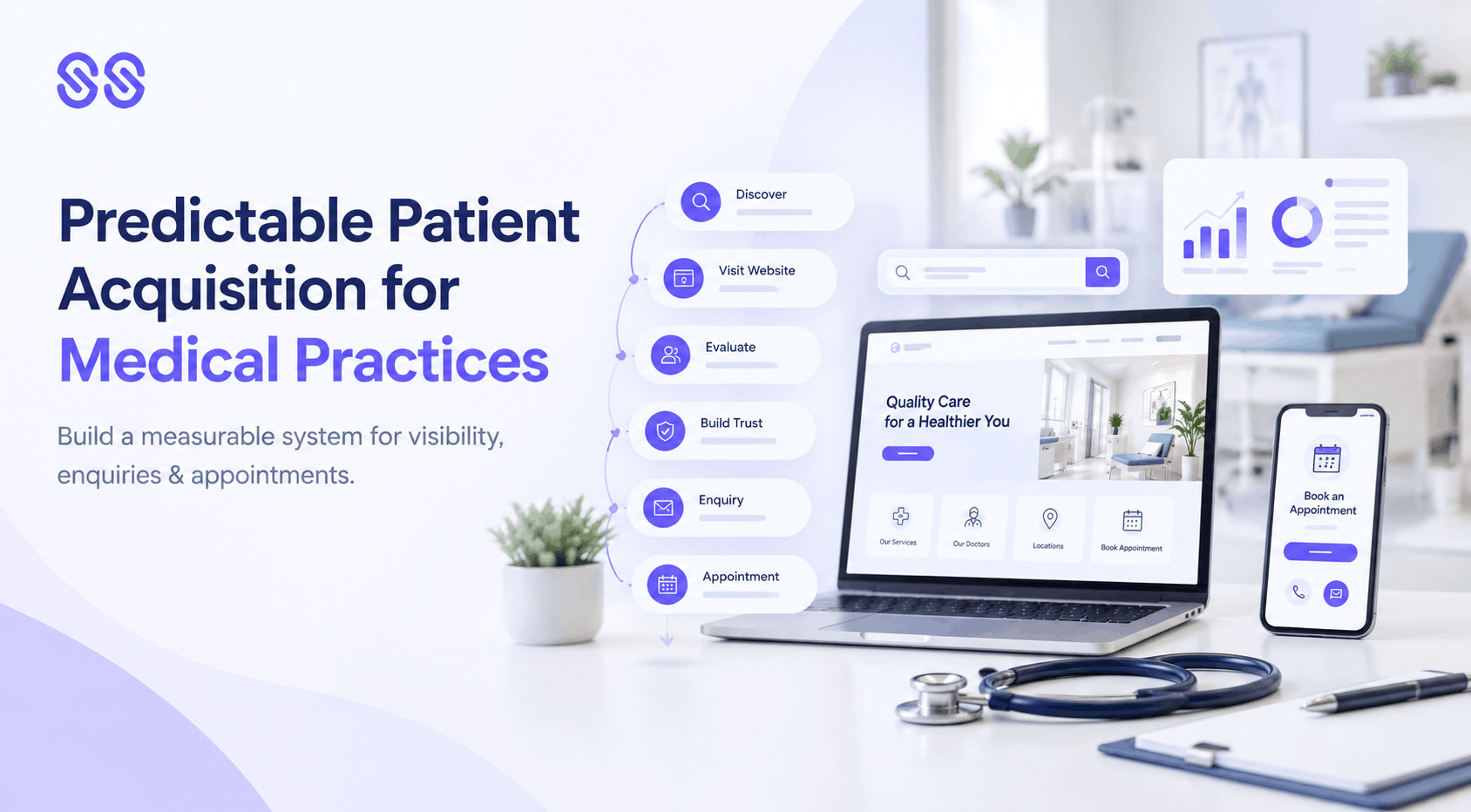
Search or discovery → Website visit → Service evaluation → Trust assessment → Enquiry → Appointment
However, patients do not always follow a straight path.
Someone may first discover a practice through a Google search, follow it on social media, read a blog article several days later and eventually call the clinic.
A patient acquisition system should therefore account for multiple touchpoints.
Also Read More - Best Digital Marketing Strategies for Ophthalmology Clinics
Why Private Practices Need a System Instead of Individual Marketing Tactics
A practice may already be doing several marketing activities:
- SEO
- Google Ads
- Social media
- Email marketing
- Content marketing
- Google Business Profile optimisation
- Referral marketing
The problem is that these activities may operate independently.
For example, SEO may generate website traffic while the appointment form creates friction. Google Ads may generate enquiries while the reception team takes too long to respond. Social media may generate awareness without a clear path to the website.
A patient acquisition system connects these activities.
Each channel should have a defined role in the broader patient journey.
Start With the Right Patient and Service Segments
Effective medical practice growth begins with understanding which services and patient groups matter most.
A private practice may provide several services, but not every service should receive equal marketing attention.
Start by identifying:
- Priority medical services
- High-demand conditions
- Profitable or strategically important services
- Geographic service areas
- Relevant patient groups
- Appointment capacity
- Services the practice wants to grow
For example, a dermatology practice may prioritise:
- Acne treatment
- Skin cancer screening
- Cosmetic dermatology
- Mole assessment
- Hair loss treatment
Each priority service can then receive its own acquisition strategy.
Build a Strong Healthcare Website Foundation
The website is often the central asset in a healthcare patient acquisition system.
It should help visitors answer basic questions quickly:
What does the practice do?
Which doctors provide care?
Where is the practice located?
Which services are available?
Why should I trust this information?
How can I contact the practice?
A strong healthcare website should contain relevant:
- Service pages
- Doctor profiles
- Location pages
- Condition information
- Educational content
- Contact information
- Appointment pathways
The website should also be mobile-friendly and technically accessible to search engines.
Create High-Intent Service Pages
One of the strongest foundations for patient acquisition for medical practices is a well-structured service-page strategy.
A service page should address the patient's likely questions rather than simply repeating a keyword.
A useful service page can explain:
- What the service involves
- Which concerns it addresses
- Who provides it
- What the assessment process may involve
- What patients should know
- Where the service is available
- How to request an appointment
For example, instead of having one generic “Our Services” page, a practice might create dedicated pages for each important treatment or specialty.
This creates more opportunities to capture specific search intent.
Use Healthcare SEO to Capture Existing Demand
SEO can help practices reach people who are actively searching for healthcare information and services.
A strong healthcare patient acquisition strategy can target different levels of search intent.
Informational Searches
Examples:
- What causes chronic back pain?
- What are the symptoms of acid reflux?
- When should I see a dermatologist?
These searches can be addressed through educational content.
Commercial Searches
Examples:
- Back pain treatment
- Dermatology clinic
- Acid reflux specialist
These searches can support service pages and treatment content.
Local Searches
Examples:
- Dermatologist in Miami
- Cardiologist near me
- Dental clinic in Dubai
These searches can be supported through local SEO and location pages.
Transactional Searches
Examples:
- Book dermatologist appointment
- Cardiologist consultation
- Physiotherapy appointment
These searches are closer to the appointment stage.
The objective is to build content for the complete search journey rather than focusing only on one keyword group.
Build a Local Patient Acquisition Engine
For practices with physical locations, local visibility can be an important source of new patient enquiries.
A local strategy can include:
- Google Business Profile optimisation
- Accurate business information
- Location pages
- Local keyword research
- Genuine reviews
- Relevant local citations
- Local authority
- Location-specific service content
Each genuine clinic location should provide accurate information about:
- Address
- Phone number
- Opening hours
- Services
- Doctors
- Directions
- Appointment options
The objective is to make it easy for nearby patients to discover and evaluate the practice.
Use Google Ads for Immediate Search Visibility
SEO is a long-term acquisition channel. Paid search can provide additional visibility for selected high-intent searches.
Google Ads can be useful when a practice wants to promote services such as:
- Specialist consultations
- High-demand procedures
- Diagnostic services
- Dental treatments
- Physiotherapy
- Cosmetic procedures
- Other eligible healthcare services
The campaign should connect:
Search query → Advertisement → Relevant landing page → Enquiry → Appointment
Sending every paid visitor to the homepage can create unnecessary friction.
A service-specific landing page is often more appropriate for high-intent searches.
Read More - Digital Marketing for Doctors: Complete 2026 Guide to Patient Acquisition
Develop a Healthcare Content Marketing Strategy
Healthcare lead generation should not depend entirely on paid advertising.
Useful educational content can attract people earlier in their decision-making process.
Content can cover:
- Symptoms
- Conditions
- Treatment options
- Frequently asked questions
- Appointment preparation
- Recovery information
- Preventive care
- Doctor expertise
For example, a physiotherapy practice might publish:
How Many Physiotherapy Sessions Do You Need?
A cardiology practice might publish:
What Happens During Your First Cardiology Consultation?
This content can attract relevant audiences while establishing the practice as a useful source of information.
Healthcare content should remain accurate, patient-focused and responsible. It should not make unsupported medical claims or attempt to diagnose readers.
Build E-E-A-T Into the Patient Journey
Trust is particularly important in healthcare.
A patient deciding whether to contact a practice may want to know:
- Who is the doctor?
- What are their qualifications?
- What do they specialise in?
- Where did they train?
- What services do they provide?
- Where is the clinic?
- Is the information on the website trustworthy?
E-E-A-T stands for:
Experience, Expertise, Authoritativeness and Trustworthiness.
A practice can strengthen these principles through:
- Detailed practitioner profiles
- Accurate qualifications
- Professional experience
- Relevant memberships where applicable
- Expert-reviewed medical content where appropriate
- Transparent organisation information
- Accurate clinic details
- Reputable medical references
- Clear authorship and content-review information where appropriate
Never invent qualifications, awards, memberships, patient outcomes or professional achievements.
Make the Appointment Journey Simple
Generating traffic is not enough.
If a potential patient cannot easily contact the practice, acquisition breaks down.
Make important actions easy to find:
- Book an Appointment
- Request a Consultation
- Call the Clinic
- Contact the Practice
- Get Directions
Forms should ask only for information that is genuinely necessary at that stage.
For mobile users, click-to-call functionality can be particularly useful.
The fewer unnecessary obstacles between a high-intent visitor and the appropriate next step, the smoother the patient journey becomes.
Respond to Leads Quickly and Professionally
Marketing can generate enquiries, but the practice's internal processes determine what happens next.
A patient acquisition system should define how enquiries are handled.
Consider:
- Who answers calls?
- How quickly are web enquiries reviewed?
- What happens to missed calls?
- Who responds to appointment requests?
- How are enquiries routed to the correct service?
- How are follow-ups handled?
A practice can have strong SEO and advertising performance but still lose potential appointments because enquiries are not handled effectively.
Read More - Periodontist Marketing Services That Help Periodontal Clinics Attract More High-Value Patients
Track Calls, Forms and Appointments
A predictable acquisition system requires measurement.
Track meaningful actions such as:
- Phone calls
- Appointment requests
- Consultation forms
- Online bookings
- Contact enquiries
- Location actions where relevant
Then connect those actions back to marketing channels where possible.
Useful metrics include:
- Cost per lead
- Cost per qualified lead
- Lead-to-appointment rate
- Appointment conversion rate
- Organic conversion rate
- Paid conversion rate
- Service-level performance
- Location-level performance
This gives practice owners a clearer understanding of which channels contribute to actual patient acquisition.
Measure Qualified Leads Instead of Lead Volume Alone
A common marketing mistake is focusing on the number of leads rather than their quality.
Suppose one campaign produces 100 enquiries while another produces 30.
If the first generates mostly irrelevant enquiries and the second produces significantly more appropriate appointment requests, the raw lead count does not tell the whole story.
Healthcare patient acquisition should therefore distinguish between:
- Total enquiries
- Relevant enquiries
- Qualified leads
- Appointments
- Completed consultations
The exact definition of a qualified lead should be agreed with the practice.
Use Retargeting and Remarketing Carefully
Patients do not always make a healthcare decision during their first website visit.
Someone may read a service page, leave the website and return several days later.
Depending on the platform, regulations and consent framework, appropriate remarketing may help maintain awareness.
However, healthcare advertising requires additional caution around privacy and sensitive information.
Practices should ensure that any advertising and tracking activity complies with applicable laws, platform policies and privacy requirements.
Build a Referral and Reputation Layer
Digital acquisition should complement—not necessarily replace—traditional referral sources.
Private practices can build a broader growth ecosystem through:
- Professional referrals
- Community relationships
- Genuine patient feedback
- Healthcare partnerships
- Professional networking
- Educational events
- Local visibility
Online reputation also matters.
Encourage genuine feedback where appropriate and respond professionally to reviews.
Never create or purchase fake patient reviews.
Create a Patient Acquisition Dashboard
A simple dashboard can bring marketing and business metrics together.
Consider tracking:
Metric
Why It Matters
Organic traffic
Measures search visibility
Paid traffic
Measures advertising reach
Qualified leads
Measures relevant enquiries
Appointment requests
Measures conversion intent
Booked appointments
Measures acquisition
Cost per lead
Measures efficiency
Cost per appointment
Measures acquisition economics
Conversion rate
Measures website effectiveness
Local actions
Measures location engagement
The exact metrics should reflect the practice's business model.
Identify and Fix Bottlenecks
A patient acquisition system can be viewed as a series of stages:
Visibility → Traffic → Engagement → Enquiry → Qualified Lead → Appointment
If visibility is low, the practice may need SEO, local SEO or advertising improvements.
If traffic is high but enquiries are low, the website or landing pages may need conversion optimisation.
If enquiries are high but appointments are low, the issue may be lead qualification, response times, availability or the booking process.
This framework helps practices identify where improvement is actually needed.
Build a Predictable Acquisition System Step by Step
Step 1: Define Priority Services
Identify the services that the practice wants to grow.
Step 2: Identify Target Patients
Understand the geographic and demographic groups relevant to those services.
Step 3: Map Search Intent
Identify informational, commercial, local and transactional searches.
Step 4: Build the Website Structure
Create service, doctor, location and educational pages around genuine patient needs.
Step 5: Strengthen Local Visibility
Optimise Google Business Profile and other legitimate local signals.
Step 6: Add Paid Search Where Appropriate
Use Google Ads to capture relevant high-intent demand.
Step 7: Build Healthcare Content
Answer patient questions and strengthen topical authority.
Step 8: Improve Conversion Paths
Make contacting and booking straightforward.
Step 9: Track Lead Quality
Measure qualified enquiries and appointments rather than traffic alone.
Step 10: Optimise Continuously
Use actual performance data to improve campaigns, content, landing pages and patient journeys.
Common Patient Acquisition Mistakes
Relying Only on Referrals
Referrals can be valuable but may not provide a scalable digital acquisition system.
Focusing Only on Website Traffic
Traffic without relevant enquiries does not necessarily support practice growth.
Publishing Generic Content
Healthcare content should address real patient questions and demonstrate genuine expertise.
Sending Paid Traffic to the Homepage
High-intent searches generally deserve more relevant landing pages.
Ignoring Local SEO
Physical practices can miss valuable local demand when their Google Business Profile and location presence are poorly managed.
Not Tracking Calls
Phone enquiries can represent an important conversion path for medical practices.
Responding Slowly to Enquiries
Marketing performance can be undermined by poor lead handling.
Making Unsupported Medical Claims
Trust is essential in healthcare. Marketing should never sacrifice accuracy for attention.
Read More - How to Optimize Healthcare Content for ChatGPT, Google AI and Perplexity
How to Make Patient Acquisition More Predictable
Predictability does not mean guaranteeing a fixed number of appointments every month.
Search demand, competition, seasonality, advertising costs and patient behaviour can change.
A more realistic goal is to make the acquisition process measurable, repeatable and optimisable.
That means knowing:
- Which services attract demand
- Which channels generate enquiries
- Which pages convert visitors
- Which campaigns produce qualified leads
- How quickly enquiries are handled
- Which locations perform best
- Where patients drop out of the journey
With this information, practice owners can make informed decisions about where to invest time and resources.
Final Thoughts
Building a predictable system for patient acquisition for medical practices requires more than choosing one marketing channel.
A successful system connects healthcare patient acquisition, medical practice growth, patient acquisition strategy and healthcare lead generation across the entire patient journey.
SEO can capture existing search demand. Local SEO can help nearby patients discover the practice. Paid search can provide additional visibility for high-intent services. Content marketing can educate people earlier in their decision-making process. Strong doctor and service pages can build trust. Conversion optimisation can make enquiries easier. And accurate tracking can reveal which activities are actually contributing to appointments.
The goal is not to chase every possible patient.
It is to build a healthcare marketing system that consistently helps the right people discover the right service, understand the practice's expertise and take an appropriate next step.
For private medical practices, that shift—from isolated marketing activities to a connected acquisition system—can provide a stronger foundation for sustainable growth.