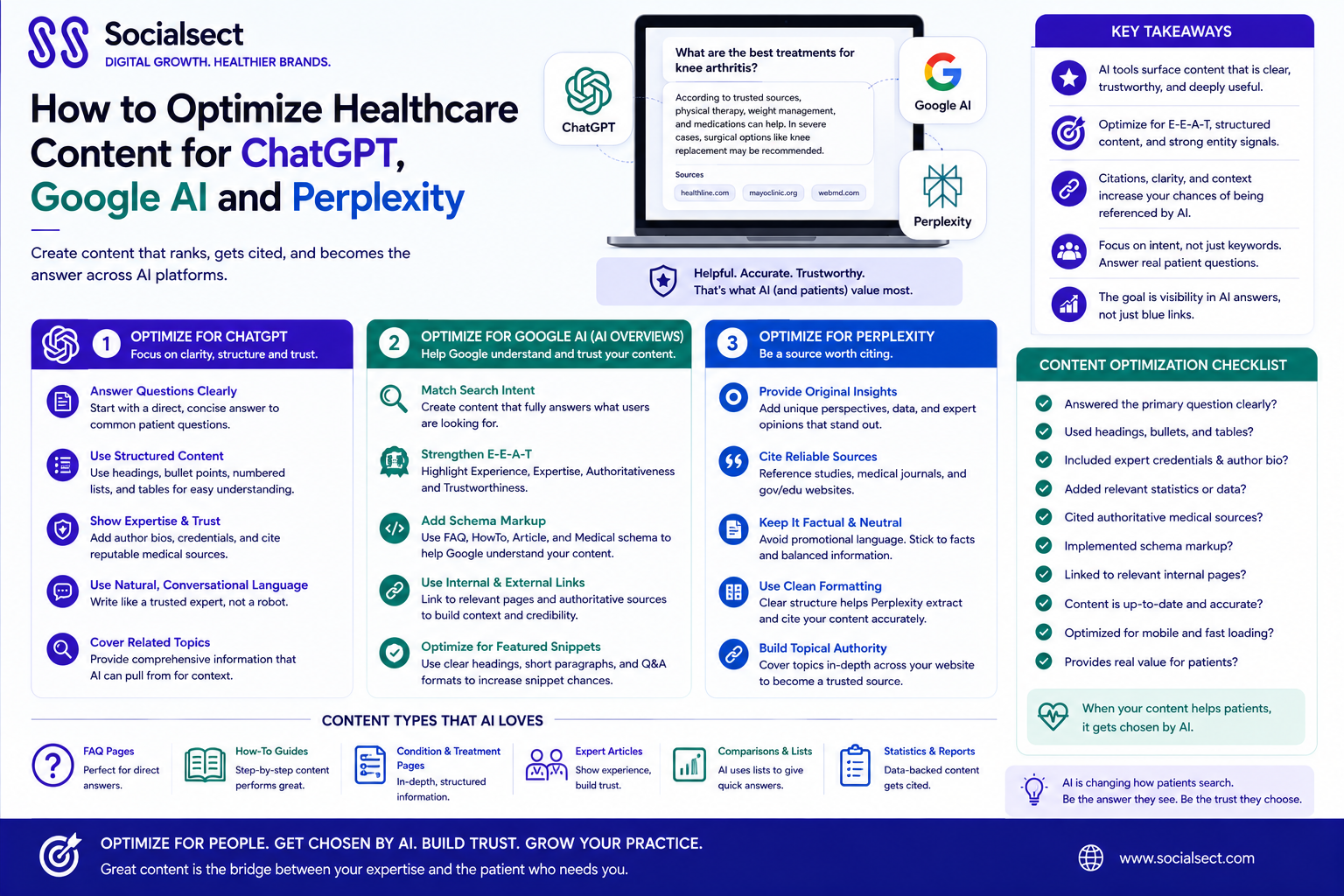
Healthcare search is changing rapidly.
Patients no longer rely exclusively on traditional Google search results when researching symptoms, treatments, medical specialists, clinics, and healthcare services. Increasingly, people are using AI-powered tools to ask detailed questions and receive summarized answers.
Platforms such as ChatGPT, Google's AI-powered search experiences, and Perplexity can help users research complex topics without requiring them to open multiple search results.
For healthcare organizations, this creates a new opportunity—but also a higher standard for content quality.
Simply publishing an article and adding keywords is not enough.
Healthcare content needs to be accurate, useful, clearly structured, transparent about expertise, and easy for both people and search systems to understand.
This is where AI SEO for healthcare becomes important.
AI SEO focuses on creating healthcare content that is discoverable, understandable, authoritative, and useful across traditional search and AI-powered search experiences.
This guide explains how doctors, clinics, hospitals, and healthcare brands can optimize content for ChatGPT, Google AI, and Perplexity while maintaining strong healthcare SEO and EEAT principles.
What Is AI SEO for Healthcare?
AI SEO for healthcare is the process of optimizing healthcare websites and content so that their information is easier for modern search systems and AI-powered discovery tools to understand, evaluate, and potentially surface.
It combines traditional SEO principles with:
- Clear information architecture
- Strong topical coverage
- Expert-led content
- Structured information
- Entity optimization
- Question-based content
- Strong internal linking
- Reliable references
- Transparent authorship
- Patient-focused explanations
AI SEO does not mean writing content specifically to "trick" ChatGPT or another AI system.
Instead, the goal is to create information that is genuinely useful and easy to interpret.
Why AI Search Matters for Healthcare
Healthcare questions are naturally conversational.
Patients may ask:
"What should I know before seeing an orthopedic surgeon for a rotator cuff tear?"
Or:
"What are the treatment options for cataracts?"
These questions are much more detailed than traditional keyword searches.
AI-powered search systems can interpret the context behind these questions and provide synthesized answers.
This means healthcare organizations need content that addresses the complete information need, not just one keyword.
ChatGPT, Google AI and Perplexity Work Differently
It is important not to treat every AI platform as one identical search engine.
ChatGPT
Depending on the product and current functionality, ChatGPT can use its own knowledge and, in supported experiences, web information to answer user questions.
Google AI
Google integrates AI-powered responses into parts of its search experience while continuing to use its broader search infrastructure.
Perplexity
Perplexity is designed around AI-assisted research and commonly provides source references alongside responses.
Because these systems can change their retrieval and ranking mechanisms, there is no single optimization technique that guarantees visibility across all of them.
The best approach is to create high-quality source material that can be understood and evaluated by different systems.
The Foundation of AI SEO: High-Quality Healthcare Content
Before optimizing content for AI, get the fundamentals right.
A strong healthcare article should:
- Answer the user's question
- Use medically appropriate language
- Explain complex concepts clearly
- Avoid unsupported claims
- Identify relevant expertise
- Provide useful context
- Address common follow-up questions
- Be easy to navigate
Do not create content solely because an AI platform might cite it.
Create content because patients need reliable information.
That approach creates a stronger foundation for both traditional SEO and AI search.
Use Healthcare EEAT as a Core Principle
Healthcare content requires a particularly strong focus on trust.
EEAT stands for:
Experience
Expertise
Authoritativeness
Trustworthiness
Your website should clearly communicate who is responsible for the information.
Depending on the content, consider including:
- Author name
- Medical reviewer
- Physician credentials
- Specialty
- Relevant experience
- Review date
- Updated date
- References
- About information
Do not invent authors, reviewers, credentials, awards, or clinical experience.
Authenticity is essential.
Put the Answer Near the Beginning
AI systems and users both benefit from clear answers.
Instead of starting with several paragraphs of generic background, provide a concise explanation early.
For example:
What Is a Rotator Cuff Tear?
A rotator cuff tear is an injury involving one or more of the tendons that help stabilize and move the shoulder. Symptoms can include pain, weakness, and difficulty raising the arm.
Then expand into:
- Causes
- Symptoms
- Diagnosis
- Treatment
- Recovery
- When to seek care
This structure makes the content easier to understand.
Optimize for Questions, Not Just Keywords
Traditional SEO often starts with keywords.
AI search makes conversational questions particularly important.
Instead of targeting only:
"migraine treatment"
create content that addresses questions such as:
- What treatments are available for migraine?
- When should someone see a neurologist for migraine?
- What causes frequent migraines?
- Can migraine symptoms change over time?
- What should patients expect during an evaluation?
This creates broader topical coverage.
Build Comprehensive Topic Clusters
One article rarely answers every healthcare question.
Instead, build connected topic clusters.
For example:
Main Topic: Knee Pain
Supporting content:
- Causes of knee pain
- Knee arthritis
- ACL injuries
- Meniscus tears
- Knee pain diagnosis
- Physical therapy for knee pain
- Knee injections
- Knee replacement
- Knee replacement recovery
Link these pages naturally.
This helps establish topical relationships while creating a better patient education experience.
Use Clear Heading Structures
Healthcare content should be easy to scan.
A useful structure may include:
H1: Knee Replacement: What Patients Should Know
H2: What Is Knee Replacement?
H2: Who May Need Knee Replacement?
H2: How Is Knee Replacement Performed?
H2: What Is Recovery Like?
H2: What Are the Risks?
H2: Frequently Asked Questions
Clear hierarchy helps both users and machines understand the page.
Answer Follow-Up Questions
AI-powered search often works by understanding a sequence of related questions.
If someone asks:
"What is LASIK?"
their next questions may be:
- Who is a candidate?
- How does LASIK work?
- Does LASIK hurt?
- How long does recovery take?
- What are the risks?
- How long do results last?
A strong healthcare article anticipates these information needs.
This is more useful than creating dozens of extremely thin pages targeting individual questions.
Make Medical Claims Carefully
Healthcare content should avoid exaggerated or unsupported claims.
Be cautious with statements such as:
- "Guaranteed results"
- "Completely risk-free"
- "Best treatment"
- "Permanent cure"
- "100% success"
- "No recovery required"
Medical outcomes can vary between individuals.
Use qualified language when appropriate and provide evidence or references for significant claims.
Cite Reliable Sources
Healthcare content can become stronger when important claims are supported by appropriate sources.
Depending on the subject, useful sources may include:
- Government health agencies
- Medical associations
- Academic institutions
- Peer-reviewed research
- Established clinical organizations
References should support the claims being made.
Do not add citations simply to make a page look authoritative.
Strengthen Author and Reviewer Information
A medical article about complex treatment should make its expertise clear.
For example:
Written by: [Qualified Author]
Medically reviewed by: [Qualified Physician]
Last reviewed: [Date]
Then provide a short explanation of the reviewer's credentials where appropriate.
This supports transparency and helps patients understand who is responsible for the information.
Build Strong Healthcare Entity Signals
AI SEO and entity SEO work well together.
Search systems need to understand relationships between:
- Doctor
- Specialty
- Clinic
- Treatment
- Condition
- Location
For example:
Dr. Smith
→ Cardiologist
→ ABC Cardiology
→ Miami
→ Heart Disease
→ Cardiac Testing
A consistent representation of these relationships across the website can make the organization easier to understand.
Optimize Physician and Clinic Pages
Do not focus all AI SEO efforts on blog articles.
Important entity pages include:
- Physician profiles
- Clinic pages
- Specialty pages
- Service pages
- Location pages
- Condition pages
A physician profile should clearly communicate expertise, qualifications, specialty, locations, and relevant services.
A clinic page should explain the organization, services, physicians, locations, and patient pathways.
Use Structured Data Correctly
Structured data can help communicate specific information about a page to search engines.
Depending on the page, healthcare websites may use relevant structured data such as:
- Physician
- MedicalClinic
- Organization
- Article
- BreadcrumbList
Only implement structured data that accurately describes the page and complies with applicable guidelines.
Structured data is not a guarantee of AI citations or search features.
Improve Internal Linking
Internal linking is particularly useful for large healthcare content libraries.
For example:
Diabetes
→ Diabetes Symptoms
→ Type 2 Diabetes
→ Diabetes Treatment
→ Endocrinologist
→ Diabetes Management
This creates a connected information ecosystem.
Internal links should be natural and genuinely useful to patients.
Optimize Content for Featured Answers
Although AI search is changing the search landscape, traditional search features remain important.
Create concise answer sections for common questions.
For example:
Can knee arthritis be treated without surgery?
Depending on the individual's condition, non-surgical options may include exercise, physical therapy, medications, weight management, or other treatments recommended by a qualified healthcare professional.
Then provide deeper detail below.
This format can help users quickly understand the answer while allowing the page to provide comprehensive context.
Make Content Easy for Patients to Understand
Medical expertise should not mean unnecessary complexity.
Use:
- Short paragraphs
- Descriptive headings
- Bulleted lists
- Tables where useful
- Definitions
- Examples
- Plain-language explanations
Instead of:
"The pathophysiological etiology involves degenerative alterations..."
consider:
"The condition can develop as tissues change over time."
Complex medical terminology can still be used when necessary, but explain it.
Keep Healthcare Content Updated
Medical information changes.
Review important healthcare pages periodically for:
- Outdated statistics
- Old treatment recommendations
- Broken references
- Outdated terminology
- Incorrect provider information
- Changed services
- New clinical guidance
Add visible update information when appropriate.
An old article that has not been reviewed for years may not provide the same trust signal as carefully maintained content.
Don't Publish AI-Generated Medical Content Without Review
AI tools can assist with research, outlines, editing, and content workflows.
But healthcare organizations should not publish unverified medical information simply because it sounds professional.
AI-generated drafts can contain:
- Incorrect claims
- Missing context
- Outdated information
- Fabricated references
- Oversimplified medical guidance
Human expertise and appropriate review remain essential.
The goal of AI SEO for healthcare should be better information—not more automated content.
What AI Search Optimization Should Not Do
Avoid strategies such as:
Keyword Stuffing
Repeating a keyword excessively does not make content more authoritative.
Fake Citations
Never invent sources or references.
Fake Physician Review
Never claim medical review occurred when it did not.
Hidden Content
Do not create invisible text designed solely for search systems.
Mass-Produced Location Pages
Avoid publishing hundreds of nearly identical pages with city names swapped.
AI Content at Scale Without Quality Control
Quantity cannot replace medical accuracy.
AI SEO for Healthcare: A Practical Workflow
A practical workflow can look like this:
Step 1: Identify Search Intent
Understand what patients are actually asking.
Step 2: Research the Topic
Review reputable medical and professional sources.
Step 3: Build the Content Outline
Cover the primary question and relevant follow-up questions.
Step 4: Add Expert Input
Use qualified healthcare professionals where appropriate.
Step 5: Write for Patients
Make the information accurate and understandable.
Step 6: Add Supporting Evidence
Reference credible sources for important claims.
Step 7: Optimize On-Page SEO
Improve:
- Title
- Headings
- URL
- Metadata
- Internal links
- Images
- Structured data where appropriate
Step 8: Strengthen EEAT
Add authorship, medical review, credentials, and transparency.
Step 9: Publish and Monitor
Track organic performance, engagement, conversions, and relevant visibility.
Step 10: Update
Review important pages as medical information and search behavior evolve.
AI SEO Healthcare Checklist
Before publishing an article, ask:
- Does the article answer the main question immediately?
- Is the medical information accurate?
- Is the content written for patients?
- Is the author identified?
- Has appropriate medical review been completed?
- Are credentials transparent?
- Are important claims supported?
- Are references reliable?
- Does the article address related questions?
- Are headings clearly structured?
- Are relevant internal links included?
- Is the page optimized for mobile?
- Is the URL descriptive?
- Is the title useful rather than clickbait?
- Is the content genuinely original?
- Is the information reviewed regularly?
How to Measure AI SEO Performance
AI search visibility is more difficult to measure than traditional rankings.
Do not rely on one metric.
Monitor:
- Organic traffic
- Branded searches
- Non-branded rankings
- Search impressions
- Click-through rates
- Referral traffic where identifiable
- Appointment requests
- Phone calls
- Contact forms
- Engagement
- Brand mentions
You can also periodically test important patient questions across relevant AI search experiences to understand how your organization and content are represented.
However, these checks should be treated as directional rather than guaranteed ranking measurements.
How Socialsect Can Help With AI SEO for Healthcare
At Socialsect, AI SEO can be integrated into a broader healthcare search strategy rather than treated as a standalone publishing tactic.
The approach can include:
- Healthcare keyword research
- AI search intent analysis
- Healthcare content strategy
- Entity SEO
- EEAT optimization
- Medical content architecture
- Physician profile optimization
- Technical SEO
- Structured data
- Internal linking
- Local SEO
- Multi-location SEO
- Content refreshes
- Patient-focused conversion optimization
The goal is to build a healthcare website that is understandable to patients, traditional search engines, and emerging AI-powered search experiences.
Final Thoughts
The future of healthcare search is becoming more conversational.
Patients are asking longer, more specific questions and expecting useful answers quickly.
That does not mean traditional SEO is disappearing.
Instead, healthcare organizations need to combine traditional search optimization with a stronger focus on information quality, entities, expertise, structure, and user intent.
Effective AI SEO for healthcare is therefore not about trying to manipulate ChatGPT, Google AI, or Perplexity.
It is about creating information that deserves to be discovered.
That means:
Accurate medical information + genuine expertise + clear structure + strong entities + useful answers + trustworthy sources + excellent patient experience.
Healthcare organizations that consistently invest in those fundamentals will be better positioned for an evolving search environment.