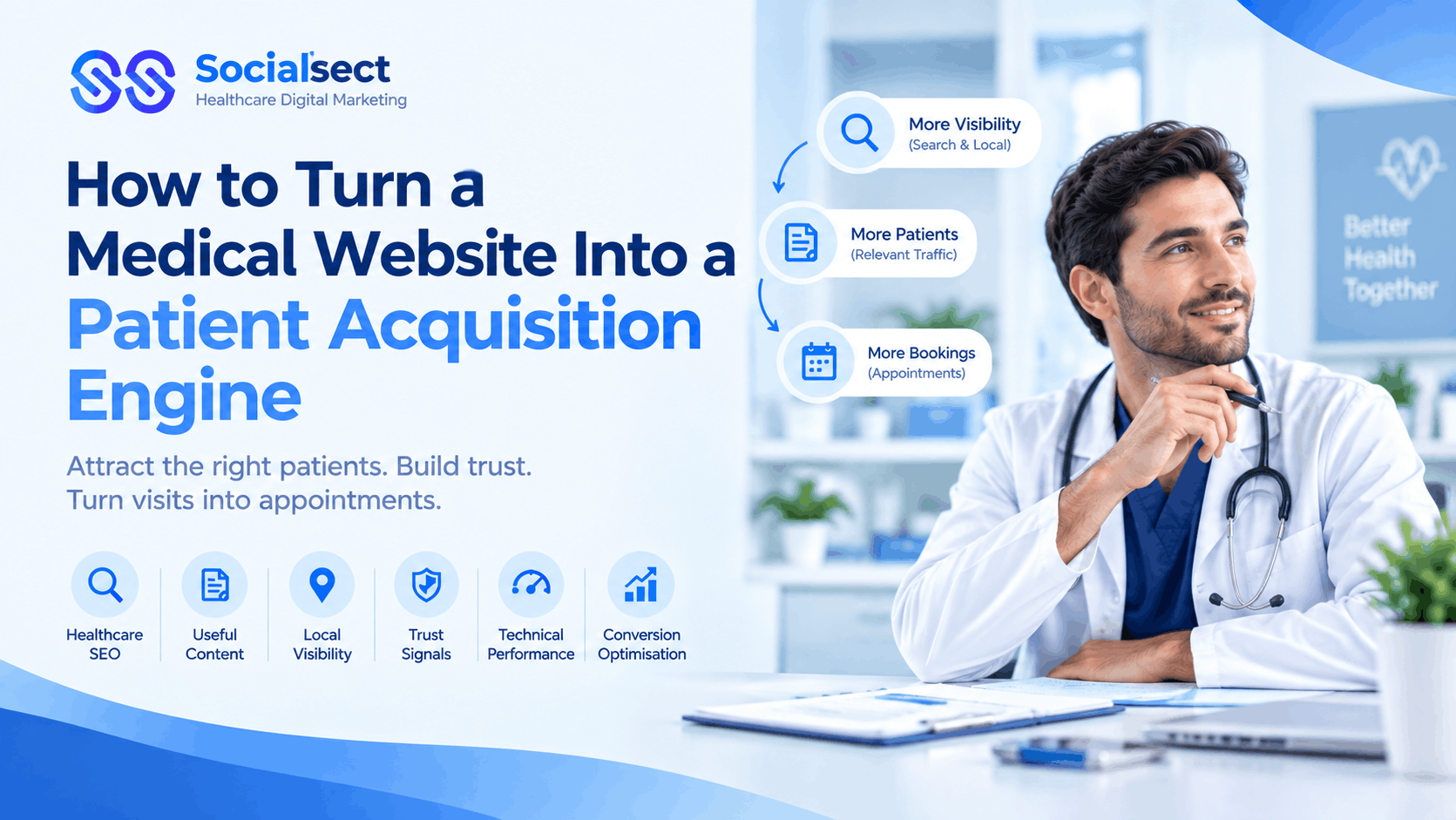
A medical website should do more than display a clinic’s address, list its services, and provide a phone number. When strategically planned, it can become one of the most valuable channels for medical patient acquisition.
Patients often visit a healthcare website before deciding whether to call, book an appointment, or continue searching for another provider. They want to understand the service, know who is providing care, assess whether the clinic appears trustworthy, and find a convenient way to take the next step.
This means healthcare websites need to serve two purposes at the same time: help patients make informed decisions and create clear pathways to conversion.
Turning a website into a patient acquisition engine requires more than increasing traffic. It involves combining healthcare SEO, useful content, local visibility, trust signals, technical performance, conversion optimisation, and accurate measurement.
What Is Medical Patient Acquisition?
Medical patient acquisition is the process of attracting prospective patients and converting them into enquiries, consultations, appointments, or other appropriate healthcare interactions.
Digital patient acquisition can come from several channels, including:
- Organic search
- Google Business Profile and local search
- Paid search advertising
- Social media
- Referral traffic
- Educational content
- Email marketing
- Online directories
- Direct website visits
Your website often sits at the centre of these channels.
A person may discover a clinic through Google, read an educational article, visit a service page, review a practitioner profile, and then book an appointment through the website.
That makes the website more than an online brochure. It becomes part of the patient's decision-making journey.
Why Medical Websites Often Fail to Generate Patients
A website can receive visitors without generating meaningful enquiries.
Common reasons include:
- Visitors cannot quickly understand the services
- Important service pages are missing
- The website is difficult to use on mobile devices
- Calls to action are unclear
- Practitioner information is limited
- Content does not answer patient questions
- Local search visibility is weak
- Pages target keywords without addressing search intent
- Appointment forms are complicated
- Trust signals are difficult to find
The solution is not always “more traffic.”
A clinic may achieve better results by improving the experience and conversion potential of the visitors it already attracts.
Build Your Website Around Patient Search Intent
Effective medical patient acquisition starts with understanding what patients are trying to accomplish when they search.
Different searches indicate different levels of intent.
For example:
Informational intent:“What causes persistent shoulder pain?”
Commercial investigation:“Best treatment for shoulder pain”
Service intent:“Shoulder specialist”
Local intent:“Shoulder specialist near me”
Each search requires a different type of content.
An educational article may be appropriate for an informational search, while a detailed service or practitioner page may be more suitable for a high-intent query.
Your website should provide a logical path between these stages.
Also Read More - How Plastic Surgeons Can Generate High-Value Leads with Google Ads
Create Dedicated Pages for High-Intent Services
One of the strongest foundations for healthcare SEO and patient acquisition is a well-structured set of service pages.
Instead of placing every treatment on one generic “Services” page, create dedicated pages for important services where there is genuine value in doing so.
A strong service page should explain:
- What the service is
- Who it may be appropriate for
- What the consultation or process involves
- Relevant benefits and considerations
- Who provides the service
- Common questions
- How patients can take the next step
The content should remain medically responsible and avoid unsupported promises or guarantees.
Match Each Page to a Clear Search Intent
A service page should have a defined purpose.
For example, a clinic offering physiotherapy might have separate pages for:
- Sports physiotherapy
- Back pain physiotherapy
- Post-operative rehabilitation
- Joint pain treatment
- Physiotherapy assessment
This creates more relevant entry points for prospective patients while making the website easier to navigate.
Make Your Healthcare Website Demonstrate E-E-A-T
Healthcare is a high-trust area, so E-E-A-T—Experience, Expertise, Authoritativeness, and Trustworthiness—should be built into the website.
Patients need confidence that the information they are reading comes from a credible healthcare organisation or qualified professional.
Useful trust signals can include:
- Practitioner qualifications
- Professional experience
- Areas of clinical practice
- Professional memberships where relevant
- Author information
- Medical content review information where appropriate
- References to reliable sources
- Clear clinic contact information
- Transparent information about services
- Accurate location details
Do not manufacture credentials, testimonials, experience, or clinical claims.
A healthcare website should communicate what the organisation and its professionals can genuinely demonstrate.
Create Detailed Practitioner Profiles
Patients often want to know who will provide their care.
A practitioner page can therefore play an important role in medical patient acquisition.
Depending on the practitioner and specialty, the profile can include:
- Name
- Specialty
- Qualifications
- Clinical interests
- Professional experience
- Relevant memberships
- Areas of practice
- Publications or professional work where applicable
The information should be current and factually accurate.
Practitioner pages can also connect to relevant service and educational pages, creating a stronger internal linking structure.
Use Healthcare SEO to Attract High-Intent Patients
Healthcare SEO should focus on more than increasing overall organic traffic.
The objective is to attract people searching for services and information relevant to the clinic.
A practical keyword strategy can include:
Service Keywords
Examples include:
- cardiology clinic
- physiotherapy clinic
- dermatology treatment
- dental implants
Specialist Keywords
Examples include:
- cardiologist near me
- dermatologist in [location]
- orthopaedic specialist
Condition Keywords
Examples include:
- acne treatment
- back pain specialist
- migraine treatment
Local Keywords
Examples include:
- private clinic in [city]
- specialist clinic near me
- [service] in [location]
Keyword targeting should always be aligned with genuine services offered by the practice.
Build Content That Supports Patient Decisions
A healthcare blog should not exist simply to publish articles every week.
Its purpose should be to answer genuine questions and support the patient journey.
Useful content can cover:
- Symptoms and conditions
- Treatment options
- Preparation
- Recovery
- Common concerns
- When to seek professional assessment
- Frequently asked questions
- Treatment comparisons
For example, an orthopaedic practice could publish an article about common causes of knee pain and connect it naturally to its relevant assessment or treatment page.
This creates a path from education to appropriate action without turning medical content into aggressive advertising.
Read More - Best Website Features for Modern Dental Clinics
Strengthen Local SEO for Patient Acquisition
For clinics serving a defined geographic area, local SEO can be an important component of digital patient acquisition.
Make sure your clinic's local information is accurate and consistent across relevant platforms.
Pay attention to:
- Clinic name
- Address
- Phone number
- Opening information
- Services
- Practitioner information
- Website details
A well-maintained Google Business Profile can also help prospective patients discover the clinic through local search and Maps.
Encourage Genuine Patient Reviews
Reviews can help prospective patients evaluate a clinic.
Healthcare organisations should develop legitimate processes for requesting feedback from real patients while respecting applicable privacy, professional, and platform requirements.
Never purchase or fabricate reviews.
Make Appointment Conversion Easy
Even excellent SEO cannot compensate for a poor conversion experience.
Once a prospective patient reaches the website, make the next step obvious.
Useful calls to action may include:
- Book an appointment
- Request a consultation
- Contact the clinic
- Call the practice
- Request an assessment
The exact CTA should reflect the clinic's actual process.
Simplify Contact Forms
Avoid asking prospective patients for unnecessary information.
A basic enquiry form may require only information needed to respond appropriately, such as:
- Name
- Contact information
- Preferred appointment information
- Brief enquiry
Healthcare organisations should handle personal and health-related information according to applicable privacy and data protection requirements.
Optimise the Website for Mobile Users
A significant portion of healthcare searches can happen on mobile devices.
A patient searching for a nearby clinic may want to call or book an appointment immediately.
Check that:
- Text is easy to read
- Buttons are easy to tap
- Forms work correctly
- Phone numbers are accessible
- Pages load efficiently
- Navigation is straightforward
- Important information is not hidden
Mobile usability is therefore both a user experience and patient acquisition consideration.
Improve Website Speed and Technical SEO
Technical problems can interfere with both search visibility and conversions.
Regularly review:
- Page speed
- Mobile performance
- Broken links
- Indexation
- XML sitemap
- Robots.txt
- Canonical URLs
- Redirects
- HTTPS
- Structured data
- Core website functionality
A technically healthy website provides a stronger foundation for SEO and patient acquisition.
Connect Content With Internal Links
Internal linking helps visitors move naturally through the website.
For example:
Educational article → Condition page → Service page → Practitioner page → Appointment
This structure can help users find relevant information without having to return to Google for every step.
It can also help search engines understand the relationships between pages.
Avoid forcing links into content simply to add keywords. Links should be useful and contextually relevant.
Use Conversion Tracking to Measure Patient Acquisition
Website traffic alone does not tell you whether SEO is producing business value.
Track meaningful actions such as:
- Appointment requests
- Contact form submissions
- Phone calls
- Consultation requests
- Booking clicks
- Location interactions
- Relevant landing pages
Where possible, connect these actions with acquisition channels.
This can help answer questions such as:
- Which organic pages generate enquiries?
- Which services attract the most valuable traffic?
- Which keywords bring high-intent visitors?
- Which landing pages have strong traffic but weak conversion?
- Which channels contribute to appointments?
Healthcare organisations should implement analytics and tracking in a way that respects applicable privacy requirements.
Turn High-Traffic Pages Into Better Conversion Pages
One of the easiest opportunities for medical patient acquisition may already exist within the website.
Look for pages receiving organic traffic but generating few enquiries.
Then evaluate:
- Does the page match the search intent?
- Is the service clearly explained?
- Is practitioner information available?
- Are relevant internal links present?
- Is the CTA visible?
- Is the content trustworthy?
- Does the page work well on mobile?
- Is the next step obvious?
Improving an existing high-traffic page can sometimes be more efficient than creating another article.
Build a Patient Acquisition Funnel
A strong medical website should guide visitors through a logical journey.
A simple funnel could look like:
Search → Educational Content → Service Page → Practitioner Profile → Appointment
Not every visitor will follow this exact path.
Some people will arrive directly on a service page, while others may first discover the clinic through local search.
The important point is that every major page should provide a useful next step.
Common Medical Patient Acquisition Mistakes
Avoid these common problems:
Focusing Only on Traffic
More visitors do not automatically mean more patients.
Targeting Only Broad Keywords
Highly competitive generic terms may bring less qualified traffic than specific service and local searches.
Using Thin Service Pages
A service page should answer meaningful patient questions rather than simply repeat a keyword.
Hiding Practitioner Information
Patients often want to understand who is providing care.
Using Aggressive Medical Claims
Healthcare content should prioritise accuracy and responsible communication.
Making Booking Difficult
Every additional barrier can create friction for prospective patients.
Ignoring Existing Data
Search Console, analytics, call data, and conversion information can reveal valuable optimisation opportunities.
Read More - Conversion-Focused Landing Pages for Healthcare Clinics
A Practical Strategy for Turning Your Website Into a Patient Acquisition Engine
A focused implementation can follow these stages:
Stage 1: Build the Foundation
- Audit the website
- Research patient search intent
- Map keywords to pages
- Improve technical SEO
- Build service pages
- Strengthen practitioner profiles
Stage 2: Increase Search Visibility
- Publish useful healthcare content
- Improve internal linking
- Strengthen local SEO
- Optimise existing pages
- Build relevant authority
Stage 3: Improve Conversions
- Review calls to action
- Simplify enquiry forms
- Improve mobile usability
- Strengthen trust signals
- Improve service-page content
Stage 4: Measure and Refine
- Track organic traffic
- Monitor search queries
- Measure enquiries
- Identify high-performing pages
- Improve pages with high traffic but low conversion
- Reassess the strategy based on actual data
Final Thoughts
A successful healthcare website should not be measured only by how attractive it looks or how much traffic it receives.
Its real value comes from how effectively it helps prospective patients find relevant healthcare medical services , information, understand the clinic's expertise, trust the organisation, and take an appropriate next step.
A strong medical patient acquisition strategy combines healthcare SEO, high-intent service pages, useful content, local search visibility, E-E-A-T, practitioner profiles, technical performance, conversion optimization, and meaningful measurement.
The goal is not simply to attract more visitors.
It is to build a website that attracts the right visitors and gives them a clear, trustworthy path toward contacting the healthcare provider.