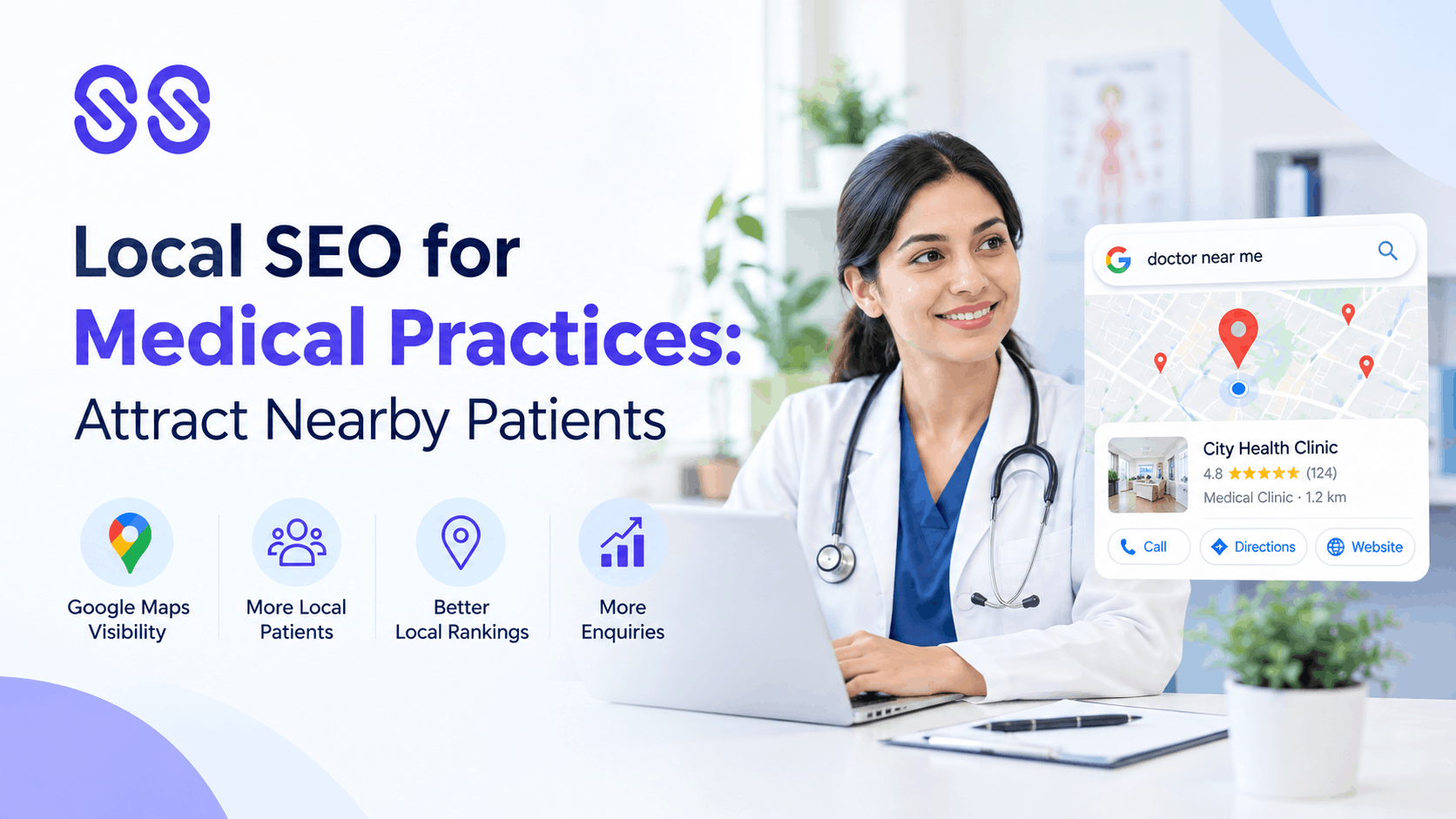
When people need a doctor, clinic or healthcare service, they often look for options close to where they live or work. Searches such as “doctor near me,” “dentist near me,” “cardiologist in Miami” or “private GP near me” show a clear geographic intent.
For medical practices, this creates a valuable opportunity to connect with prospective patients who are actively looking for healthcare providers in their area.
This is where local SEO for medical practices becomes important.
Local SEO helps medical practices improve their visibility for geographically relevant searches and makes it easier for nearby patients to find essential information about a clinic, doctor or healthcare service.
However, effective local SEO involves much more than adding a city name to a website.
A strong strategy combines Google Business Profile optimisation, location-specific website content, accurate business information, genuine reviews, local search relevance, technical SEO and a clear patient conversion journey.
The objective is not simply to rank higher on Google Maps or appear for “near me” searches. It is to help the right local patients discover a legitimate healthcare provider, understand its services and take an appropriate next step.
What Is Local SEO for Medical Practices?
Local SEO for medical practices is the process of improving a medical practice's visibility in search results when people are looking for healthcare services in a specific geographic area.
It can involve:
- Google Business Profile optimisation
- Google Maps SEO
- Local keyword research
- Location-page optimisation
- NAP consistency
- Genuine patient reviews
- Local citations
- Service-area relevance
- Local content
- Technical SEO
- Internal linking
- Conversion optimisation
For example, a physiotherapy practice in London may want to appear when people search for:
- Physiotherapist near me
- Physiotherapy clinic London
- Physiotherapist in [local area]
- Sports physiotherapy near me
A cardiology practice may target searches such as:
- Cardiologist near me
- Cardiologist in Miami
- Heart specialist near me
- Cardiology clinic near me
The strategy should reflect the practice's actual location, services and patient catchment area.
Why Local SEO Matters for Medical Practices
Healthcare is inherently local for many types of care.
Patients may consider:
- Distance from home
- Distance from work
- Travel time
- Parking
- Public transport
- Appointment availability
- Doctor expertise
- Clinic reputation
Someone searching for a healthcare provider is often not interested in a provider hundreds of kilometres away if an appropriate option exists nearby.
This makes medical practice local SEO particularly valuable for practices that depend on physical appointments.
Local visibility can help patients discover:
- Clinic locations
- Doctors
- Services
- Opening hours
- Phone numbers
- Directions
- Reviews
- Appointment information
The information needs to be accurate and useful once the patient finds it.
Read More - Best Digital Marketing Strategies for Ophthalmology Clinics
Understand How Local Search Works
Local search visibility is influenced by several factors.
Google commonly describes local results in terms of relevance, distance and prominence.
Relevance
How well does the healthcare provider match the search?
A dermatology clinic is more relevant to “dermatologist near me” than a general business with no dermatology services.
Distance
How close is the business to the searcher's location or the location specified in the search?
Distance can influence which businesses appear in local results.
Prominence
How established or well-known is the business in the relevant context?
Reviews, mentions and other signals can contribute to a practice's broader local presence.
Because these factors interact, there is no single optimisation that guarantees a particular Google Maps position.
Optimise Your Google Business Profile
A well-managed Google Business Profile is a key component of healthcare local SEO for eligible physical medical practices.
The profile should accurately represent the real-world practice.
Important information includes:
- Practice name
- Address
- Phone number
- Website
- Opening hours
- Primary category
- Relevant services
- Appropriate business attributes
The information should be reviewed regularly.
If a clinic changes its address, phone number or opening hours, the profile should be updated promptly.
For practices with multiple legitimate locations, each eligible location should be represented accurately rather than combining unrelated locations into one listing.
Use the Correct Category
Business categories help communicate what a practice does.
A medical practice should select the category that most accurately represents its primary business.
Additional categories may be appropriate where supported, but they should reflect genuine services rather than being selected simply because they contain desirable keywords.
Incorrect categories can create an inaccurate representation of the practice.
Connect Google Business Profile With the Right Website Page
A common local SEO mistake is sending every location's Google Business Profile to the same homepage.
Where appropriate, a location should link to its corresponding website page.
For example:
Clinic A Google Business Profile → Clinic A location page
Clinic B Google Business Profile → Clinic B location page
The location page can then provide:
- Address
- Opening hours
- Services
- Doctors
- Directions
- Contact details
- Location-specific information
This creates a clearer connection between the physical clinic, business listing and website.
Read More - Best Website Features for Modern Dental Clinics
Create Dedicated Location Pages
If a medical practice has multiple genuine locations, each location may benefit from a dedicated page.
A useful location page should include information such as:
- Exact clinic address
- Phone number
- Opening hours
- Doctors available
- Services provided
- Parking
- Public transport
- Accessibility
- Nearby areas
- Directions
- Appointment information
The content should be genuinely useful.
Avoid creating dozens of pages that simply replace one city name with another while leaving the rest of the content unchanged.
Unique local information should come from the actual clinic.
Build Service + Location Relevance
One of the strongest approaches to local SEO for doctors is connecting medical services with genuine geographic intent.
For example:
Service: Dermatology
Location: Miami
The website may have a relevant page such as:
Dermatology Clinic in Miami
The page can explain:
- Dermatology services available
- Relevant doctors
- Conditions treated or assessed
- Clinic location
- Patient information
- Appointment options
This creates a clearer relationship between what the practice offers and where it provides that service.
Keep Name, Address and Phone Information Consistent
NAP stands for:
- Name
- Address
- Phone number
Consistency across important online sources can help avoid confusion.
Check information across:
- Website
- Google Business Profile
- Healthcare directories
- Local directories
- Professional profiles
- Social media
- Relevant third-party listings
If different platforms show different addresses or phone numbers, prospective patients may become uncertain about which information is current.
Accuracy should always take priority over simply creating more listings.
Build Genuine Patient Reviews
Reviews are an important part of local reputation.
For healthcare practices, reviews can help prospective patients understand other people's experiences while evaluating the practice.
A responsible review strategy should focus on genuine feedback.
Practices can:
- Make it easy for patients to leave feedback
- Ask appropriately for genuine reviews
- Respond professionally
- Address legitimate concerns
- Monitor their online reputation
Avoid:
- Fake reviews
- Purchased reviews
- Fabricated patient stories
- Manipulated testimonials
- Incentives that violate platform rules
Healthcare reputation should be built through genuine patient experiences.
Use Reviews as a Trust Signal, Not a Marketing Shortcut
A large number of reviews does not automatically mean that a healthcare provider is the right choice for a patient.
Patients may also consider:
- Doctor expertise
- Services
- Location
- Appointment availability
- Professional qualifications
- Clinic facilities
- Communication
- Their individual healthcare needs
Reviews are one part of the trust picture.
A strong medical practice local SEO strategy should therefore combine reputation with accurate professional and practice information.
Strengthen Doctor Profiles
Doctor pages can support both local SEO and patient trust.
A useful practitioner profile can include:
- Full name
- Medical qualifications
- Professional experience
- Specialty
- Areas of expertise
- Treatments provided
- Professional memberships where applicable
- Languages spoken
- Clinic locations
All information should be accurate and verifiable.
Do not publish unsupported claims such as “best doctor” or “leading specialist” without an appropriate, substantiated basis.
For healthcare websites, genuine expertise is more valuable than exaggerated promotional language.
Implement E-E-A-T Across Local Pages
Healthcare websites need strong trust signals because patients may rely on their information when making health-related decisions.
E-E-A-T means:
Experience, Expertise, Authoritativeness and Trustworthiness.
A local medical practice can demonstrate these principles through:
Experience
Provide accurate information about the clinic, services and patient experience.
Expertise
Identify qualified doctors and healthcare professionals.
Authoritativeness
Use reliable medical references and professional information where appropriate.
Trustworthiness
Maintain accurate business information, transparent contact details and responsible medical content.
These principles should be visible across service pages, doctor profiles, location pages and educational resources.
Create Local Healthcare Content
Local content can support healthcare local SEO when it serves a genuine purpose.
Examples include:
- Healthcare guides relevant to local patients
- Clinic access information
- Local health education
- Community healthcare resources
- Doctor interviews
- Educational events
- Local service information
Avoid creating generic city articles simply to insert a location keyword.
For example, an article about “10 things to do in Miami” is unlikely to strengthen a cardiology practice's topical authority simply because the word Miami appears throughout it.
Local content should have a genuine relationship with the healthcare organisation and its audience.
Optimise for “Near Me” Searches Naturally
A practice does not need to repeat “near me” throughout its website.
Instead, build genuine local relevance through:
- Accurate location information
- Google Business Profile
- Location pages
- Local service pages
- Doctor profiles
- Reviews
- Relevant local mentions
- Strong local authority
Google can interpret geographic intent without requiring unnatural repetition of the phrase “near me.”
Write for people first.
Improve Mobile Local Search Experience
People searching for a nearby healthcare provider may be using a smartphone.
The website should make essential information easy to access.
Check:
- Mobile page speed
- Click-to-call buttons
- Address visibility
- Directions
- Opening hours
- Appointment buttons
- Navigation
- Form usability
A person who finds a practice through Google Maps should be able to move from discovery to contact without unnecessary friction.
Use Google Maps SEO Strategically
Google Maps SEO is closely connected to local search visibility.
The objective should be to make the practice's location and services easy for Google and users to understand.
Important areas include:
- Accurate Google Business Profile information
- Correct category
- Complete profile
- Relevant services
- Genuine reviews
- Consistent business information
- Strong website-location relationship
- Local authority
However, no ethical SEO strategy can guarantee a particular Google Maps position.
Local results can vary based on the searcher's location, query, competition and other factors.
Build Local Authority
Local authority can come from legitimate references and relationships.
Potential sources include:
- Healthcare directories
- Professional associations
- Local organisations
- Community organisations
- Local publications
- Relevant industry websites
- Professional partnerships
The emphasis should be on relevance and credibility rather than acquiring a large number of low-quality links.
For a medical practice, a relevant professional or local reference may be more meaningful than a large collection of unrelated backlinks.
Connect Local SEO With Organic Healthcare SEO
Local SEO should not operate independently from broader SEO.
For example:
Local SEO
→ Google Business Profile→ Location page→ Local visibility
Healthcare SEO
→ Service page→ Condition content→ Doctor profile→ Supporting articles
These components can support each other through internal linking.
A patient searching for a local cardiologist might discover the clinic through Google Maps and then visit the website's cardiology service page and doctor profile before contacting the practice.
Read More - Digital Marketing for Doctors: Complete 2026 Guide to Patient Acquisition
Make Local Pages Conversion-Focused
Ranking is only the first part of the patient journey.
A local page should make it easy for visitors to:
- Call the clinic
- Request an appointment
- Find directions
- Understand available services
- Meet the relevant doctor
- View opening hours
Use clear calls to action such as:
Book an Appointment
Call the Clinic
Request a Consultation
Get Directions
The appropriate CTA depends on the practice's actual patient journey.
Track Local SEO Performance
A medical practice should measure more than local rankings.
Useful metrics include:
- Google Business Profile views
- Website visits from local search
- Calls
- Direction requests
- Website clicks
- Appointment enquiries
- Local organic impressions
- Local keyword visibility
- Qualified patient enquiries
Where possible, track performance by location.
A multi-location organisation may discover that some clinics have strong visibility while others need additional optimisation.
Identify Local SEO Problems
If a practice is not attracting nearby patients, investigate several areas.
Is the Google Business Profile accurate?
Check address, category, hours and services.
Does the website have a relevant location page?
If not, create one for genuine locations.
Is the service information clear?
Patients should understand what the clinic actually provides.
Are reviews genuine and active?
Monitor reputation consistently.
Is the practice targeting the correct area?
A clinic should focus on its actual service area.
Is the website mobile-friendly?
Local search often happens on mobile devices.
Is the conversion path clear?
Patients need an obvious way to contact the practice.
Common Local SEO Mistakes Medical Practices Make
Creating Fake Location Pages
Do not create pages for locations where the practice has no legitimate presence simply to target local keywords.
Duplicating Location Content
Changing only the city name provides little additional value.
Ignoring Google Business Profile
A website alone is not the entire local search presence.
Using Inconsistent NAP Information
Conflicting business information can create confusion.
Buying Fake Reviews
Artificial reviews can damage trust and violate platform rules.
Keyword Stuffing
Repeating “doctor near me” or city names unnaturally does not create a better patient experience.
Ignoring Doctor Expertise
Patients want to know who will provide their care.
Focusing Only on Rankings
The ultimate objective should be meaningful patient engagement and appropriate enquiries.
A Step-by-Step Local SEO Strategy for Medical Practices
Step 1: Audit Your Current Local Presence
Review Google Business Profile, location pages, NAP information, reviews and local search visibility.
Step 2: Identify Priority Services
Determine which healthcare services you want to attract more local demand for.
Step 3: Map Service and Location Keywords
Connect relevant services with genuine geographic search intent.
Step 4: Optimise Google Business Profile
Ensure all information is accurate, complete and representative of the real practice.
Step 5: Build Location Pages
Create useful pages for genuine clinic locations.
Step 6: Strengthen Doctor Profiles
Communicate accurate qualifications, expertise and professional information.
Step 7: Build Genuine Reviews
Encourage authentic patient feedback in an appropriate way.
Step 8: Improve Local Website Content
Add relevant local information without keyword stuffing.
Step 9: Build Local Authority
Develop legitimate professional and community references where appropriate.
Step 10: Track Patient Enquiries
Measure calls, forms, appointments and other meaningful local actions.
Step 11: Optimise Continuously
Use performance data to improve weak locations, services and conversion paths.
Final Thoughts
Local SEO for medical practices is about much more than ranking a clinic on Google Maps.
It is about building a complete local digital presence that helps nearby patients discover a legitimate healthcare provider, understand its services, evaluate its expertise and take an appropriate next step.
A strong strategy combines healthcare local SEO, local SEO for doctors, Google Maps SEO and medical practice local SEO with accurate business information, useful location pages, genuine reviews, doctor profiles, E-E-A-T and a clear conversion journey.
For medical practices, local visibility becomes far more valuable when it leads to meaningful patient actions.
The goal is therefore not simply:
“How do we rank on Google Maps?”
It is:
“How do we make it easier for the right patients in our area to find, trust and contact our practice?”
That patient-focused approach provides a stronger foundation for sustainable local search visibility and long-term practice growth.