Healthcare SEO is often measured by rankings, impressions and organic traffic. These metrics matter, but they do not tell the complete story.
For a healthcare organisation, the more important question is what happens after someone discovers the website.
A person may search for a symptom, condition, treatment, doctor or clinic. They may read an educational article, visit a service page, compare providers, check a doctor's credentials and eventually decide whether to contact the practice.
That entire journey can be designed as a healthcare SEO funnel.
A healthcare SEO funnel connects search intent with useful content, relevant service pages, trust signals and clear conversion paths. Instead of treating SEO as a traffic-generation activity, it turns organic search into a structured patient acquisition journey.
The objective is not to force every visitor into an appointment immediately. Healthcare decisions often require research and consideration. The objective is to give people the right information and next step based on where they are in their decision-making process.
What Is a Healthcare SEO Funnel?
A healthcare SEO funnel is a search-driven journey that moves a potential patient from an initial Google search to a relevant healthcare action, such as contacting a clinic or requesting an appointment.
The journey may look like this:
Search query → Educational content → Service page → Doctor/location page → Trust evaluation → Appointment action
Different patients enter the funnel at different stages.
For example, someone searching:
“What causes persistent shoulder pain?”
may still be researching.
Someone searching:
“shoulder specialist near me”
has stronger local and commercial intent.
Someone searching:
“book shoulder specialist appointment”
is much closer to taking action.
A strong healthcare SEO funnel creates appropriate content for each stage instead of sending every visitor to the same generic homepage.
Also Read More - Best Website Features for Modern Dental Clinics
Why Healthcare SEO Needs a Funnel Approach
Healthcare search behaviour is rarely linear.
A potential patient may:
Search for symptoms.
Read several articles.
Search for possible conditions.
Research treatment options.
Look for a specialist.
Compare clinics.
Check reviews and credentials.
Search for a nearby location.
Visit the website again.
Book an appointment.
This means a healthcare website needs more than individual pages ranking for individual keywords.
It needs a connected ecosystem of content.
The funnel helps healthcare brands understand how informational searches can eventually contribute to patient acquisition without making educational content overly promotional.
Understand the Four Main Stages of a Healthcare SEO Funnel
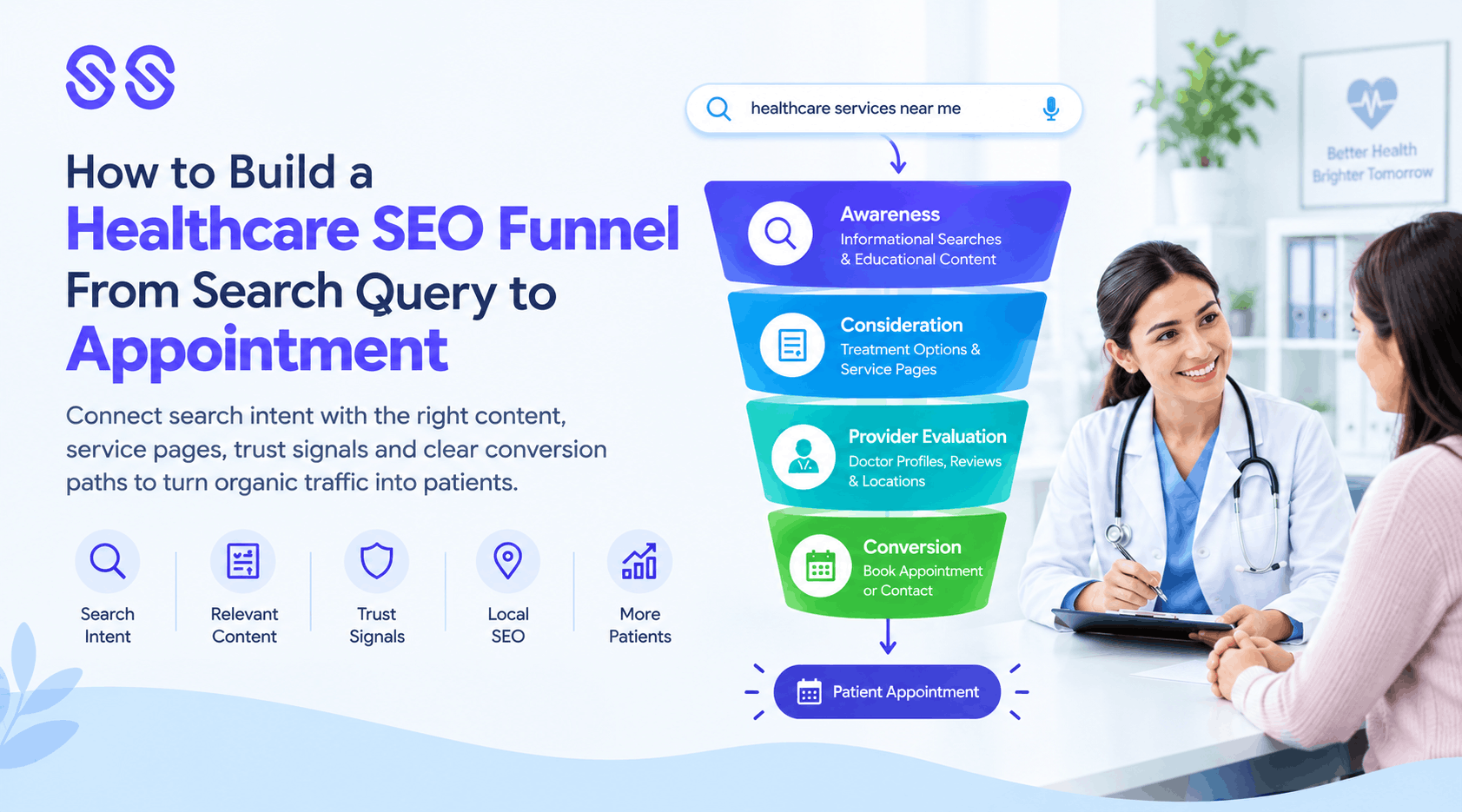
A practical healthcare SEO funnel can be divided into four major stages:
Stage 1: Awareness
The person is identifying a problem or looking for information.
Typical searches include:
- Causes of knee pain
- Symptoms of acid reflux
- What causes hair loss?
- Signs of gum disease
- When should I see a cardiologist?
The user may not yet know which healthcare provider they need.
Stage 2: Consideration
The person understands the problem and starts researching possible solutions.
Examples include:
- Knee pain treatment options
- Best treatment for acid reflux
- Hair transplant vs PRP
- Gum disease treatment
- Cardiologist consultation
At this stage, detailed service and treatment content becomes more important.
Stage 3: Provider Evaluation
The person starts comparing healthcare professionals or organisations.
Examples:
- Cardiologist in Miami
- Dermatologist in Dubai
- Orthopaedic surgeon near me
- Best dental clinic in London
- Fertility clinic near me
Doctor profiles, location pages, reviews, credentials and service information can become particularly important.
Stage 4: Conversion
The user is ready to take action.
Examples:
- Book cardiologist appointment
- Dermatologist appointment Dubai
- Schedule physiotherapy consultation
- Dental clinic appointment near me
The website should make the next step straightforward.
Map Keywords to Every Funnel Stage
Keyword research should not only identify high-volume terms.
The objective is to understand search intent.
Create keyword groups based on what the searcher is trying to accomplish.Awareness searches are informational, such as “causes of knee pain.” Consideration searches show commercial research intent, such as “knee pain treatment.” Provider evaluation searches have local or commercial intent, such as “orthopaedic doctor in Miami.” Conversion searches have transactional intent, such as “book orthopaedic consultation.” This approach prevents a common SEO problem: trying to rank one page for every type of search.
A condition guide should answer the condition-related question.
A service page should explain the service.
A doctor page should explain the practitioner's expertise.
A location page should explain where the service is provided.
An appointment page should facilitate conversion.
Build Top-of-Funnel Healthcare Content
Top-of-funnel content attracts people who are still researching.
This content can cover:
- Symptoms
- Causes
- Risk factors
- Prevention
- Diagnosis
- General treatment information
- When to seek professional care
For example, an orthopaedic practice might create:
What Causes Persistent Shoulder Pain?
The article can explain common causes, warning signs and when professional assessment may be appropriate.
The content should not attempt to diagnose the reader.
Instead, it should provide accurate educational information and direct readers toward appropriate professional evaluation when relevant.
Create Middle-of-Funnel Treatment Content
Once someone understands their problem, they may start researching treatment options.
This is where middle-of-funnel content becomes valuable.
Potential topics include:
- Shoulder pain treatment options
- When is knee surgery necessary?
- Physiotherapy vs medication for back pain
- Dental implant treatment process
- Hair restoration treatment options
These pages can explain:
- What the treatment involves
- Who may be considered for it
- What the assessment process involves
- Potential benefits and limitations
- Questions patients may want to discuss with a qualified professional
- What the next step typically involves
The information should remain medically responsible and avoid guarantees.
Build High-Intent Service Pages
Service pages are often some of the most commercially valuable pages on a healthcare website.
A strong healthcare service page should answer:
What is the service?
Who provides it?
Who may be suitable for evaluation?
What does the process involve?
Where is it available?
How can someone contact the clinic?
For example:
Knee Replacement Surgery in Miami
could include:
- Overview
- Conditions addressed
- Treatment approach
- Doctor information
- Assessment process
- Recovery considerations
- Location
- FAQs
- Appointment CTA
This page can then receive relevant internal links from educational content about knee pain and treatment.
Read More - Best Digital Marketing Strategies for Ophthalmology Clinics
Use Doctor Pages as Trust and Conversion Assets
Patients often want to know who will provide their care.
Doctor profiles can therefore play an important role in a healthcare SEO funnel.
A high-quality profile should include accurate information such as:
- Full name
- Professional qualifications
- Areas of clinical expertise
- Relevant experience
- Treatments or procedures provided
- Professional memberships where applicable
- Languages spoken
- Clinic locations
- Appointment information
Healthcare organisations should verify all professional claims before publishing them.
Do not create credentials, awards, memberships, experience or outcomes that cannot be substantiated.
Connect Location Pages to the Funnel
Local intent becomes increasingly important as the user moves closer to conversion.
Someone may progress from:
“What causes back pain?”
to:
“Back pain treatment”
to:
“Back specialist in Miami”
to:
“Back specialist near me.”
Location pages should therefore connect naturally with service pages and practitioner profiles.
For a multi-location healthcare organisation, each genuine clinic can have a dedicated location page containing:
- Address
- Opening hours
- Services
- Doctors
- Directions
- Contact information
- Appointment options
- Location-specific FAQs
This helps turn general search visibility into location-specific patient journeys.
Build Internal Links Between Funnel Stages
Internal linking is one of the simplest ways to connect a healthcare SEO funnel.
For example:
Blog article
“What Causes Shoulder Pain?”
↓
Condition page
“Shoulder Pain”
↓
Service page
“Shoulder Pain Treatment”
↓
Doctor page
“Shoulder Specialist”
↓
Location page
“Shoulder Specialist in Miami”
↓
Appointment page
“Request a Consultation”
Each link should make sense in context.
The goal is not to add as many internal links as possible. The goal is to help users discover the next useful resource.
Add E-E-A-T Throughout the Funnel
Healthcare SEO requires a strong focus on trust.
E-E-A-T stands for:
- Experience
- Expertise
- Authoritativeness
- Trustworthiness
These principles should be visible throughout the patient journey.
Experience
Use real information about the organisation, services, locations and patient processes where appropriate.
Expertise
Identify qualified healthcare professionals and clearly communicate their areas of expertise.
Authoritativeness
Support medical information with reputable sources and professional expertise where appropriate.
Trustworthiness
Maintain accurate information, transparent contact details, clear ownership and responsible medical claims.
The trust signals should not be limited to the homepage.
A person entering through a blog post should also be able to understand who created or reviewed the information and where they can find legitimate professional care.
Make Healthcare Content Helpful Before Promotional
One of the biggest mistakes in healthcare SEO is turning every article into an advertisement.
If someone searches:
“What are the symptoms of plantar fasciitis?”
they expect an educational answer.
A paragraph saying:
“Book an appointment with our clinic today”
may be appropriate at the end of the article, but the majority of the content should answer the question.
The stronger approach is:
Educate → Build trust → Provide relevant next step
rather than:
Keyword → Sales pitch → Appointment CTA
This improves the user experience and creates a more credible healthcare website.
Optimise the Conversion Stage
Once a visitor reaches a high-intent page, the website should make conversion simple.
Important elements can include:
- Clear appointment buttons
- Click-to-call phone numbers
- Contact forms
- Doctor information
- Clinic address
- Opening hours
- Insurance information where applicable
- Consultation information
- Directions
Avoid forcing users through unnecessary steps.
A patient who has already decided to contact a clinic should not have to search through several pages to find a phone number or appointment option.
Use Different CTAs for Different Funnel Stages
Not every visitor should receive the same call to action.
Awareness CTA
“Read the complete guide”
Consideration CTA
“Explore treatment options”
Provider Evaluation CTA
“Meet our specialists”
Local CTA
“Find a clinic near you”
Conversion CTA
“Request an appointment”
This creates a more natural patient journey.
Optimise for Mobile Search
Healthcare searches frequently occur on mobile devices.
The mobile experience should therefore make important information immediately accessible.
Check:
- Page loading speed
- Font size
- Navigation
- CTA visibility
- Click-to-call functionality
- Appointment forms
- Location information
- Maps and directions
- Form usability
A technically strong page that is difficult to use on mobile can still lose potential patients.
Measure the Funnel Beyond Organic Traffic
A healthcare SEO funnel should be measured as a business process, not simply a content project.
Track metrics such as:
Awareness Metrics
- Organic impressions
- Organic clicks
- Search visibility
- New users
Engagement Metrics
- Page engagement
- Internal link clicks
- Service-page visits
- Doctor-profile visits
- Location-page visits
Conversion Metrics
- Appointment requests
- Phone calls
- Contact form submissions
- Consultation requests
- Bookings
- Qualified leads
The most useful question is not simply:
“How much traffic did SEO generate?”
It is:
“How much qualified patient activity did organic search contribute?”
Track Assisted Conversions
Not every patient will book during their first visit.
A potential patient might read a blog post today, return through a branded search several days later and then book an appointment.
If reporting only credits the final page, the educational content may appear less valuable than it actually is.
Where appropriate, healthcare organisations should use analytics and conversion reporting to understand the broader patient journey while respecting privacy requirements.
Create Topic Clusters Around High-Value Services
A strong healthcare SEO funnel often starts with topic clusters.
For example, a cardiology practice might build a cluster around heart health:
Pillar: Cardiology Services
Supporting content:
- Signs you should see a cardiologist
- What does a cardiologist do?
- Common heart conditions
- How cholesterol affects heart health
- What happens during a cardiology consultation
- Cardiac testing explained
These pages can link to relevant service and doctor pages.
This creates topical depth while giving users multiple entry points into the funnel.
Read More - Digital Marketing for Doctors: Complete 2026 Guide to Patient Acquisition
Avoid Common Healthcare SEO Funnel Mistakes
Focusing Only on High-Volume Keywords
High search volume does not automatically mean high patient value.
Sending Every Visitor to the Homepage
Users should be directed toward the most relevant next page.
Publishing Content Without Internal Links
Disconnected blog posts cannot effectively move users through the funnel.
Using Aggressive CTAs Everywhere
Healthcare decisions require trust and context.
Ignoring Doctor and Location Pages
These pages can be critical during provider evaluation.
Measuring Only Rankings
Rankings are useful indicators, but patient enquiries and appointments are closer to the actual business objective.
Making Unsupported Medical Claims
Healthcare content should be accurate, responsible and evidence-informed.
A Step-by-Step Healthcare SEO Funnel Framework
Healthcare organisations can build their funnel using the following process.
Step 1: Identify High-Value Services
List the treatments, specialties and services that are strategically important.
Step 2: Research Search Intent
Identify informational, commercial, local and transactional searches around each service.
Step 3: Map Keywords to URLs
Assign each search intent to the most appropriate page type.
Step 4: Build Topic Clusters
Create supporting educational content around priority services and conditions.
Step 5: Strengthen Service Pages
Make high-intent pages comprehensive, trustworthy and conversion-focused.
Step 6: Optimise Doctor and Location Pages
Connect professional expertise and local availability with relevant services.
Step 7: Improve Internal Linking
Create logical pathways from informational content to relevant commercial pages.
Step 8: Improve Conversion Paths
Make contacting, calling or requesting an appointment straightforward.
Step 9: Measure Patient Acquisition
Track organic traffic alongside enquiries, calls, appointments and other meaningful conversions.
Final Thoughts
A successful healthcare SEO funnel is more than a collection of pages targeting medical keywords.
It is a connected search journey that helps people move from question to understanding, understanding to consideration, consideration to provider evaluation, and provider evaluation to an appropriate healthcare action.
The strongest funnels do not push every visitor toward an appointment immediately. They provide the information, expertise and trust signals people need at each stage of their journey.
For healthcare organisations, the combination of search intent, high-quality medical content, service pages, doctor profiles, local SEO, internal linking and conversion optimisation can turn organic search into a more measurable patient acquisition channel.
The goal is not simply to rank for more keywords.
The goal is to build a healthcare website that answers the right question at the right stage and makes the next appropriate step clear.
Also Read About- Oral Surgeon Marketing: Complete SEO, Google Ads & Patient Acquisition Guide for Oral and Maxillofacial Surgeons