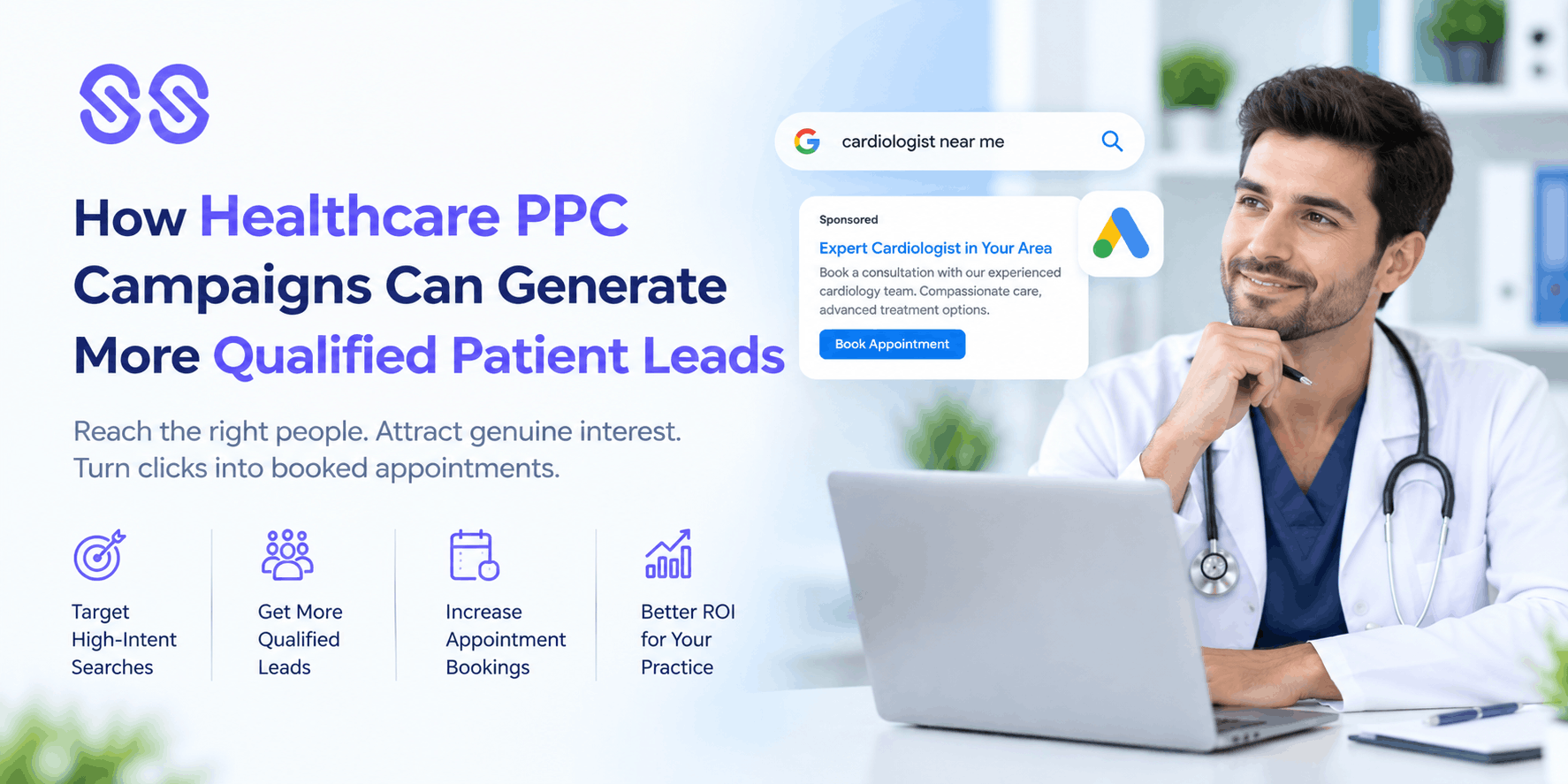
For many medical practices, getting clicks from Google is not the hardest part of running an advertising campaign. The real challenge is attracting qualified patient leads—people who are genuinely looking for the services the practice provides and are in an appropriate position to enquire or book a consultation.
This is where healthcare PPC can play an important role.
A properly structured paid search campaign can place a medical practice in front of people actively searching for specific doctors, treatments, clinics or healthcare services. But simply increasing clicks or impressions does not guarantee meaningful results. Healthcare advertising needs to connect targeting, search intent, landing pages, conversion tracking and lead handling.
Whether managed internally or with a healthcare PPC agency, the goal should be to build campaigns around relevant patient intent rather than maximising traffic alone.
This guide explains how medical PPC, PPC for doctors, healthcare Google Ads and broader medical lead generation strategies can work together to attract more relevant enquiries.
What Is Healthcare PPC?
Healthcare PPC refers to pay-per-click advertising used by eligible healthcare organisations and professionals to reach relevant audiences through paid search and other advertising platforms.
With search advertising, a practice may appear when someone searches for a relevant service.
For example:
- Cardiologist near me
- Private dermatologist
- Dental implant consultation
- Physiotherapy clinic
- IVF clinic
- Orthopaedic specialist
- Cataract surgeon
The exact advertising opportunities available depend on the healthcare service, location, platform policies and applicable regulations.
The core principle is simple:
Reach relevant searchers → provide useful information → encourage an appropriate enquiry or appointment.
Also Read More - Best Digital Marketing Strategies for Ophthalmology Clinics
Why Healthcare PPC Is Different From General PPC
Healthcare advertising requires a more careful approach than many other industries.
People searching for medical services may be dealing with sensitive conditions, urgent concerns or important treatment decisions. Advertising therefore needs to balance performance with accuracy, transparency and responsible communication.
Healthcare PPC should avoid:
- Unsupported medical claims
- Guaranteed treatment outcomes
- Misleading before-and-after representations
- Sensational health claims
- Inaccurate qualifications
- Misleading pricing
- Unverifiable superiority claims
A strong campaign should accurately represent the services and professionals behind the advertisement.
Why Clicks Alone Are Not a Healthcare PPC Goal
One of the biggest mistakes in medical advertising is treating clicks as the primary success metric.
Suppose a campaign receives:
- 5,000 impressions
- 400 clicks
- 30 enquiries
That may initially look positive.
But what if only five enquiries were relevant to the practice?
The campaign may have generated substantial activity without producing enough qualified opportunities.
This is why medical lead generation should focus on the quality of enquiries, not simply the number of clicks.
Useful metrics include:
- Qualified leads
- Appointment requests
- Cost per qualified lead
- Lead-to-appointment rate
- Cost per appointment
- Conversion rate
- Search-term relevance
Start With High-Intent Patient Searches
The foundation of effective healthcare Google Ads is understanding search intent.
Not every keyword represents the same level of interest.
Informational Searches
Examples:
- What is sciatica?
- What causes knee pain?
- Symptoms of acid reflux
These searches may indicate that the person is researching a health concern.
They can be useful for content strategies, but may not always be the highest-priority paid search terms.
Service Searches
Examples:
- Knee pain specialist
- Dermatology clinic
- Physiotherapy treatment
- Dental implant clinic
These searches indicate a stronger connection to a specific service.
Local Searches
Examples:
- Cardiologist in Miami
- Dentist near me
- Private GP London
Local intent can be particularly important for practices that depend on in-person consultations.
Appointment Searches
Examples:
- Book cardiologist appointment
- Private dermatologist consultation
- Physiotherapy appointment
These searches can indicate stronger action intent.
A PPC strategy should differentiate between these search behaviours rather than placing all keywords into one campaign.
Build Campaigns Around Specific Services
A medical practice may offer multiple services.
Instead of creating one campaign covering everything, consider organising campaigns around major service categories.
For example, an orthopaedic practice might separate campaigns for:
- Knee treatment
- Shoulder treatment
- Sports injuries
- Hip conditions
- Spine services
This structure can make it easier to align:
Keyword → Ad → Landing Page → Conversion
A person searching for a specific service should ideally see an advertisement and landing page that directly relate to that service.
Use Relevant Landing Pages
Sending every PPC visitor to the homepage can weaken the patient journey.
A dedicated landing page can provide information specifically related to the search.
For example:
Search: “sports physiotherapy near me”
Ad: “Sports Physiotherapy Consultations”
Landing page: Sports Physiotherapy service page
The landing page can include:
- Service overview
- Relevant conditions
- Practitioner information
- Clinic location
- What patients can expect
- Appropriate FAQs
- Contact information
- Appointment pathway
The content should remain educational and accurate rather than making unrealistic promises.
Read More - Best Website Features for Modern Dental Clinics
Make Trust Visible
Healthcare decisions involve trust.
A prospective patient may want to know:
- Who provides the service?
- What are their qualifications?
- What does the practice specialise in?
- Where is the clinic located?
- How can I contact the practice?
- What can I expect from the consultation?
Landing pages can address these questions through genuine information.
Useful trust elements may include:
Doctor Profiles
Include accurate qualifications, training, professional experience and areas of expertise.
Practice Information
Clearly identify the clinic, location and services.
Educational Content
Explain procedures and conditions in patient-friendly language.
Professional References
Where appropriate, use reputable sources to support educational claims.
Clear Contact Information
Make it easy for visitors to contact the practice or request an appointment.
These elements contribute to E-E-A-T principles: experience, expertise, authoritativeness and trustworthiness.
Use Negative Keywords to Reduce Wasted Spend
A major part of medical PPC optimisation is controlling irrelevant searches.
Negative keywords can help prevent ads from appearing for searches that do not align with the practice's services.
Depending on the campaign, irrelevant terms might include searches for:
- Jobs
- Courses
- Training
- Definitions
- Free services
- Unrelated products
- Academic research
The exact negative keyword strategy should be based on the practice's services and actual search-term data.
Regular search-term analysis can reveal where advertising spend is being wasted.
Target Location Carefully
For local medical practices, geographic targeting can significantly affect lead quality.
A clinic may only serve patients within a particular:
- City
- Region
- Metro area
- Radius
- Catchment area
Advertising outside the appropriate service area can produce clicks that are unlikely to become appointments.
A healthcare PPC agency should therefore consider the practice's real patient catchment area when building location targeting.
Location targeting should be reviewed regularly because patient demand and campaign performance can vary across different areas.
Optimise Ads for Relevance, Not Hype
Healthcare advertisements should clearly communicate what the practice provides.
A useful ad may highlight:
- Medical specialty
- Relevant service
- Location
- Consultation availability where appropriate
- Practice name
- Appropriate call to action
Avoid exaggerated claims such as:
- “Guaranteed cure”
- “Best doctor in the country”
- “100% success”
- “Instant treatment”
The goal is to attract relevant patients while maintaining accurate expectations.
Use Different Messages for Different Search Intent
A person searching for a general specialist and someone searching for a specific procedure may need different information.
For example:
General Specialist Search
“Private Cardiology Consultation”
Condition Search
“Specialist Care for Heart Rhythm Concerns”
Service Search
“Cardiac Diagnostic Consultation”
Each message should connect to the corresponding landing page and actual service.
This helps make the campaign more relevant to the searcher's intent.
Track Calls and Appointment Requests
Healthcare businesses often receive enquiries through phone calls.
If call tracking is not configured correctly, PPC reporting may underestimate campaign performance.
Depending on the practice's setup, conversion tracking can include:
- Phone calls
- Contact forms
- Appointment requests
- Online bookings
- Consultation requests
- Other meaningful actions
Tracking should be implemented carefully, particularly where healthcare privacy requirements apply.
The objective is to understand which campaigns generate meaningful enquiries.
Measure Qualified Patient Leads
Not every lead is equally valuable.
A campaign could generate an enquiry from:
- A patient outside the service area
- Someone looking for a service the clinic does not offer
- Someone seeking emergency care when the clinic is not an emergency provider
- Someone asking for employment
- A genuinely relevant prospective patient
The practice should establish what constitutes a qualified patient lead.
This may depend on:
- Location
- Service requested
- Patient eligibility
- Appointment type
- Insurance or payment requirements where applicable
- Availability
Once defined, campaign reporting can focus more closely on qualified opportunities.
Read More - Digital Marketing for Doctors: Complete 2026 Guide to Patient Acquisition
Connect PPC With Medical Lead Generation
PPC should not operate independently from the rest of the marketing strategy.
A broader medical lead generation system can combine:
- PPC
- SEO
- Local SEO
- Content marketing
- Website optimisation
- Reputation management
- Social media
- Referral strategies
PPC can capture immediate paid search demand, while SEO can build longer-term organic visibility.
This combination can help reduce dependence on any single acquisition channel.
Use PPC Data to Improve SEO
Paid search data can reveal valuable information about patient search behaviour.
For example, PPC search-term data may reveal:
- New service-related searches
- Local keyword variations
- High-converting phrases
- Frequently asked questions
- Patient terminology
- Search intent patterns
These insights can inform SEO and content strategies.
A phrase that performs well in paid search may provide useful insight for developing a relevant organic service page or educational article.
Improve Conversion Rates Before Increasing Budget
Increasing advertising spend is not always the first solution when leads are low.
Before increasing budget, review:
- Landing-page relevance
- Mobile usability
- Page speed
- Contact visibility
- Form experience
- Appointment process
- Call handling
- Search-term quality
- Ad relevance
For example, if a campaign generates 100 relevant clicks but only one enquiry, the landing-page and conversion experience may deserve investigation before simply increasing the advertising budget.
Create a Follow-Up Process
PPC generates opportunities, but the practice needs an effective process for handling them.
Consider:
- Who receives enquiries?
- How quickly are calls answered?
- What happens to missed calls?
- Who checks online forms?
- How are appointment requests processed?
- How are unsuitable enquiries handled?
Marketing and administration should work together.
A strong campaign can still produce poor business results if relevant enquiries are not handled appropriately.
Common Healthcare PPC Mistakes
Using Broad Keywords Without Control
Broad targeting can generate irrelevant searches and unnecessary spend.
Sending Traffic to the Homepage
A relevant service landing page can create a clearer patient journey.
Ignoring Search-Term Reports
Search-term analysis helps identify irrelevant traffic and new opportunities.
Measuring Only Clicks
Clicks do not necessarily represent qualified patient opportunities.
Ignoring Mobile Users
Healthcare searches frequently occur on mobile devices, so landing pages and contact options need to work well on mobile.
Making Unsupported Medical Claims
Advertising should remain accurate and compliant with applicable rules.
Failing to Track Calls
Phone calls can be a significant source of patient enquiries.
Increasing Budget Before Fixing Conversion Problems
More traffic does not solve a poor landing-page or lead-handling experience.
How to Build a Qualified Healthcare PPC Campaign
A practical campaign process can include the following steps.
Step 1: Define the Goal
Determine whether the campaign is designed to generate consultation requests, appointment enquiries, calls or another meaningful action.
Step 2: Identify Priority Services
Choose the services that are appropriate for paid search and available to accept relevant enquiries.
Step 3: Research Search Intent
Identify high-intent searches related to those services and locations.
Step 4: Structure Campaigns
Organise campaigns and ad groups around closely related services and search themes.
Step 5: Create Relevant Ads
Match advertisements to the search intent without making unsupported claims.
Step 6: Build Dedicated Landing Pages
Provide useful service information and a clear next step.
Step 7: Configure Conversion Tracking
Track calls, forms, bookings and other meaningful actions appropriately.
Step 8: Add Negative Keywords
Reduce irrelevant searches and wasted spend.
Step 9: Review Search-Term Data
Use actual search behaviour to refine targeting.
Step 10: Measure Qualified Leads
Move beyond clicks and track the quality of enquiries.
Step 11: Optimise Regularly
Adjust targeting, messaging, landing pages and budget allocation based on performance data.
How a Healthcare PPC Agency Can Help
A healthcare PPC agency can manage the strategic and technical components of paid search campaigns for eligible healthcare organisations.
Depending on the engagement, this can include:
- Keyword research
- Search-intent analysis
- Campaign structure
- Ad copy
- Landing-page strategy
- Geographic targeting
- Negative keyword management
- Conversion tracking
- Search-term analysis
- Budget optimisation
- Performance reporting
However, the quality of an agency should not be judged simply by the number of clicks it produces.
A useful healthcare PPC partner should understand the difference between:
Traffic → Lead → Qualified Lead → Appointment
The reporting structure should reflect the practice's actual business objectives.
How Much Should Healthcare PPC Focus on Lead Quality?
There is no universal budget or lead target that works for every medical practice.
Advertising costs can vary according to:
- Specialty
- Location
- Competition
- Search volume
- Service demand
- Patient value
- Campaign structure
- Landing-page performance
Instead of choosing a budget based only on competitor spending, practices should consider their own acquisition economics.
For example:
Advertising spend → Leads → Qualified leads → Appointments → Revenue
The practice can then evaluate whether the acquisition cost is commercially sustainable.
Also Read About - Oral Surgeon Marketing: Complete SEO, Google Ads & Patient Acquisition Guide for Oral and Maxillofacial Surgeons
Final Thoughts
Healthcare PPC can be a valuable patient acquisition channel when campaigns are built around search intent, accurate messaging and measurable outcomes.
The objective should not be to generate the highest possible number of clicks.
It should be to reach relevant prospective patients, provide useful information and make it easy for appropriate users to take the next step.
A successful approach to PPC for doctors combines relevant keyword targeting, healthcare Google Ads, dedicated landing pages, local targeting, conversion tracking, negative keywords and ongoing optimisation.
At the same time, PPC works best as part of a broader medical lead generation strategy that includes SEO, local search, content, website optimisation and reputation management.
Whether managed internally or with a healthcare PPC agency, the most important measurement is not simply how much traffic an advertisement generates.
It is whether the campaign is producing relevant, qualified patient enquiries that can move appropriately toward appointments.