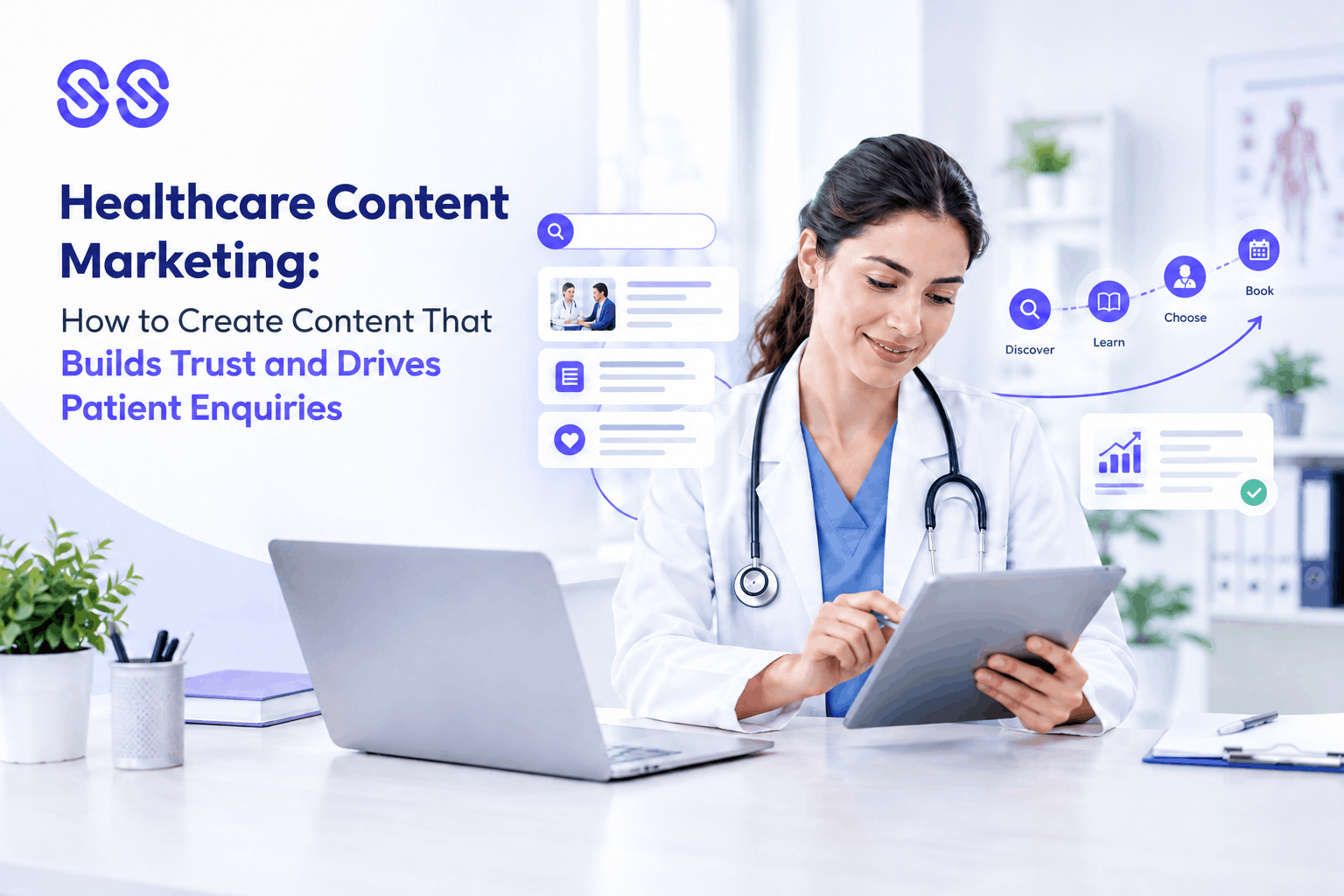
Healthcare decisions rarely begin with a phone call. Many patients first turn to Google when they have symptoms, receive a diagnosis, need a specialist, or want to understand their treatment options.
That makes the quality of a healthcare organisation's online content extremely important.
A medical practice may have experienced doctors, modern facilities and strong patient services, but if its website does not clearly answer the questions patients are asking, it can struggle to turn online visibility into enquiries and appointments.
This is where healthcare content marketing becomes valuable.
Effective healthcare content marketing is not simply about publishing more blog posts. It is about creating accurate, useful and patient-focused information that answers genuine questions, demonstrates professional expertise and guides people towards appropriate next steps.
A strong strategy can combine educational articles, service pages, doctor profiles, treatment guides, FAQs, location content and other resources into one connected healthcare content strategy.
The goal is straightforward: help patients understand their healthcare options while building the trust they need to take the next step.
What Is Healthcare Content Marketing?
Healthcare content marketing is the strategic creation and distribution of useful healthcare information to attract, educate and engage potential patients.
It can include:
- Medical blog articles
- Treatment and procedure guides
- Service pages
- Doctor and specialist profiles
- Frequently asked questions
- Patient education resources
- Condition-specific content
- Preventive healthcare guides
- Location-based healthcare content
- Videos and educational social media posts
- Downloadable healthcare resources
- Case-based educational content where appropriate
Unlike general content marketing, healthcare content requires a higher level of responsibility.
People may use medical information to influence decisions about their health. Content therefore needs to be clear, evidence-informed, appropriately qualified and transparent about its limitations.
The strongest healthcare content does not attempt to replace a consultation. Instead, it helps patients understand a topic and recognise when professional medical advice may be appropriate.
Read More - Best Digital Marketing Strategies for Ophthalmology Clinics
Why Healthcare Content Marketing Matters for Patient Acquisition
Healthcare marketing has changed significantly as patients have gained more control over how they research providers.
Someone searching for a doctor may compare several practices before making contact. Another patient may spend days researching symptoms before deciding whether they need professional help.
This creates several opportunities for medical organisations.
It helps patients discover your practice
Search engines can introduce potential patients to healthcare organisations through informational and commercial searches.
For example, someone may search:
- What causes persistent shoulder pain?
- When should I see a physiotherapist?
- How is cataract surgery performed?
- What are the symptoms of gum disease?
- How long does ACL rehabilitation take?
- Which doctor treats chronic back pain?
A well-structured content strategy can help a practice become visible at different stages of this research journey.
It answers questions before the first appointment
Good content can reduce uncertainty.
Patients may want to understand what a treatment involves, what questions to ask a specialist, how preparation works or what factors can affect recovery.
Useful content gives them a reliable starting point.
It demonstrates expertise
Content provides an opportunity to show how a healthcare organisation approaches patient education.
Author information, professional review processes, accurate references, specialist input and clear medical explanations can all contribute to stronger trust signals.
It supports patient enquiries
Educational content should ultimately connect naturally with relevant services.
For example, an article about persistent knee pain could link to a relevant orthopaedic service page. A guide about physiotherapy could direct readers towards the appropriate treatment service or appointment information.
The transition should be helpful rather than aggressive.
Build a Healthcare Content Strategy Around Patient Intent
A successful healthcare content strategy starts with understanding what potential patients actually want to know.
Not every search has the same intent.
Someone searching for "what is rotator cuff pain" is at a different stage from someone searching for "shoulder specialist near me."
Your content should reflect those differences.
Informational content
Informational searches are usually focused on understanding a condition, symptom, treatment or healthcare topic.
Examples include:
- What is frozen shoulder?
- What causes lower back pain?
- What are the symptoms of arthritis?
- What happens during physiotherapy?
These searches are ideal for educational resources and medical blogs.
Consideration-stage content
At this stage, people may already understand their problem and are comparing options.
Examples include:
- Physiotherapy vs surgery for knee pain
- How to choose an orthopaedic specialist
- What questions should I ask before surgery?
- How long does physiotherapy take?
This content should provide balanced information without making unsupported claims.
High-intent searches
High-intent searches often indicate that someone is considering contacting a provider.
Examples include:
- Orthopaedic specialist in Miami
- Dental implants clinic
- Physiotherapy clinic near me
- Private dermatologist consultation
- Sports injury specialist
These searches should generally be supported by strong service, doctor and location pages rather than relying only on blog content.
Create Patient-Focused Content, Not Keyword-Focused Content
One of the most common mistakes in medical content marketing is writing articles primarily for search engines.
Keywords are important for SEO, but patients should remain the central audience.
Instead of repeatedly inserting a keyword into every paragraph, build content around the questions people genuinely need answered.
For example, an article targeting "knee pain treatment" should not simply repeat that phrase throughout the page.
It could explain:
- Common causes of knee pain
- When medical assessment may be appropriate
- How clinicians evaluate knee problems
- Common treatment approaches
- Factors that influence treatment decisions
- Questions patients can ask a specialist
- When urgent medical attention may be necessary
This produces more useful content while allowing relevant keywords to appear naturally.
Read More - Best Website Features for Modern Dental Clinics
Use Medical Blogs to Answer Real Patient Questions
Medical blog marketing works best when blog topics are connected to genuine patient concerns.
Rather than publishing generic articles simply to increase the number of pages on a website, healthcare organisations should identify information gaps.
Useful sources for topic research can include:
- Search queries
- Website search data
- Google Search Console data
- Patient FAQs
- Questions asked during consultations
- Existing service pages
- Competitor content gaps
- Common misconceptions
- Seasonal healthcare concerns
- Specialist expertise
A strong medical blog should answer a specific question or solve a specific information need.
For example, instead of a broad topic such as "All About Shoulder Health," a more focused article could address "When Should You See a Shoulder Specialist for Persistent Pain?"
The second topic has a clearer patient intent and a more defined search purpose.
Apply E-E-A-T to Healthcare Content
Trust is particularly important in healthcare.
Google's quality guidance emphasises experience, expertise, authoritativeness and trustworthiness, commonly referred to as E-E-A-T. For healthcare websites, demonstrating these qualities should be an important part of the content process.
Experience
Where appropriate, content can reflect real-world healthcare experience.
This may include:
- Practical observations from qualified professionals
- Common patient questions
- Clinically relevant explanations
- Appropriate examples based on professional experience
Experience should never be fabricated.
Expertise
Healthcare content should demonstrate appropriate subject knowledge.
Where medical claims are made, organisations should consider having content written, reviewed or overseen by suitably qualified professionals.
Author bios can also help explain who created or reviewed the content.
Authoritativeness
Authority can be strengthened through:
- Qualified medical authors
- Specialist profiles
- Professional affiliations where relevant
- Reliable external references
- High-quality educational resources
- Consistent publication standards
Trustworthiness
Trust is the foundation of healthcare content.
Websites should make it easy for visitors to understand:
- Who operates the practice
- Who wrote or reviewed medical content
- How to contact the organisation
- Where the practice is located
- What services are offered
- How information is sourced
- When content was last reviewed or updated
Avoid exaggerated claims, guaranteed outcomes and unsupported statements.
Build Content Around Healthcare Services
A healthcare content strategy should not exist separately from the services a practice provides.
Each major service should have a clear content ecosystem.
For example:
Core service page:Orthopaedic Consultation
Supporting content:
- What Does an Orthopaedic Consultation Involve?
- When Should You See an Orthopaedic Specialist?
- Common Causes of Joint Pain
- What to Expect at Your First Orthopaedic Appointment
- Questions to Ask an Orthopaedic Specialist
This creates a topic cluster around the service.
Internal links can then connect related pages, helping users navigate from educational information to relevant services.
Make Every Piece of Content Lead Somewhere Useful
Patient-focused content should provide a logical next step.
That does not mean every article needs an aggressive "Book Now" button.
Depending on search intent, useful next steps could include:
- Read a related treatment guide
- View a specialist profile
- Explore a service
- Find a clinic location
- Contact the practice
- Request an appointment
- Read frequently asked questions
The call to action should match the user's stage in the decision-making process.
Someone reading an introductory article may need more education. Someone viewing a specific treatment page may be ready to enquire.
Optimise Healthcare Content for Search Without Sacrificing Quality
SEO remains an important part of healthcare content marketing, but optimisation should support the reader rather than interfere with the content.
Important on-page elements include:
- Clear page titles
- One descriptive H1
- Logical H2 and H3 headings
- Natural keyword usage
- Descriptive URLs
- Helpful internal links
- Relevant image alt text
- Concise introductions
- Search-friendly FAQs
- Appropriate structured data
- Clear author and reviewer information
Content should also satisfy the underlying search intent.
If someone searches for "how long does ACL recovery take," an article should provide a useful explanation rather than redirecting the reader immediately to a generic service page.
Use Different Content Formats Across the Patient Journey
Not every patient consumes information in the same way.
A broader content strategy can include:
Blog articles
Useful for answering specific informational searches and building topical relevance.
Service pages
Designed to explain a healthcare service and support high-intent searches.
Doctor profiles
Help patients understand the clinician's qualifications, experience, areas of practice and approach.
FAQs
Useful for addressing concise patient questions and improving usability.
Videos
Can simplify complex healthcare concepts when professionally produced and medically appropriate.
Infographics
Can make processes, preparation instructions or general educational information easier to understand.
A strong strategy uses different formats for different information needs.
Keep Healthcare Content Accurate and Up to Date
Medical information can change as evidence, guidelines, technology and treatment approaches develop.
A healthcare content strategy should therefore include a review process.
Content teams should periodically check:
- Medical claims
- Treatment descriptions
- Statistics
- References
- Provider information
- Service availability
- Contact details
- Outdated terminology
- Broken links
- Publication and review dates
Updating old content can also improve its usefulness.
However, updates should be substantive where necessary. Simply changing a publication date without reviewing the content does not create genuine freshness.
Read More - Digital Marketing for Doctors: Complete 2026 Guide to Patient Acquisition
Avoid Common Medical Content Marketing Mistakes
Healthcare organisations often lose the value of content because of avoidable problems.
Publishing for volume alone
More articles do not automatically create more patients.
Quality, relevance and search intent matter more than simply increasing publishing frequency.
Using generic medical information
Content that could appear on hundreds of healthcare websites may offer little differentiation.
Add genuine expertise, practical context and clear patient value.
Making unsupported medical claims
Avoid absolute statements such as "this treatment always works" or "this procedure guarantees results."
Healthcare outcomes can vary between individuals.
Ignoring conversion paths
A blog may attract visitors but fail to generate enquiries if readers cannot easily find relevant services or contact options.
Hiding authorship
For healthcare topics, transparency around who created or reviewed content can be particularly valuable.
Writing only for keywords
Keyword research should inform the strategy, not dictate every sentence.
Measure Healthcare Content Marketing by More Than Traffic
Website traffic is useful, but it is not the only meaningful metric.
Healthcare organisations should also monitor:
- Organic impressions
- Organic clicks
- Keyword visibility
- Engagement
- Service-page visits
- Appointment enquiries
- Phone calls
- Contact-form submissions
- Assisted conversions
- Conversion rate
- Location-based traffic
- Returning visitors
A page with fewer visitors but highly relevant patient enquiries may provide more business value than a high-traffic article that attracts people outside the practice's service area.
The objective is not simply to attract visitors.
It is to attract the right visitors and help them move towards an appropriate healthcare action.
How to Create a High-Trust Healthcare Content Workflow
A repeatable workflow can make medical content marketing more effective.
Step 1: Research patient questions
Identify what your target audience is searching for and asking about.
Step 2: Map search intent
Determine whether the query is informational, consideration-focused or high-intent.
Step 3: Select the right content type
Decide whether the topic belongs on a blog, service page, doctor profile, location page or FAQ.
Step 4: Build the content brief
Define the primary keyword, related topics, questions, search intent and internal linking opportunities.
Step 5: Create medically responsible content
Use clear language and avoid unsupported claims.
Step 6: Add E-E-A-T signals
Include appropriate author information, professional review, references and transparent business information.
Step 7: Optimise the page
Improve headings, metadata, internal links, images, URLs and structured data where relevant.
Step 8: Connect content to services
Give readers an appropriate next step based on their intent.
Step 9: Publish and monitor
Track visibility, engagement and patient enquiries.
Step 10: Review and improve
Update content when information, patient needs or search behaviour changes.
Why Patient Trust Should Be the Core of Healthcare Content
Healthcare decisions are personal.
Patients are not simply looking for another website that ranks on Google. They want information they can understand and a provider they can feel comfortable contacting.
That is why effective healthcare content marketing combines SEO with education, transparency and patient experience.
A strong article can answer a question.
A strong content strategy can build a relationship between that first search and a potential patient enquiry.
When healthcare organisations consistently publish accurate, useful and patient-focused information, their website can become more than an online brochure. It can become an important part of the patient acquisition journey.
The most effective approach is not to create content simply because there is a keyword to target. Create content because there is a patient question worth answering.
Final Thoughts
Healthcare content should do more than fill a blog section.
When planned around patient intent, supported by genuine expertise and connected to relevant healthcare services, content can contribute to both search visibility and patient acquisition.
The strongest healthcare content strategy combines useful education with responsible medical communication. It answers real questions, demonstrates expertise and makes it easier for patients to understand what to do next.
That combination is what turns content from a collection of web pages into a meaningful part of a healthcare organisation's digital growth strategy.