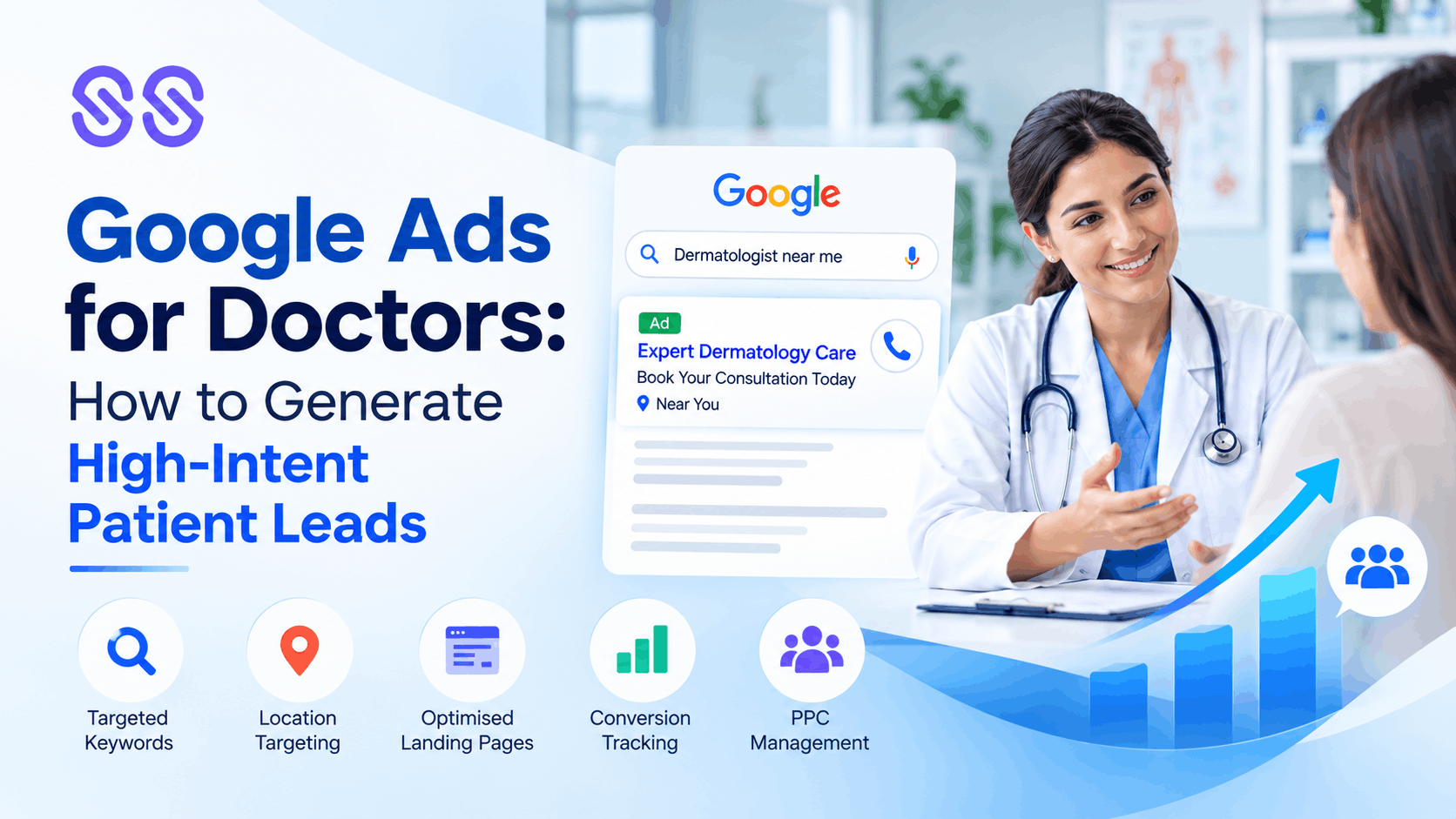
For doctors and medical practices, getting website traffic is only one part of patient acquisition. The more important question is whether that traffic comes from people who are actively looking for a relevant medical service and are ready to take the next step.
This is where Google Ads for doctors can play an important role.
Unlike many forms of digital advertising, Google Ads can place a medical practice in front of people who are actively searching for a doctor, treatment, clinic or consultation. However, simply launching a campaign and bidding on medical keywords does not guarantee high-quality patient enquiries.
Effective healthcare advertising requires careful keyword selection, compliant ad messaging, location targeting, landing-page optimisation, conversion tracking and ongoing campaign management.
A well-structured healthcare Google Ads campaign should therefore focus on search intent rather than clicks alone.
The objective is to connect the right patient, with the right service, at the right point in their search journey.
What Are Google Ads for Doctors?
Google Ads for doctors refers to paid search advertising used by doctors, clinics and medical practices to appear when potential patients search for relevant healthcare services on Google.
For example, a patient may search for:
- Cardiologist near me
- Dermatologist in Miami
- Orthopaedic doctor near me
- IVF clinic in Dubai
- Dental implants clinic
- Physiotherapist near me
- Knee pain specialist
- Hair transplant consultation
Depending on the search query, a practice may be able to show a relevant paid advertisement above or alongside organic search results.
The advantage is that the practice does not necessarily have to wait for organic rankings before becoming visible for valuable searches.
However, the quality of the campaign depends heavily on what happens after the click.
Also Read More - Best Digital Marketing Strategies for Ophthalmology Clinics
Why Search Intent Matters in Healthcare PPC
Not every healthcare search represents the same level of intent.
Consider these three searches:
“What causes knee pain?”
This is primarily informational.
“Knee pain treatment”
This indicates treatment research.
“Knee specialist near me”
This suggests stronger provider and local intent.
A medical PPC campaign should generally prioritise searches that are relevant to the services the practice actually provides and that are likely to lead to meaningful enquiries.
This does not mean informational searches are useless. They may be valuable for organic SEO and educational content.
But paid search budgets should be carefully managed because every click can carry a cost.
Focus on High-Intent Healthcare Keywords
Keyword selection is one of the most important parts of Google Ads for medical practices.
Instead of targeting broad medical terms, start by identifying searches closely connected to actual services.
For example, a dermatology practice may target searches around:
- Dermatologist near me
- Dermatology clinic
- Acne specialist
- Skin specialist
- Mole removal consultation
- Dermatology appointment
A cardiology practice may focus on:
- Cardiologist near me
- Heart specialist
- Cardiology consultation
- Cardiologist appointment
- Cardiology clinic
The exact keyword strategy should reflect the practice's services, location and target patient population.
Separate Campaigns by Service
One campaign containing every healthcare service can make optimisation difficult.
A better structure may separate campaigns around important services.
For example:
Campaign 1: Dermatology
Campaign 2: Acne Treatment
Campaign 3: Mole Removal
Campaign 4: Skin Cancer Screening
This structure allows the ad copy and landing page to match the user's search more closely.
It also makes performance easier to analyse.
If one service generates qualified enquiries while another produces mostly irrelevant clicks, the budget and strategy can be adjusted accordingly.
Use Location Targeting Carefully
Location is critical for many medical practices.
A clinic serving Miami should not waste significant advertising budget showing ads to people who cannot realistically visit the practice.
Location targeting should reflect:
- Clinic location
- Service area
- Patient travel patterns
- Appointment availability
- Business objectives
For multi-location practices, separate campaigns or tightly structured location targeting can help connect searches with the appropriate clinic.
The landing page should also reflect the location being advertised.
For example:
Ad: Cardiologist in Miami
should ideally lead to a relevant cardiology or Miami location page rather than a generic homepage.
Create Dedicated Landing Pages
One of the biggest mistakes in Google Ads for medical practices is sending every advertisement to the homepage.
A person searching for a specific service should generally land on a page that immediately addresses that service.
A strong healthcare landing page can include:
- Clear service heading
- Explanation of the service
- Relevant doctor information
- Conditions or concerns addressed
- Treatment information
- Clinic location
- Contact information
- Appointment CTA
- Frequently asked questions
- Trust and professional credentials where appropriate
The page should answer the visitor's most important questions without forcing them to navigate through several other pages.
Match the Ad With the Landing Page
Ad-to-page relevance is important for both user experience and campaign efficiency.
Suppose someone searches:
“Dental implant specialist Miami.”
The advertisement could communicate:
Dental Implant Consultation in Miami
The landing page should then clearly discuss:
- Dental implant services
- Relevant practitioners
- Consultation process
- Clinic location
- Appointment options
A mismatch such as sending that visitor to a general dental homepage creates unnecessary friction.
The closer the relationship between keyword → ad → landing page → conversion action, the more coherent the patient journey becomes.
Write Healthcare Ads Around Patient Intent
Healthcare advertising copy should be clear, accurate and responsible.
A useful ad can communicate:
- Service
- Location
- Relevant expertise
- Consultation availability
- Appropriate next step
Avoid exaggerated claims such as:
- Guaranteed results
- Best doctor in the city
- 100% success
- Instant cure
- Number-one treatment
Unless a claim is objectively substantiated and permitted under applicable advertising rules, it can create unnecessary compliance and trust risks.
Healthcare advertising should prioritise accuracy over sensational messaging.
Use Negative Keywords to Reduce Wasted Spend
Negative keywords can be particularly important in healthcare PPC.
They can help prevent ads from appearing for searches that are irrelevant to the practice.
Depending on the service and campaign, potentially irrelevant searches might include:
- Jobs
- Careers
- Courses
- Training
- Salary
- Free
- DIY
- Definition
- Student information
The appropriate negative keyword list depends on the medical specialty and campaign.
For example, a private clinic may not want to pay for someone searching for:
“cardiology course”
or:
“cardiologist salary.”
Regular search-term reviews can reveal additional irrelevant queries that should be excluded.
Optimise for Phone Calls and Appointment Enquiries
A patient searching for a doctor may not want to complete a long form.
They may simply want to call.
For appropriate campaigns, conversion tracking can include:
- Phone calls
- Appointment requests
- Contact forms
- Booking completions
- Consultation requests
Click-to-call functionality can be especially useful on mobile devices.
The practice should ensure that calls are answered during advertised hours or that an appropriate process exists for handling missed enquiries.
Generating a lead is only one part of the patient acquisition process.
Read More - Digital Marketing for Doctors: Complete 2026 Guide to Patient Acquisition
Track Qualified Leads, Not Just Conversions
Not every conversion is equally valuable.
A form submission may come from:
- A genuine prospective patient
- Someone outside the service area
- Someone looking for a service the practice does not provide
- A job seeker
- A spam submission
- An existing patient
This is why Google Ads for doctors should be measured beyond basic conversion counts.
Useful metrics can include:
- Qualified enquiries
- Booked consultations
- Cost per qualified lead
- Cost per appointment
- Conversion rate
- Search-term quality
- Call quality
- Service-level performance
If a campaign generates 50 form submissions but only three relevant patient enquiries, the headline lead count can be misleading.
Use Conversion Tracking Correctly
Accurate tracking is essential for healthcare Google Ads campaigns.
Depending on the practice and technical setup, tracking can measure:
- Form submissions
- Phone calls
- Appointment requests
- Online bookings
- Key button interactions
Healthcare organisations should also consider privacy requirements when implementing analytics and advertising measurement.
Tracking should collect only the information necessary for legitimate measurement and should be implemented responsibly.
Build Trust Into the Landing Page
Healthcare is a trust-sensitive industry.
A prospective patient may ask:
Who is the doctor?
What are their qualifications?
What services do they provide?
Where is the clinic?
How can I contact them?
A strong landing page should make legitimate answers easy to find.
Useful trust signals can include:
- Doctor qualifications
- Professional experience
- Areas of expertise
- Clinic address
- Contact information
- Professional memberships where applicable
- Relevant accreditations where verifiable
- Clear organisation information
Do not invent credentials, awards, patient outcomes or testimonials.
E-E-A-T should come from genuine evidence.
Combine Google Ads With SEO
Paid search and organic SEO can complement each other.
Google Ads can provide immediate paid visibility for selected high-intent searches, while SEO can build organic visibility over time.
For example:
A clinic may use Google Ads for:
“orthopaedic surgeon near me”
while its SEO strategy develops organic rankings for:
- Orthopaedic surgery
- Knee pain treatment
- Shoulder surgery
- Sports injury treatment
- Orthopaedic specialist
Paid search data can also provide useful insight into which keywords, services and messages generate relevant enquiries.
That information can inform broader medical SEO and content strategy.
Create Separate Campaigns for High-Value Services
Not every service deserves the same advertising budget.
A practice can prioritise services based on factors such as:
- Patient demand
- Commercial intent
- Appointment availability
- Geographic demand
- Service value
- Competition
- Historical lead quality
For example, a clinic may choose to separate campaigns for:
- Consultation
- Surgery
- Diagnostic services
- Cosmetic procedures
- Follow-up care
The exact structure depends on the organisation.
The key principle is to avoid treating every service as equally valuable when patient demand and business priorities differ.
Read More - Periodontist Marketing Services That Help Periodontal Clinics Attract More High-Value Patients
Optimise the Patient Journey After the Click
A successful healthcare PPC agency should look beyond the advertising platform.
Consider the complete journey:
Search query
↓
Google Ad
↓
Landing page
↓
Call or appointment form
↓
Reception/contact team
↓
Consultation booking
↓
Patient appointment
If the ad campaign is performing well but the reception team does not respond to enquiries promptly, advertising performance may appear weaker than it actually is.
Patient acquisition therefore requires coordination between marketing, website, reception and clinical operations.
Test Different Ad Messages
Testing can help identify which messages generate better-quality enquiries.
For example, a clinic may test messaging around:
- Specialist expertise
- Local availability
- Consultation
- Specific service
- Appointment access
- Patient education
Testing should be conducted within applicable advertising and healthcare rules.
Do not test exaggerated medical claims simply because they may attract more clicks.
The objective should be to find messages that accurately communicate the practice's value and attract relevant users.
Review Search Terms Regularly
Search-term analysis is one of the most useful optimisation activities in medical PPC.
It can reveal:
- High-intent queries
- Irrelevant searches
- New keyword opportunities
- Location variations
- Service variations
- Queries generating poor-quality leads
The campaign can then be refined by:
- Adding relevant keywords
- Adding negative keywords
- Adjusting match types
- Improving ad copy
- Refining landing pages
- Adjusting location targeting
This ongoing optimisation is what separates an actively managed PPC campaign from a campaign that is simply left running.
Common Google Ads Mistakes Doctors Should Avoid
Sending All Ads to the Homepage
A generic homepage may not satisfy a specific search intent.
Targeting Extremely Broad Keywords
Broad terms can attract clicks from users who are not looking for the practice's services.
Ignoring Search Terms
Without reviewing actual searches, wasted spend can accumulate.
Measuring Only Clicks
Clicks do not tell you whether the campaign generated relevant patient enquiries.
Using Unverified Medical Claims
Healthcare advertising should remain accurate and responsible.
Ignoring Mobile Users
Many healthcare searches happen on mobile devices, making mobile landing pages and calls important.
Failing to Track Calls
For many practices, phone calls can represent an important conversion pathway.
Using One Landing Page for Every Service
Different services often require different information and patient journeys.
How to Build a High-Intent Google Ads Campaign for Doctors
A practical process can look like this:
Step 1: Identify Priority Services
Start with services the practice genuinely wants to grow.
Step 2: Research Search Intent
Identify keywords showing strong service, provider or appointment intent.
Step 3: Group Keywords by Service
Separate campaigns or ad groups according to meaningful themes.
Step 4: Build Relevant Landing Pages
Match each important service with a page designed around that search intent.
Step 5: Configure Location Targeting
Target the geographic areas the practice can realistically serve.
Step 6: Create Accurate Ad Copy
Communicate the service and next step without unsupported claims.
Step 7: Add Negative Keywords
Reduce irrelevant traffic based on actual search behaviour.
Step 8: Set Up Conversion Tracking
Track calls, forms, bookings and other meaningful actions.
Step 9: Review Lead Quality
Analyse which searches and services produce relevant enquiries.
Step 10: Optimise Continuously
Adjust keywords, ads, targeting, landing pages and budget allocation based on performance data.
How a Healthcare PPC Agency Can Help
Managing Google Ads for doctors requires more than setting a budget and creating advertisements.
A specialist healthcare PPC agency can help with:
- Keyword research
- Search-intent analysis
- Campaign structure
- Location targeting
- Ad copy
- Landing-page strategy
- Negative keyword management
- Conversion tracking
- Search-term analysis
- Lead-quality analysis
- Campaign optimisation
- Reporting
The exact level of support should be based on the medical practice's needs and internal capabilities.
Read More - How to Optimize Healthcare Content for ChatGPT, Google AI and Perplexity
Final Thoughts
Google Ads for doctors can be a valuable patient acquisition channel when campaigns are built around genuine search intent rather than simply maximising clicks.
The strongest campaigns connect the entire journey:
High-intent search → Relevant ad → Useful landing page → Clear conversion path → Qualified patient enquiry.
Healthcare Google Ads should also be supported by accurate messaging, appropriate location targeting, responsible medical advertising practices and meaningful conversion tracking.
For doctors and medical practices, success should not be defined only by impressions or clicks. The more useful question is whether paid search is helping the right patients discover the right service and take an appropriate next step.
When medical PPC, SEO, landing-page optimisation and conversion tracking work together, paid search can become a more measurable part of a broader healthcare patient acquisition strategy.