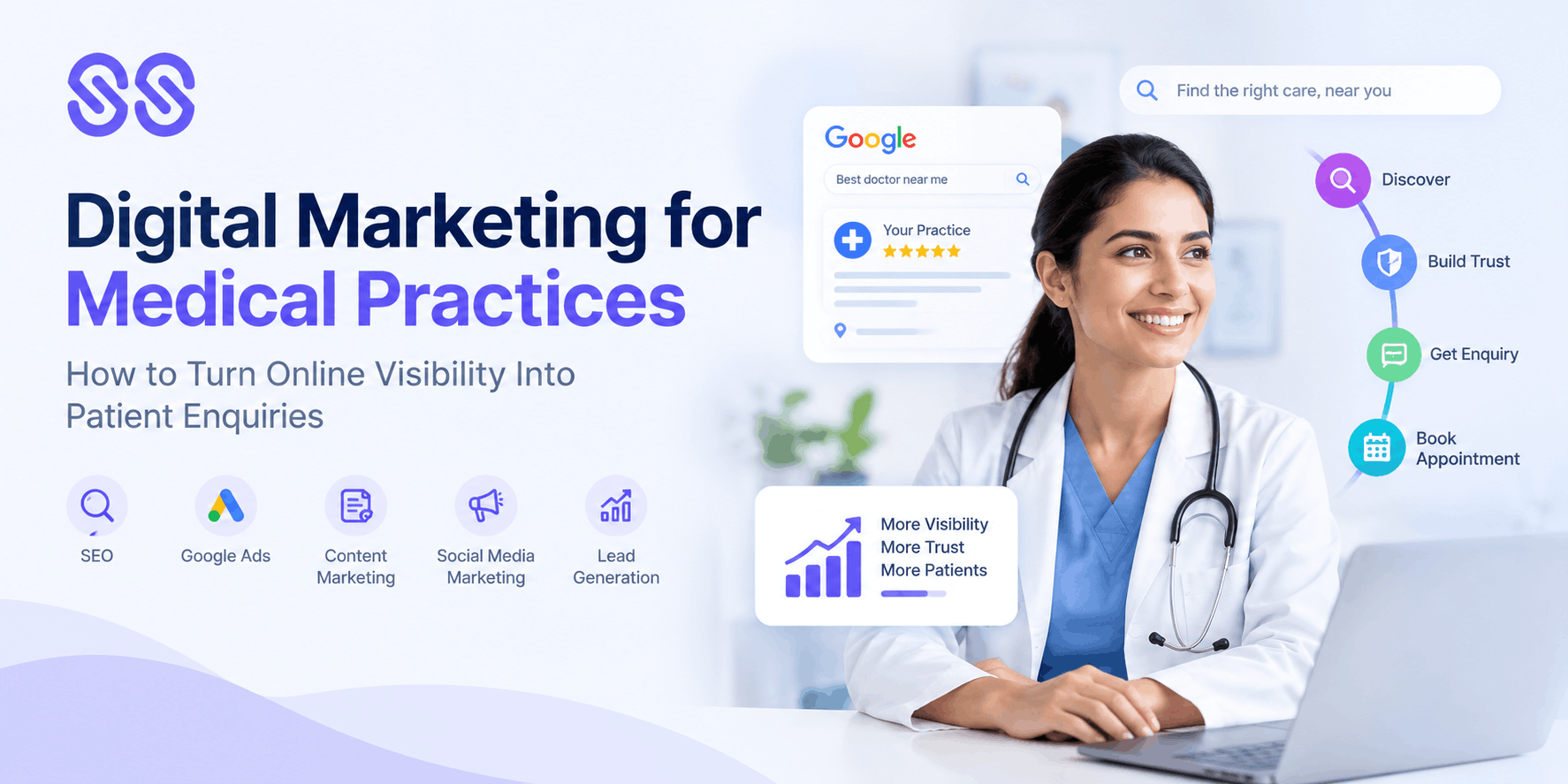
Having a medical website, social media profile or Google Business Profile does not automatically result in new patients. A practice can have strong online visibility and still receive very few calls, appointment requests or consultation enquiries.
The difference often comes down to strategy.
Effective digital marketing for medical practices connects visibility with patient intent, trust, conversion and follow-up. Instead of focusing only on website traffic or social media engagement, a healthcare practice needs a digital ecosystem that helps prospective patients discover relevant services, understand the practice's expertise and take an appropriate next step.
This is where healthcare digital marketing, medical practice marketing, digital marketing for doctors and healthcare lead generation work together.
For private practices, clinics and individual doctors, the goal should not simply be to appear online. The goal is to build a measurable patient journey from search or discovery to enquiry and, where appropriate, appointment.
What Is Digital Marketing for Medical Practices?
Digital marketing for medical practices is the use of online channels and strategies to increase the visibility of a medical practice, communicate its expertise, attract relevant prospective patients and generate appropriate enquiries.
Depending on the practice, this can include:
- Healthcare SEO
- Local SEO
- Google Ads
- Healthcare content marketing
- Social media marketing
- Website optimisation
- Conversion rate optimisation
- Online reputation management
- Email marketing
- Healthcare lead generation
- Analytics and performance tracking
Each channel has a different role.
SEO can help capture organic search demand. Paid advertising can provide immediate visibility for selected high-intent searches. Social media can support awareness and engagement. Content can answer patient questions and demonstrate expertise. A well-designed website can turn interested visitors into enquiries.
The strongest strategy connects these channels rather than treating them as separate activities.
Also Read More - Best Digital Marketing Strategies for Ophthalmology Clinics
Why Online Visibility Alone Does Not Generate Patients
A common misconception is:
More traffic = more patients.
That is not always the case.
A medical practice could receive thousands of monthly website visits but generate relatively few enquiries if:
- Visitors are searching for unrelated information.
- The website targets low-intent keywords.
- Service pages are difficult to find.
- Calls to action are unclear.
- The booking process is complicated.
- The website does not establish trust.
- The practice serves a different location from its visitors.
- Pages load poorly on mobile devices.
- Contact information is difficult to locate.
The purpose of medical practice marketing should therefore extend beyond traffic acquisition.
A useful framework is:
Visibility → Relevant Traffic → Trust → Engagement → Enquiry → Appointment
Every stage should be measured and improved.
Start With Patient Search Intent
Before investing in digital channels, understand what prospective patients are actually searching for.
Healthcare searches can generally fall into several intent categories.
Informational Search Intent
Examples include:
- What causes chronic back pain?
- What are symptoms of acid reflux?
- When should I see a dermatologist?
These searches indicate a need for information.
Educational blog posts and healthcare resources can address this audience.
Service-Based Search Intent
Examples include:
- Dermatology clinic
- Physiotherapy treatment
- Cataract surgery
- IVF clinic
- Dental implants
These searches indicate interest in a specific healthcare service.
Dedicated service pages can target these searches.
Local Search Intent
Examples include:
- Cardiologist near me
- Dentist in Miami
- Physiotherapist near me
- Private GP in London
These searches are particularly important for practices that serve specific geographic areas.
Appointment-Oriented Search Intent
Examples include:
- Book dermatologist appointment
- Cardiologist consultation
- Private GP appointment
These searches can represent stronger conversion intent.
Understanding these differences helps a practice build content and campaigns around the entire patient journey.
Build a Healthcare Website That Supports Conversion
The website is often the centre of digital marketing for doctors.
A prospective patient should be able to understand the practice quickly.
Important website elements include:
- Clear service pages
- Doctor profiles
- Practice information
- Location details
- Contact information
- Appointment options
- Educational content
- Frequently asked questions
- Trust signals
- Mobile-friendly design
The website should make it easy to answer questions such as:
What services do you provide?
Which doctor provides the service?
Where is the practice located?
How can I request an appointment?
What should I know before contacting the practice?
A website that answers these questions clearly can reduce friction during the patient decision-making process.
Create Dedicated Pages for Important Services
A common problem with healthcare websites is relying on a single services page.
For example, a multi-specialty practice might offer:
- Cardiology
- Dermatology
- Orthopaedics
- Physiotherapy
- Gastroenterology
Instead of describing everything briefly on one page, important services can have dedicated pages.
A strong service page can explain:
- What the service is
- Which conditions or concerns it addresses
- Who provides the service
- What patients can expect
- Relevant treatment information
- Clinic location
- Appointment options
- Common questions
This provides search engines with clearer context while giving visitors a more relevant experience.
Read More - Best Website Features for Modern Dental Clinics
Use Healthcare SEO to Capture Organic Demand
SEO is an important part of healthcare digital marketing because many patients begin their research on search engines.
A healthcare SEO strategy can target:
- Doctor searches
- Specialty searches
- Treatment searches
- Condition searches
- Location searches
- Long-tail questions
- Appointment-related searches
For example, a physiotherapy practice might develop content around:
- Physiotherapist near me
- Sports physiotherapy
- Back pain physiotherapy
- Physiotherapy for knee pain
- Physiotherapy consultation
The objective should be to create genuinely useful content rather than simply repeating keywords.
Strengthen Local SEO for Medical Practices
For practices with physical locations, local search visibility can directly support healthcare lead generation.
Important local SEO elements include:
- Google Business Profile
- Accurate business information
- Consistent name, address and phone information
- Location pages
- Relevant local content
- Genuine reviews
- Local citations where appropriate
- Service and location relevance
The practice should make it easy for patients to find:
- Address
- Phone number
- Opening hours
- Directions
- Services
- Website
- Appointment information
For multi-location practices, each genuine location should have accurate, useful information rather than simply duplicating the same page with a different city name.
Use Google Ads to Capture High-Intent Searches
Organic SEO can take time to build.
Paid search can provide another acquisition channel for eligible healthcare services.
For example, a clinic may use Google Ads to target searches related to:
- Specialist consultations
- Specific treatments
- Private healthcare services
- Diagnostic services
- Local clinic searches
The campaign should connect the search query to a relevant advertisement and landing page.
For example:
Search: “private cardiologist in London”
Ad: “Private Cardiology Consultation in London”
Landing page: Dedicated cardiology consultation page
This alignment can make the patient journey more relevant than sending every visitor to a generic homepage.
Build Trust Through E-E-A-T
Healthcare is a trust-sensitive area.
People need confidence that the information they read is accurate and that the professionals behind the practice are appropriately qualified.
E-E-A-T refers to:
- Experience
- Expertise
- Authoritativeness
- Trustworthiness
A medical practice can demonstrate these principles through genuine evidence.
Useful elements may include:
Doctor Credentials
Provide accurate information about qualifications, training, professional experience and areas of expertise.
Content Expertise
Healthcare articles should be written or reviewed appropriately, particularly when discussing medical conditions and treatments.
Transparent Practice Information
Make the organisation, location and contact details clear.
Reliable References
Where appropriate, educational content can reference reputable medical or professional sources.
Accurate Claims
Avoid unsupported statements such as “best doctor,” “guaranteed results” or “100% success.”
E-E-A-T should reflect real expertise rather than marketing language alone.
Read More - Digital Marketing for Doctors: Complete 2026 Guide to Patient Acquisition
Use Healthcare Content Marketing to Answer Patient Questions
Healthcare content marketing can attract potential patients before they are ready to book an appointment.
A practice can create content around:
- Common symptoms
- Treatment options
- Procedure explanations
- Recovery information
- Prevention
- Frequently asked questions
- Appointment preparation
- Condition education
For example, an orthopaedic practice might publish:
What Causes Persistent Shoulder Pain?
A gastroenterology practice could publish:
When Should You See a Gastroenterologist for Digestive Problems?
These topics can capture informational searches and introduce prospective patients to the practice.
The content should educate rather than diagnose individuals.
Turn One Topic Into Multiple Content Formats
A single well-researched healthcare topic can support several marketing channels.
For example:
Blog article
↓
Instagram carousel
↓
Short educational video
↓
LinkedIn post
↓
Email newsletter
↓
Relevant service-page link
This approach makes digital marketing for doctors more efficient while maintaining consistency across channels.
Use Social Media to Build Familiarity
Social media can help patients become familiar with doctors and healthcare practices.
Useful content can include:
- Doctor introductions
- Educational videos
- Common questions
- Treatment explanations
- Clinic information
- Healthcare awareness content
- Professional insights
- General patient education
The objective should not be to turn every post into an advertisement.
A practice that consistently provides useful information can build a stronger digital relationship with its audience.
Healthcare professionals should also maintain appropriate boundaries when responding to individual medical questions online.
Make Calls and Appointment Requests Easy
One of the most important aspects of healthcare lead generation is reducing friction.
A prospective patient should not have to search through several pages to find the contact number.
Useful conversion elements include:
- Book an Appointment
- Request a Consultation
- Call the Clinic
- Contact Us
- Find the Clinic
On mobile devices, click-to-call functionality can be particularly useful.
Forms should also be straightforward and request only information that is appropriate and necessary for the stage of the enquiry.
Track More Than Website Traffic
Traffic is an important metric, but it is not the final business outcome.
A medical practice should consider tracking:
- Phone calls
- Appointment requests
- Contact forms
- Online bookings
- Qualified enquiries
- Cost per lead
- Cost per appointment
- Organic conversions
- Paid conversions
This helps identify whether marketing activity is actually contributing to patient acquisition.
For example, 10,000 website visitors with five enquiries may be less useful than 2,000 visitors producing 40 relevant enquiries.
Quality and intent matter.
Improve Lead Handling After the Enquiry
Digital marketing does not stop when someone submits a form.
The next stage is lead management.
A practice should establish:
- Who receives new enquiries?
- How quickly are enquiries reviewed?
- How are missed calls handled?
- Who follows up with online enquiries?
- How are appointment requests routed?
- How are inappropriate or irrelevant enquiries handled?
If a marketing campaign generates strong enquiries but the practice responds slowly, potential appointments may be lost.
Marketing and front-desk operations therefore need to work together.
Build a Healthcare Lead Generation Funnel
A simple healthcare lead generation funnel can look like:
Stage 1: Discovery
The patient sees the practice through Google, social media, an advertisement, referral or another channel.
Stage 2: Education
The patient reads service information, doctor profiles or educational content.
Stage 3: Evaluation
The patient compares options and looks for evidence of expertise, location, services and trust.
Stage 4: Enquiry
The patient calls, submits a form or requests an appointment.
Stage 5: Qualification
The practice determines whether the enquiry is appropriate for its services.
Stage 6: Appointment
The prospective patient schedules the appropriate consultation or service.
This funnel can help identify where potential patients are dropping out.
Use Online Reputation as a Trust Layer
Reputation can influence how prospective patients evaluate a practice.
Practices should maintain accurate profiles and encourage genuine patient feedback where appropriate.
Good reputation management includes:
- Monitoring reviews
- Responding professionally
- Addressing legitimate concerns
- Maintaining accurate practice information
- Avoiding fake or incentivised reviews where prohibited
Reviews should never be fabricated.
Patient trust is more valuable than short-term reputation manipulation.
Common Digital Marketing Mistakes Medical Practices Should Avoid
Focusing Only on Rankings
Ranking is useful, but rankings should ultimately support relevant visibility and patient journeys.
Targeting Broad Keywords
Broad keywords can bring traffic that has little relevance to the practice.
Using One Page for Every Service
Dedicated pages can provide a clearer experience for important services.
Ignoring Local Search
A practice can lose valuable nearby demand without a strong local presence.
Making Unsupported Medical Claims
Healthcare marketing should remain accurate and evidence-informed.
Making the Website Difficult to Contact
Visitors should have an obvious next step.
Tracking Only Traffic
Calls, enquiries and appointments provide more meaningful acquisition data.
Ignoring Mobile Experience
Many healthcare searches occur on mobile devices, so websites and conversion paths need to work well on smaller screens.
How to Build a Digital Patient Acquisition System
A practical approach can be divided into several steps.
Step 1: Define Your Priority Services
Identify the services the practice wants to grow.
Step 2: Understand Patient Search Behaviour
Research how people search for those services, conditions and doctors.
Step 3: Build the Website Around Search Intent
Create useful service, doctor, location and educational pages.
Step 4: Strengthen Local Visibility
Optimise legitimate local search assets and maintain accurate business information.
Step 5: Create Helpful Healthcare Content
Build content around genuine patient questions.
Step 6: Add Paid Search Where Appropriate
Use Google Ads to capture relevant high-intent searches.
Step 7: Improve Conversion Paths
Make calls, forms and appointment requests easy to find.
Step 8: Establish Lead Management
Create a clear process for handling new enquiries.
Step 9: Measure Patient Acquisition
Track qualified enquiries, appointments and acquisition costs.
Step 10: Optimise Continuously
Use performance data to improve SEO, advertising, content, website experience and lead handling.
What Does Successful Digital Marketing Look Like for a Medical Practice?
Success should not be defined by a single metric.
A healthy digital acquisition system should gradually provide better visibility, more relevant website traffic, stronger engagement and a clearer path to enquiries.
Important indicators may include:
- Growth in relevant organic traffic
- Increased visibility for priority services
- More local search actions
- Higher-quality paid traffic
- More appointment enquiries
- Improved landing-page conversion
- Better lead quality
- Lower wasted advertising spend
- Stronger online reputation
The exact targets will vary according to the practice's specialty, location, capacity and business objectives.
Also Read About - Oral Surgeon Marketing: Complete SEO, Google Ads & Patient Acquisition Guide for Oral and Maxillofacial Surgeons
Final Thoughts
Digital marketing for medical practices works best when it is treated as a connected patient acquisition system rather than a collection of individual tactics.
SEO helps patients discover the practice through organic search. Local SEO improves visibility for nearby searches. Google Ads can capture selected high-intent demand. Healthcare content marketing answers important questions. Social media builds familiarity and engagement. A well-structured website establishes trust and provides clear conversion paths.
Together, these activities create a more complete approach to healthcare digital marketing.
For doctors and practice owners, the most important shift is to look beyond online visibility.
The real question is:
What happens after a prospective patient discovers your practice?
If the website answers their questions, demonstrates genuine expertise, provides relevant service information and makes contacting the practice straightforward, digital visibility has a better opportunity to become meaningful patient enquiries.
A strong medical practice marketing strategy therefore connects search, content, advertising, reputation, website experience and lead handling.
That is how a medical practice can move from simply being visible online to building a measurable and sustainable patient acquisition system.