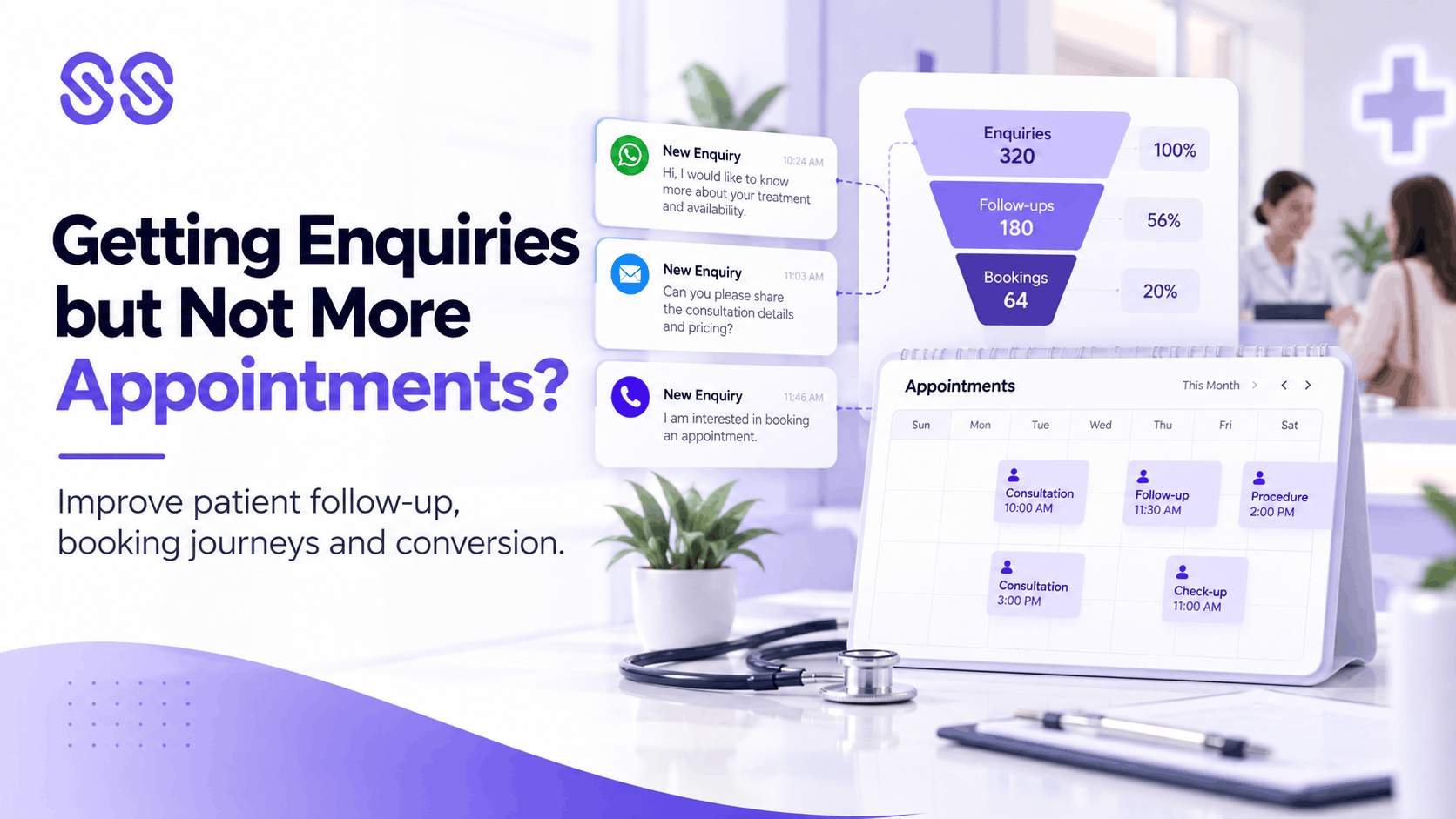
Getting enquiries from potential patients is an encouraging sign for any clinic. It suggests that people are discovering your services, engaging with your website, or responding to your marketing campaigns. However, enquiries alone do not guarantee business growth. If your clinic receives calls, website form submissions, WhatsApp messages, or appointment requests but struggles to convert them into confirmed bookings, there may be a gap between lead generation and patient conversion.
This is where clinic enquiry conversion becomes important. Your marketing may be attracting the right audience, but delays in responding, unclear communication, complicated booking processes, or a lack of follow-up can prevent interested people from taking the next step.
Improving conversion does not always require a larger advertising budget. In many cases, clinics can generate more appointments from existing enquiries by improving patient enquiry management, strengthening communication, and making booking easier.
This guide explains why clinics lose potential appointments and what you can do to turn more genuine enquiries into confirmed bookings.
What Is Clinic Enquiry Conversion?
Clinic enquiry conversion is the process of turning a prospective patient's enquiry into a meaningful next step, such as a confirmed appointment or consultation.
For example, someone may find your clinic through Google Search, visit a service page, and contact your team to ask about treatment availability. If the person schedules an appointment, the enquiry has converted into a booking.
However, not every enquiry will become an appointment. Some people may be researching treatment options, comparing providers, checking prices, or seeking information before making a decision.
The goal is not simply to convert every enquiry. It is to help suitable prospective patients access the information they need and make an informed decision about booking.
Also Read More - Best Digital Marketing Strategies for Ophthalmology Clinics
Why the Clinic Appointment Conversion Rate Matters
Your clinic appointment conversion rate helps you understand how effectively your team converts enquiries into bookings.
A simple way to calculate it is:
Clinic appointment conversion rate = (Enquiries resulting in confirmed appointments ÷ Total eligible enquiries) × 100
For example, if your clinic receives 200 eligible enquiries in a month and 40 result in confirmed appointments, the appointment conversion rate is 20%.
This figure becomes more useful when reviewed alongside lead quality, appointment attendance, treatment suitability, and the original marketing source. A high conversion rate is not necessarily beneficial if the enquiries are unsuitable or the appointments do not result in meaningful patient engagement.
7 Reasons Your Clinic Gets Enquiries but Not Appointments
Understanding where potential patients drop off is the first step towards improving clinic bookings.
1. Your Team Responds Too Slowly
When someone contacts your clinic, they may be actively considering an appointment. If they do not receive a timely response, they may lose interest, contact another provider, or continue researching alternatives.
This can happen when reception teams are busy, calls go unanswered, website forms are checked infrequently, or WhatsApp messages are handled without a clear process.
How to improve it:
- Establish a clear process for responding to new enquiries during working hours.
- Assign responsibility for monitoring calls, forms, emails, and messages.
- Set internal response-time targets that your team can realistically maintain.
- Use an appropriate acknowledgement message when a detailed response cannot be provided immediately.
- Review unanswered and missed enquiries regularly.
A prompt, helpful response can reduce uncertainty and make it easier for prospective patients to take the next step.
2. Your Follow-Up Process Is Inconsistent
Some people will not book during their first interaction. They may need to check their schedule, discuss costs, understand the consultation process, or consider whether the clinic is suitable for their needs.
If your team contacts them once and never follows up, you may lose genuine opportunities.
Effective medical lead follow-up means maintaining appropriate communication without overwhelming or pressuring prospective patients.
How to improve it:
Create a consistent follow-up process based on the patient's preferred communication channel and the nature of their enquiry. A simple workflow could include:
- An initial response that addresses the enquiry.
- A follow-up if the person has requested more information but has not booked.
- A final, respectful check-in where appropriate.
- A clear option to stop receiving further messages.
Follow-up should be relevant and helpful. Avoid sending repeated generic messages, making unsupported treatment promises, or using urgency that is not genuine.
Read More - Conversion-Focused Landing Pages for Healthcare Clinics
3. Your Team Is Not Addressing Patient Concerns
An enquiry often signals interest, but interest does not automatically mean readiness to book.
Prospective patients may have questions about consultation fees, treatment suitability, appointment availability, preparation, recovery, insurance, or the qualifications of the clinician. If these concerns remain unanswered, they may postpone booking.
For healthcare services, trust is especially important because people may be making decisions that affect their health, comfort, finances, or wellbeing.
How to improve it:
Train your team to understand common administrative and service-related questions. Provide accurate information about consultation fees, available appointments, clinic location, and what patients can expect during their first visit.
Clinical questions should be directed to an appropriately qualified healthcare professional rather than answered by unqualified administrative staff.
Your website should also address frequently asked questions so prospective patients can find essential information before contacting the clinic.
4. Your Booking Process Is Complicated
Even interested patients can abandon the booking process if it involves too many steps.
Common problems include lengthy enquiry forms, unclear calls to action, difficult-to-find contact details, limited booking options, and forms that do not work properly on mobile devices.
If someone has to search several pages to find your phone number or wait for a callback without knowing when to expect one, booking becomes unnecessarily difficult.
How to improve it:
Make the next step obvious on every important service page. Use clear calls to action such as “Book an Appointment,” “Request a Consultation,” or “Call the Clinic,” depending on the actual service offered.
Keep forms short and collect only the information needed to respond appropriately. Make phone numbers clickable on mobile devices and test all forms, booking links, and confirmation messages regularly.
Where online scheduling is available, explain how it works and what happens after the booking is submitted.
5. Your Website Generates Interest but Does Not Build Enough Trust
A prospective patient may discover your clinic through search results or an advertisement and still hesitate to book if your website does not answer their questions.
Outdated information, vague service descriptions, missing clinician credentials, unclear pricing information, and weak contact details can create uncertainty.
For healthcare providers, website credibility should be built on accurate, verifiable information rather than exaggerated marketing claims.
How to improve it:
Review the pages that generate the most enquiries and make sure they include:
- Clear explanations of the services offered and who they may be suitable for.
- Accurate clinician biographies and relevant qualifications.
- Transparent information about consultation fees or how to obtain pricing.
- The clinic's address, opening hours, and contact information.
- Relevant patient information and FAQs.
- Clear appointment-booking options.
Patient testimonials and reviews can support trust when they are genuine, appropriately presented, and compliant with applicable healthcare advertising and privacy requirements.
6. Your Marketing Is Attracting the Wrong Enquiries
Not every enquiry represents a person who is ready or eligible to book an appointment. Your campaigns may be attracting people who want free advice, are searching for services you do not provide, or are outside your service area.
This can happen when advertising keywords are too broad, campaign messaging is unclear, or service pages do not match what prospective patients expect.
For example, an advertisement promoting a specialist consultation may attract enquiries from people looking for general information if its message and landing page do not clearly explain the service.
How to improve it:
Review the search terms, audience targeting, landing pages, and enquiry sources behind your leads. Make sure your advertising accurately reflects the services available, the location served, and any relevant consultation requirements.
Analyse lead quality alongside cost per enquiry. A campaign that generates fewer but more suitable enquiries may deliver better appointment outcomes than one producing a large volume of low-quality leads.
This is an important part of effective healthcare conversion optimisation.
7. Your Clinic Does Not Track What Happens After an Enquiry
Many clinics measure marketing performance by website traffic, clicks, calls, or form submissions. These metrics show whether people are engaging with marketing, but they do not reveal whether enquiries become appointments.
Without tracking the full journey, it is difficult to identify where opportunities are being lost.
For instance, one marketing channel may generate many enquiries but few bookings, while another produces fewer enquiries with a higher appointment conversion rate.
How to improve it:
Use a clinic management system, CRM, or structured tracking sheet to record each enquiry's progress. Track relevant stages such as:
- New enquiry received.
- Contact attempted.
- Contact established.
- Appointment booked.
- Appointment attended or cancelled.
- Enquiry closed or marked as unsuitable, where appropriate.
Use consistent definitions across your team. Protect patient information, restrict access appropriately, and ensure any analytics or marketing tracking complies with applicable privacy laws and healthcare requirements.
How to Improve Clinic Bookings: A Practical Strategy
Improving appointment conversion works best when marketing, reception, booking systems, and patient communication operate together.
Step 1: Audit Your Existing Enquiries
Start by reviewing enquiries from the previous 30 to 90 days, depending on the volume available.
Look at how many resulted in confirmed appointments, how many remain unresolved, and how many were unsuitable for your services. Identify patterns by service, enquiry source, time of contact, and response channel.
Where possible, review anonymised or appropriately protected records to understand the reasons people did not book. Avoid collecting unnecessary sensitive information for marketing analysis.
Step 2: Create a Standardised Enquiry Management Process
Every team member should understand how new enquiries are received, assigned, answered, and followed up.
Create simple guidelines for response times, handling missed calls, documenting outcomes, answering administrative questions, and escalating clinical concerns.
A consistent process reduces the risk of enquiries being overlooked when staff are busy or responsibilities change.
Step 3: Improve Your Website's Booking Experience
Review the pages that generate the most relevant enquiries. Check whether the service is explained clearly, the contact information is easy to find, and the booking process works smoothly on mobile devices.
Use clear calls to action and remove unnecessary steps. Where suitable, provide multiple contact options so patients can choose the method that works best for them.
Measure whether these changes improve completed bookings rather than relying only on button clicks.
Step 4: Align Marketing Campaigns with Appointment Goals
Your marketing strategy should focus on attracting people who are looking for the services your clinic actually provides.
For paid campaigns, review search terms, targeting, landing page relevance, and the quality of enquiries generated. For organic search, create helpful service pages that answer patient questions and clearly explain the next step.
Local SEO can also help clinics reach people searching for relevant services in their area. Keep your clinic's business information accurate and consistent, and ensure that service pages reflect genuine services and locations.
Step 5: Train Your Team to Communicate Clearly
The way your team responds can influence whether a prospective patient feels comfortable proceeding.
Train staff to listen carefully, answer administrative questions accurately, explain the booking process, and respond professionally to concerns. They should avoid pressure tactics and should not make clinical assurances outside their responsibilities.
A good patient enquiry experience is informative, respectful, and straightforward.
Step 6: Review Performance Every Month
Use a monthly review to identify which improvements are working and where further action is needed.
Track enquiry volume, response times, appointment conversion, attendance, lead source, and reasons for non-booking where these can be recorded reliably.
Compare performance across similar periods and services. Consider seasonal patterns and changes in campaign spend before attributing improvements or declines to a single action.
Also Read More - Digital Marketing for Doctors: Complete 2026 Guide to Patient Acquisition
Key Metrics Every Clinic Should Track
The following metrics can help you understand the relationship between marketing activity and confirmed appointments.
The total enquiries metric measures the number of people contacting the clinic.
The qualified enquiry rate shows the proportion of enquiries relevant to the services offered.
First-response time measures how quickly the team responds, while the contact rate indicates the proportion of enquiries where meaningful contact is established.
The clinic appointment conversion rate measures the proportion of eligible enquiries that become confirmed bookings, and the appointment attendance rate shows how many booked appointments are actually attended.
Cost per enquiry measures the marketing cost associated with generating an enquiry, while cost per booked appointment measures the marketing cost of generating a confirmed booking.
Finally, enquiry-to-appointment time measures how long it takes for an enquiry to become a confirmed booking.
Definitions should remain consistent. For example, decide whether the appointment conversion rate includes all enquiries or only qualified enquiries, and use the same definition when comparing periods.
Where possible, connect marketing data with booking outcomes in a privacy-conscious way. This helps you make decisions based on meaningful business results rather than surface-level engagement.
A 30-Day Plan to Improve Clinic Enquiry Conversion
You do not need to overhaul every part of your clinic's marketing at once. A focused 30-day plan can help identify practical improvements.
Week 1: Identify the Gaps
Review recent enquiries, missed calls, response times, and booking outcomes. Identify the most common reasons enquiries fail to progress, and check whether your existing tracking is reliable.
Week 2: Improve Follow-Up
Assign clear responsibilities, introduce a consistent enquiry workflow, and prepare accurate responses to common administrative questions. Set realistic response targets and define when follow-up should stop.
Week 3: Optimise Your Website and Campaigns
Test important booking forms, contact buttons, mobile usability, and appointment links. Review the marketing sources generating the most suitable enquiries and improve pages or campaigns that attract mismatched traffic.
Week 4: Measure and Refine
Compare the latest results with your baseline. Review response times, confirmed bookings, attendance, and cost per booked appointment. Keep the changes that demonstrate meaningful improvement and investigate areas where results remain weak.
The goal is to establish a repeatable process, not to expect every change to produce immediate results.
Read More - AEO vs GEO vs SEO: What Healthcare Brands Need to Know in 2026
How Socialsect Helps Clinics Improve Patient Conversion
Generating enquiries is only one part of a successful healthcare marketing strategy. Clinics also need a clear path from discovery to contact, from contact to booking, and from booking to attendance.
Socialsect helps healthcare businesses strengthen their digital marketing through healthcare SEO, local SEO, paid campaign optimisation, website improvements, conversion-focused landing pages, and performance measurement.
Our approach focuses on understanding how prospective patients discover a clinic, what information they need before making contact, and where the booking journey may be creating unnecessary friction.
By aligning marketing activity with enquiry quality and appointment outcomes, clinics can make better-informed decisions about where to invest their time and budget.
The right strategy depends on your services, audience, current marketing performance, and internal enquiry-handling process. A structured review can help identify the most relevant opportunities for improvement.
Conclusion
If your clinic is receiving enquiries but not generating enough appointments, the problem may not be the volume of leads. It may be what happens after someone makes contact.
Slow responses, inconsistent medical lead follow-up, unclear information, complicated booking processes, and weak conversion tracking can all create avoidable barriers.
Start by reviewing your existing enquiries and identifying where prospective patients stop progressing. Then improve the areas with the greatest impact, whether that means strengthening your follow-up process, simplifying your website, refining your campaigns, or training your team.
Better clinic enquiry conversion comes from connecting marketing performance with a reliable, patient-friendly booking experience. When every stage is measured and managed effectively, your clinic can make better use of its existing enquiries and build a more sustainable approach to appointment growth.