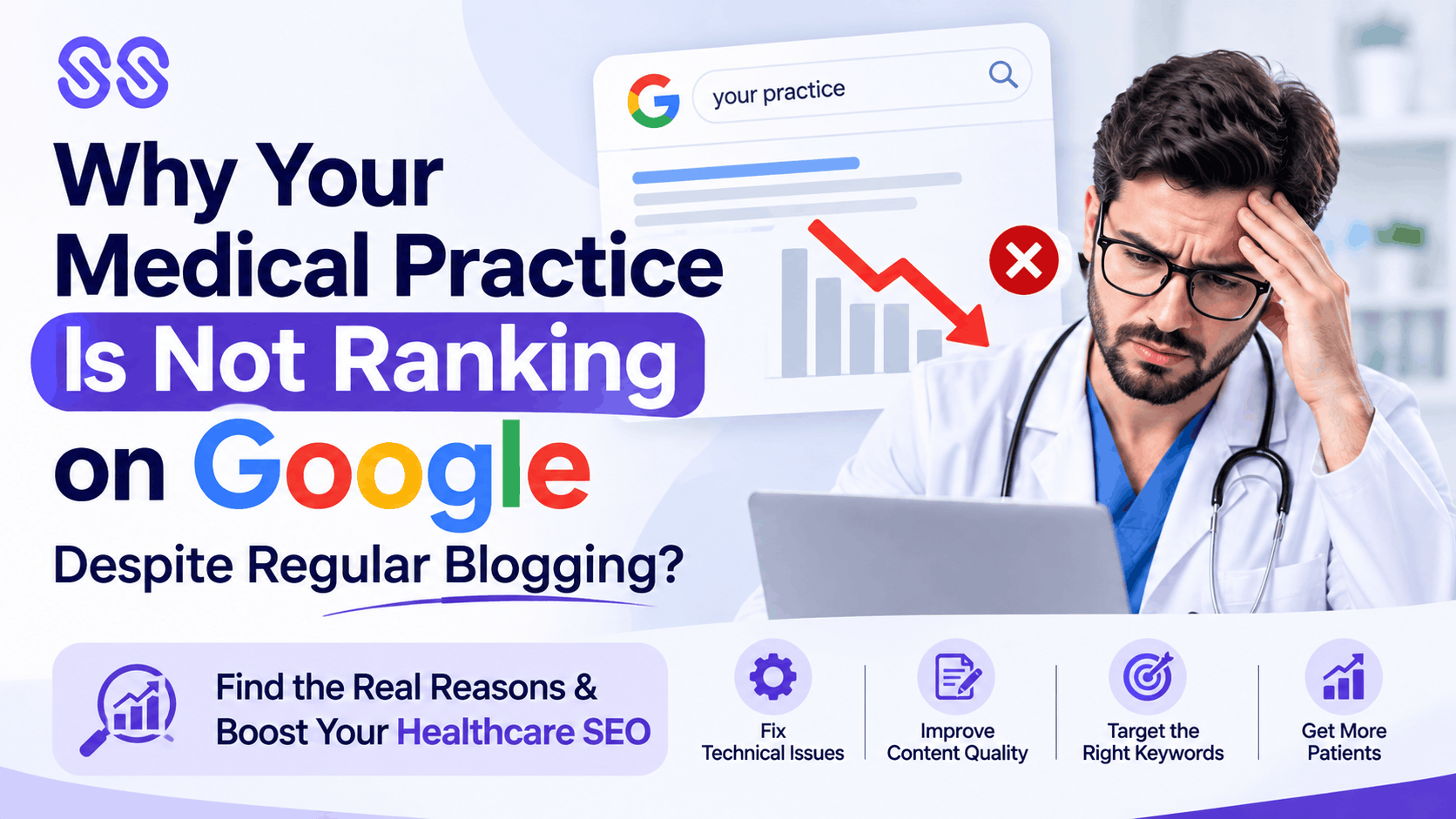
Publishing blog posts consistently is a common part of healthcare SEO. Medical practices invest time in creating educational content to answer patient questions, improve website visibility, and attract relevant organic traffic. However, regular blogging does not always lead to better rankings.
If your medical practice publishes articles every week but still struggles to appear in Google Search, the issue may not be publishing frequency. Your website could have technical SEO problems, weak keyword targeting, limited topical authority, poor internal linking, or content that does not fully satisfy search intent.
Understanding these medical practice SEO problems is essential to improving search visibility. Instead of publishing more articles without a clear strategy, practices should identify what is preventing existing pages from performing and address those issues systematically.
This guide explains why a doctor website may not rank despite regular blogging and how a structured healthcare SEO audit can help uncover opportunities for improvement.
Why Regular Blogging Does Not Guarantee Google Rankings
Blogging can help a medical practice build topical relevance, answer patient questions, and attract organic traffic. However, Google evaluates many factors when determining which pages to show for a search.
Publishing frequently does not automatically make content useful, authoritative, or relevant to a particular query. A blog may be well-written but target the wrong keyword, overlap with another page, or fail to provide information that searchers need.
For healthcare websites, content quality and trust are especially important because medical information can affect people's health decisions.
A successful SEO strategy requires more than a publishing calendar. It needs technical accessibility, relevant content, clear site structure, trustworthy information, and ongoing performance analysis.
Also Read More - Ultimate Guide to Healthcare Digital Marketing
8 Reasons Your Medical Practice Is Not Ranking on Google
1. Your Blogs Target the Wrong Keywords
One of the most common reasons a doctor website is not ranking is that its content targets keywords that do not align with the practice's services or audience.
For example, a clinic may publish broad informational articles with high search volume while neglecting local and service-specific queries that are more relevant to its patient acquisition goals.
Keyword research should consider:
- Search intent and the type of information users expect.
- Relevance to the practice's actual services.
- Local search behaviour and geographic targeting.
- Competition and the current search results.
- Whether the keyword is better suited to a blog or service page.
A medical practice should not choose keywords based on search volume alone. The most useful topics are those that connect audience needs with the services the practice can genuinely provide.
2. Your Content Does Not Fully Satisfy Search Intent
A blog can include the target keyword and still fail to answer the searcher's question.
For example, someone searching for the cost of a medical consultation may expect information about pricing factors, what is included, and how to obtain an accurate quote. A general article about the benefits of the specialty may not satisfy that intent.
Before creating or updating content, review the search results for the target query. Identify the type of content ranking, the questions it answers, and the level of detail users appear to need.
Then create content that is accurate, useful, clearly structured, and aligned with the query. Avoid copying competitors or adding unnecessary length simply to make an article appear comprehensive.
3. Your Medical Blogs Lack Trust and Expertise Signals
Healthcare content falls within a subject area where accuracy and trust matter greatly. If your articles lack clear authorship, credible sourcing, or appropriate clinical review, they may struggle to establish confidence with readers.
Strengthen medical blog SEO by including:
- Accurate author and reviewer information where applicable.
- Relevant professional qualifications that can be verified.
- References to reliable medical sources when needed.
- Clear explanations written for the intended audience.
- Dates indicating when content was published or meaningfully updated.
- A transparent distinction between general education and individual medical advice.
Do not invent credentials, clinical experience, or review processes. Trust signals should reflect the practice's actual expertise and editorial standards.
4. Your Website Has Technical SEO Issues
Even useful content may struggle to rank if search engines cannot efficiently crawl, render, or index it.
Common technical issues include:
- Important pages blocked from crawling.
- Incorrect noindex directives.
- Canonical tags pointing to the wrong URLs.
- Broken internal links and excessive redirects.
- Duplicate or near-duplicate pages.
- Slow page performance or mobile usability problems.
- Sitemap errors or inconsistent URL structures.
A healthcare SEO audit should examine these issues alongside content performance.
Google Search Console can help identify indexing problems, search performance trends, and pages that are not appearing as expected. Technical findings should be verified before making changes, since not every excluded URL needs to be indexed.
5. Your Blog Posts Compete with Your Own Pages
Keyword cannibalisation can occur when multiple pages on a website target the same or very similar search intent.
For example, a clinic may have several articles about the same treatment while its main service page also targets the same query. Search engines may have difficulty determining which page best serves the searcher.
Review pages with overlapping topics and rankings. Depending on the situation, you may need to:
- Differentiate the intent of each page.
- Consolidate overlapping content.
- Improve internal links to the preferred page.
- Redirect genuinely redundant URLs when appropriate.
- Update the service page to better address commercial intent.
Do not automatically delete pages just because they rank for similar keywords. First determine whether they serve distinct audiences or search intents.
Read More - SEO services for ophthalmologists in Phoenix, AZ
6. Your Internal Linking Is Weak
Internal links help users and search engines discover related content and understand the relationship between pages.
If blog posts are isolated from relevant service pages, they may not contribute effectively to the site's structure or help visitors find the next useful step.
For example, an article about common shoulder pain questions could link naturally to the practice's relevant shoulder consultation or treatment page, if that service is offered.
Use descriptive anchor text and link only where the destination is genuinely relevant. Important service pages should be accessible through clear navigation and contextual links, not buried several clicks deep.
7. Your Local SEO Is Underdeveloped
Medical practices often depend on patients within a defined geographic area. If your website does not clearly communicate where you operate, it may struggle to attract relevant local search traffic.
Review whether your site includes accurate location information, service-area details, and consistent business contact information.
Local SEO improvements may include:
- Maintaining an accurate Google Business Profile.
- Creating useful location pages for genuine clinic locations.
- Ensuring consistent name, address, and phone details.
- Encouraging genuine patient reviews in accordance with applicable rules.
- Linking location pages to relevant services.
- Monitoring local search visibility and website enquiries.
Avoid creating doorway pages for locations where the practice does not operate.
8. You Publish New Content but Do Not Improve Existing Pages
A regular blogging schedule can divert attention from pages that already have ranking potential.
Some articles may receive impressions but few clicks. Others may rank on page two or three, have outdated information, or overlap with newer content.
Use Google Search Console and analytics data to identify pages that need improvement. Review their queries, impressions, clicks, click-through rates, and engagement.
Content updates may include clarifying the search intent, improving headings, adding missing information, strengthening internal links, correcting outdated details, or consolidating overlapping content.
The goal is to improve usefulness and relevance—not to change the publication date without making meaningful updates.
Also Read More - Digital Marketing for Medical Practices: How to Turn Online Visibility Into Patient Enquiries
How to Conduct a Healthcare SEO Audit
A structured audit helps identify the reasons your medical website is underperforming and prioritise improvements.
Step 1: Review Google Search Console Performance
Start by reviewing organic performance over the last three to six months, while accounting for seasonality and major website changes.
Look for:
- Pages receiving impressions but few clicks.
- Important service pages with limited visibility.
- Queries that are relevant but rank poorly.
- Sudden changes in clicks or impressions.
- Indexing and crawling issues affecting important URLs.
Use this data to create a list of pages and issues that require further investigation.
Step 2: Audit Your Keyword and Content Strategy
Map each important keyword to the page that should satisfy its search intent.
Check whether your blog posts and service pages have distinct purposes. Identify missing service pages, outdated articles, duplicate topics, and content that attracts irrelevant traffic.
Prioritise topics based on relevance, patient needs, business objectives, and realistic ranking opportunities.
Step 3: Check Technical SEO
Review crawling, indexing, canonicalisation, redirects, sitemap configuration, mobile usability, and page performance.
Resolve issues according to their impact on important pages. A technical error affecting the main service pages may deserve more attention than a minor issue on an unimportant archive page.
Step 4: Evaluate Content Quality and Trust
Review whether each important article is accurate, original, clear, and useful to its intended audience.
Confirm that author and reviewer information is accurate. Update outdated medical information and add reliable references where appropriate.
Step 5: Improve Internal Links and Site Structure
Make sure relevant blog posts connect to the appropriate service pages and that important pages are easy to find.
Review navigation, breadcrumbs, related-content links, and the depth of important URLs.
Step 6: Measure Results and Prioritise Work
Create an action plan that separates urgent technical fixes from content improvements and longer-term authority building.
Track organic visibility, relevant traffic, qualified enquiries, and appointment outcomes. SEO improvements can take time, so evaluate trends over an appropriate period rather than expecting immediate ranking changes.
A 30-Day Action Plan to Improve Medical Practice SEO
Week | Priority | Key Actions |
|---|---|---|
Week 1 | Diagnose | Review Search Console, indexing, technical health, and keyword mapping |
Week 2 | Optimise | Improve priority service pages, titles, headings, and search intent alignment |
Week 3 | Strengthen | Update important blogs, add relevant internal links, and improve trust signals |
Week 4 | Measure | Review rankings, impressions, clicks, qualified enquiries, and remaining issues |
This plan provides a starting point. Larger technical issues or substantial content restructuring may require more time and resources.
How Socialsect Helps Improve Medical Website Optimisation
Medical practices need an SEO strategy that connects technical health, useful content, local visibility, and patient acquisition goals.
Socialsect supports healthcare businesses through healthcare SEO audits, keyword research, technical SEO, medical content strategy, local SEO, and website optimisation.
The process begins by identifying why important pages are not performing, whether the issue relates to technical accessibility, content relevance, search intent, or site structure. Recommendations are then prioritised according to their likely impact and the evidence available.
For practices publishing regularly without seeing meaningful progress, the focus is not automatically on producing more blogs. It is on improving the quality, relevance, and discoverability of existing content while addressing the underlying SEO barriers.
Conclusion
Regular blogging can support medical practice SEO, but it cannot compensate for technical problems, weak search intent alignment, poor site structure, or insufficient trust signals.
If your doctor website is not ranking, start by reviewing the performance and technical health of your existing pages. Identify which issues are preventing search engines and users from accessing the most useful information, then prioritise improvements based on evidence.
A structured healthcare SEO audit, combined with relevant content and ongoing measurement, can help your medical practice build stronger search visibility and attract more qualified organic traffic over time.