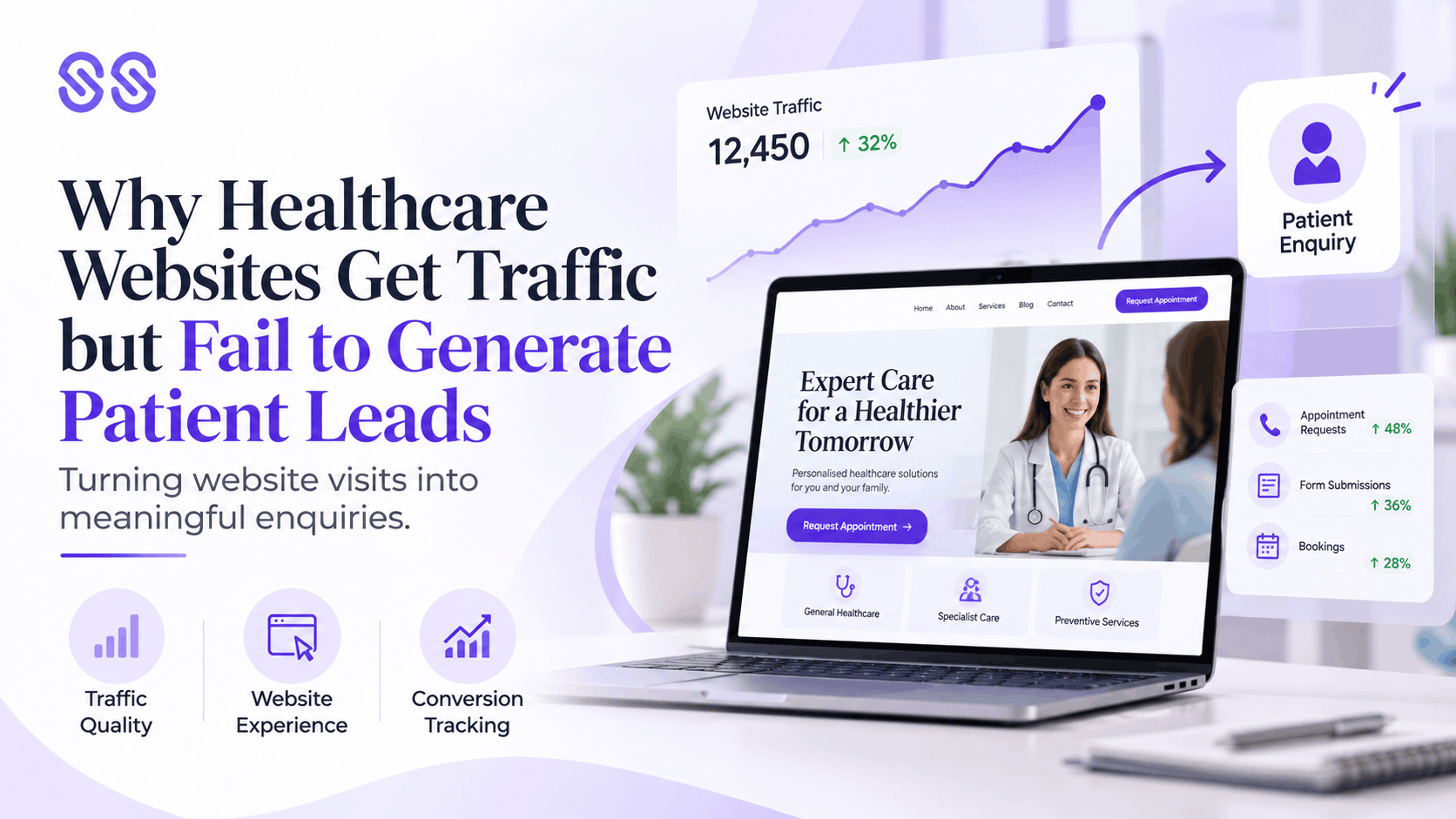
Generating website traffic is an important part of digital marketing, but traffic alone does not guarantee business growth. Many healthcare providers invest in SEO, paid advertising, social media, and content marketing to attract visitors, yet struggle to convert those visitors into patient enquiries and appointment requests.
A healthcare website may rank well on Google, attract thousands of monthly visitors, and receive consistent engagement without generating the expected number of leads. In many cases, the problem is not a lack of visibility. Instead, visitors may struggle to find relevant information, understand the services offered, trust the provider, or complete the appointment booking process.
This is where healthcare website conversion becomes important. Conversion optimisation focuses on improving the experience between a visitor's first interaction with a website and the action they want to take, such as requesting an appointment, calling a clinic, or submitting an enquiry.
For hospitals, clinics, and medical practices, improving conversions requires a combination of website usability, relevant content, clear calls to action, trust signals, technical performance, and accurate measurement.
This guide explains why healthcare websites often fail to generate patient leads despite receiving traffic and what healthcare businesses can do to improve their medical website conversion rate.
Read more - How Plastic Surgeons Can Generate High-Value Leads with Google Ads
What Is Healthcare Website Conversion?
Healthcare website conversion refers to the process of turning website visitors into people who complete a meaningful action related to a healthcare service.
Depending on the provider's goals, conversions may include appointment requests, enquiry form submissions, calls to the clinic, or bookings through an online scheduling system.
For example, if 2,000 people visit a clinic website in a month and 40 submit an appointment enquiry, the website's enquiry conversion rate is 2%.
Conversion rate = (Number of conversions ÷ Total website visitors) × 100
In this example:
(40 ÷ 2,000) × 100 = 2%
This calculation provides a starting point, not a universal benchmark. A suitable conversion rate depends on the type of healthcare service, traffic source, location, visitor intent, booking process, and the way conversions are measured.
The objective is not simply to increase the number of form submissions. It is to attract relevant visitors and help them take an appropriate next step.
1. The Website Attracts the Wrong Type of Traffic
One of the most common reasons healthcare websites fail to generate leads is a mismatch between the traffic they attract and the services they provide.
A website may receive substantial organic traffic from informational articles, broad keywords, or searches unrelated to appointment booking. While this traffic can support brand awareness, it may not generate immediate enquiries.
Broad Keywords Do Not Always Bring Potential Patients
Consider a dermatology clinic that receives most of its organic traffic from an article about common skin problems. Visitors may be researching symptoms for general knowledge rather than looking for a dermatologist.
By comparison, someone searching for a dermatologist in a specific location or a clinic offering a particular treatment may have a more immediate service-related need.
Both types of visitors can be valuable, but they require different content and conversion paths.
How to Improve Traffic Quality
Healthcare businesses should align their SEO strategy with the services they want to grow. This means identifying the difference between informational, commercial, and appointment-focused searches.
Build dedicated service pages for the clinic's actual offerings, use relevant location-based keywords where appropriate, and link educational articles to useful service information.
Review traffic by landing page, search query, channel, and conversion activity. This helps determine whether the website is attracting the right audience rather than relying on total traffic as the main success metric.
Read More - SEO services for dentists in Dallas
2. Visitors Cannot Find the Information They Need
Healthcare decisions often involve uncertainty. Visitors may want to understand the services available, the qualifications of the clinician, the location of the clinic, or how to arrange an appointment.
If the website does not answer these questions clearly, visitors may leave and continue researching elsewhere.
Important Information Is Difficult to Find
Common problems include unclear navigation, generic service descriptions, outdated doctor profiles, missing contact details, and appointment options hidden several clicks away.
Visitors should not have to explore multiple pages to discover whether a clinic provides a relevant service.
Create Clear, Service-Specific Pages
Each major service should have a dedicated page where appropriate. The page should explain what the service involves, which conditions or concerns it addresses, what patients can generally expect, and how to contact the provider.
For example, a physiotherapy practice might create separate pages for sports injury rehabilitation, back pain, and post-operative rehabilitation if these are services it offers.
Keep the information accurate, useful, and easy to scan. Clear headings and concise paragraphs can help visitors find relevant details quickly.
3. The Website Does Not Build Enough Trust
Trust is particularly important in healthcare because people may be making decisions that affect their wellbeing, privacy, and finances.
A website that looks outdated, provides limited information about clinicians, or makes unsupported claims may leave visitors uncertain about the provider.
Missing Professional and Clinical Information
Healthcare websites should communicate relevant expertise through accurate clinician profiles, verified qualifications, service descriptions, and appropriate professional affiliations.
Where medical advice or educational content is published, identify authors and clinical reviewers when appropriate. Content should be accurate and reviewed to a level suitable for the topic.
Use Genuine Trust Signals
Useful trust signals can include:
- Accurate clinician profiles and verified qualifications.
- Clear information about available services and facilities.
- Current contact details, address, and opening hours.
- Genuine patient feedback published in accordance with applicable rules.
- Secure website functionality and transparent privacy information.
- Clear explanations of appointment procedures and patient support.
Avoid fabricated testimonials, unsupported success rates, exaggerated clinical claims, or language that promises guaranteed treatment outcomes.
Trust should be built through transparency and reliable information, not promotional claims alone.
4. Calls to Action Are Weak or Difficult to Notice
A visitor may be interested in a service but unsure what to do next. If a healthcare website does not provide a clear next step, it can lose potential enquiries even when the content is relevant.
Generic Calls to Action Create Friction
Buttons such as “Click Here” or vague links may not explain what happens after a visitor selects them. Important actions may also be buried at the bottom of a long page.
Use clear, descriptive calls to action such as “Request an Appointment,” “Call the Clinic,” or “Contact Our Team,” depending on the available process.
Place Calls to Action Where They Are Useful
Include an appropriate next step near the beginning of important service pages and again after relevant information. On mobile devices, ensure that buttons are easy to tap and do not obstruct essential content.
The wording should match the action the clinic can actually provide. If appointments are requested rather than confirmed immediately, the button and surrounding text should make that distinction clear.
Read More - seo for hair transplant clinics
5. The Appointment Booking Process Is Too Complicated
Even interested visitors may abandon the process if booking an appointment takes too much effort.
Long enquiry forms, unclear instructions, technical errors, and limited contact options can create unnecessary barriers.
Reduce Unnecessary Form Fields
Ask only for information needed to handle the initial enquiry. A clinic may need a person's name, preferred contact method, and basic appointment request, but it should avoid collecting detailed health information through an ordinary marketing form unless there is a suitable, secure, and compliant process.
Explain how the enquiry will be handled and what the visitor should expect after submitting it.
Offer Practical Contact Options
Depending on the clinic's workflow, options may include telephone contact, an online appointment request, or an integrated booking system.
Check that all options work correctly on desktop and mobile devices. Test the complete process regularly, including form submissions, confirmation messages, notifications, and links to external booking systems.
6. Slow Loading and Poor Mobile Experience Reduce Conversions
Many people research healthcare providers using mobile devices. If a website loads slowly, displays poorly, or makes basic actions difficult, visitors may leave before contacting the clinic.
Common Technical and Mobile Issues
Problems can include oversized images, unnecessary scripts, layout shifts, small text, difficult navigation, intrusive pop-ups, and buttons that are hard to tap.
These issues can affect the user experience and may also contribute to search performance problems.
Improve Website Performance
Review real-world performance data and use tools such as Google PageSpeed Insights to identify areas for improvement.
Prioritise practical fixes, including appropriately sized images, efficient scripts, reliable hosting, readable mobile layouts, and stable page elements.
Test key pages on different screen sizes. Pay particular attention to the homepage, high-traffic service pages, contact pages, and appointment forms.
Website speed should be assessed alongside content relevance and usability. A fast website alone cannot compensate for unclear service information or a poor booking process.
7. Landing Pages Do Not Match Search Intent
A visitor who clicks an advertisement for a specific treatment expects to find information about that treatment. If the link leads to a generic homepage, the visitor must work harder to find what they came for.
This mismatch can reduce the effectiveness of both paid advertising and organic search.
Create Dedicated Landing Pages for Priority Services
A focused landing page should reflect the topic or service that brought the visitor to the website. It should explain the service, provide accurate information about the provider, answer relevant questions, and present a clear next step.
For example, an advertisement for a particular physiotherapy service should lead to a relevant service page rather than an unrelated general page.
Keep the Message Consistent
The language used in advertisements, search results, and landing pages should be consistent. Avoid promising something in an advertisement that the destination page or clinic cannot substantiate.
For SEO, landing pages should also provide useful, distinct information rather than repeating nearly identical content across multiple URLs.
8. The Website Has Content but Lacks a Clear Patient Journey
Publishing blogs and service pages can improve visibility, but visitors also need a logical way to move from general information to relevant services.
A website with disconnected articles may attract readers without helping them understand what the clinic offers.
Connect Educational Content with Relevant Services
An article explaining the general causes of back pain may naturally link to a physiotherapy service page if that service is available. Similarly, an article about skin health can direct readers to relevant dermatology information where appropriate.
Internal links should be useful and contextually relevant. They should not pressure readers into booking or imply that an article can determine which treatment an individual needs.
Organise the Website Around User Needs
Create clear navigation for key services, clinician profiles, patient information, location details, and appointments. Use related articles and internal links to help visitors discover relevant information.
A well-organised website supports both usability and SEO by helping visitors and search engines understand how the content fits together.
9. Local Search Visitors Encounter Inconsistent Information
For clinics serving a defined geographic area, local search can be an important source of enquiries. However, inaccurate business information can create friction at the point when someone is ready to contact the provider.
Keep Local Business Details Accurate
Review the clinic's Google Business Profile and ensure that its name, address, phone number, website, opening hours, and relevant categories are accurate.
Check that the website displays the same essential information. Update details promptly if the clinic moves, changes its number, or modifies its operating hours.
Make Location and Access Information Clear
Provide directions, relevant transport or parking details, and accurate information about the facility where appropriate.
If the clinic operates from multiple locations, make it clear which services are available at each branch and how patients can contact the correct location.
These improvements can help reduce uncertainty for visitors who discover the clinic through Google Maps or location-based searches.
10. The Clinic Is Not Measuring Conversions Properly
Some healthcare websites appear to generate few leads because tracking has not been configured correctly. In other cases, the website records traffic accurately but does not track important actions such as appointment requests or calls.
Without reliable measurement, it is difficult to identify where the patient journey is breaking down.
Track Meaningful Conversion Events
Depending on the website and booking system, useful events may include:
- Successful enquiry form submissions.
- Clicks on telephone links.
- Appointment booking completions.
- Visits to confirmation pages.
- Qualified enquiries recorded through the clinic's own systems.
Not every button click represents a completed enquiry. For example, clicking a phone number does not confirm that a call connected or resulted in an appointment.
Connect Marketing Performance with Business Outcomes
Use analytics to understand which pages and channels contribute to relevant enquiries. Where feasible and lawful, compare website conversion data with appointment records to evaluate the quality of demand.
Protect patient confidentiality when configuring analytics, advertising pixels, call tracking, and CRM integrations. Avoid sending identifiable patient information or sensitive health data to advertising platforms unless the specific processing is lawful and expressly permitted.
How to Calculate and Improve Your Medical Website Conversion Rate
A simple conversion calculation can establish a baseline for improvement.
Suppose a clinic receives 3,000 website visits and records 45 completed appointment enquiries in one month.
The conversion rate is:
[\frac{45}{3000}\times100=1.5%]
If the clinic later records 60 enquiries from the same number of visits, the conversion rate becomes 2%.
This would represent an improvement in the measured enquiry conversion rate. However, the clinic should also assess whether those enquiries are relevant, whether appointments are booked, and whether the change can reasonably be attributed to the optimisation work.
A Practical Conversion Optimisation Process
Step 1: Establish a baseline. Review traffic, landing pages, enquiry sources, form completion, and available appointment data.
Step 2: Identify friction points. Check whether visitors are struggling with navigation, service information, mobile usability, forms, or contact options.
Step 3: Prioritise improvements. Start with high-traffic service pages and issues that prevent visitors from taking action.
Step 4: Test changes. Where sufficient traffic and suitable measurement are available, compare alternative page layouts, calls to action, or form designs.
Step 5: Review results. Assess both conversion rate and enquiry quality over a suitable period. Avoid drawing strong conclusions from very small samples or short testing windows.
Conversion rate optimisation is an ongoing process. Results depend on the audience, service, website, and quality of implementation.
Also Read More - Best Digital Marketing Strategies for Ophthalmology Clinics
How Socialsect Can Help Improve Healthcare Website Conversion
Socialsect helps healthcare organisations strengthen their digital presence through healthcare SEO, website optimisation, landing page development, content strategy, and conversion-focused digital marketing.
For a clinic receiving traffic but generating fewer enquiries than expected, the first step is to identify where the problem occurs. The issue may involve traffic quality, search intent, website usability, service-page content, technical performance, or the appointment process.
A structured review can help prioritise improvements based on the clinic's goals and available data. This may include optimising high-intent service pages, improving calls to action, reviewing mobile performance, strengthening local SEO, or correcting conversion tracking.
The objective is to make it easier for relevant visitors to find accurate information and take an appropriate next step, while measuring whether those improvements contribute to meaningful enquiries.
Conclusion
A healthcare website can attract significant traffic and still struggle to generate patient leads when the visitors are poorly matched to its services or encounter barriers during their journey.
Improving healthcare website conversion requires more than changing the design or adding another call-to-action button. Clinics need relevant traffic, clear service pages, trustworthy information, a straightforward booking process, reliable website performance, and accurate conversion tracking.
By identifying where visitors lose interest and addressing the underlying issues, healthcare providers can make their websites more useful to prospective patients and improve the chances of generating relevant enquiries.
The key is to measure success beyond traffic alone. A website should help people understand the services available, find the information they need, and take an appropriate next step.