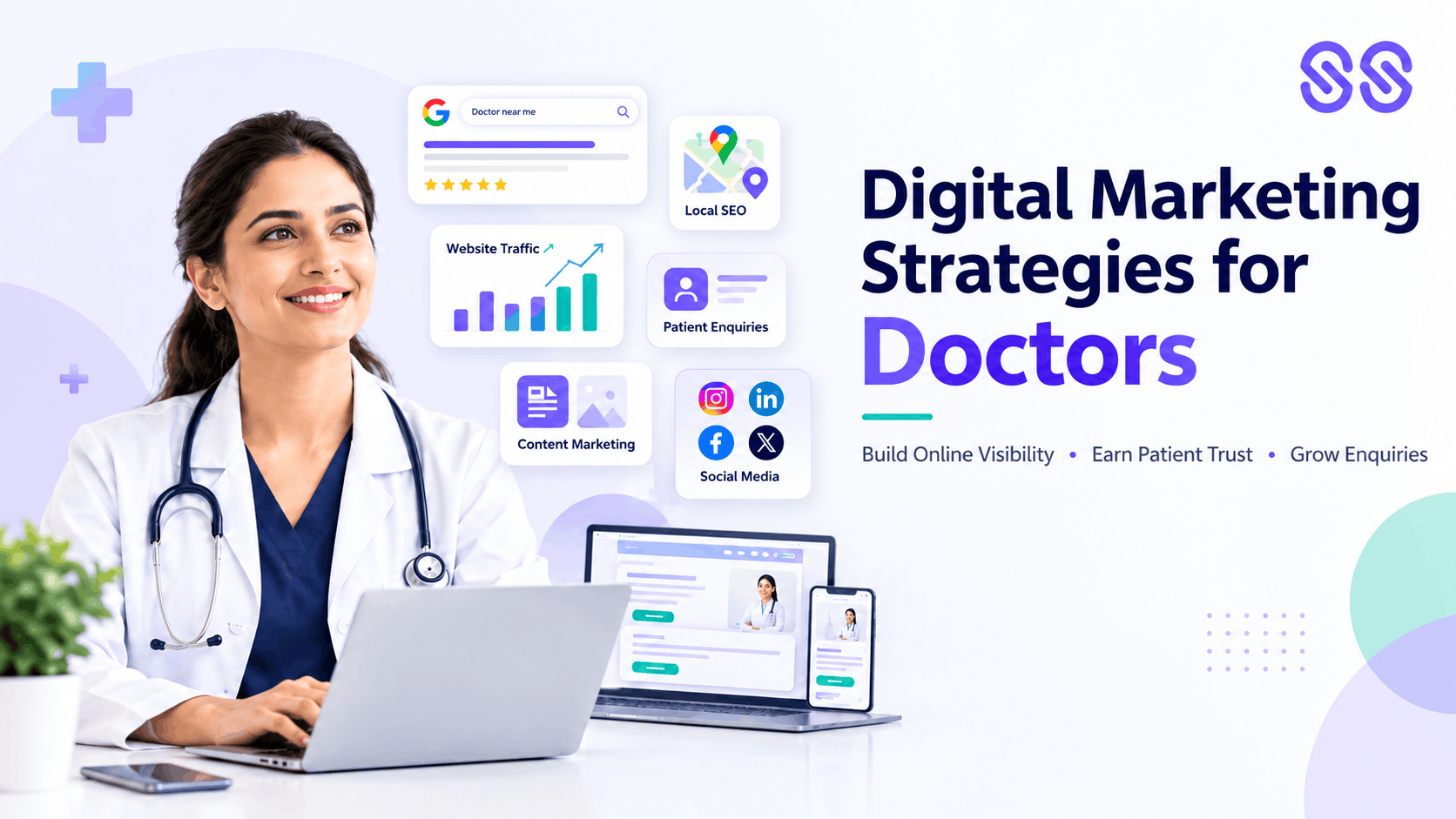
Patients increasingly rely on online search to find doctors, compare medical practices and understand available healthcare services. Before booking an appointment, they may visit a doctor's website, check professional credentials, read reviews, explore treatment information or search for a nearby clinic.
For doctors, this creates an opportunity to build a stronger online presence and connect with people looking for relevant healthcare services.
However, simply creating a website or posting occasionally on social media is rarely enough to support consistent growth. Effective digital marketing requires a structured approach that combines search engine optimisation, local SEO, content marketing, paid advertising, social media and website conversion optimisation.
The right digital marketing strategies for doctors help potential patients discover a practice, understand its services and find a clear path to making an enquiry.
The objective is not simply to increase website traffic. It is to build credibility, improve relevant visibility and create a reliable digital experience that supports patient acquisition.
Why Digital Marketing Is Important for Doctors
Digital marketing helps doctors communicate their expertise and make their services easier to discover online.
A well-planned strategy can support several objectives.
Improve online visibility
Patients may search for a specific doctor, medical specialty, treatment or clinic location. Search engine optimisation and local SEO can help a practice appear for relevant queries.
Build professional credibility
Accurate doctor profiles, transparent qualifications, useful medical content and consistent business information can help patients evaluate a practice before contacting it.
Attract relevant patient enquiries
Targeted marketing can connect a practice with people searching for the services it actually provides.
Improve the patient journey
A clear website, accessible contact information and straightforward appointment options can make it easier for prospective patients to take the next step.
Support long-term practice growth
A combination of organic search, paid campaigns and educational content can diversify the ways potential patients discover a practice.
Read more - How Plastic Surgeons Can Generate High-Value Leads with Google Ads
1. Develop a Clear Doctor Digital Marketing Strategy
A successful doctor digital marketing strategy starts with clear goals rather than choosing marketing channels at random.
Before launching campaigns, identify the services the practice wants to promote, the locations it serves and the types of enquiries it wants to attract.
Define your target audience
Consider the patients the practice is equipped to serve, the services they may search for and the information they need before making contact.
For example, an orthopaedic practice may prioritise searches related to joint pain, sports injuries and specialist consultations. A dermatologist may focus on skin conditions, dermatology consultations and appropriate treatment services.
Set measurable objectives
Establish goals such as:
- Improving organic search visibility
- Increasing relevant website visits
- Generating more qualified enquiries
- Increasing appointment requests
- Improving Google Maps visibility
- Reducing cost per qualified lead
The most useful metrics depend on the practice's size, services and business objectives.
Choose the right marketing channels
Not every doctor needs the same marketing mix. A local general practice may prioritise local SEO, while a specialist clinic may benefit from a combination of treatment-focused SEO and paid search.
2. Optimise Your Website for Healthcare SEO
Healthcare SEO is one of the most important components of online marketing for doctors.
It helps medical websites improve their visibility for relevant searches without relying entirely on paid advertising.
Create dedicated service pages
Each important service should have a clear, informative page where appropriate.
A useful service page explains what the service involves, who provides it, where it is available and how patients can enquire.
For example, an orthopaedic clinic could have dedicated pages for shoulder care, knee conditions and sports injury consultations, provided each page offers distinct value.
Use relevant keywords naturally
Keyword research helps identify the language people use when looking for doctors and healthcare services.
Potential keyword themes include:
- Doctor in [location]
- Specialist consultation in [location]
- Dermatologist near me
- Orthopaedic clinic in [location]
- Medical practice in [location]
Include relevant phrases naturally in page titles, headings, descriptions and content. Avoid excessive repetition or creating multiple pages with nearly identical information.
Improve technical SEO
Technical issues can affect how search engines access and understand a website.
Review:
- Website loading speed
- Mobile usability
- Indexing and crawlability
- XML sitemap configuration
- Broken links and errors
- URL structure
- Internal linking
- Appropriate structured data
Technical SEO should support a website that is easy for both search engines and patients to use.
3. Use Local SEO to Attract Nearby Patients
For doctors who serve a defined geographic area, local SEO can be particularly valuable.
Patients often search for a healthcare provider near their home, workplace or preferred location. A strong local presence helps them discover relevant practices and access essential information.
Optimise Google Business Profile
Keep the practice's Google Business Profile accurate and complete.
Important details include:
- Practice name
- Address
- Phone number
- Opening hours
- Website
- Relevant business categories
- Available services
- Professional photographs
Use accurate information and avoid adding unsupported claims or irrelevant categories.
Create useful location pages
If a practice genuinely serves multiple locations, dedicated location pages can help patients find relevant information.
Each page should include accurate location details, services available at that location, directions and appropriate contact information.
Avoid creating thin or duplicate location pages simply to target additional keywords.
Encourage authentic patient reviews
Reviews can help prospective patients understand aspects of the practice experience.
Use an ethical process for requesting genuine feedback and respond professionally while respecting patient confidentiality. Do not disclose or confirm a person's patient status in a public response.
4. Build Trust Through Medical Content Marketing
Content marketing is an important part of digital marketing for physicians because it allows doctors to provide useful information beyond their core service pages.
Patients may research symptoms, conditions, treatment options and preparation before deciding whether to consult a healthcare professional.
Educational content can help address those questions.
Publish helpful medical blogs
Potential topics include:
- Common symptoms associated with a condition
- When to seek professional medical advice
- What happens during a consultation
- Treatment options and their considerations
- Recovery and aftercare information
- Questions to ask a specialist
The topics should reflect the practice's expertise and the information patients genuinely need.
Apply E-E-A-T principles
Healthcare content should demonstrate Experience, Expertise, Authoritativeness and Trustworthiness.
Doctors can support these qualities by providing accurate professional information, identifying content authors and reviewers where appropriate, citing reliable sources and reviewing medical content regularly.
Avoid fabricated credentials, unsupported treatment claims and promises of guaranteed outcomes.
Connect blogs to relevant services
Educational articles should link naturally to related service pages where doing so helps the reader.
For example, an article explaining common causes of shoulder pain could link to a relevant orthopaedic consultation page.
This helps readers move from general education to information about available services.
Read More - SEO services for dentists in Dallas
5. Use Google Ads to Reach High-Intent Patients
SEO is a long-term investment, while Google Ads can provide paid visibility for selected searches after campaigns are approved and launched.
For doctors, paid search can be useful when promoting priority services or reaching potential patients in a defined location.
Create focused campaigns
Organise campaigns around relevant services rather than sending all traffic through a single generic advertisement.
For example, a dental practice might separate campaigns for dental implants, orthodontics and general dental consultations.
Match ads with landing pages
If an advertisement promotes a specific service, the landing page should provide relevant information about that service.
A strong landing page includes a clear heading, service details, appropriate doctor credentials, contact information and an easy way to request an appointment.
Monitor lead quality
Track calls, forms, consultation requests and qualified enquiries wherever possible.
Also review search terms regularly to identify irrelevant traffic and exclude unsuitable queries.
Healthcare advertising is subject to platform policies and applicable regulations. Campaigns should be checked for relevant restrictions on treatments, claims, targeting and sensitive health-related information.
6. Strengthen Your Professional Presence on Social Media
Social media can help doctors share educational information, introduce their practice and maintain a consistent professional presence.
The most effective approach prioritises useful communication rather than posting promotional content every day.
Share educational information
Possible content formats include:
- General health education
- Answers to common questions
- Introductions to doctors and services
- Explanations of clinical processes
- Preventive health information
- Practice updates
- Links to relevant educational articles
Maintain professional boundaries
Doctors should protect patient privacy and avoid sharing identifiable patient information without appropriate authorisation and consent.
Medical advice should not be given without sufficient context, and social media content should not create unrealistic expectations about diagnosis or treatment.
A consistent, professional approach helps ensure social media supports the broader marketing strategy.
Read More - cosmetic surgery marketing los angeles
7. Improve Your Doctor Profile and Personal Brand
A doctor's professional profile can influence how patients evaluate a practice.
Doctor marketing strategies should therefore include accurate, detailed and accessible professional information.
A strong profile may include:
- Professional name and title
- Medical qualifications
- Relevant clinical experience
- Areas of practice
- Professional registrations where applicable
- Languages spoken, where relevant
- Consultation locations
- Links to relevant services
Doctors can also build professional recognition through educational articles, appropriate speaking engagements and contributions to credible healthcare publications.
Personal branding should reflect genuine expertise rather than relying on exaggerated claims or unverified rankings.
8. Optimise Your Website for Patient Enquiries
Visibility alone does not guarantee patient enquiries.
Once someone reaches the website, they should be able to understand the services and identify the next step without unnecessary effort.
Important improvements include:
Make contact details easy to find
Display the practice's phone number, address and appointment information clearly.
Simplify enquiry forms
Ask for only the information needed at the initial enquiry stage. Handle personal and health-related information according to applicable privacy and data-protection requirements.
Improve mobile usability
Ensure that the website is readable, loads efficiently and provides accessible contact options on mobile devices.
Use clear calls to action
Depending on the practice, appropriate options might include "Request an Appointment," "Contact the Clinic" or "View Our Services."
The call to action should be relevant to the page and should not pressure patients into making clinical decisions.
9. Build a Consistent Medical Practice Marketing System
Effective medical practice marketing connects different channels instead of treating each activity as a separate project.
For example, a practice may use:
- SEO to improve organic visibility
- Local SEO to attract nearby searches
- Google Ads to target selected high-intent queries
- Content marketing to educate potential patients
- Social media to share useful information
- Website optimisation to support enquiries
- Review management to maintain an authentic reputation
Each channel should have a defined role and contribute to shared business objectives.
The strategy should also account for what happens after an enquiry. Clear response procedures and appropriate appointment management help ensure that marketing-generated leads receive timely attention.
10. Track the Results of Your Digital Marketing
A strong healthcare digital marketing strategy should be measured using relevant business outcomes.
Useful metrics include:
- Organic impressions and clicks
- Search visibility for priority services
- Google Maps visibility
- Website enquiries
- Phone calls
- Appointment requests
- Qualified patient leads
- Conversion rate
- Cost per qualified lead
- Booked consultations
Avoid evaluating performance solely by website traffic or social media engagement.
For example, an article may attract many visitors but few relevant enquiries. A service page with less traffic may generate more appointment requests from people actively seeking that service.
Review performance regularly and use the findings to improve campaigns, pages and content.
11. Common Digital Marketing Mistakes Doctors Should Avoid
Using the same strategy for every specialty
Different specialties serve different patient needs and may require different keywords, content and marketing channels.
Publishing generic content
Content should answer genuine questions and demonstrate appropriate expertise rather than simply repeating common medical information.
Ignoring local search
Doctors serving a specific area should make location, contact and service information easy to find.
Relying entirely on paid advertising
Paid campaigns can be useful, but an appropriate organic and local search strategy can diversify patient acquisition over time.
Making unsupported claims
Avoid guaranteed outcomes, misleading comparisons and fabricated testimonials.
Failing to measure appointments
Lead volume alone does not reveal whether a marketing strategy is attracting suitable patients or supporting practice growth.
Read More - seo for hair transplant clinics
12. A Practical Digital Marketing Plan for Doctors
Doctors can use the following workflow to organise their marketing activities.
Step 1: Audit the current online presence. Review the website, local listings, content, social profiles and existing campaigns.
Step 2: Identify priority services and locations. Focus on services that align with the practice's expertise and capacity.
Step 3: Conduct keyword research. Map informational, local and high-intent searches to appropriate pages.
Step 4: Optimise service and doctor pages. Improve content quality, professional information, metadata and contact options.
Step 5: Strengthen local SEO. Maintain accurate business information and improve relevant location visibility.
Step 6: Develop an educational content plan. Publish useful, professionally responsible content around patient questions.
Step 7: Launch suitable paid campaigns. Target relevant searches while following advertising policies and applicable regulations.
Step 8: Improve the conversion experience. Make enquiries and appointment requests straightforward.
Step 9: Track performance. Measure qualified leads, booked appointments and channel-level outcomes.
Step 10: Refine the strategy. Use actual performance data to prioritise future improvements.
Conclusion
Building a strong online presence requires more than a website or an active social media account. Doctors need a connected strategy that helps potential patients discover their services, understand their expertise and take an appropriate next step.
The most effective digital marketing strategies for doctors combine SEO, local search, educational content, paid advertising, professional branding and website optimisation.
When these activities work together, doctors can build a more credible online presence and create better opportunities for relevant patient enquiries.
The key is to focus on accurate information, genuine expertise, a clear patient experience and measurable results. Rather than chasing traffic alone, doctors should build a digital marketing system that connects online visibility with qualified enquiries and appropriate appointments.