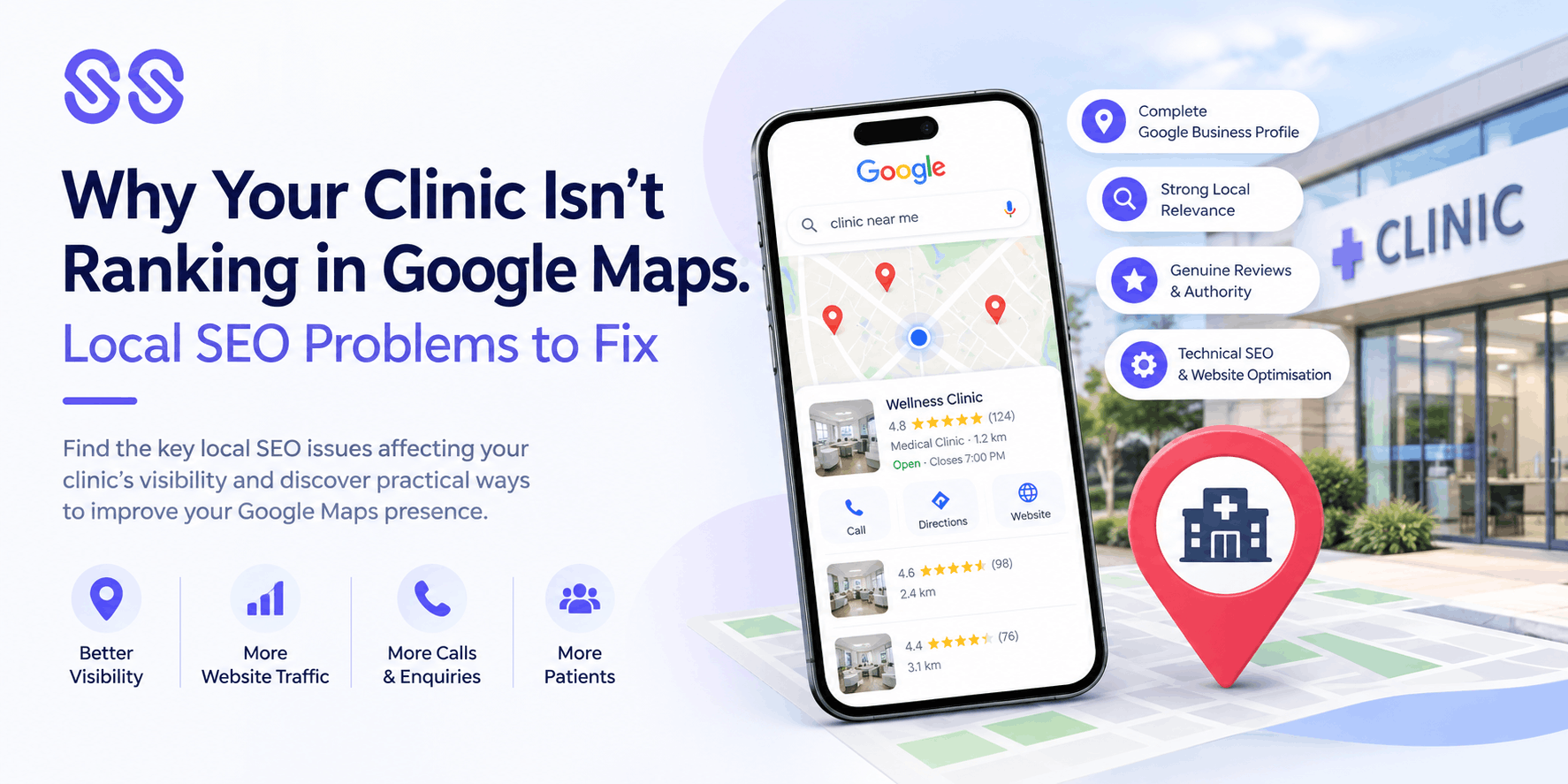
Patients looking for a doctor, specialist, dentist, physiotherapist, or clinic often use Google Search and Google Maps to find nearby healthcare providers. For a local practice, appearing prominently in these results can make a significant difference in how easily potential patients discover the clinic.
Yet many clinics have a Google Business Profile and still struggle to appear for important local searches.
The problem is rarely just one thing.
Weak clinic local SEO, inaccurate business information, poor location relevance, limited website optimisation, inconsistent business details, weak local authority, or an incomplete Google Business Profile can all affect a clinic's local visibility.
The good news is that many of these issues can be identified and improved with a structured local SEO strategy.
Why Google Maps Visibility Matters for Clinics
When someone searches for a healthcare provider, Google may display a local results section featuring nearby businesses alongside their locations, reviews, and other information.
For example, a patient might search for:
- Dentist near me
- Dermatologist in [city]
- Physiotherapy clinic near me
- Cardiologist in [location]
- Private clinic near me
These searches often have strong local intent.
A clinic that is visible when prospective patients are actively looking for its services has an opportunity to attract highly relevant website visits, calls, directions requests, and appointment enquiries.
However, having a Google Business Profile does not guarantee prominent placement.
How Google Determines Local Search Visibility
Google's local search systems generally consider factors related to relevance, distance, and prominence.
This means a clinic needs more than a physical address.
Its online presence should clearly communicate:
- What services it provides
- Where it is located
- Which healthcare professionals work there
- What the website is about
- How the business is represented across the web
- Whether patients and other legitimate sources recognise the practice
This is where a well-planned clinic local SEO strategy becomes important.
Also Read More - Digital Marketing for Doctors: Complete 2026 Guide to Patient Acquisition
Your Google Business Profile Is Incomplete or Poorly Optimised
One of the first areas to check is the clinic's Google Business Profile.
An incomplete profile can make it harder for Google and potential patients to understand the business.
Review whether the profile has accurate and complete information about:
- Clinic name
- Primary category
- Relevant additional categories
- Address
- Phone number
- Website
- Opening hours
- Services
- Business description
- Photos
Do not add information simply for the sake of adding keywords.
The profile should accurately represent the real clinic.
Choose the Most Relevant Primary Category
Your primary category is particularly important because it helps describe what the business primarily does.
A clinic should select the most accurate available category rather than choosing a category solely because it appears to have higher search demand.
Additional categories should also be genuinely relevant.
Unrelated categories can make the profile less precise rather than improving visibility.
Your Clinic Website Is Not Supporting Local SEO
A Google Business Profile should not operate in isolation.
Your website provides additional context about the clinic, its services, professionals, and location.A strong healthcare local SEO strategy requires your website and Google Business Profile to work together to clearly communicate where your clinic operates and what healthcare services it provides.
If the website barely mentions where the clinic operates or what services are provided, local relevance may be weaker.
Your website should clearly communicate:
- Clinic location
- Service areas where relevant
- Core healthcare services
- Practitioner information
- Contact information
- Appointment options
- Relevant local information
The clinic's website and Google Business Profile should provide consistent, accurate information.
Your Name, Address and Phone Information Is Inconsistent
Consistency matters when building local signals.
Check the clinic's business information across:
- Website
- Google Business Profile
- Healthcare directories
- Professional organisations
- Local directories
- Social profiles where applicable
Look for differences in:
- Business name
- Address formatting
- Phone number
- Website URL
This does not mean every website must use identical punctuation or formatting.
The important point is that legitimate references should clearly refer to the same real-world clinic.
Your Clinic Has Weak Location Relevance
A clinic can be physically located in a city but still have a website that provides very little local context.
For example, a page that simply says:
“We provide specialist healthcare services.”
does not communicate much about where those services are available.
A stronger page may explain the clinic's actual location, nearby service area, accessibility, and the services available there.
Create Useful Location Pages When Appropriate
Clinics with multiple genuine locations may benefit from dedicated location pages.
Each page should provide unique, useful information about that location.
It can include:
- Exact clinic location
- Services available
- Practitioners working there
- Contact information
- Opening information
- Relevant access details
- Genuine local FAQs
Avoid creating dozens of near-identical pages where only the city name changes.
Your Service Pages Are Too Generic
Local SEO and healthcare SEO work better when your website clearly explains the services patients are searching for.
Instead of placing every treatment on one generic page, consider dedicated service pages for important services where each page provides substantial value.
For example, a dermatology clinic may have pages for:
- Dermatology consultations
- Acne treatment
- Mole assessment
- Skin condition treatment
- Cosmetic dermatology
These pages can target relevant service intent while providing useful information for prospective patients.
Your Clinic Has Limited Online Authority
Local visibility is influenced by more than your own website.
Legitimate mentions of your clinic can help establish its broader online presence.
Potential sources may include:
- Professional associations
- Local organisations
- Healthcare directories
- Relevant publications
- Community organisations
- Industry websites
The focus should be on relevance and legitimacy.
Avoid buying large volumes of low-quality directory links or participating in artificial link schemes.
A smaller number of relevant references can be more meaningful than a large collection of unrelated listings.
Your Google Reviews Are Limited or Inactive
Reviews are an important part of how prospective patients evaluate local healthcare providers.
A clinic with very little genuine feedback may have a harder time establishing the same level of social proof as an established competitor.
Clinics can develop an ethical review process by inviting genuine patients to share feedback where appropriate.
Do not:
- Buy reviews
- Write fake reviews
- Ask staff to impersonate patients
- Manipulate ratings
- Offer inappropriate incentives for positive reviews
Healthcare practices should also consider applicable privacy, professional, and platform requirements when handling patient reviews.
Your Website Does Not Demonstrate E-E-A-T
Healthcare is a trust-sensitive topic.
A clinic's website should make it easy for users to understand who provides care and why the information can be trusted.
This is where E-E-A-T—Experience, Expertise, Authoritativeness, and Trustworthiness—becomes important.
Useful signals can include:
- Detailed practitioner profiles
- Qualifications
- Relevant professional memberships
- Clinical areas of practice
- Author information
- Medical content review information where appropriate
- Reliable references
- Accurate clinic information
- Transparent contact details
Never create fictional credentials, reviews, qualifications, or clinical claims.
The strongest E-E-A-T signals are based on information the clinic can genuinely substantiate.
Your Website Has Poor Mobile Experience
Many local healthcare searches happen when people are away from a desktop computer.
Someone searching for a clinic may want to:
Read about the service
Check the location
Call the clinic
Request an appointment
If the website is difficult to use on a phone, potential patients may leave before taking action.
Check:
- Mobile navigation
- Font sizes
- Button placement
- Page loading
- Contact information
- Appointment forms
- Click-to-call functionality
- Location information
A good mobile experience supports both usability and conversion.
Your Clinic Has Technical SEO Problems
Technical problems can also affect how search engines discover and understand your website.
Review:
- Indexability
- XML sitemap
- Robots.txt
- Canonical URLs
- Redirects
- Broken links
- HTTPS
- Page speed
- Mobile performance
- Structured data
- Internal links
Make sure important local and service pages can be crawled and indexed.
Your Local Content Does Not Match Search Intent
Local SEO content should not be created simply by inserting a city name into existing text.
Instead, understand what people in the area are actually looking for.
For example, a patient searching for:
“physiotherapist in [city]”
may want to know:
- Which services are available?
- Where is the clinic?
- Who provides treatment?
- What conditions are treated?
- How can an appointment be arranged?
Your page should address those practical questions.
Your Competitors Have Stronger Local Signals
Sometimes your clinic is technically sound but competitors have a stronger overall local presence.
Compare your clinic with competing practices for:
- Google Business Profile completeness
- Primary category
- Reviews
- Website quality
- Service coverage
- Practitioner information
- Local relevance
- Content depth
- Authority
- Online mentions
The objective is not to copy competitors.
Instead, identify what patients need that your website currently does not communicate well.
You Are Targeting Searches Outside Your Real Service Area
Distance can matter significantly in local search.
A clinic cannot necessarily rank prominently across an entire city simply because it serves that city.
Your strategy should reflect the clinic's genuine physical location and service area.
Avoid creating artificial location pages for places where the clinic has no legitimate presence.
You Are Expecting Instant Google Maps Results
Local SEO is not an overnight process.
A new or recently optimised clinic profile may need time to establish stronger relevance and prominence.
Results can vary depending on:
- Competition
- Location
- Specialty
- Existing online authority
- Reviews
- Website quality
- Local search demand
- Profile completeness
- Overall SEO implementation
Rather than expecting an immediate ranking jump, monitor visibility and improve the factors within the clinic's control.
Read More - Best Digital Marketing Strategies for Ophthalmology Clinics
A Practical Clinic Local SEO Checklist
Use this checklist when reviewing a clinic's local search performance.
Google Business Profile
- Accurate business name
- Correct primary category
- Relevant additional categories
- Correct address
- Correct phone number
- Accurate hours
- Complete services
- Relevant photos
- Updated information
Website
- Clear location information
- Dedicated service pages
- Practitioner profiles
- Accurate contact details
- Mobile-friendly design
- Strong internal linking
- Technical SEO
- Local relevance
Reputation
- Genuine patient reviews
- Ethical review process
- Accurate responses where appropriate
- No fake or purchased reviews
Local Authority
- Relevant professional listings
- Legitimate healthcare directories
- Relevant local references
- Appropriate industry mentions
Measurement
Monitor:
- Google Maps visibility
- Local search queries
- Website traffic
- Calls
- Appointment enquiries
- Direction requests
- Service-page performance
- Search Console data
How to Improve Your Clinic Local SEO Step by Step
A practical improvement process can follow five stages.
Step 1: Audit Your Google Business Profile
Check categories, information, services, photos, reviews, and profile accuracy.
Step 2: Audit Your Website
Review technical SEO, location signals, service pages, practitioner content, mobile usability, and conversion paths.
Step 3: Analyse Local Competitors
Identify where competing clinics have stronger relevance, authority, content, reviews, or local signals.
Step 4: Strengthen Local Relevance
Improve genuine location information, service pages, practitioner profiles, local references, and business listings.
Step 5: Measure and Refine
Track local visibility and patient actions rather than relying only on ranking position.
Final Thoughts
If your clinic is not appearing prominently in Google Maps, the solution is rarely to simply add more keywords.
A successful clinic local SEO strategy requires a combination of accurate business information, a strong Google Business Profile, relevant service pages, genuine reviews, local authority, technical SEO, practitioner expertise, and a trustworthy website experience.A well-planned medical clinic SEO strategy can also help strengthen your website's visibility by making it easier for search engines and potential patients to understand your clinic, services, location, and areas of expertise.
Start by identifying the biggest weaknesses rather than changing everything at once.
Make sure Google can clearly understand what your clinic does, where it is located, and why it is relevant to the patients searching for those services.
At the same time, build the website for people—not just search engines. Accurate healthcare information, genuine expertise, transparent clinic details, and an easy path to contact the practice are essential for turning local visibility into meaningful patient enquiries.