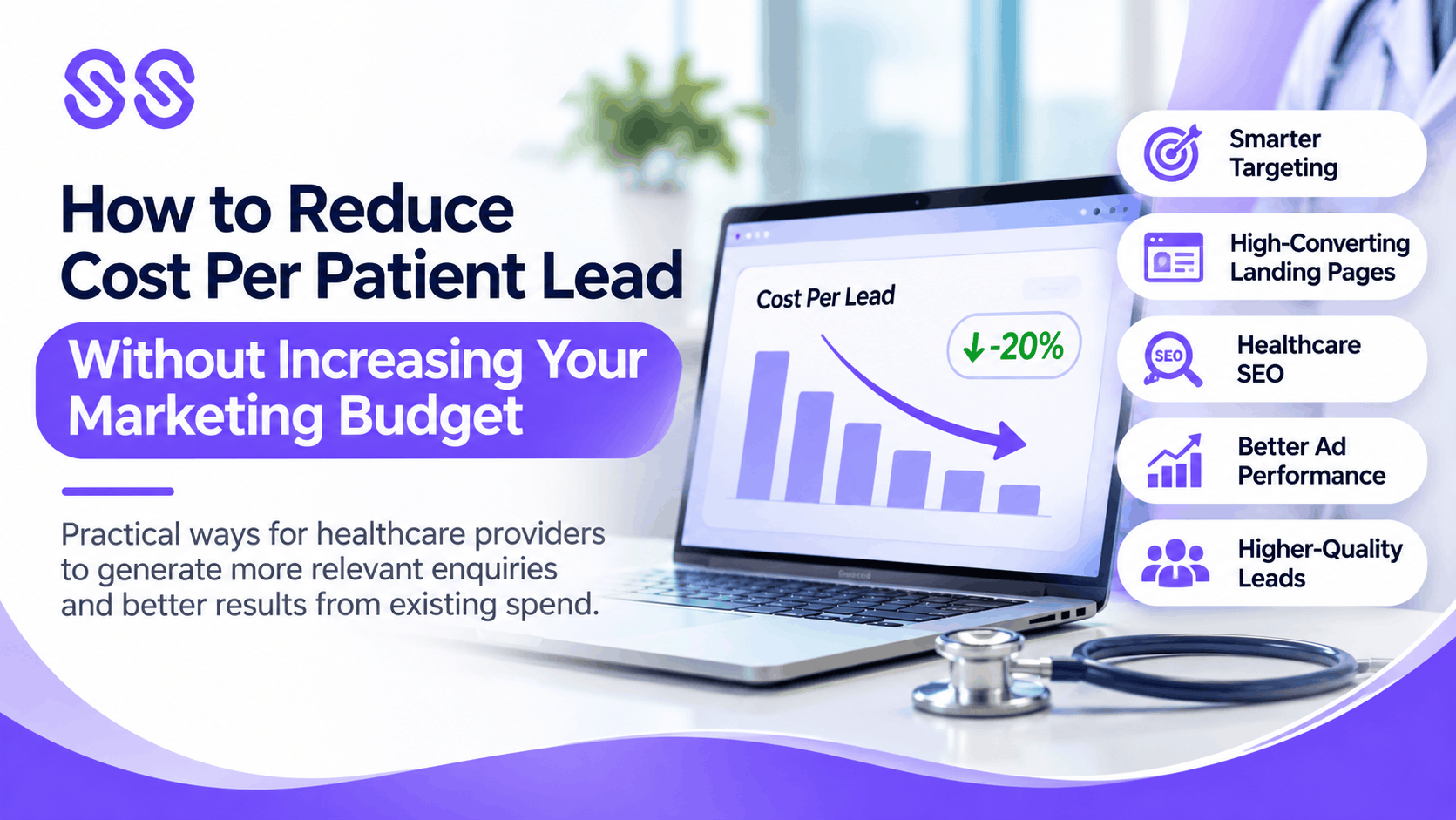
Healthcare organisations need a consistent flow of patient enquiries to support sustainable growth. However, generating those enquiries can become expensive when advertising campaigns attract irrelevant clicks, landing pages fail to convert visitors, or marketing teams struggle to identify which channels deliver valuable leads.
For hospitals, clinics, and medical practices, the challenge is not always to increase the marketing budget. In many cases, the greater opportunity lies in improving how existing resources are used.
Reducing cost per patient lead requires a closer look at audience targeting, keyword selection, campaign performance, website conversion rates, lead quality, and patient enquiry management. Small improvements across these areas can help healthcare providers generate more relevant enquiries from their current marketing investment.
A lower cost per lead is not automatically a sign of better performance. A campaign may produce inexpensive enquiries that rarely turn into appointments, while another may generate fewer but more relevant leads. The objective should be to improve efficiency without compromising patient experience, clinical accuracy, or the quality of enquiries.
This guide explains practical ways to reduce cost per patient lead through smarter healthcare marketing, improved conversion rates, and better use of existing marketing budgets.
What Is Cost Per Patient Lead?
Cost per patient lead measures how much a healthcare organisation spends to generate a patient enquiry through its marketing activities.
Depending on the campaign, a lead might be a completed appointment request, an enquiry form submission, or a relevant telephone enquiry. Healthcare organisations should define what counts as a lead before comparing performance across campaigns.
The basic formula is:
Cost per lead = Total marketing spend ÷ Number of leads generated
For example, suppose a clinic spends ₹60,000 on digital marketing in one month and receives 120 enquiries.
Cost per lead = ₹60,000 ÷ 120 = ₹500.
If the clinic generates 150 enquiries with the same budget, the cost per lead becomes ₹400.
This represents a 20% reduction in cost per lead, assuming the spending and lead definitions remain consistent.
However, the clinic should also evaluate whether the additional enquiries are relevant, whether they progress to appointments, and whether the team can handle them appropriately. A low-cost lead that does not match the clinic's services may have little practical value.
Also Read More - SEO Services for Dermatologists in Los Angeles, CA
1. Audit Your Existing Marketing Campaigns Before Spending More
One of the most effective ways to reduce healthcare cost per lead is to understand where the current budget is going and which activities are producing useful results.
Increasing campaign budgets without identifying performance problems can simply amplify existing inefficiencies.
Identify Your Best-Performing Channels
Review performance across Google Ads, organic search, local SEO, social media advertising, and other active marketing channels.
Compare each channel using consistent measures, including spend, enquiries, qualified leads, appointment requests, and cost per qualified lead where the data is available.
For example, a paid search campaign may generate a high volume of enquiries at a relatively high cost, while local SEO may contribute fewer but more relevant enquiries over time. Both channels should be evaluated in the context of their costs, contribution, and time horizon.
Identify Wasted Spend
Look for campaigns that attract irrelevant search queries, advertisements that receive clicks without generating enquiries, and landing pages with poor conversion performance.
In paid search, review search terms and add appropriate negative keywords to reduce irrelevant traffic. Check geographic targeting, device performance, and campaign settings to ensure they match the clinic's actual service area.
Pause or adjust underperforming activity based on sufficient evidence rather than reacting to a few days of fluctuating results.
Establish a Reliable Baseline
Before making changes, record current spending, lead volume, cost per lead, lead qualification rate, and appointment conversion rate where measurable.
This baseline helps determine whether subsequent changes genuinely improve efficiency.
2. Improve Audience and Keyword Targeting
Poor targeting is a common reason healthcare campaigns become expensive. When advertisements reach people who are not looking for the services a provider offers, the campaign may generate clicks without producing relevant enquiries.
Focus on Service-Relevant Search Intent
For search advertising, prioritise queries that closely match the clinic's services and the user's likely need.
For example, a physiotherapy practice may focus on searches related to physiotherapy appointments, sports injury rehabilitation, or back pain assessment, provided those services are available.
Broad terms can sometimes help build awareness, but they should be assessed separately from high-intent searches because their conversion behaviour may differ.
Use Negative Keywords Strategically
Negative keywords can prevent advertisements from appearing for unsuitable searches. Depending on the clinic and campaign, irrelevant terms might include searches for jobs, training courses, free educational resources, or services the clinic does not offer.
Review actual search-term data before adding exclusions. Overly broad negative keyword lists can block relevant searches and reduce campaign reach unnecessarily.
Refine Geographic Targeting
Clinics should target locations that reflect their genuine service area and patient access patterns.
A local practice may not benefit from spending heavily on distant locations if most patients need to visit the facility in person. However, a specialist centre may reasonably attract patients from a wider region.
Use enquiry and appointment data to determine which locations contribute relevant demand rather than assuming that a larger geographic audience is always better.
Read More - orthopedic seo company los angeles
3. Optimise Landing Pages to Generate More Enquiries
Paid advertising and SEO bring visitors to a website, but the landing page influences what happens next. If visitors cannot find relevant information or understand how to contact the clinic, part of the marketing budget may be wasted.
Improving landing page conversion can help generate more enquiries without increasing advertising expenditure.
Match Each Landing Page to the Advertised Service
A visitor clicking an advertisement for a particular treatment should arrive on a page that explains that treatment or service.
Sending all campaign traffic to the homepage can create unnecessary friction. Service-specific landing pages help visitors understand whether the clinic offers what they are looking for.
Make the Next Step Clear
Use descriptive calls to action such as “Request an Appointment,” “Call the Clinic,” or “Enquire About This Service,” depending on the actual booking process.
Place contact options where visitors can find them easily, including on mobile devices. Explain whether an action requests an appointment or confirms a booking.
Remove Unnecessary Barriers
Review forms for unnecessary fields, confusing instructions, and technical problems. Ask only for information needed to handle the initial enquiry, and avoid collecting sensitive health details through an unsuitable marketing form.
Test forms, phone links, booking integrations, and confirmation messages regularly to ensure that interested visitors can complete the process.
4. Invest in Healthcare SEO to Reduce Dependence on Paid Leads
Paid advertising can provide visibility while campaigns are active, but relying exclusively on paid channels may make patient acquisition expensive over time.
Healthcare SEO can help clinics and hospitals attract relevant visitors through organic search, reducing their dependence on paid clicks alone. SEO requires ongoing investment, and results depend on competition, website quality, content, and other factors.
Optimise Existing Service Pages First
Before commissioning large volumes of new content, review the service pages that already attract relevant traffic or support high-priority treatments.
Improve page titles, headings, service descriptions, internal links, local relevance, and calls to action. Ensure that the content accurately explains the services available and answers common patient questions.
Target Relevant Commercial Keywords
Build keyword groups around actual services, treatment categories, specialist consultations, and locations where appropriate.
For example, a clinic may prioritise searches for its specific treatment services rather than focusing exclusively on broad healthcare terms.
Use search performance data to identify pages with relevant impressions but limited clicks or pages attracting traffic without meaningful enquiries.
Build a Sustainable Content Strategy
Publish useful, accurate healthcare content that answers questions patients commonly have before contacting a provider.
Educational articles can support organic visibility and guide readers towards relevant service pages. Medical information should be accurate, appropriately reviewed, and free from unsupported promises about treatment outcomes.
SEO is not free marketing. It requires resources for content, technical work, and optimisation, but it may improve the long-term balance between paid and organic acquisition.
5. Strengthen Local SEO to Attract Nearby Patients
For clinics that serve a defined area, local search can be an important source of relevant enquiries. Improving local visibility may help a provider reach people already looking for services in its location.
Optimise Your Google Business Profile
Ensure the clinic's Google Business Profile contains accurate contact information, opening hours, categories, website details, and relevant service information.
Correct outdated details promptly and make sure patients can contact the clinic through the listed channels.
Improve Location-Based Website Content
Create useful location pages where the clinic genuinely operates or serves a distinct area. These pages should contain meaningful information about available services, directions, contact details, and access arrangements.
Avoid creating repetitive city pages solely to target keywords. Thin or misleading location content can provide a poor experience and may not support sustainable search visibility.
Manage Genuine Patient Reviews Responsibly
Encourage honest feedback in accordance with applicable laws and platform policies. Respond professionally to reviews without disclosing confidential patient information.
A strong local presence can support discovery and confidence, but review volume alone should not be treated as a direct measure of lead quality.
6. Improve Lead Quality Instead of Chasing Cheap Enquiries
A low cost per lead may appear attractive, but it can hide inefficiencies if many enquiries are irrelevant, unreachable, or unrelated to the clinic's services.
Healthcare providers should evaluate both lead cost and lead quality.
Define a Qualified Lead
Establish practical criteria for what constitutes a relevant enquiry. For example, it might come from someone seeking a service the clinic offers, within a location the clinic can serve, and using a valid contact method.
Qualification should be based on service relevance and legitimate operational requirements, not discriminatory assumptions about a person's health or personal characteristics.
Track Qualified Leads Separately
Compare total enquiries with qualified enquiries to understand how much of the campaign's output is useful.
Suppose Campaign A generates 100 enquiries at ₹400 each, while Campaign B generates 60 enquiries at ₹550 each. If only 25% of Campaign A's enquiries are qualified but 60% of Campaign B's enquiries are qualified, Campaign B may produce qualified leads more efficiently.
Metric
Campaign A
Campaign B
Marketing spend
₹40,000
₹33,000
Total enquiries
100
60
Cost per enquiry
₹400
₹550
Qualified lead rate
25%
60%
Qualified leads
25
36
Cost per qualified lead
₹1,600
₹916.67
In this example, Campaign B has a higher cost per enquiry but a lower cost per qualified lead. It also generates more qualified leads with less spending.
The lesson is simple: assess the cost of relevant enquiries, not just the cost of all form submissions.
7. Improve Enquiry Handling and Follow-Up
Marketing efficiency does not end when a person submits a form or calls a clinic. If enquiries are missed or handled inconsistently, the organisation may fail to convert marketing-generated demand into appointments.
Establish Clear Ownership
Assign responsibility for reviewing incoming calls, forms, and appointment requests. Create a process for handling enquiries during operating hours and for managing requests received outside those hours.
Staff should be able to explain administrative procedures accurately and direct clinical questions to the appropriate healthcare professional.
Review Response Delays
Track how long it takes to acknowledge enquiries and identify recurring gaps. Clear internal procedures can reduce avoidable delays and improve the experience for people trying to contact the clinic.
Avoid making unsupported promises about how quickly every patient can be seen. Appointment availability should be communicated accurately.
Measure Appointment Progression
Where data is available, review how many qualified enquiries progress to booked appointments and how many bookings are attended.
This helps identify whether the main issue lies in marketing, enquiry handling, appointment availability, or another stage of the process.
Protect patient confidentiality when using CRM systems, call tracking, or analytics integrations.
8. Use A/B Testing to Improve Conversion Rates
A/B testing compares two versions of a page or campaign element to determine which performs better under suitable conditions.
Rather than redesigning an entire website based on assumptions, clinics can test focused changes and measure their effects.
Test One Important Element at a Time
Potential tests include:
- Different calls to action.
- Shorter versus longer enquiry forms.
- Alternative service-page headings.
- More prominent contact details.
- Different landing page layouts.
- Clearer explanations of the appointment process.
The most useful test depends on the specific problem identified through analytics and user feedback.
Use Reliable Testing Methods
Ensure that tests have sufficient traffic and run long enough to account for normal variation. Changing several major elements simultaneously can make it difficult to understand what caused a difference.
Do not choose a winner based on a handful of enquiries or a short period of unusually high traffic.
Protect Clinical Accuracy and Patient Trust
Conversion improvements should never rely on misleading claims, fabricated urgency, or unsupported treatment promises. The aim is to make the patient journey clearer, not to pressure people into making healthcare decisions.
Also Read About - Conversion-Focused Landing Pages for Healthcare Clinics
9. Allocate Your Budget Based on Performance and Capacity
A fixed marketing budget can often be used more efficiently by prioritising channels and services according to evidence.
Prioritise Services with Clear Demand
Review which services receive relevant enquiries, which have available appointment capacity, and which align with the organisation's goals.
Do not automatically direct more budget towards the department generating the highest volume of leads. Consider lead quality, costs, appointment progression, and the ability to provide the service.
Balance Short-Term and Long-Term Channels
Paid search can capture existing demand, while SEO and useful content can support longer-term discovery. Local SEO may help clinics attract nearby patients, and conversion optimisation can improve the performance of both paid and organic traffic.
The right mix depends on the organisation's starting point, resources, and objectives.
Avoid Cutting Spend Without Understanding the Impact
Reducing a campaign budget may lower total spending, but it can also reduce qualified enquiries. Before pausing an activity, evaluate its contribution to relevant appointments and consider whether targeting, landing page quality, or conversion tracking could be improved first.
10. Track the Metrics That Reveal Marketing Efficiency
Healthcare organisations should monitor a consistent set of performance indicators to understand how effectively their marketing investment is being used.
KPI
Why It Matters
Cost per lead
Measures spending relative to total enquiries
Cost per qualified lead
Measures spending relative to relevant enquiries
Lead qualification rate
Shows what proportion of enquiries meet defined criteria
Landing page conversion rate
Measures how effectively a page generates the intended action
Appointment booking rate
Shows how many enquiries progress to bookings
Appointment attendance rate
Indicates how many bookings result in attended appointments, where measurable
Organic enquiry volume
Helps evaluate leads from unpaid search
Cost per acquired patient
Measures acquisition cost when patient attribution can be assessed appropriately
Use consistent definitions when comparing channels. For example, a form submission should not be counted as a qualified lead in one campaign and a general enquiry in another without making the distinction clear.
Attribution can also be imperfect because people may interact with several channels before booking. Reports should acknowledge these limitations and avoid assigning every appointment to a single marketing activity without sufficient evidence.
A Practical 30-Day Plan to Reduce Cost Per Patient Lead
A focused 30-day plan can help a clinic identify immediate opportunities without increasing its marketing budget.
Week 1: Audit Campaigns and Tracking
Review advertising expenditure, search terms, geographic targeting, landing pages, conversion events, and existing lead data. Check whether the tracking system records genuine enquiries correctly.
Week 2: Fix High-Impact Problems
Exclude clearly irrelevant search terms, correct targeting issues, repair broken forms, improve important service pages, and make contact options easier to find.
Week 3: Improve Conversion and Lead Quality
Test a focused landing page improvement, review enquiry qualification criteria, and examine where prospective patients drop out of the booking process.
Week 4: Evaluate and Reallocate
Compare performance against the initial baseline. Review cost per qualified lead, appointment progression, and channel-level results. Reallocate budget only when the evidence supports the change.
Thirty days may be enough to identify and implement improvements, but it may not be enough to establish reliable results for every channel. SEO and other longer-term activities should be assessed over an appropriate period.
How Socialsect Can Help Reduce Healthcare Lead Generation Costs
Socialsect supports healthcare businesses with SEO, paid marketing strategy, technical website optimisation, landing page development, local SEO, and conversion-focused digital marketing.
For a hospital, clinic, or medical practice experiencing high lead costs, the first step is to identify where the inefficiency occurs. It may involve poor targeting, irrelevant search traffic, weak landing pages, inaccurate conversion tracking, or a gap between enquiries and appointments.
A structured assessment can help prioritise improvements using existing data rather than automatically recommending a larger budget. Depending on the findings, the strategy may focus on improving campaign relevance, strengthening organic visibility, optimising service pages, or measuring qualified enquiries more accurately.
The goal is to make better use of existing marketing resources while improving the relevance and quality of patient enquiries.
Conclusion
Reducing cost per patient lead does not always require a larger marketing budget. Often, the opportunity lies in improving how existing spending is targeted, how effectively websites convert visitors, and how accurately teams measure lead quality.
Healthcare organisations can start by auditing campaigns, refining keywords and locations, improving landing pages, strengthening healthcare SEO, and establishing a consistent enquiry management process.
Most importantly, they should look beyond the cheapest lead. A sustainable strategy focuses on relevant enquiries, appropriate appointments, and efficient use of marketing resources while maintaining patient trust and protecting sensitive information.
With a clear baseline, consistent tracking, and evidence-based improvements, clinics and hospitals can make better decisions about their marketing investment and work towards more efficient patient acquisition.
Also Read About- Best Digital Marketing Strategies for Ophthalmology Clinics