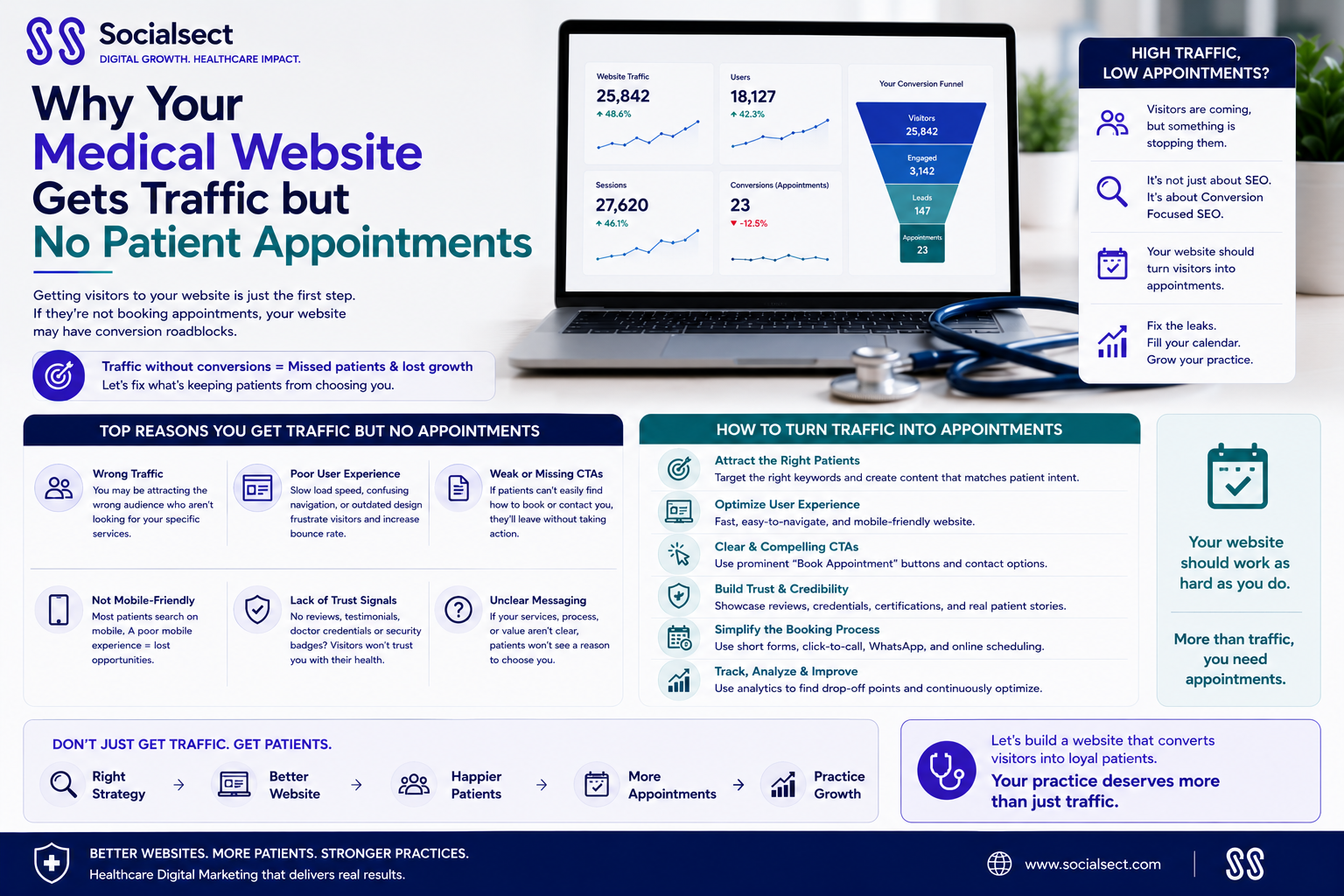
Getting traffic to a medical website is only the first part of digital growth. The bigger question is what happens after visitors arrive.
If your website receives organic traffic, Google clicks, social visitors, or paid advertising traffic but generates very few appointment requests, something is wrong with the conversion journey.
A medical website not converting is rarely caused by one issue. It may have weak calls to action, confusing navigation, poor mobile usability, slow loading pages, limited trust signals, unclear services, or content that attracts the wrong search intent.
For doctors, clinics, hospitals, and healthcare organisations, website conversion is especially important. Patients are not simply buying a product. They are deciding whether they trust a healthcare provider enough to take the next step.
This guide explains why medical websites get traffic but fail to generate patient appointments—and what you can do to improve medical website conversion.
What Does It Mean When a Medical Website Is Not Converting?
A medical website is not converting when visitors arrive but do not take meaningful actions such as:
- Booking an appointment
- Calling the clinic
- Submitting an enquiry form
- Requesting a consultation
- Finding directions to the practice
- Starting an online consultation
- Contacting the clinic through an approved communication channel
A website can have thousands of monthly visitors and still produce disappointing results if the conversion path is unclear.
This is why healthcare marketing should not focus exclusively on traffic and keyword rankings. Patient acquisition requires a connection between search visibility, useful content, trust, user experience, and conversion opportunities.
Why Your Medical Website Gets Traffic but No Patient Appointments
1. Your Website Attracts the Wrong Traffic
High traffic does not automatically mean high-quality traffic.
For example, a clinic may rank for broad informational searches such as:
- What is back pain?
- What causes headaches?
- Symptoms of knee pain
- How does physiotherapy work?
These searches can generate significant traffic, but not every visitor is ready to contact a provider.
Meanwhile, searches such as:
- Orthopaedic surgeon near me
- Book a dermatologist appointment
- IVF clinic consultation
- Private cardiologist in [city]
- Best shoulder specialist near me
often indicate stronger commercial or local intent.
If your SEO strategy focuses heavily on informational keywords without building pages around high-intent searches, your website may attract visitors who are researching rather than booking.
The solution: Review your organic keywords and traffic sources. Identify which pages attract visitors who are actually looking for a healthcare provider or service, then strengthen those pages for conversion.
2. Your Call-to-Action Is Difficult to Find
A patient should not have to search your website to figure out what to do next.
Some medical websites have a “Contact” page buried in the navigation while important service pages contain no obvious appointment option.
Your primary CTA should be easy to identify.
Depending on the practice, this could include:
Book an Appointment | Call the Clinic | Request a Consultation | Contact the Practice
The important point is consistency.
A visitor reading about a treatment should have a clear next step directly from that page.
Make Your CTA Contextual
Instead of placing the same generic button everywhere, match the CTA to the visitor's intent.
For example:
Service page:“Book a Consultation”
Doctor profile:“Request an Appointment with Dr [Name]”
Location page:“Contact Our [City] Clinic”
Urgent enquiry page:“Call the Practice”
Contextual CTAs can make the patient journey much more intuitive.
3. Your Service Pages Do Not Answer Patient Questions
A thin service page can struggle to convince visitors to take action.
Patients typically want to know:
- What does the service involve?
- Who provides it?
- Who may be suitable for it?
- What should I expect?
- Where is the service available?
- What happens during the consultation?
- What should I do next?
Your healthcare website content should answer these questions clearly without overwhelming visitors with unnecessary medical terminology.
For medical SEO, service pages should also demonstrate genuine expertise.
Include relevant information about the provider, treatment approach, clinical considerations, locations, and patient journey where appropriate.
Avoid copying generic medical content from competitors or rewriting the same information found across hundreds of websites.
Original, useful, expert-reviewed healthcare content is much more valuable than pages created simply to increase word count.
4. Your Website Does Not Build Enough Trust
Trust is one of the biggest factors influencing healthcare conversion.
Before booking an appointment, patients may want reassurance that they are dealing with a legitimate and appropriately qualified provider.
Your website should make important trust information easy to find.
Useful Healthcare Trust Signals Include:
- Doctor or practitioner profiles
- Relevant qualifications and professional memberships
- Areas of clinical expertise
- Clinic location and contact information
- Clear service information
- Appropriate patient information
- Professional photography
- Links to relevant professional or institutional profiles where appropriate
- Transparent information about the practice
- Secure and professional enquiry processes
Do not add credentials, reviews, awards, or claims that cannot be verified.
For healthcare brands, E-E-A-T—Experience, Expertise, Authoritativeness, and Trustworthiness—should influence both your content strategy and website experience.
The goal is not to make the website look impressive. It is to help patients understand who is providing their care and why the information can be trusted.
5. Your Website Is Difficult to Use on Mobile
A significant portion of healthcare searches happen on mobile devices.
Imagine a potential patient searching for a clinic while travelling or sitting at home. If the website requires excessive scrolling, tiny buttons, difficult menus, or awkward forms, they may simply leave.
A medical website should make essential actions easy on smaller screens.
Check:
- Is the phone number easy to tap?
- Is the appointment button visible?
- Are forms easy to complete?
- Can users navigate the menu quickly?
- Is text readable without zooming?
- Do images and content fit properly?
- Does the page load efficiently?
Mobile usability is not just a technical SEO consideration. It directly affects the patient's ability to contact the practice.
6. Your Website Loads Too Slowly
A slow medical website can create friction before a visitor even reads the content.
Large images, unnecessary scripts, poorly configured hosting, excessive third-party tools, and inefficient code can all contribute to performance problems.
Check important pages on both mobile and desktop.
Prioritise:
- Image optimisation
- Efficient caching
- Reduced unnecessary scripts
- Proper image dimensions
- Efficient hosting
- Clean technical implementation
- Core Web Vitals and overall page experience
Speed alone will not turn an ineffective website into a high-converting one. However, removing unnecessary friction gives visitors a better opportunity to engage with your content and CTAs.
7. Your Appointment Form Is Asking for Too Much
Long forms can discourage potential patients.
If someone wants to request an appointment but is presented with a form containing numerous unnecessary fields, they may abandon it.
Start by identifying the information the practice genuinely needs at the initial enquiry stage.
For example:
- Name
- Contact information
- Preferred appointment details
- Relevant service
- Optional message
The exact requirements depend on the practice and its operational process.
Also make sure patients understand what happens after submitting the form.
A simple message such as “Our team will contact you to discuss appointment availability” can remove uncertainty.
8. Your Website Does Not Make Local Information Clear
For clinics and medical practices, local intent can be extremely valuable.
Someone searching for a provider usually wants to know where the practice is located and whether it is convenient to reach.
Your website should clearly communicate:
- Clinic address
- Service area
- Opening hours
- Contact number
- Directions
- Parking or access information where relevant
- Individual locations for multi-location practices
Local SEO should also connect your website with an accurate and well-maintained Google Business Profile.
For multi-location healthcare organisations, create genuinely useful location pages rather than producing near-identical pages with only city names changed.
9. Your Content and Landing Pages Do Not Match Search Intent
Search intent determines what users expect to find after clicking a result.
If someone searches “knee replacement surgeon in Miami,” sending them to a generic homepage creates unnecessary friction.
They should ideally land on a relevant page explaining:
- The service
- The provider
- Relevant expertise
- Location
- What patients can expect
- How to request an appointment
Similarly, informational searches should lead to useful educational content rather than aggressive sales pages.
A strong healthcare SEO strategy maps keywords to the right type of page.
A Simple Search Intent Structure
Informational intent → Educational articles and patient resources
Commercial intent → Service and treatment pages
Local intent → Location and practice pages
Provider intent → Doctor or practitioner profiles
Transactional intent → Appointment and contact pathways
Matching content to intent can improve both organic performance and conversion potential.
10. You Are Measuring Traffic Instead of Patient Acquisition
One of the biggest mistakes in healthcare digital marketing is treating website traffic as the final KPI.
Traffic is useful, but it is only one part of the picture.
A better measurement framework looks at the complete funnel:
Search → Website Visit → Engagement → CTA Click → Enquiry → Appointment → Patient
Track actions such as:
- Appointment form submissions
- Phone clicks
- Contact form completions
- Consultation requests
- Direction requests
- Appointment-page visits
- Conversion rate by landing page
- Organic conversions
- Paid-search conversions
- Conversion rate by device
This helps identify where potential patients are dropping out.
For example, if a service page receives 5,000 visits but only 10 appointment enquiries, the problem may not be SEO traffic. It could be the page's messaging, trust signals, CTA, UX, or search-intent alignment.
How to Improve Medical Website Conversion
Fixing a medical website not converting requires more than adding another “Book Now” button.
Start with the complete patient journey.
Step 1: Identify Your Highest-Value Pages
Look at pages receiving the most organic traffic and pages targeting your highest-intent services.
Ask:
- Does this page match the keyword intent?
- Is the service clearly explained?
- Is the provider information visible?
- Is there a strong CTA?
- Can visitors easily contact the practice?
- Does the page work well on mobile?
Step 2: Improve Above-the-Fold Messaging
The first screen should quickly communicate:
What you offer + Who you help + Where you provide it + What the visitor can do next.
Avoid forcing users to scroll through multiple paragraphs before discovering the purpose of the page.
Step 3: Strengthen E-E-A-T Signals
Healthcare content should demonstrate genuine expertise rather than relying on generic marketing language.
Use accurate practitioner information, credible sources where appropriate, transparent authorship, medically responsible language, and content that reflects real clinical expertise.
Where medical content is authored or reviewed by a qualified professional, make that relationship clear and accurate.
Step 4: Test Your Conversion Paths
Do not assume your website works simply because the forms technically submit.
Test:
- Appointment forms
- Phone buttons
- Contact forms
- Booking links
- Mobile navigation
- Location information
- Confirmation messages
A broken or confusing conversion path can waste otherwise valuable SEO and advertising traffic.
SEO Traffic and Conversion Rate Must Work Together
SEO and conversion optimisation should not operate as separate strategies.
SEO helps the right people discover your website. Conversion optimisation helps them take the next appropriate step.
For a healthcare practice, the goal should not simply be:
“Get more website visitors.”
It should be:
“Attract relevant patients and make it easy for them to take the next step.”
That means combining healthcare SEO, local SEO, technical SEO, helpful content, E-E-A-T, UX, analytics, and conversion optimisation into one patient acquisition strategy.
Final Thoughts
If your medical website receives traffic but generates very few appointments, do not immediately assume you need more traffic.
First determine why existing visitors are not converting.
The problem could be poor search-intent targeting, weak service pages, unclear CTAs, insufficient trust signals, mobile UX issues, slow performance, complicated forms, or a disconnected patient journey.
A high-performing healthcare website should do more than rank in Google. It should clearly communicate expertise, build trust, answer patient questions, and provide an easy path toward contacting the practice.
If your medical website is not converting, a detailed SEO and conversion audit can reveal where potential patients are dropping off—and which improvements are most likely to create meaningful growth.