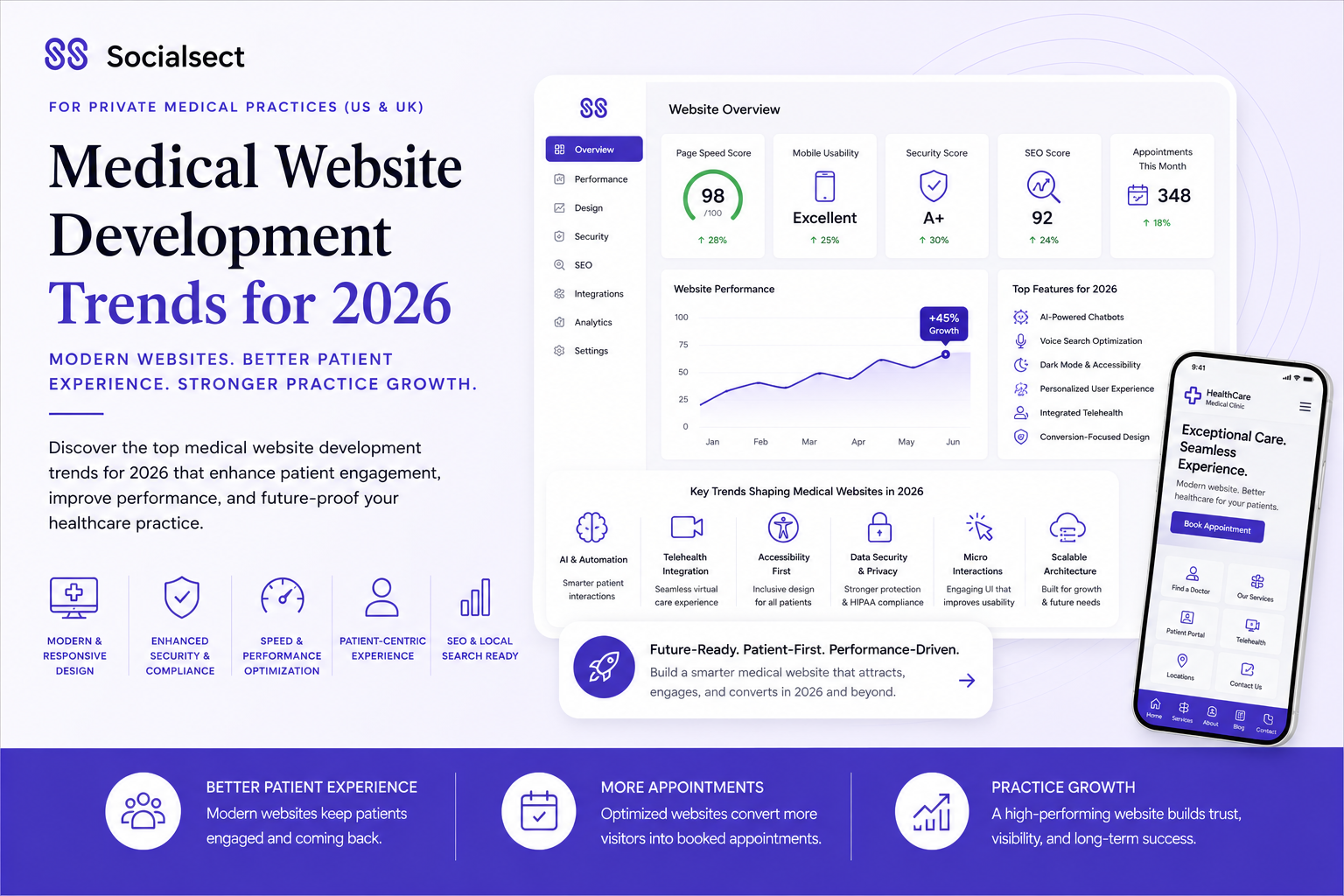
Healthcare websites are evolving rapidly as patient expectations, search technologies, artificial intelligence, and healthcare regulations continue to reshape the digital landscape. In 2026, healthcare organizations can no longer rely on basic websites that simply display contact information and services. Modern healthcare websites must deliver exceptional user experiences, support patient engagement, meet compliance requirements, and perform effectively across both traditional and AI-powered search environments.
The future of medical website development focuses on patient-centered experiences, AI optimization, mobile-first performance, accessibility, security, and seamless integration with healthcare technologies. Healthcare organizations that adopt these innovations will be better positioned to attract patients, improve trust, and increase online conversions.
At Socialsect, we help healthcare organizations build future-ready websites that combine advanced functionality, search visibility, and exceptional patient experiences.
Why Medical Website Development Is Changing
Healthcare consumers have become increasingly digital.
Before scheduling appointments, patients often:
- Search online for providers
- Compare healthcare websites
- Read reviews
- Research treatments
- Evaluate credentials
- Access educational resources
As a result, healthcare websites have become one of the most important patient acquisition tools.
Modern healthcare website development must support:
- Patient trust
- Search visibility
- Appointment generation
- Accessibility
- Compliance
- Mobile usability
The websites that succeed in 2026 will be those that prioritize both user needs and technological innovation.
Trend #1: AI-Ready Healthcare Websites
Artificial intelligence is transforming how patients discover healthcare information.
Search experiences increasingly include:
- Google AI Overviews
- AI-powered assistants
- Voice search
- Large language models
Future-focused medical website development must be optimized for AI-driven search.
Key requirements include:
Structured Content
Organized information improves AI understanding.
Question-Based Content
Addresses patient search intent directly.
FAQ Sections
Support Answer Engine Optimization (AEO).
Schema Markup
Provides search engines with additional context.
AI-ready websites improve discoverability and future-proof search visibility.
Trend #2: Healthcare UX Design Takes Center Stage
One of the most significant medical website trends for 2026 is the growing emphasis on user experience.
Patients expect healthcare websites to be:
- Easy to navigate
- Fast-loading
- Informative
- Mobile-friendly
- Accessible
Strong healthcare UX design helps visitors quickly find:
- Providers
- Services
- Locations
- Appointment scheduling
- Contact information
Poor user experiences often result in lost patients and lower conversion rates.
Healthcare UX has become a competitive advantage.
Trend #3: Mobile-First Medical Web Development
Mobile traffic continues to dominate healthcare searches.
Patients increasingly search for:
- Doctors near me
- Urgent care clinics
- Dental appointments
- Telehealth services
As a result, medical web development must prioritize mobile performance.
Best practices include:
Responsive Layouts
Adapt seamlessly across devices.
Fast Page Speeds
Reduce abandonment rates.
Simplified Navigation
Improve usability.
Mobile Appointment Booking
Make scheduling easier.
Mobile-first development will remain a core priority throughout 2026.
Trend #4: HIPAA Compliant Websites Become Standard
Data privacy remains one of the most important concerns in healthcare.
Healthcare organizations must protect sensitive patient information while maintaining user trust.
Modern HIPAA compliant websites include:
Secure Data Transmission
Encrypted communication channels.
Protected Contact Forms
Secure patient inquiries.
Access Controls
Restrict unauthorized access.
Data Privacy Policies
Provide transparency regarding information handling.
Compliance is no longer optional—it is expected by both patients and regulators.
Trend #5: Personalized Patient Experiences
Patients increasingly expect personalized digital experiences.
Future healthcare websites will use data and technology to provide:
- Customized content
- Relevant service recommendations
- Personalized appointment scheduling
- Location-specific information
Personalization improves:
- Engagement
- Patient satisfaction
- Conversion rates
This trend is reshaping modern healthcare web design.
Trend #6: Advanced Appointment Scheduling Systems
Online scheduling has become a standard expectation.
Healthcare websites in 2026 will increasingly integrate:
Real-Time Availability
Patients can view open appointments instantly.
Telehealth Scheduling
Support virtual consultations.
Automated Reminders
Reduce no-show rates.
Self-Service Management
Allow patients to modify appointments.
Convenience plays a major role in patient acquisition and retention.
Trend #7: Voice Search Optimization
Voice search continues to grow across healthcare.
Patients commonly ask:
- Where is the nearest dermatologist?
- What is a fertility consultation?
- How much does a dental implant cost?
Healthcare websites should optimize content for conversational queries.
Voice search optimization includes:
Natural Language Content
Reflect how people speak.
Direct Answers
Provide concise responses.
FAQ Sections
Support voice search visibility.
This trend aligns closely with AEO and AI optimization strategies.
Trend #8: Enhanced Healthcare Website Features
Modern healthcare websites require more than basic functionality.
Important healthcare website features include:
Online Appointment Booking
Simplifies scheduling.
Provider Profiles
Builds trust.
Patient Portals
Improves engagement.
Telehealth Integration
Supports virtual care.
Secure Messaging
Enhances communication.
Educational Resource Centers
Provides valuable information.
Healthcare websites increasingly function as digital patient engagement platforms.
Trend #9: Accessibility-First Design
Accessibility is becoming a major focus of healthcare digital experiences.
Healthcare websites should support users with varying needs.
Accessibility improvements include:
Screen Reader Compatibility
Improves usability.
Keyboard Navigation
Supports diverse users.
Readable Typography
Enhances accessibility.
Color Contrast Compliance
Improves readability.
Accessible design benefits both users and search performance.
Trend #10: Integrated Healthcare Technology Ecosystems
Healthcare websites increasingly connect with:
- Electronic Medical Records
- Practice Management Systems
- Patient Portals
- CRM Platforms
- Marketing Automation Tools
These integrations streamline operations and improve patient experiences.
Modern healthcare website development focuses on creating connected digital ecosystems rather than standalone websites.
Trend #11: Healthcare SEO and AI Optimization Convergence
Traditional SEO is evolving.
Modern websites must optimize for:
Search Engines
Google and Bing rankings.
AI Systems
Large language models and AI assistants.
Answer Engines
Featured snippets and direct answers.
Voice Search
Conversational queries.
This convergence represents one of the most important medical website trends for 2026.
Trend #12: Trust-Centered Website Design
Healthcare websites must demonstrate trust immediately.
Visitors often evaluate:
- Credentials
- Certifications
- Reviews
- Experience
- Treatment outcomes
Strong trust-building elements include:
Patient Testimonials
Provide social proof.
Physician Profiles
Highlight expertise.
Awards and Certifications
Support authority.
Transparent Information
Build credibility.
Trust directly influences patient decisions.
EEAT and the Future of Healthcare Websites
Google continues emphasizing EEAT.
Healthcare organizations should focus on:
Experience
Show real patient outcomes and clinical expertise.
Expertise
Highlight qualifications and training.
Authoritativeness
Publish educational healthcare content.
Trustworthiness
Maintain transparency and accuracy.
Future healthcare web design strategies must incorporate these principles throughout the website.
Common Mistakes Healthcare Organizations Should Avoid
Many healthcare providers fall behind because they:
Ignore Mobile Optimization
Hurting user experience and rankings.
Neglect Security
Creating compliance risks.
Publish Thin Content
Limiting visibility.
Lack AI Optimization
Reducing discoverability.
Use Outdated Designs
Undermining patient trust.
Avoiding these issues helps organizations stay competitive.
Why Healthcare Providers Choose Socialsect
At Socialsect, we specialize in future-ready healthcare websites that combine design, functionality, and performance.
Our expertise includes:
- Medical website development
- Healthcare website development
- Healthcare UX design
- HIPAA compliant websites
- Healthcare web design
- AI-ready content architecture
- SEO optimization
- Conversion-focused design
- Healthcare website features implementation
We help healthcare organizations build websites that attract patients, strengthen trust, and support long-term growth.
The Future of Healthcare Website Development
Healthcare websites will continue evolving through:
- Artificial intelligence
- Personalization
- Automation
- Voice search
- Advanced patient engagement tools
- Enhanced security frameworks
Organizations that invest in modern development strategies today will be better prepared for tomorrow's healthcare landscape.
Conclusion
The future of medical website development extends far beyond visual design. Healthcare websites in 2026 must support patient acquisition, user experience, AI discoverability, compliance, accessibility, and operational efficiency.
From advanced healthcare website features and mobile-first experiences to HIPAA compliant websites, AI optimization, and modern healthcare UX design, successful healthcare websites will combine technology, trust, and usability.
At Socialsect, we help healthcare organizations embrace these trends and create digital experiences that support sustainable growth, stronger patient relationships, and long-term success.