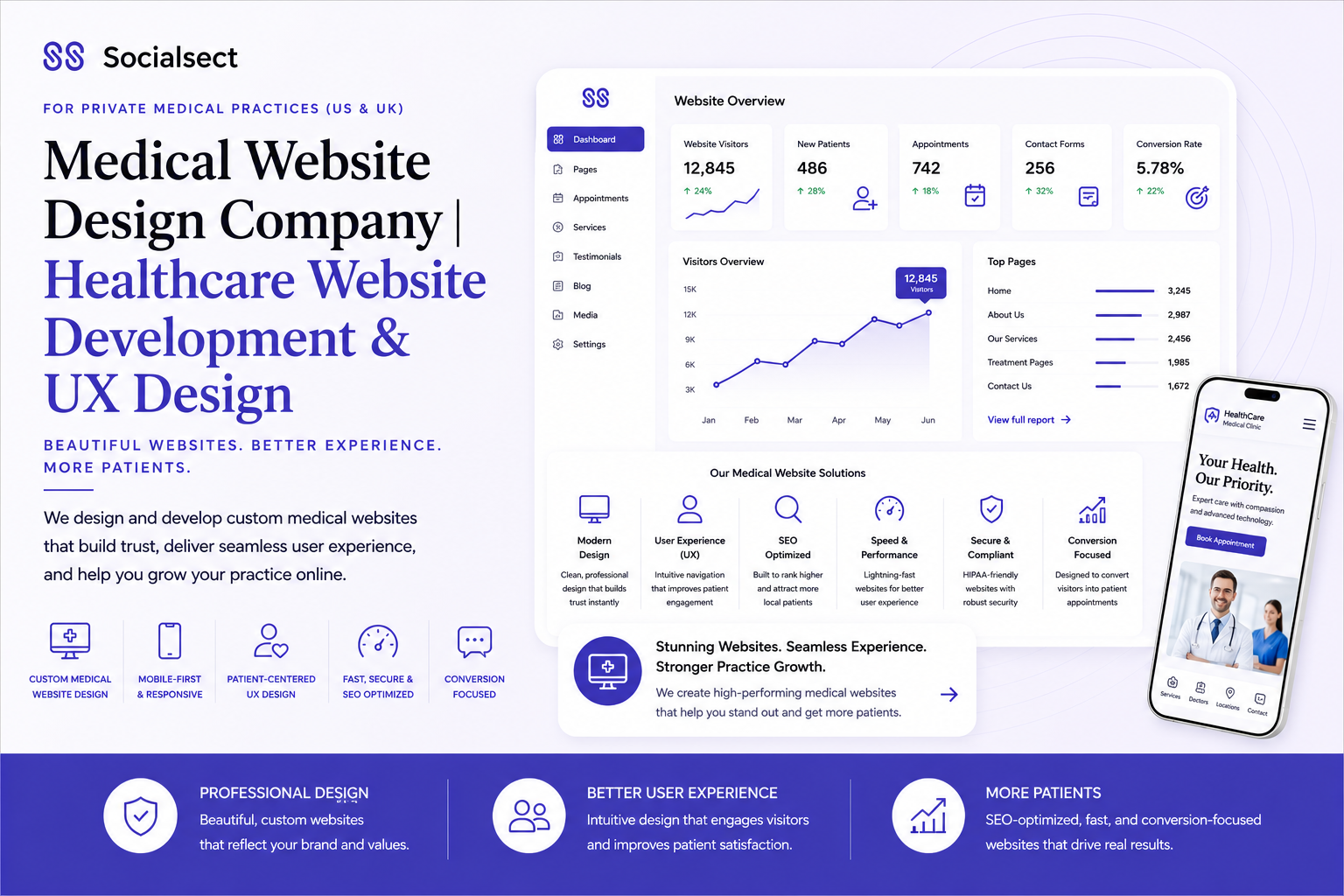
Medical Website Design Company | Healthcare Website Development & UX Design
A professional healthcare website is often the first interaction a patient has with a medical practice, clinic, hospital, or healthcare brand. Modern patients expect websites that load quickly, work seamlessly on mobile devices, provide easy access to information, and allow them to book appointments with minimal effort.
A trusted medical website design company helps healthcare organizations create websites that combine excellent user experience, strong SEO foundations, patient-focused design, and conversion optimization. Through strategic healthcare website development, healthcare providers can improve patient acquisition, strengthen trust, and enhance their online presence.
At Socialsect, we believe that successful healthcare websites should not only look professional but also function as powerful patient acquisition and engagement tools.
Why Healthcare Organizations Need Professional Website Design
Healthcare consumers have changed significantly over the last decade.
Before scheduling an appointment, patients often:
- Search for healthcare providers online
- Compare treatment options
- Read patient reviews
- Verify credentials
- Review services offered
- Check insurance information
- Browse clinic websites
Your website serves as your digital front door.
An outdated, slow, or poorly structured website can negatively impact patient trust and conversion rates.
This is why investing in professional medical website development has become essential for healthcare organizations seeking sustainable growth.
The Role of a Medical Website Design Company
A specialized medical website design company understands the unique challenges of healthcare marketing.
Unlike general web design agencies, healthcare-focused teams understand:
- Patient behavior
- Medical compliance requirements
- Healthcare SEO
- Accessibility standards
- Healthcare user experience
- Patient conversion journeys
The goal is not simply to create attractive websites.
The objective is to build platforms that help patients find information, trust providers, and book appointments.
Essential Features of Modern Healthcare Websites
Mobile-Responsive Design
Today, the majority of healthcare-related searches occur on smartphones and tablets.
Patients search for:
- Doctors near me
- Dermatologist appointments
- Dental clinics
- Plastic surgeons
- Orthopedic specialists
If your website fails to perform well on mobile devices, you risk losing valuable opportunities.
Responsive medical websites automatically adapt to different screen sizes and provide a consistent experience across all devices.
Benefits include:
- Improved user experience
- Better SEO performance
- Higher engagement
- Increased appointment requests
Mobile responsiveness is now a core requirement in modern healthcare website development.
Fast Loading Speed
Website speed directly affects patient engagement.
Research consistently shows that users leave websites that take too long to load.
Fast-loading websites contribute to:
- Better search rankings
- Lower bounce rates
- Improved user satisfaction
- Higher conversion rates
Professional medical website development focuses heavily on performance optimization and Core Web Vitals.
Clear Navigation Structure
Patients should be able to find information quickly.
A well-organized navigation menu helps users access:
- Services
- Treatments
- Provider profiles
- Locations
- Insurance information
- Contact details
Simple navigation enhances both usability and patient satisfaction.
Online Appointment Scheduling
Convenience is one of the most important factors in healthcare user experience.
Patients increasingly expect online booking functionality.
An effective scheduling system should:
- Display available time slots
- Send appointment confirmations
- Integrate with practice management systems
- Work seamlessly on mobile devices
This feature improves operational efficiency while enhancing patient convenience.
The Importance of Healthcare UX Design
One of the most overlooked aspects of healthcare websites is user experience.
Healthcare UX design focuses on making websites intuitive, accessible, and patient-centered.
Healthcare users often visit websites while:
- Experiencing symptoms
- Seeking urgent care
- Researching treatments
- Comparing providers
Complex navigation or confusing layouts create friction.
Good UX design removes barriers and helps users accomplish their goals quickly.
Key Elements of Healthcare UX Design
Readable Content
Medical information should be easy to understand.
Avoid unnecessary jargon and present information clearly.
Accessible Design
Healthcare websites should support users with different abilities.
Accessibility features include:
- Alternative text for images
- Keyboard navigation
- Screen reader compatibility
- Proper contrast ratios
Clear Calls-to-Action
Patients should immediately know what actions they can take.
Examples include:
- Schedule Appointment
- Request Consultation
- Contact Our Team
- Find a Provider
Effective CTAs improve conversion rates.
Why Custom Healthcare Websites Outperform Generic Templates
Many healthcare providers initially choose generic website templates.
While templates may appear cost-effective, they often limit growth.
Custom healthcare websites provide:
- Unique branding
- Better performance
- Scalability
- Enhanced SEO capabilities
- Improved patient experience
Custom development allows healthcare organizations to build websites aligned with their specific goals and workflows.
SEO and Website Development Go Hand in Hand
A beautiful website has limited value if patients cannot find it.
Professional healthcare website development incorporates SEO from the beginning.
This includes:
- Search-friendly architecture
- Optimized page speed
- Mobile responsiveness
- Structured data
- Local SEO optimization
- Metadata implementation
SEO-friendly websites attract more qualified traffic and generate more appointment requests.
Healthcare Website Development for Different Medical Specialties
Different healthcare organizations require unique website strategies.
Examples include:
Dermatology Clinics
Focus areas:
- Treatment pages
- Before-and-after galleries
- Online consultations
Dental Practices
Focus areas:
- Appointment scheduling
- Service pages
- Patient education
Plastic Surgery Clinics
Focus areas:
- Visual content
- Consultation requests
- Patient testimonials
Orthopedic Clinics
Focus areas:
- Treatment guides
- Specialist profiles
- Location pages
A specialized healthcare web design agency understands how these requirements differ across specialties.
AI Search, AEO, and LLM Optimization for Healthcare Websites
Search behavior is evolving rapidly.
Patients now receive answers through:
- Google AI Overviews
- Voice assistants
- AI-powered search engines
- Large language models
Healthcare websites should be structured to support these technologies.
Answer Engine Optimization (AEO)
AEO focuses on providing direct answers to common patient questions.
Examples:
What is telehealth?
Telehealth allows patients to receive healthcare services remotely through video, phone, or online communication.
How often should I visit a dentist?
Most patients should schedule dental checkups every six months.
Direct answers improve visibility in featured snippets and AI-generated responses.

LLM Optimization
Large language models prioritize:
- Well-structured content
- Clear headings
- Expert-backed information
- Trusted sources
- Comprehensive coverage
Content should be written in a way that AI systems can easily understand and reference.
Trust and EEAT in Healthcare Websites
Healthcare falls under Google's Your Money or Your Life (YMYL) category.
As a result, trust signals are extremely important.
Strong EEAT includes:
Experience
Showcase real patient outcomes and provider expertise.
Expertise
Highlight credentials, certifications, and medical training.
Authoritativeness
Demonstrate leadership within the healthcare industry.
Trustworthiness
Provide accurate information, privacy policies, and secure website functionality.
A professional healthcare web development agency should incorporate these trust elements throughout the website.
Conversion-Focused Website Features
Generating traffic is only part of the equation.
Successful websites convert visitors into patients.
High-converting healthcare websites include:
Contact Forms
Simple and easy to complete.
Click-to-Call Functionality
Especially important for mobile users.
Live Chat
Provides immediate assistance.
Testimonials
Build trust and credibility.
Provider Profiles
Help patients feel confident in their healthcare decisions.
Common Healthcare Website Mistakes
Avoid these common issues:
Slow Website Performance
Impacts rankings and user satisfaction.
Poor Mobile Experience
Drives potential patients away.
Weak SEO Structure
Reduces visibility in search engines.
Outdated Design
Creates negative impressions.
Complicated Navigation
Makes information difficult to find.
Lack of Conversion Paths
Reduces appointment requests.
Why Healthcare Providers Choose Socialsect
At Socialsect, we specialize in building websites designed specifically for healthcare organizations.
Our approach combines:
- Healthcare-focused strategy
- Modern UX principles
- SEO-first development
- Conversion optimization
- Mobile responsiveness
- AI-ready content architecture
As a dedicated medical website design company, our goal is to create websites that help healthcare providers attract more patients, strengthen credibility, and achieve long-term growth.
Whether you need complete medical website development, advanced healthcare UX design, or fully custom healthcare websites, our team focuses on delivering measurable results.
Conclusion
A healthcare website is much more than a digital brochure. It serves as a critical patient acquisition, engagement, and trust-building tool.
By investing in professional healthcare website development, strong healthcare UX design, responsive functionality, and SEO best practices, healthcare organizations can significantly improve their online performance.
As patient expectations continue to evolve, providers that prioritize user experience, accessibility, AI optimization, and conversion-focused design will be best positioned for future success.
Working with an experienced healthcare web design agency such as Socialsect ensures your website is designed not only for today's users but also for tomorrow's search technologies.