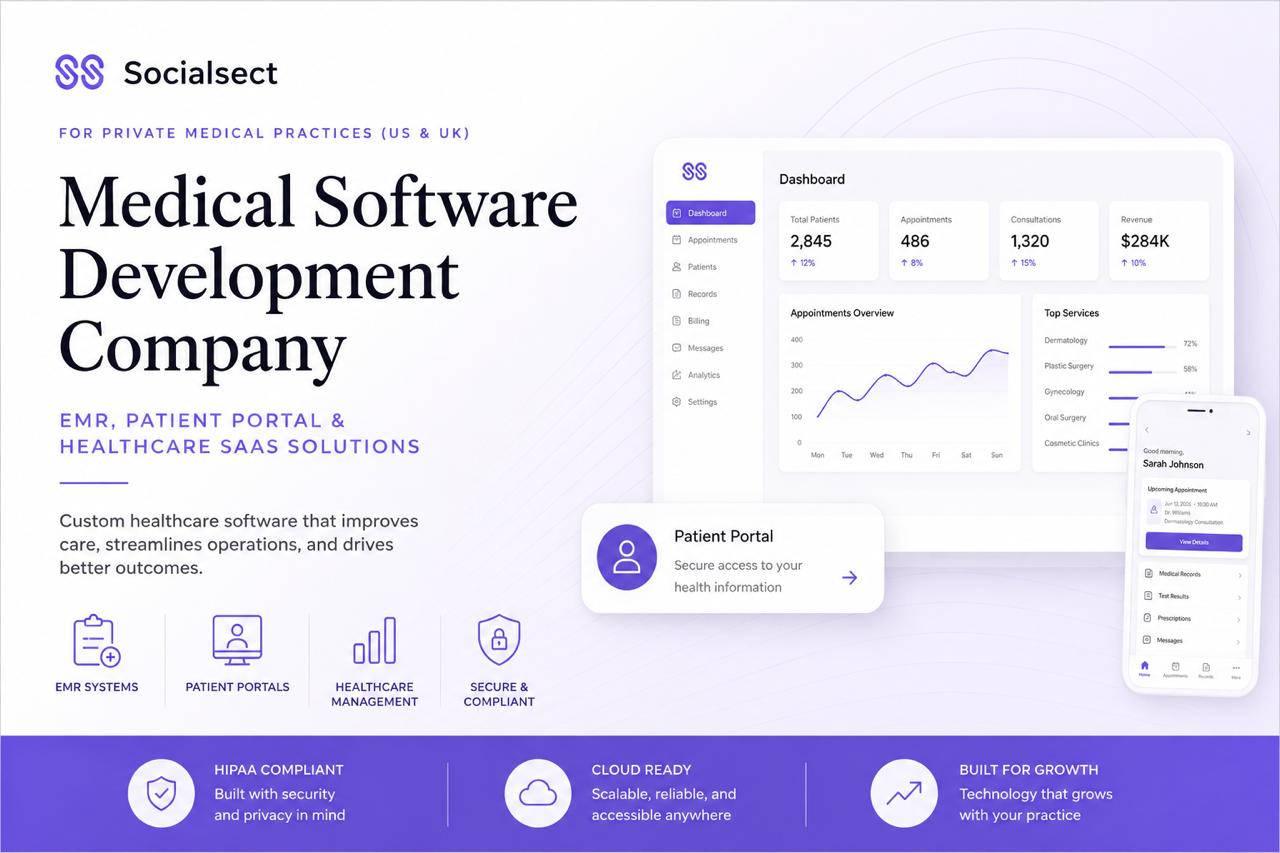
Healthcare organizations are rapidly embracing digital transformation to improve patient care, streamline operations, and manage growing volumes of healthcare data. Modern healthcare providers require intelligent software systems that connect patients, providers, administrators, and healthcare resources through a secure and scalable digital ecosystem.
Professional medical software development helps healthcare organizations build customized technology solutions such as Electronic Medical Record (EMR) systems, patient portals, healthcare CRM platforms, healthcare management software, and cloud-based healthcare applications. These systems improve efficiency, support regulatory compliance, enhance patient engagement, and enable better healthcare outcomes.
At Socialsect, we specialize in healthcare-focused software solutions that combine innovation, security, scalability, and user-centric design to meet the evolving needs of healthcare providers, clinics, hospitals, and healthcare startups.
Why Healthcare Organizations Need Custom Medical Software
The healthcare industry generates enormous amounts of data every day.
Managing appointments, patient records, treatment histories, billing information, and communication manually creates inefficiencies and increases administrative burdens.
Modern healthcare software helps organizations:
- Improve patient experiences
- Streamline workflows
- Reduce operational costs
- Enhance data accessibility
- Improve provider productivity
- Support compliance requirements
- Enable data-driven decision-making
As healthcare becomes increasingly digital, custom medical software development has become essential for organizations seeking long-term growth and operational excellence.
What Is Medical Software Development?
Medical software development refers to the design, development, deployment, and maintenance of software solutions specifically created for healthcare organizations.
These solutions may include:
- Electronic Medical Records (EMR)
- Patient Portals
- Healthcare CRM Systems
- Telemedicine Platforms
- Practice Management Systems
- Healthcare SaaS Applications
- Appointment Management Platforms
- Clinical Workflow Software
Healthcare software differs from traditional business software because it must address patient privacy, regulatory compliance, data security, and complex healthcare workflows.
EMR Software Development: The Foundation of Digital Healthcare
One of the most important areas of healthcare technology is EMR software development.
Electronic Medical Records provide centralized access to patient information and enable healthcare providers to manage clinical data efficiently.
EMR systems typically include:
- Patient histories
- Clinical notes
- Prescriptions
- Laboratory results
- Imaging reports
- Treatment plans
- Billing information
Benefits of EMR software include:
Improved Clinical Efficiency
Healthcare providers can quickly access complete patient records.
Better Care Coordination
Information can be shared securely between healthcare professionals.
Reduced Administrative Work
Automated documentation reduces paperwork and manual tasks.
Enhanced Patient Safety
Accurate and accessible medical records help minimize errors.
Modern EMR platforms are a critical component of digital healthcare infrastructure.
Healthcare Management Software for Operational Excellence
Healthcare organizations rely on multiple departments and workflows.
Healthcare management software helps coordinate these processes through centralized systems.
Key features often include:
- Appointment scheduling
- Staff management
- Billing and invoicing
- Reporting and analytics
- Resource allocation
- Inventory management
Healthcare management platforms help improve operational efficiency while reducing administrative complexity.
Patient Portal Development: Empowering Patients
Today's patients expect greater control over their healthcare experiences.
This has increased demand for patient portal development solutions.
Patient portals provide secure online access to:
- Medical records
- Test results
- Appointment scheduling
- Prescription requests
- Provider communication
- Billing information
Benefits for patients include:
- Increased convenience
- Better engagement
- Improved healthcare transparency
Benefits for providers include:
- Reduced administrative workload
- Improved communication
- Enhanced patient satisfaction
Patient portals have become a key component of modern healthcare delivery.
Cloud Based Healthcare Software: The Future of Healthcare Technology
Traditional on-premise systems often struggle to meet modern healthcare demands.
This is why many organizations are adopting cloud based healthcare software solutions.
Cloud platforms offer:
Scalability
Organizations can expand resources as needed.
Accessibility
Authorized users can securely access information from multiple locations.
Cost Efficiency
Reduced infrastructure and maintenance costs.
Data Security
Advanced security measures help protect sensitive healthcare information.
Cloud technologies continue to drive innovation across healthcare organizations of all sizes.
Healthcare CRM Development for Better Patient Relationships
Patient engagement has become a major priority for healthcare providers.
Healthcare CRM development helps organizations build stronger relationships with patients through centralized communication and engagement systems.
Healthcare CRM platforms may include:
- Patient communication tools
- Appointment reminders
- Marketing automation
- Patient segmentation
- Follow-up workflows
- Referral tracking
Benefits include:
- Improved patient retention
- Better communication
- Increased appointment attendance
- Enhanced patient experiences
Healthcare CRM systems help organizations deliver more personalized care experiences.
Healthcare Web App Development for Modern Healthcare Delivery
Web applications provide healthcare providers with flexible, accessible solutions.
Healthcare web app development enables organizations to build browser-based platforms that support:
- Clinical workflows
- Telehealth services
- Patient management
- Administrative operations
- Healthcare analytics
Advantages include:
- Cross-device compatibility
- Reduced deployment complexity
- Easier maintenance
- Improved accessibility
Healthcare web applications continue to play a vital role in digital healthcare transformation.
Healthcare Portal Development: Connecting Providers and Patients
Healthcare organizations often require portals that support multiple user groups.
Healthcare portal development focuses on creating secure platforms for:
- Patients
- Physicians
- Administrative staff
- Insurance providers
- Care coordinators
Portal solutions may include:
Patient Portals
Providing healthcare information and communication tools.
Physician Portals
Supporting clinical workflows and patient management.
Administrative Portals
Managing scheduling, billing, and operational tasks.
Well-designed healthcare portals improve communication and collaboration across healthcare ecosystems.
Medical Web Application Development for Specialized Healthcare Needs
Healthcare organizations often require customized digital solutions.
Medical web application development supports specialized use cases such as:
- Specialty clinic management
- Telemedicine services
- Diagnostic workflows
- Research platforms
- Healthcare analytics
- Population health management
Custom web applications allow healthcare organizations to address unique operational challenges while maintaining flexibility and scalability.
Healthcare SaaS Development: Scalable Healthcare Innovation
Software-as-a-Service has transformed healthcare technology.
Healthcare SaaS development enables organizations to deliver cloud-based healthcare solutions through subscription models.
Examples include:
- EMR platforms
- Telemedicine systems
- Healthcare CRMs
- Practice management software
- Patient engagement platforms
Benefits of SaaS healthcare solutions include:
Lower Upfront Costs
Organizations avoid major infrastructure investments.
Continuous Updates
Providers receive new features and security improvements automatically.
Scalability
Solutions grow alongside organizational needs.
Accessibility
Authorized users can access systems from virtually anywhere.
Healthcare SaaS models continue to drive innovation throughout the industry.
Security and Compliance in Medical Software Development
Healthcare software handles highly sensitive information.
Security and compliance must be integrated throughout the development process.
Key considerations include:
- HIPAA compliance
- GDPR compliance
- Data encryption
- Role-based access control
- Audit logging
- Secure authentication
- Disaster recovery planning
Security is not simply a feature—it is a foundational requirement for healthcare technology.
AI, AEO, and LLM Optimization in Healthcare Software
Artificial intelligence is transforming healthcare operations.
Modern healthcare software increasingly incorporates:
- AI-powered analytics
- Predictive healthcare insights
- Automated workflows
- Intelligent patient engagement
- Clinical decision support
Healthcare organizations are also adapting their digital content for:
Answer Engine Optimization (AEO)
Providing direct answers to healthcare questions.
AI Optimization (AIO)
Structuring content for AI-powered search experiences.
LLM Optimization
Ensuring healthcare content is easily understood by large language models.
These approaches help improve discoverability and user engagement.
Building Trust Through EEAT Principles
Healthcare technology providers must demonstrate expertise and trustworthiness.
Strong EEAT signals include:
Experience
Showcasing healthcare technology implementation expertise.
Expertise
Demonstrating technical and healthcare industry knowledge.
Authoritativeness
Establishing leadership within healthcare technology.
Trustworthiness
Prioritizing security, compliance, transparency, and reliability.
These factors are especially important in healthcare-related digital solutions.
Why Healthcare Organizations Choose Socialsect
At Socialsect, we understand the complexities of healthcare technology and software development.
Our expertise includes:
- Medical software development
- EMR software development
- Patient portal development
- Healthcare CRM development
- Healthcare management software
- Healthcare web app development
- Healthcare portal development
- Medical web application development
- Healthcare SaaS development
- Cloud based healthcare software
We focus on creating scalable, secure, and future-ready healthcare solutions that improve operational efficiency and patient experiences.
The Future of Medical Software Development
Healthcare technology will continue evolving rapidly over the next decade.
Future innovations will likely include:
- AI-driven healthcare automation
- Advanced predictive analytics
- Integrated patient ecosystems
- Remote monitoring platforms
- Intelligent clinical decision support
- Personalized patient experiences
Organizations investing in modern healthcare software today are positioning themselves for future growth and competitive advantage.
Conclusion
Healthcare organizations require technology solutions that support both operational efficiency and exceptional patient experiences.
Whether you're seeking EMR software development, patient portal development, healthcare CRM development, healthcare management software, or advanced healthcare SaaS development, choosing the right development partner is critical.
Professional medical software development enables healthcare organizations to streamline operations, improve patient engagement, strengthen security, and support long-term digital transformation.
At Socialsect, we help healthcare providers build innovative software solutions designed to meet today's challenges while preparing for tomorrow's opportunities.