Search visibility has become an important part of how patients discover doctors, clinics, hospitals, specialists, and healthcare organizations.
Someone looking for a cardiologist may search for a physician by name. Another person may search for a nearby hospital, a treatment, a symptom, or a specific healthcare service.
Although these searches all fall within the broader healthcare industry, the SEO strategy required to reach those audiences can be different.
This is where the question of medical SEO vs healthcare SEO becomes important.
The terms are sometimes used interchangeably, but they can describe different areas of search engine optimization.
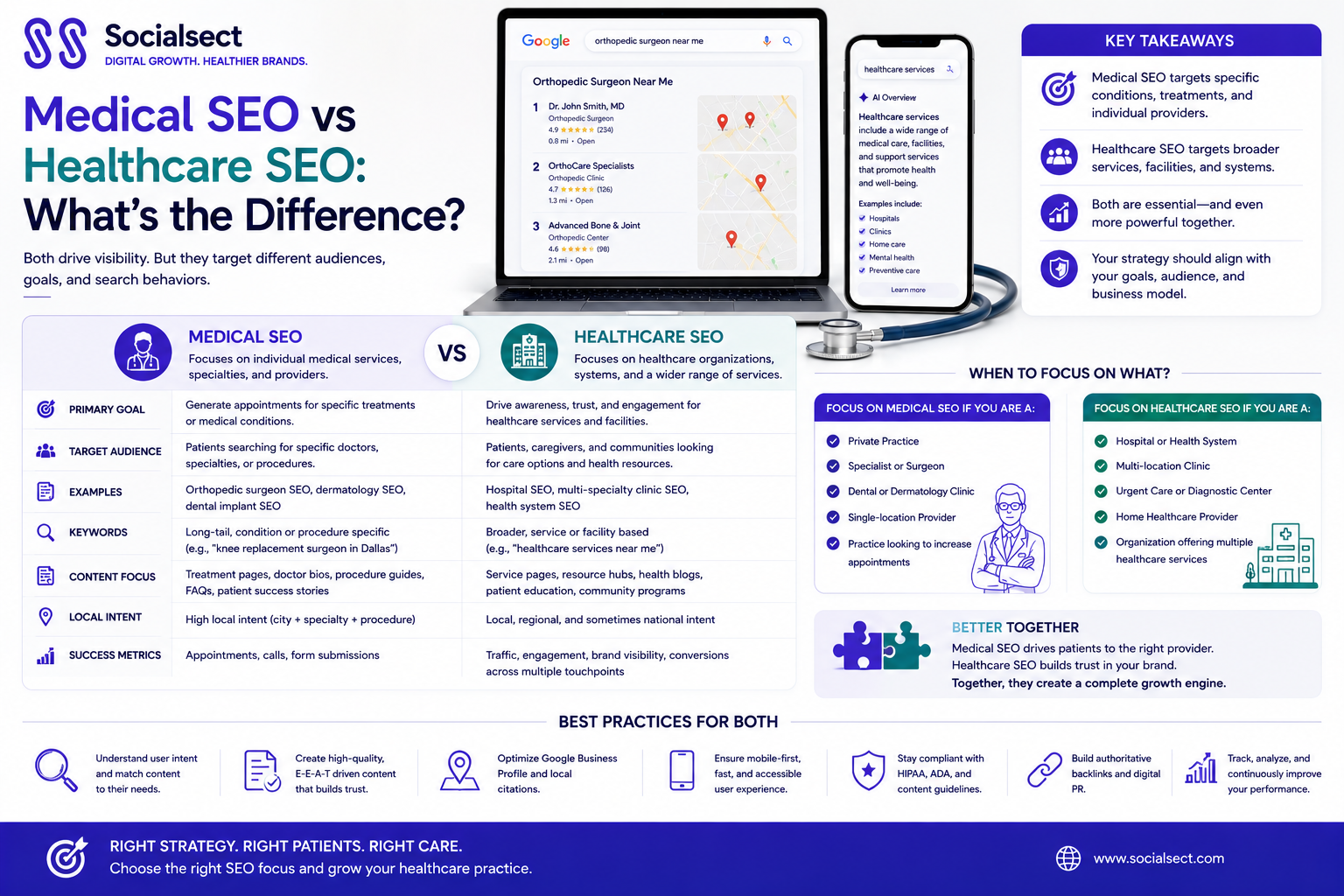
Medical SEO generally focuses more heavily on individual medical professionals, medical practices, clinics, specialties, treatments, and patient-facing clinical services.
Healthcare SEO is broader. It can encompass hospitals, healthcare networks, health systems, medical groups, healthcare technology companies, healthcare organizations, clinics, providers, and other healthcare-related businesses.
Both require strong technical SEO, useful content, trust, local visibility, and a patient-focused experience.
However, the scale, audience, content architecture, and business objectives can differ significantly.
This guide explains the difference between medical SEO and healthcare SEO, when each strategy is appropriate, and how healthcare organizations can build an effective search strategy.
What Is Medical SEO?
Medical SEO is the practice of optimizing websites and online resources for medical practices, doctors, specialists, clinics, and patient-focused healthcare services.
The primary objective is often to help potential patients discover:
- Doctors
- Specialists
- Medical practices
- Treatments
- Procedures
- Conditions
- Local clinics
- Consultation services
For example, a medical practice may target searches such as:
- Cardiologist in Miami
- Orthopedic surgeon near me
- Dermatologist for acne
- Spine specialist in New York
- Cataract surgeon near me
The strategy typically focuses heavily on patient acquisition.
What Is Healthcare SEO?
Healthcare SEO is a broader digital search strategy covering organizations across the healthcare ecosystem.
It can include:
- Hospitals
- Health systems
- Multi-specialty groups
- Clinic networks
- Healthcare franchises
- Medical groups
- Specialty clinics
- Healthcare organizations
- Healthcare technology businesses
- Healthcare service providers
A healthcare organization's search strategy may involve thousands of pages and multiple audiences.
For example, a hospital group may need SEO for:
- Emergency services
- Cardiology
- Oncology
- Orthopedics
- Women's health
- Neurology
- Locations
- Physicians
- Patient resources
- Insurance information
- Health education
This creates a much broader SEO environment.
Medical SEO vs Healthcare SEO: The Core Difference
The simplest way to understand medical SEO vs healthcare SEO is:
Medical SEO often focuses on helping patients find specific medical providers, practices, treatments, and services, while healthcare SEO can encompass a much broader organization, audience, and digital ecosystem.
There is significant overlap.
Both require:
- Technical SEO
- Content optimization
- Local SEO
- EEAT
- Keyword research
- Search intent analysis
- Internal linking
- Conversion optimization
- Reputation management
The difference is primarily in scope, scale, audience, and business objectives.
Medical SEO vs Healthcare SEO: Comparison
Area
Medical SEO
Healthcare SEO
Primary focus
Doctors, practices, clinics
Healthcare organizations and networks
Typical scale
Small to medium
Medium to enterprise
Main audience
Patients
Patients, caregivers, professionals, organizations
Local SEO
Extremely important
Important, especially for locations
Physician profiles
Core asset
Often part of larger architecture
Content
Conditions, treatments, services
Broader healthcare topics
Website structure
Relatively focused
Often complex
Multiple locations
Possible
Frequently significant
Patient acquisition
Major objective
Important but broader
Technical complexity
Moderate to high
Often high
Enterprise SEO
Sometimes
Frequently
Brand management
Practice-focused
Organization-wide
Medical SEO Focuses on Patient Intent
Medical SEO usually has a direct relationship with patient search intent.
A patient might search:
"Shoulder surgeon near me."
That search has a clear local and commercial purpose.
A strong medical SEO strategy would connect the searcher with:
- Relevant surgeon
- Specialty
- Treatment
- Location
- Credentials
- Patient information
- Appointment option
Medical websites should therefore make it easy for patients to understand who provides care and how to contact the practice.
Healthcare SEO Can Target Multiple Audiences
Healthcare SEO can have a much broader audience.
Depending on the organization, content may be created for:
- Patients
- Caregivers
- Referring physicians
- Healthcare professionals
- Researchers
- Employees
- Business partners
For example, a hospital network may need both patient education and institutional content.
A healthcare technology company might target healthcare executives and organizations rather than individual patients.
Therefore, keyword research and content architecture need to reflect the actual business model.
The Importance of EEAT in Both Strategies
The healthcare industry is highly sensitive to accuracy and trust.
This makes Experience, Expertise, Authoritativeness, and Trustworthiness (EEAT) important for both medical SEO and healthcare SEO.
Medical websites should clearly communicate:
- Physician qualifications
- Professional experience
- Areas of expertise
- Medical credentials
- Content authorship
- Medical review processes
Healthcare organizations should also demonstrate:
- Organizational credibility
- Qualified experts
- Accurate information
- Transparent ownership
- Relevant certifications
- Trustworthy references
The exact implementation depends on the type of organization.
Medical SEO Requires Strong Physician Profiles
For medical practices, physician profiles can be among the most important pages.
A useful physician profile should include:
- Full name
- Specialty
- Credentials
- Education
- Certifications
- Professional memberships
- Clinical interests
- Experience
- Locations
- Services
- Appointment information
Where appropriate, physician profiles should connect to relevant conditions and treatments.
For example:
Dr. Smith → Cardiology → Heart Failure → Cardiac Testing
This helps patients understand the physician's clinical focus.
Healthcare SEO Requires Strong Organizational Architecture
Large healthcare organizations often require a more complex website architecture.
For example:
Healthcare Group
→ Locations
→ Specialties
→ Physicians
→ Conditions
→ Treatments
→ Services
→ Patient Resources
→ About
→ Contact
Each section can contain hundreds or thousands of URLs.
This creates additional SEO considerations such as:
- Crawl efficiency
- Faceted navigation
- Indexation control
- Canonicalization
- Internal linking
- Duplicate content
- URL management
- Sitemap segmentation
This is where enterprise healthcare SEO becomes particularly important.
Local SEO Is Critical for Medical Practices
For individual doctors and clinics, local SEO can be one of the most valuable components of the strategy.
Patients often search:
- Dentist near me
- Dermatologist near me
- Cardiologist in Chicago
- Orthopedic surgeon in Miami
- IVF clinic near me
Medical practices should therefore optimize:
- Google Business Profile
- Location pages
- Contact information
- Services
- Physician profiles
- Reviews
- Local citations
Accurate information is essential.
Local SEO Also Matters for Healthcare Groups
Healthcare organizations with multiple locations face additional challenges.
A healthcare group may have offices across:
- Multiple cities
- States
- Regions
- Countries
Each location should have useful and accurate information.
A strong location page can include:
- Address
- Phone
- Office hours
- Services
- Physicians
- Directions
- Parking
- Nearby areas
- Appointment information
Avoid creating thousands of pages that are nearly identical except for location names.
Content Strategy: Medical SEO vs Healthcare SEO
Content strategy is another major difference.
Medical SEO Content
Medical practices often prioritize:
- Condition pages
- Treatment pages
- Procedure guides
- Symptoms
- Recovery information
- FAQs
- Physician content
- Local service pages
For example, an orthopedic practice might create content around:
Knee Pain
→ Causes → Arthritis → ACL Injury → Meniscus Tear → Treatment → Surgery → Recovery
Healthcare SEO Content
A healthcare organization may need broader content covering:
- Health conditions
- Treatment options
- Patient services
- Hospital departments
- Wellness
- Prevention
- Healthcare programs
- Locations
- Provider networks
The strategy should reflect organizational scale and audience.
Technical SEO Differences
Technical SEO is important in both approaches.
However, larger healthcare organizations typically have more complex technical requirements.
Medical practice websites may need to address:
- Indexation
- Site speed
- Mobile experience
- Canonicals
- Redirects
- Sitemaps
- Structured data
Large healthcare websites may additionally deal with:
- Thousands of URLs
- Multiple domains
- Subdomains
- Multiple locations
- CMS migrations
- JavaScript frameworks
- Provider directories
- Filtering systems
- International websites
This requires a more advanced technical SEO framework.
Patient Acquisition Is a Core Medical SEO Objective
For many private practices, SEO success is closely connected to patient acquisition.
The journey may be:
Google Search
↓
Service Page
↓
Physician Profile
↓
Location
↓
Appointment
A medical SEO strategy should therefore optimize the entire path.
A page that ranks well but does not encourage relevant patient action may have limited commercial value.
Healthcare SEO Can Have Broader Business Goals
Healthcare organizations may measure SEO against a wider range of objectives.
These can include:
- Patient acquisition
- Brand visibility
- Service awareness
- Location growth
- Referral visibility
- Healthcare program awareness
- Patient education
- Reputation
- Market expansion
For enterprise healthcare organizations, SEO can become part of a larger digital transformation strategy.
Medical SEO vs Healthcare SEO and AI Search
AI-powered search is changing how people discover healthcare information.
Patients can ask detailed questions such as:
"What are the treatment options for chronic knee pain?"
or:
"When should I see a cardiologist for chest pain?"
Healthcare websites should therefore provide:
- Clear answers
- Comprehensive information
- Expert-supported content
- Transparent authorship
- Strong internal linking
- Accurate medical information
Both medical SEO and healthcare SEO can benefit from creating authoritative, patient-focused resources.
However, healthcare organizations with extensive content libraries may have additional opportunities to build topical authority across many subject areas.
Common Mistakes in Medical SEO
Keyword Stuffing
Repeating medical keywords unnaturally reduces readability.
Thin Service Pages
Patients need meaningful information before making healthcare decisions.
Anonymous Content
Important medical information should have appropriate authorship and review.
Duplicate Location Pages
City-name replacement is not a sustainable local SEO strategy.
Ignoring Physician Profiles
Patients want to know who will provide their care.
Focusing Only on Rankings
Appointment requests and qualified leads matter more than rankings alone.
Common Healthcare SEO Mistakes
Large healthcare organizations can face additional problems.
Poor Website Architecture
Thousands of pages can become difficult to navigate and crawl.
Duplicate Content
Multiple locations or departments may publish similar information.
Weak Internal Linking
Important pages may become disconnected.
Indexation Problems
Large websites can accidentally index unnecessary URLs.
Inconsistent Branding
Different locations may provide conflicting information.
Poor Migration Planning
Website migrations can result in lost URLs, redirects, and organic visibility if not carefully managed.
How to Choose the Right SEO Strategy
Ask what type of organization you operate.
If You Are an Individual Doctor
Focus on:
- Physician SEO
- Local SEO
- Service pages
- Condition content
- Reputation
- Appointment conversion
If You Are a Private Clinic
Add:
- Multi-service SEO
- Local landing pages
- Physician profiles
- Patient education
- Service-specific content
If You Are a Healthcare Group
Add:
- Enterprise SEO
- Multi-location SEO
- Brand consistency
- Large-scale content architecture
- Advanced technical SEO
If You Are a Hospital or Health System
You may need:
- Enterprise healthcare SEO
- Location architecture
- Department SEO
- Provider directories
- Service-line optimization
- Complex technical SEO
- Reputation management
- Patient education
A Practical SEO Framework for Both
Regardless of terminology, a strong strategy should include:
1. Technical SEO
Make the website crawlable, indexable, fast, and mobile-friendly.
2. Keyword Research
Identify relevant patient and organizational search demand.
3. Search Intent
Match each page to what the user actually wants.
4. Healthcare Content
Create accurate and useful resources.
5. EEAT
Demonstrate genuine expertise and trust.
6. Local SEO
Optimize locations and provider information.
7. Internal Linking
Connect related topics logically.
8. Conversion Optimization
Make contacting the organization easy.
9. Reputation
Maintain accurate and trustworthy online information.
10. Performance Measurement
Track traffic, leads, appointments, and business outcomes.
Medical SEO vs Healthcare SEO: Which One Does Your Organization Need?
The answer depends on your organization.
If your website represents an individual physician, specialist, or private medical practice, medical SEO may be the more appropriate way to describe your strategy.
If your organization includes multiple practices, hospitals, locations, departments, healthcare services, or broader healthcare operations, healthcare SEO may better describe the scope.
However, these are not completely separate disciplines.
Medical SEO is effectively a specialized component of the broader healthcare search ecosystem.
The fundamentals overlap.
The difference is primarily in:
Scale + Audience + Website Architecture + Business Goals
How Socialsect Approaches Medical and Healthcare SEO
At Socialsect, we develop healthcare search strategies based on the organization's actual goals rather than forcing every practice into the same SEO model.
Our approach can include:
- Medical SEO
- Healthcare SEO
- Local SEO
- Physician SEO
- Multi-location SEO
- Enterprise SEO
- Healthcare content strategy
- EEAT optimization
- AI search optimization
- Technical SEO
- Healthcare website optimization
- Conversion optimization
- Patient acquisition strategy
Whether the organization is a single-specialty practice or a multi-location healthcare group, the objective remains the same:
Create a search-friendly, trustworthy, patient-focused digital presence that produces measurable business value.
Final Thoughts
The difference between medical SEO vs healthcare SEO is primarily a difference in scope.
Medical SEO tends to focus on doctors, medical practices, clinics, treatments, and patient acquisition.
Healthcare SEO can encompass a much broader ecosystem of hospitals, healthcare groups, health systems, multi-location organizations, and healthcare businesses.
Both require strong technical foundations, accurate content, EEAT, local visibility, effective information architecture, and a clear understanding of search intent.
The most successful healthcare organizations will not treat SEO as simply a ranking exercise.
They will build websites that answer patient questions, demonstrate genuine expertise, make healthcare services easier to discover, and create a clear path from search to meaningful patient action.
Whether you call it medical SEO or healthcare SEO, the strategy should ultimately serve both search visibility and patient trust.