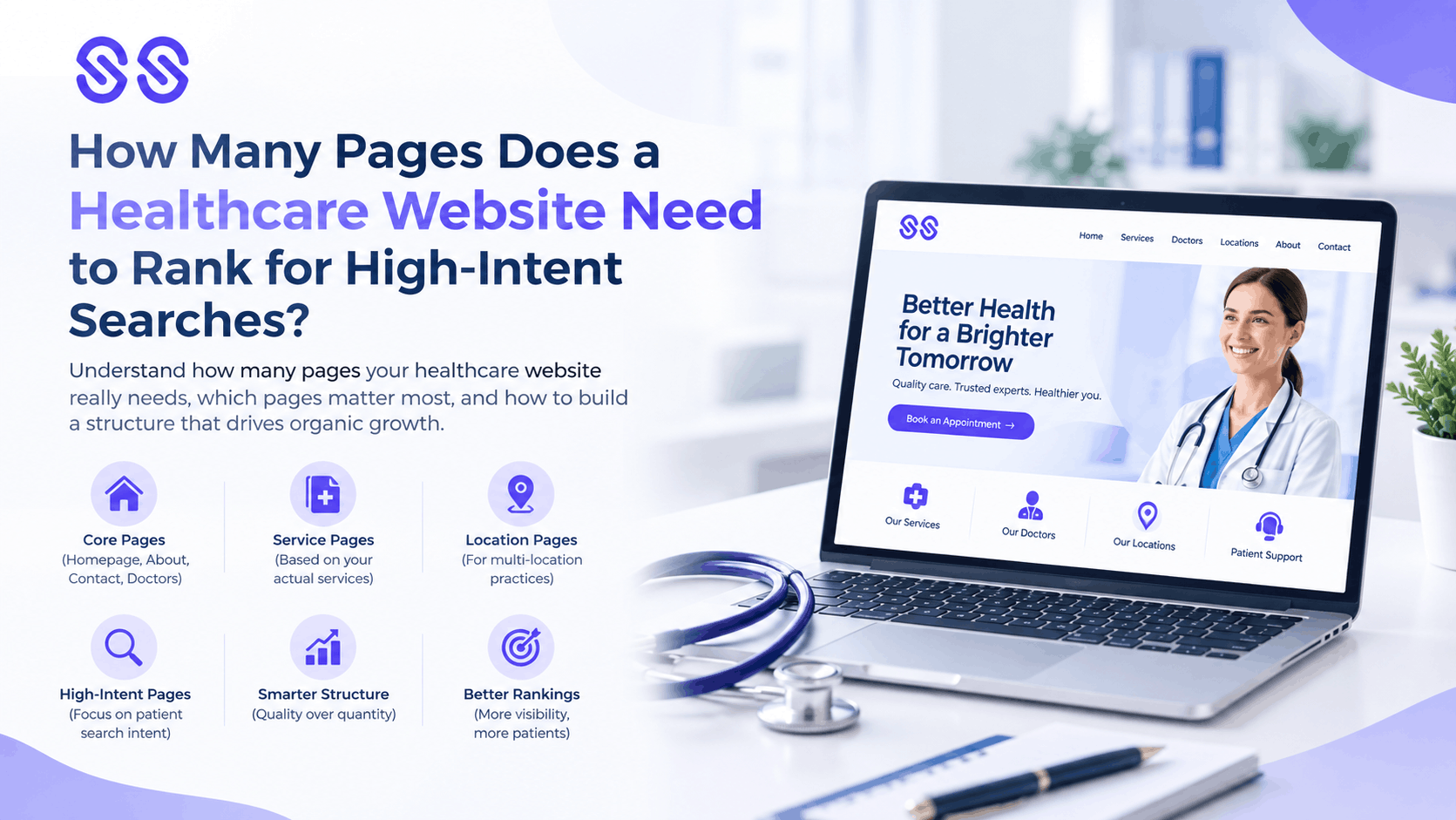
A common question in healthcare website SEO is: How many pages does a medical website actually need to rank on Google?
There is no fixed number that guarantees rankings. A small specialist practice may need fewer pages than a multi-location healthcare organisation with dozens of services. What matters more than page count is whether the website has the right pages for its services, locations, specialties, patient questions, and search intent.
A healthcare website with 30 highly relevant, well-optimised pages can outperform a website with 300 thin or repetitive pages.
The goal should therefore not be to create as many pages as possible. The goal is to build a website where every important page has a clear purpose and contributes to the overall healthcare website SEO strategy.
Is There a Perfect Number of Pages for a Healthcare Website?
No.
Search engines do not use a simple rule such as “websites with 100 pages rank better than websites with 50 pages.”
Page quantity is only one part of a much larger picture.
A healthcare website's organic performance can depend on:
- Content quality
- Search intent
- Technical SEO
- Website architecture
- Topical relevance
- Internal linking
- Local SEO
- Practitioner expertise
- Website authority
- User experience
- Competition
For example, a private dermatologist may have a relatively focused website covering consultations, conditions, treatments, doctor information, location, and patient education.
A large healthcare group operating across several cities may require significantly more pages because it has multiple locations, departments, specialists, and services.
The right question is therefore:
“Which pages does this healthcare website need to satisfy the searches that matter to the business and its patients?”
What Pages Should Every Healthcare Website Have?
A strong healthcare website usually starts with a core set of pages that clearly communicate who the organisation is, what it offers, and where it operates.
Homepage
The homepage establishes the overall identity of the healthcare organisation.
It should clearly communicate:
- Who you are
- What services you provide
- Your specialties
- Where you operate
- Who provides the services
- How patients can contact you
The homepage should also link naturally to important service, specialty, practitioner, and location pages.
About Page
An effective About page can support trust by explaining the practice, organisation, team, approach, and relevant background.
For healthcare businesses, transparency is important. Avoid vague claims and make professional information easy for users to understand.
Contact Page
Your contact page should make it easy for patients to find:
- Address
- Phone number
- Email where appropriate
- Opening information
- Appointment options
- Directions or access information where useful
Doctor and Practitioner Pages
Individual practitioner pages can be particularly valuable for healthcare website SEO.
Where appropriate, include:
- Name
- Specialty
- Qualifications
- Professional experience
- Areas of practice
- Relevant memberships
- Publications or professional contributions where applicable
The information should be accurate and supported by the practitioner's real professional background.
How Many Service Pages Does a Healthcare Website Need?
Your service structure should reflect the actual services provided by the practice.
For example, a dermatology clinic may have separate pages for:
- Acne treatment
- Mole assessment
- Skin lesion removal
- Skin cancer screening
- Cosmetic dermatology
- Hair loss treatment
The exact number depends on the practice.
The important principle is:
One important service or search intent should have a clear, useful destination when there is enough unique value to justify a page.
Do not create separate pages simply because you can attach another keyword to them.
For example, creating separate pages for:
- “dermatologist in London”
- “London dermatologist”
- “best dermatologist London”
with nearly identical content can create unnecessary duplication.
Instead, build a strong page that genuinely addresses the relevant intent.
High-Intent Pages Should Be Your Priority
If the primary objective is patient acquisition, not every page has equal commercial value.
High-intent searches often indicate that someone is actively looking for a healthcare provider or service.
Examples include:
- Specialist near me
- [Treatment] clinic
- [Condition] specialist
- [Service] doctor
- Private [specialist]
- [Treatment] in [city]
- Book a consultation with [specialist]
These searches should generally be mapped to relevant service, specialist, or location pages.
Your healthcare website SEO strategy should prioritise pages that have a realistic connection to patient enquiries and appointments.
Build Condition Pages Where They Add Genuine Value
Healthcare websites can also benefit from condition-specific pages.
For example:
Specialty: Cardiology
Condition pages:
- Heart arrhythmia
- High blood pressure
- Coronary artery disease
- Heart failure
Each page should provide genuinely useful information rather than simply repeating the same template.
A strong condition page can explain:
- What the condition is
- Common symptoms
- Risk factors where appropriate
- Diagnosis
- Treatment approaches
- When professional evaluation may be appropriate
- Which specialist provides relevant care
Medical content should be accurate, appropriately qualified, and reviewed or authored by suitable professionals where required by the organisation's editorial process.
Location Pages Can Expand Local Search Visibility
If your healthcare organisation has multiple locations, location pages can support local SEO.
For example:
- Healthcare clinic in Miami
- Healthcare clinic in Fort Lauderdale
- Healthcare clinic in Boca Raton
But each page should have a genuine purpose.
Useful location pages can include:
- Actual clinic information
- Services available at that location
- Practitioners working there
- Address
- Contact information
- Local access information
- Relevant FAQs
Avoid generating hundreds of city pages with only the location name changed.
Thin location pages can create a poor experience and add little value.
How Many Blog Pages Does a Healthcare Website Need?
There is no ideal number of healthcare blog posts.
A better approach is to build content around the questions your patients actually ask.
For example, an orthopaedic practice could publish useful content around:
- Symptoms
- Causes
- Treatment options
- Recovery
- Prevention
- When to seek medical advice
- Questions to ask a specialist
The objective is to develop topical authority, not maximise the blog count.
Ten excellent articles covering an important topic comprehensively can be more valuable than 100 generic articles written only to target keywords.
Create Topic Clusters Instead of Random Blog Posts
A topic cluster connects related information around a central service or specialty.
For example:
Core service page:Knee replacement surgery
Supporting content:
- When is knee replacement considered?
- Knee replacement recovery timeline
- Questions to ask before knee replacement
- Knee replacement preparation
- Knee replacement risks and considerations
- Alternatives to knee replacement
Relevant articles can link naturally to the core service page.
This creates a more organised healthcare website SEO structure and helps users move from informational research toward appropriate service information.
How Many Pages Does a New Healthcare Website Need?
For a new healthcare website, focus on building a strong foundation rather than launching with hundreds of pages.
A starting structure might include:
- 1 homepage
- 1 about page
- 1 contact page
- Practitioner pages
- Core specialty pages
- Important service pages
- Relevant condition pages
- Location pages where necessary
- A carefully planned collection of educational resources
The exact number depends on the practice.
A single-specialty clinic may begin with a relatively focused website, while a multi-specialty medical organisation may require a much larger structure.
The website can then expand based on search data, patient questions, service priorities, and content opportunities.
How Many Pages Does a Multi-Location Healthcare Website Need?
Multi-location healthcare organisations often require a larger architecture.
A possible structure could be:
Healthcare Organisation
→ Specialty
→ Service
→ Location
→ Practitioner
However, the structure should be designed around the organisation's actual operations.
Each location should only have a dedicated page when the organisation genuinely operates there and can provide useful local information.
This prevents the common SEO mistake of producing large numbers of nearly identical location pages.
Quality Matters More Than Page Count
A healthcare website with fewer pages can outperform a much larger site when its pages are more useful and relevant.
Before creating another page, ask:
Does this page serve a unique patient need?
Does it target a meaningful search intent?
Can we provide genuinely useful information here?
Does the organisation have real expertise or services relevant to this topic?
Will this page contribute to the overall website structure?
If the answer is no, another page may not be necessary.
How E-E-A-T Should Influence Healthcare Website SEO
Healthcare websites operate in an area where users need reliable information.
E-E-A-T—Experience, Expertise, Authoritativeness, and Trustworthiness—should therefore be considered throughout the website.
Useful trust signals can include:
- Accurate practitioner profiles
- Professional qualifications
- Relevant experience
- Clear authorship
- Appropriate medical review information
- Reliable references
- Transparent practice information
- Clear contact details
Content should not make unsupported claims about medical outcomes, expertise, or patient experiences.
The goal is to demonstrate genuine expertise rather than manufacture SEO signals.
How Internal Linking Connects Your Healthcare Pages
As your website grows, internal linking becomes increasingly important.
A well-structured healthcare website might connect:
Blog → Condition → Service → Practitioner → Contact
For example, an article about symptoms could link to a relevant condition page. That condition page could link to an appropriate treatment or specialist page.
This helps users find the next useful piece of information while creating a logical structure across the website.
How to Decide Which Pages to Create First
A practical prioritisation framework is:
Priority 1: Revenue and Patient-Intent Pages
Create pages for important services, treatments, specialists, and locations.
Priority 2: Supporting Condition Pages
Build pages around conditions that are genuinely connected to your services.
Priority 3: Educational Content
Answer relevant patient questions and build topical depth.
Priority 4: Supporting Resources
Add additional resources when there is a clear user or business need.
This approach prevents teams from spending months creating low-value content while important service pages remain weak.
Should You Create More Pages If Your Competitors Have More?
Not automatically.
Competitor page count can provide useful research, but copying their number of pages is not an SEO strategy.
Instead, analyse:
- Which pages attract organic traffic
- Which services they target
- Which topics they cover
- Which locations they serve
- Which questions they answer
- Where their content is weak
- Which topics your website does not address
Then identify genuine opportunities.
Your goal should be to build a better website architecture, not simply a larger website.
How Often Should You Add New Healthcare Pages?
There is no required publishing frequency.
New pages should be created when there is a genuine content, service, location, or patient-information opportunity.
A healthcare website may benefit from:
- New service pages
- Updated condition pages
- New educational articles
- New practitioner profiles
- New location pages
But quality control should remain more important than publishing volume.
Healthcare information can become outdated, so existing pages should also be reviewed and updated when necessary.
A Practical Healthcare Website SEO Page Structure
A well-planned website could follow a structure such as:
Homepage
About
Specialties
- Specialty 1
- Specialty 2
Services
- Service 1
- Service 2
- Service 3
Conditions
- Condition 1
- Condition 2
Doctors
- Practitioner 1
- Practitioner 2
Locations
- Location 1
- Location 2
Resources / Blog
- Educational article 1
- Educational article 2
Contact / Appointments
This is only a framework. The final structure should reflect the healthcare organisation's actual services, practitioners, locations, and patient needs.
Final Thoughts
There is no magic page count that makes a healthcare website rank.
Effective healthcare website SEO depends on creating the right pages for the right search intents and connecting those pages through a clear, useful website architecture.
For most healthcare websites, the priority should be:
Core pages → Service pages → Specialist and condition pages → Location pages → Supporting educational content
Build pages where there is genuine value, maintain accurate healthcare information, demonstrate real expertise, and avoid creating thin pages simply to target additional keywords.
A smaller website with strong service pages, useful patient resources, clear practitioner information, excellent technical SEO, and a logical internal linking structure can be far more effective than a large website filled with repetitive content.
The question is not “How many pages do we need?”
It is:
“How many useful pages do we need to fully serve our patients and the searches that matter to our healthcare organisation?”
That is the foundation of a sustainable healthcare SEO strategy.