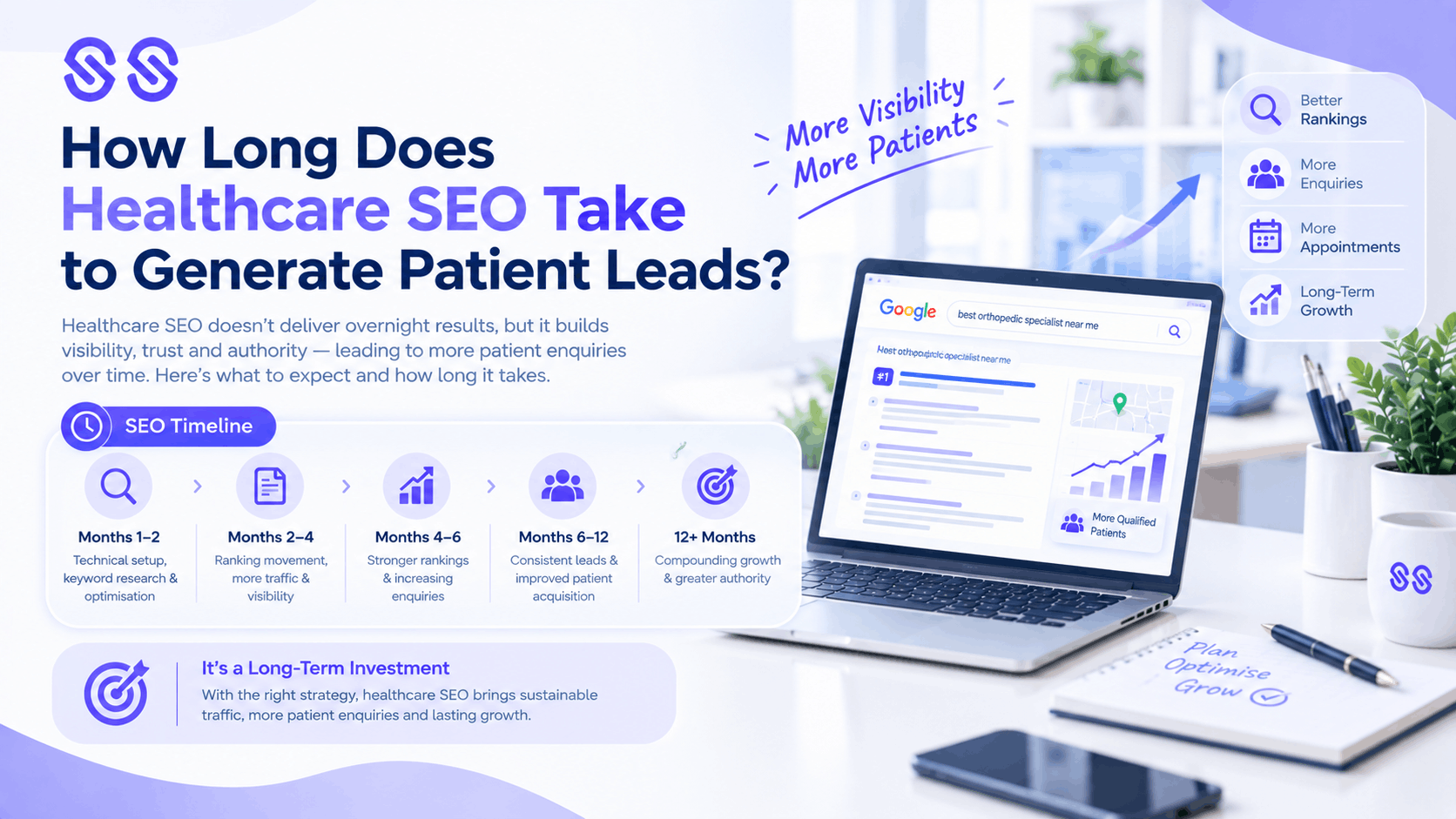
Healthcare SEO can generate a consistent source of patient enquiries, but it rarely produces meaningful results overnight. Unlike paid advertising, where increasing budget can often increase visibility quickly, SEO requires time to build relevance, authority, trust, and sustainable search visibility.
So, how long does healthcare SEO take to generate patient leads?
For many healthcare practices, initial SEO improvements may become visible within the first few months, while meaningful patient-lead growth often takes several months of consistent work. The exact timeline depends on the website's existing authority, competition, technical condition, content quality, location, services, and the search demand for those services.
Understanding this timeline is important because healthcare SEO results should not be judged only by rankings in the first few weeks. A successful SEO strategy should gradually improve visibility, relevant traffic, enquiries, appointment opportunities, and ultimately patient acquisition.
What Is a Realistic Healthcare SEO Timeline?
There is no universal timeline for healthcare SEO results.
A new clinic competing in a highly competitive city may require considerably more time than an established practice with a technically strong website and existing authority.
A practical framework looks like this:
SEO Period
What You May See
Months 1–2
Technical improvements, keyword research, indexing and optimisation
Months 2–4
Ranking movement, impressions and relevant organic traffic growth
Months 4–6
Stronger rankings for targeted services and increasing enquiries
Months 6–12
More consistent organic leads and improved visibility
12+ months
Compounding organic growth and stronger topical authority
These are general expectations, not guarantees.
Healthcare SEO results depend heavily on the market, competitors, website history, content quality, authority, and execution.
The most important point is that SEO should be evaluated as a growth process rather than a fixed-duration campaign.
Why Healthcare SEO Takes Time
Healthcare is a particularly competitive SEO environment because people rely on search engines to find information about medical conditions, treatments, doctors, clinics, and healthcare services.
Search engines also need to determine whether healthcare content is useful, reliable, and appropriate for users.
This makes E-E-A-T—Experience, Expertise, Authoritativeness, and Trustworthiness especially important when developing healthcare content and websites.
A healthcare SEO strategy may need to improve several areas simultaneously:
- Technical SEO
- Service pages
- Location pages
- Doctor profiles
- Educational content
- Internal linking
- Local SEO
- Website usability
- Author and reviewer information
- Trust signals
- Backlink profile
- Conversion paths
These improvements do not all produce results at the same speed.
Healthcare SEO Results During the First 3 Months
The first few months are often about building the foundation.
If a website has technical issues, thin service pages, poor internal linking, weak location signals, or limited useful content, those problems should be addressed before expecting significant lead growth.
Month 1: Research and Technical Foundation
The first stage should typically include:
- Website and technical SEO audit
- Keyword research
- Search-intent analysis
- Competitor research
- Google Search Console analysis
- Analytics review
- Service-page evaluation
- Local SEO assessment
- Content gap analysis
- Internal-linking review
- Conversion-path assessment
For an established website, this stage may also uncover opportunities to improve pages that are already receiving impressions but are not generating sufficient clicks or enquiries.
Months 2–3: Content and On-Page Optimisation
The next phase can focus on improving important pages.
This may include:
- Optimising service pages
- Improving title tags and headings
- Expanding thin content
- Creating location-specific content
- Improving doctor/practitioner profiles
- Publishing useful healthcare articles
- Strengthening internal links
- Adding relevant structured data
- Improving calls to action
At this point, you may see increases in impressions, keyword visibility, and ranking movement before substantial patient-lead growth occurs.
That distinction matters.
Visibility usually comes before consistent conversion growth.
What Happens Between Months 3 and 6?
This is often when healthcare SEO results become more meaningful.
Pages that have been properly optimised and supported by relevant content can begin competing more effectively for valuable searches.
For example, a clinic may start moving from:
Position 30 → Position 18 → Position 11 → Position 7
The exact progression varies significantly.
As important keywords move closer to the first page, organic clicks can increase. If the landing pages are well designed and the search intent is appropriate, those additional visitors may begin generating more appointment enquiries.
This is why SEO reporting should track more than keyword positions.
Monitor:
- Organic impressions
- Organic clicks
- Ranking keywords
- Non-brand traffic
- Service-page traffic
- Location-page traffic
- Phone clicks
- Form submissions
- Appointment requests
- Organic conversion rate
When Can Healthcare SEO Start Generating Patient Leads?
There is no single month when every healthcare website suddenly starts generating leads.
Some practices may generate enquiries relatively early because they operate in a less competitive market or already have strong search visibility.
Others may take longer because they are competing against hospitals, major healthcare platforms, established clinics, and highly authoritative websites.
Lead generation also depends on keyword intent.
A page ranking for:
“what is shoulder pain?”
has a different commercial value from a page ranking for:
“shoulder surgeon near me.”
The first may attract informational visitors. The second may attract someone actively looking for a provider.
This is why a healthcare SEO strategy should balance informational content with high-intent service, doctor, treatment, and location pages.
What Factors Affect Healthcare SEO Results?
1. Your Website's Starting Point
An established healthcare website with strong backlinks, indexed content, and existing rankings may see improvements faster than a brand-new website.
However, an older website is not automatically stronger.
Technical problems, outdated content, poor architecture, and historical SEO issues can limit growth.
2. Competition in Your Location
Competition is one of the biggest factors affecting SEO timelines.
Ranking for a specialist service in a smaller city can be very different from competing for the same service in New York, London, Los Angeles, Dubai, or another highly competitive healthcare market.
The number and strength of competing providers matter.
3. Your Services and Search Demand
Some healthcare services have substantial search demand, while others have relatively limited monthly searches.
A niche medical service may generate fewer searches but still produce highly valuable leads.
SEO strategy should therefore focus on business value rather than traffic volume alone.
4. Content Quality and Expertise
Healthcare content should not be created simply to fill a blog calendar.
Useful content should answer genuine patient questions while demonstrating appropriate expertise.
Where appropriate, content can be strengthened through:
- Accurate practitioner information
- Clear authorship
- Medical review information
- References to credible sources
- First-hand clinical insights where legitimately available
- Transparent information about the practice
Never manufacture medical credentials, patient stories, reviews, or clinical outcomes for SEO purposes.
5. Technical SEO
Technical problems can prevent even excellent content from performing effectively.
Common issues include:
- Poor site architecture
- Indexing problems
- Broken links
- Duplicate pages
- Incorrect canonicalisation
- Slow page performance
- Mobile usability issues
- Poor internal linking
- Incorrect redirects
- Sitemap problems
Technical SEO does not replace content quality, but it provides the foundation that allows search engines and users to access your website effectively.
Why Some Healthcare Websites Get Traffic but Few Leads
More traffic does not necessarily mean more patients.
A healthcare website can rank well and still struggle with lead generation if the traffic is not relevant or the website does not provide a clear conversion path.
For example, a clinic may attract thousands of visitors through informational blog posts but have very few visitors reaching its appointment pages.
This is where healthcare SEO and conversion optimisation need to work together.
Important conversion elements include:
- Clear appointment CTAs
- Easy-to-use contact forms
- Click-to-call functionality
- Provider information
- Service-specific landing pages
- Location details
- Trust signals
- Mobile-friendly design
- Clear patient next steps
The goal is not simply to get visitors.
The goal is to attract the right visitors and help them take the appropriate next step.
How to Measure Healthcare SEO Results Correctly
One of the biggest mistakes practices make is judging SEO only by rankings.
Rankings are useful indicators, but they are not the final business outcome.
A better measurement framework is:
Visibility → Traffic → Engagement → Enquiries → Appointments → Patients
Key SEO Metrics to Monitor
Search visibility:Are more relevant keywords appearing in search results?
Impressions:Are your pages being shown more frequently?
Organic clicks:Are more potential patients visiting the website?
Landing-page performance:Which service and location pages attract the most relevant visitors?
Conversions:Are visitors calling, submitting forms, or requesting appointments?
Lead quality:Are enquiries relevant to the services you actually provide?
Patient acquisition:Are organic leads turning into consultations and patients?
This approach provides a much more accurate picture of healthcare SEO results.
How to Accelerate Healthcare SEO Growth
SEO cannot be safely reduced to a shortcut, but certain practices can make the strategy more efficient.
Prioritise High-Intent Pages
Instead of publishing dozens of unrelated articles, focus first on pages that can directly support patient acquisition.
These may include:
- Core service pages
- Treatment pages
- Doctor pages
- Location pages
- Specialty pages
- High-intent supporting content
Build Topic Authority
Create useful content around the services and specialties you want to become known for.
For example, an orthopaedic practice could develop related content around:
- Shoulder conditions
- Rotator cuff problems
- Shoulder surgery
- Recovery questions
- Treatment options
- Specialist consultations
The content should be genuinely useful rather than created solely to insert keywords.
Strengthen Internal Linking
Connect relevant educational articles with service pages and provider pages.
This helps users discover related information and gives search engines clearer context about the site's important topics.
Improve Local SEO
For practices serving specific geographic areas, local SEO should be part of the broader strategy.
Maintain accurate business information, build relevant local authority, optimise location pages, and ensure the website clearly communicates where services are provided.
Should You Expect Leads Every Month From Healthcare SEO?
SEO leads are rarely perfectly consistent from month to month.
One month may produce more appointment enquiries than another because of:
- Seasonal demand
- Search behaviour
- Competition
- Service demand
- Website changes
- Advertising activity
- Patient decision cycles
Therefore, healthcare SEO should be evaluated using trends over time, rather than reacting to every monthly fluctuation.
Look at three-, six-, and twelve-month patterns where possible.
The objective is to build a stronger organic acquisition channel that becomes increasingly valuable over time.
When Should You Consider Changing Your SEO Strategy?
If your website shows no meaningful improvement after several months of properly executed SEO work, investigate before simply publishing more content.
Review:
- Are we targeting the right keywords?
- Are the pages matching search intent?
- Is the website technically healthy?
- Is the content genuinely useful?
- Are competitors significantly more authoritative?
- Are important services properly covered?
- Is local SEO being addressed?
- Are conversions being tracked correctly?
- Is the website actually converting visitors?
Sometimes the issue is not the amount of SEO work being performed. It is the direction of the strategy.
Final Thoughts
So, how long does healthcare SEO take to generate patient leads?
There is no guaranteed timeline, but meaningful healthcare SEO results typically develop progressively rather than overnight.
The first stage is usually about establishing the technical, content, local, and conversion foundations. As relevant pages gain visibility and authority, organic traffic can increase. With the right search intent and a well-optimised website, that visibility can translate into more enquiries and appointment opportunities.
The most effective healthcare SEO strategies focus on the entire patient acquisition journey not simply rankings.
If your objective is sustainable organic growth, measure the right things: relevant visibility, qualified traffic, conversions, lead quality, and ultimately patient acquisition.
SEO is a long-term investment, but when the strategy is built around genuine expertise, useful content, strong technical foundations, and patient intent, the results can compound over time.