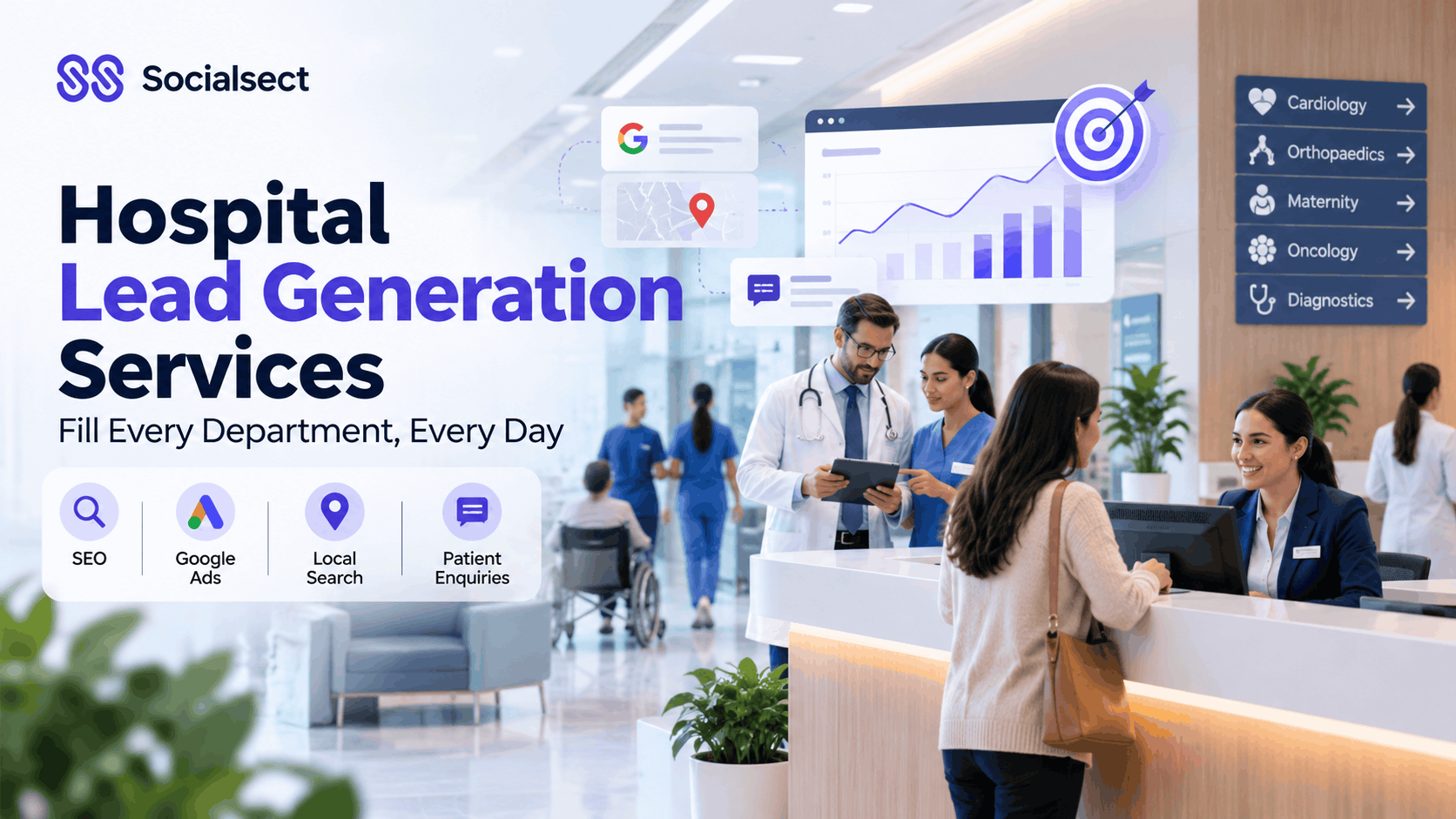
Hospitals need more than online visibility to attract patients consistently. They need a structured approach that connects people searching for healthcare services with the right departments, specialists and appointment options.
From cardiology and orthopaedics to maternity, oncology, diagnostics and emergency services, every department may have different patient needs, search behaviour and acquisition priorities. A hospital-wide marketing strategy must account for these differences rather than promoting every service in the same way.
This is where hospital lead generation becomes important.
A well-planned strategy combines search engine optimisation (SEO), Google Ads, local search, useful healthcare content, website optimisation and enquiry management. These channels help hospitals reach people looking for relevant services and make it easier for them to request information or appointments.
The goal is not simply to increase calls or website traffic. Effective patient lead generation focuses on attracting relevant enquiries, connecting prospective patients with appropriate services and measuring how marketing contributes to appointments.
What Is Hospital Lead Generation?
Hospital lead generation is the process of attracting potential patients and encouraging them to take an appropriate next step, such as requesting an appointment, calling a department or enquiring about a service.
Depending on the hospital's facilities and operating model, this can include:
- Specialist consultation enquiries
- Outpatient department appointments
- Diagnostic test enquiries
- Maternity consultation requests
- Elective procedure enquiries
- Rehabilitation and physiotherapy enquiries
- Health check-up enquiries
- Second-opinion requests
Not every enquiry represents a suitable patient or a confirmed appointment. Hospitals should therefore distinguish between general enquiries, qualified leads, booked consultations and completed appointments.
A structured patient acquisition for hospitals strategy tracks these stages so the organisation can understand which marketing activities produce meaningful results.
Why Hospitals Need a Dedicated Patient Acquisition Strategy
Hospitals often serve multiple specialties, locations and patient groups. Each department may have different service priorities, competition levels and capacity constraints.
A general hospital campaign may increase brand awareness, but it may not generate enough relevant enquiries for a particular department.
A dedicated acquisition strategy helps hospitals prioritise services and allocate marketing resources according to measurable objectives.
Promote individual departments effectively
Patients searching for a cardiologist may have very different needs from those looking for a maternity consultation or diagnostic imaging. Department-specific campaigns make it possible to align messaging with the relevant service.
Improve visibility across patient search journeys
Some people search for a condition or treatment, while others look directly for a specialist or hospital. A combination of SEO and paid advertising can address different types of search intent.
Support measurable hospital growth
Tracking enquiries by service line helps hospital teams understand which departments are attracting relevant demand and where improvements may be needed.
Connect marketing with operational capacity
Marketing should reflect the services a hospital can actually provide, available appointment capacity and the appropriate patient pathway. Generating demand without the ability to respond can waste marketing spend and create a poor patient experience.
1. Build a Department-Wise Hospital Marketing Strategy
An effective hospital marketing strategy begins by identifying the services that need greater visibility and the outcomes the hospital wants to improve.
Instead of treating the hospital as a single service, create a plan for priority departments.
Identify high-priority service lines
Depending on the hospital's capabilities, priority departments may include:
- Cardiology
- Orthopaedics
- Neurology
- Oncology
- Gynaecology and maternity
- Paediatrics
- Dermatology
- Gastroenterology
- Urology
- Diagnostics and imaging
- Physiotherapy and rehabilitation
The appropriate priorities depend on clinical capacity, service availability, business objectives and patient demand.
Define goals for each department
Set clear objectives, such as increasing qualified outpatient enquiries, improving visibility for a specialist service or generating more appointment requests for a diagnostic department.
Match campaigns to the patient journey
Some patients may be researching symptoms or treatment options. Others may be comparing providers or looking for a specific consultant. Each stage requires appropriate information and a clear next step.
2. Use Healthcare SEO to Generate Organic Patient Enquiries
Healthcare SEO helps hospitals improve their visibility in organic search results for relevant healthcare services, conditions, treatments and specialists.
It can be a valuable component of long-term healthcare lead generation because it supports discovery without relying exclusively on paid campaigns.
Create dedicated department pages
Each major department should have a clear page explaining its services, relevant specialists, facilities and appointment process.
For example, an orthopaedics page could connect visitors to information about joint conditions, sports injuries, specialist consultations and available treatment services.
Pages should reflect the hospital's actual capabilities and provide distinct value rather than repeating generic content across departments.
Optimise specialist profiles
Patients may search for an individual doctor by name or specialty. Accurate profiles can help them understand the practitioner's qualifications, areas of practice, experience and consultation locations.
Keep professional details current and avoid unsupported claims about clinical outcomes or rankings.
Target relevant healthcare keywords
Keyword research should cover different search intents, including:
- Hospital in [location]
- Cardiologist in [location]
- Orthopaedic hospital in [location]
- Maternity consultation in [location]
- Diagnostic imaging centre in [location]
- Specialist consultation near me
Use keywords naturally in page titles, headings, content and internal links. Search intent and relevance should guide page creation rather than keyword repetition.
3. Use Google Ads for High-Intent Patient Lead Generation
Google Ads can help hospitals gain paid visibility for selected service-related searches after campaigns are approved and launched.
For departments where relevant search demand exists, paid search can support targeted medical lead generation.
Create separate campaigns for key services
Where budgets and search volumes justify it, organise campaigns around individual departments or treatments.
This makes it easier to align keywords, advertisements and landing pages.
For example, a cardiology campaign should direct visitors to a relevant cardiology page rather than a general hospital homepage.
Build relevant landing pages
A department landing page should clearly explain the service, identify relevant specialists, provide accurate location details and make appointment options easy to find.
Avoid vague advertising messages that do not match the service being promoted.
Review search terms regularly
Search-term analysis can help identify irrelevant queries and opportunities to refine targeting.
Hospitals should also follow applicable advertising rules and platform policies, particularly for sensitive health-related topics, treatments and audience targeting.
Measure meaningful outcomes
Track relevant calls, appointment requests and qualified enquiries wherever reliable measurement is available. Clicks and impressions alone do not show whether a campaign is attracting suitable patients.
4. Strengthen Local SEO and Google Maps Visibility
Hospitals often serve patients from specific cities, neighbourhoods and surrounding areas. Local SEO helps people discover the hospital when searching for nearby healthcare services.
Important activities include maintaining an accurate Google Business Profile, ensuring consistent contact information, providing correct opening hours and publishing useful location information.
Optimise location information
Clearly communicate the hospital's address, directions, contact numbers and available services. If the organisation operates multiple locations, each location should have accurate information.
Improve department-level discovery
Department pages should explain where services are available and provide relevant contact or appointment details.
Where appropriate, link location pages to relevant department pages so visitors can navigate directly to the service they need.
Maintain an authentic reputation
Encourage genuine patient feedback through appropriate processes and respond professionally. Protect patient confidentiality when replying to public reviews, and never disclose or confirm someone's patient status.
5. Create Healthcare Content That Supports Patient Decisions
Content marketing helps hospitals answer questions that arise before someone contacts a department.
People may search for information about symptoms, diagnostic tests, treatment options, preparation requirements or what to expect during a consultation.
Useful content can address these needs while helping patients understand the hospital's services.
Examples include:
- What to expect during a cardiology consultation
- When to seek assessment for persistent joint pain
- How to prepare for a diagnostic imaging appointment
- Questions to ask during a maternity consultation
- What happens during a physiotherapy assessment
- How to prepare for a specialist appointment
Clinical content should be accurate, understandable and appropriately reviewed by qualified professionals.
6. Apply E-E-A-T Across Hospital Websites
Healthcare content can influence important decisions, so credibility is essential.
E-E-A-T stands for Experience, Expertise, Authoritativeness and Trustworthiness. These principles provide a useful framework for developing trustworthy hospital content and presenting professional information.
Demonstrate clinical expertise
Provide accurate doctor profiles, qualifications, professional registrations where applicable and relevant areas of practice.
Identify authors and reviewers
For educational medical content, identify the author and qualified reviewer where appropriate.
Support clinical claims
Use reliable sources for medical information and avoid unsupported statistics, exaggerated claims or guarantees.
Keep information current
Review treatment information, doctor profiles, department details, opening hours and contact information regularly.
Provide transparent service information
Clearly communicate available services, consultation processes and relevant limitations. Do not imply that a department provides treatments or facilities that are unavailable.
Trust should be reflected throughout the website, advertisements and patient enquiry process.
7. Optimise the Hospital Website for More Enquiries
Even when marketing attracts relevant visitors, a confusing website can prevent them from making contact.
Hospital websites should make it easy to navigate departments, understand services and find the appropriate contact option.
Important improvements include:
- Clear department navigation
- Dedicated service pages
- Accessible doctor profiles
- Mobile-friendly layouts
- Visible phone numbers
- Appointment request options
- Accurate location information
- Useful FAQs
- Fast-loading pages
- Accessible forms
Forms should request only the information necessary for the initial enquiry. Sensitive health information must be handled in accordance with applicable privacy and data-protection requirements.
8. Improve Enquiry Handling Across Departments
Hospital lead generation does not end when a person submits a form or calls a department.
Enquiries need to reach the appropriate team and receive a suitable response.
A clear process should define how enquiries are received, routed, recorded and followed up.
For example, a diagnostic enquiry may require a different response process from a specialist consultation request.
Hospitals should establish clear ownership for each enquiry type, appropriate response procedures and a way to record outcomes.
Marketing performance improves when the organisation can identify whether leads become appointments and where enquiries are being lost.
9. Track Hospital Lead Generation Performance
A strong hospital digital marketing strategy should connect marketing data with meaningful business outcomes.
Useful metrics include:
- Organic search clicks and impressions
- Department-page visits
- Paid search conversions
- Phone calls and appointment requests
- Qualified patient enquiries
- Booked consultations
- Cost per qualified lead
- Appointment conversion rate
- Performance by department
- Performance by location
- Enquiry response and follow-up outcomes
Review results at the department level wherever practical. This helps hospital teams understand which services attract relevant demand and where campaigns or landing pages need improvement.
Tracking should be configured carefully to avoid sending identifiable patient information or sensitive health details to analytics and advertising platforms without an appropriate legal basis and safeguards.
10. Common Hospital Marketing Mistakes to Avoid
Promoting every department with the same campaign
Different services have different search intent and patient needs. Department-specific planning can improve relevance.
Sending all paid traffic to the homepage
A focused department or treatment page often provides a more relevant experience for a specific search.
Focusing only on traffic volume
Traffic does not necessarily translate into suitable enquiries or appointments. Lead quality should be measured.
Publishing generic healthcare content
Content should answer genuine questions and accurately reflect the hospital's clinical expertise and available services.
Ignoring operational capacity
Marketing should align with appointment availability, service capacity and the hospital's ability to respond to enquiries.
Failing to track lead outcomes
Without tracking what happens after an enquiry, it is difficult to assess the contribution of marketing to patient acquisition.
11. A Practical Hospital Patient Acquisition Framework
Hospitals can use the following workflow to develop a more structured lead-generation programme.
Step 1: Audit current performance. Review the website, organic visibility, paid campaigns, local listings and enquiry process.
Step 2: Prioritise departments. Identify service lines based on demand, clinical capacity and organisational goals.
Step 3: Map search intent. Research informational, specialist-related and high-intent service searches.
Step 4: Improve department pages. Provide useful service information, accurate specialist details and clear contact options.
Step 5: Strengthen local SEO. Ensure that location information and business listings are accurate.
Step 6: Launch focused campaigns. Use appropriate SEO and paid advertising strategies for priority services.
Step 7: Develop educational content. Answer relevant patient questions with medically responsible information.
Step 8: Improve enquiry routing. Ensure enquiries reach the appropriate department or team.
Step 9: Measure lead quality. Track qualified enquiries, booked consultations and cost per qualified lead.
Step 10: Optimise continuously. Use performance data and operational feedback to improve campaigns and patient journeys.
How Socialsect Supports Hospital Lead Generation
Socialsect can help hospitals develop an integrated digital strategy that connects search visibility, healthcare content, paid advertising and website optimisation.
The process begins by assessing the hospital's priority departments, target locations, current online visibility and enquiry-handling process.
Based on these findings, the strategy can focus on department-specific SEO, local search optimisation, paid search campaigns, useful healthcare content and conversion improvements.
Socialsect's approach should be measured against relevant outcomes such as qualified enquiries and appointment requests—not traffic alone. The aim is to build a more structured patient acquisition system that supports the hospital's services, clinical capacity and growth objectives.
Conclusion
Effective hospital lead generation requires more than increasing website traffic or running broad advertising campaigns. Hospitals need a structured approach that connects the right audiences with relevant departments and makes the next step clear.
By combining healthcare SEO, paid search, local visibility, useful content, conversion optimisation and reliable enquiry management, hospitals can build a more measurable approach to patient acquisition.
The priority is to generate relevant enquiries, support informed patient decisions and connect marketing performance with real appointment outcomes.
Rather than promising to fill every department every day, a responsible strategy focuses on improving visibility and lead quality while aligning demand with the hospital's services, clinical capacity and ability to respond.