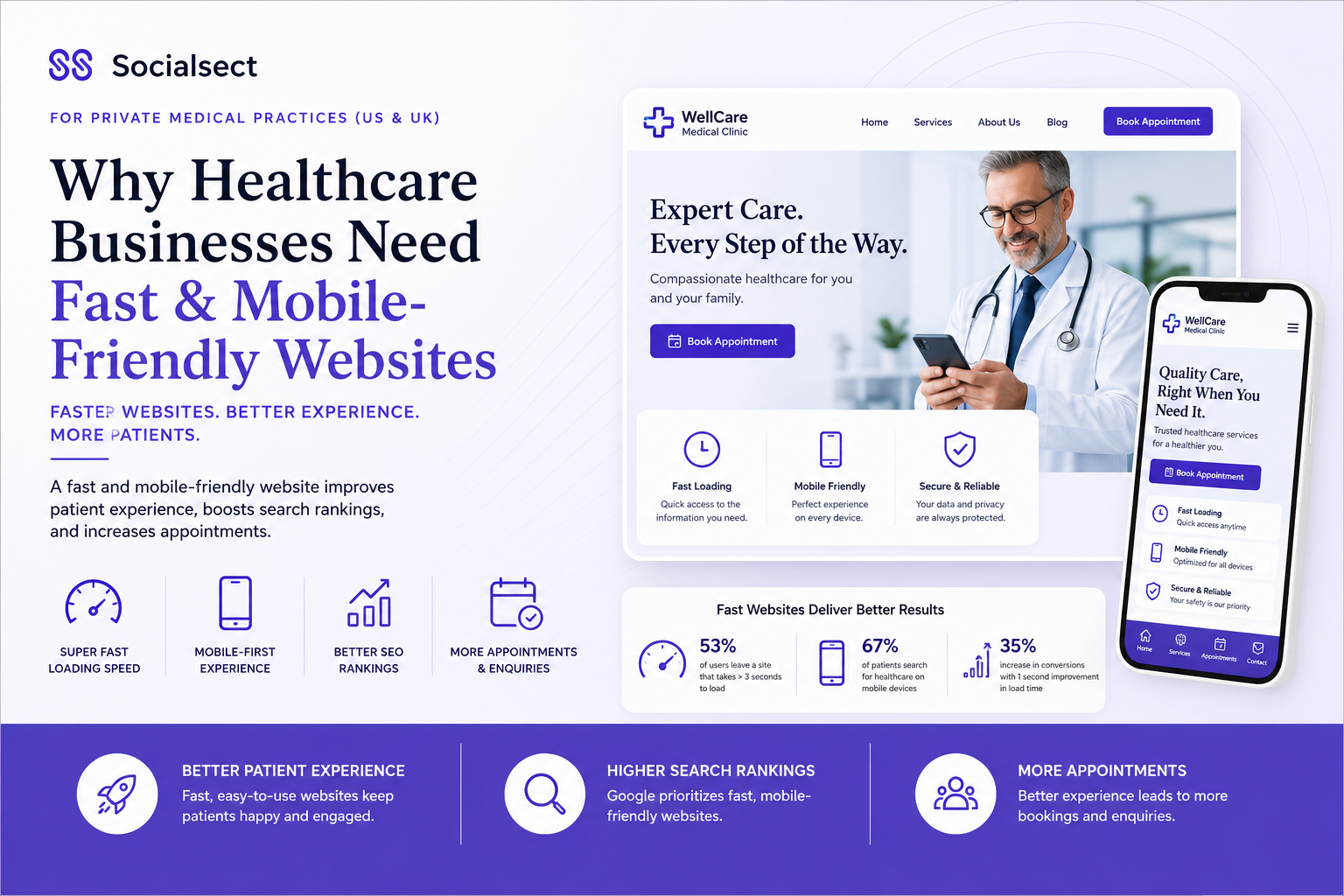
In today’s digital-first healthcare environment, a website is often the first interaction patients have with a clinic, hospital, medical practice, or healthcare brand. Before booking appointments, patients typically search online, compare providers, read reviews, and visit websites to evaluate trust, credibility, and convenience. If a healthcare website loads slowly or performs poorly on mobile devices, potential patients often leave within seconds.
This makes healthcare website optimization a critical part of digital growth. Fast loading speeds, strong mobile performance, seamless navigation, and excellent user experience directly influence patient trust, search rankings, and conversion rates. Modern healthcare websites must deliver both speed and usability to compete in increasingly crowded markets.
At Socialsect, we help healthcare organizations build high-performing digital experiences that improve patient engagement, increase conversions, and strengthen search visibility.
Why Website Performance Matters in Healthcare
Healthcare decisions often involve urgency.
Patients searching for services such as:
- Urgent care
- Orthopedic consultation
- Dermatology appointment
- Fertility treatment
- Dental emergency
- Eye specialist
expect quick access to information.
They want to find:
- Contact details
- Appointment forms
- Provider profiles
- Treatment information
- Directions
immediately.
If a website is slow or difficult to use, patients often move to a competitor.
This makes website performance a direct business factor.
What Is Healthcare Website Optimization?
Healthcare website optimization refers to improving a healthcare website’s performance, speed, usability, responsiveness, and conversion potential.
Optimization includes:
- Faster page speed
- Better mobile usability
- Improved user experience
- Technical SEO improvements
- Conversion optimization
- Better design structure
The goal is to ensure patients can quickly find information and take action.
A well-optimized website improves both user satisfaction and marketing performance.
The Rise of Mobile Healthcare Searches
Mobile dominates healthcare search behavior.
Patients increasingly search using smartphones for:
- Doctor near me
- Clinic near me
- Emergency appointment
- Dentist nearby
- Specialist consultation
This means mobile-friendly healthcare websites are no longer optional.
They are essential.
If patients cannot navigate your website on mobile, you lose potential appointments.
Mobile optimization directly affects:
- Bounce rate
- Engagement
- SEO rankings
- Conversion rates
- Patient satisfaction
Why Mobile-Friendly Healthcare Websites Matter
A mobile-friendly healthcare website automatically adapts to all screen sizes.
This ensures:
Easy Navigation
Menus remain usable.
Readable Content
Text scales properly.
Fast Loading
Mobile users expect speed.
Better Conversion
Forms are easier to complete.
Improved Trust
Modern design builds confidence.
Poor mobile experiences create friction and reduce conversions.
Slow Websites Cost Clinics Patients
Website speed is one of the biggest conversion killers.
A delay of even a few seconds can lead to:
- Higher bounce rates
- Lower engagement
- Lost trust
- Fewer appointments
Patients expect instant access.
Slow websites feel:
- Outdated
- Unprofessional
- Unreliable
This negatively affects brand perception.
Fast websites create confidence.
Website Speed Optimization and Patient Retention
Website speed optimization improves how quickly website content loads and becomes interactive.
Important speed improvements include:
Image Compression
Reduce large file sizes.
Code Minification
Optimize CSS and JavaScript.
CDN Usage
Deliver assets faster globally.
Caching
Reduce load time for repeat visits.
Server Optimization
Improve backend performance.
Faster websites improve both UX and SEO.
Healthcare UX and Patient Experience
Strong healthcare UX (user experience) is about making websites intuitive and frictionless.
Patients should easily complete tasks such as:
- Finding doctors
- Booking appointments
- Calling the clinic
- Accessing treatment pages
- Locating contact details
Poor UX creates confusion.
Strong UX creates trust.
Key healthcare UX elements include:
Clear Navigation
Help users find information quickly.
Strong CTAs
Guide patients toward booking.
Logical Layouts
Improve usability.
Accessibility
Support all users.
Good UX improves conversions significantly.
Medical Website Performance and SEO
Medical website performance affects more than usability—it affects rankings.
Google evaluates website quality signals including:
- Page speed
- Mobile usability
- Stability
- User experience
Poor performance can reduce visibility in search.
Better performance improves:
- Organic traffic
- Engagement
- Rankings
- Lead generation
This makes optimization essential for healthcare SEO.
Responsive Healthcare Websites Improve Conversion
Responsive healthcare websites automatically adapt to:
- Smartphones
- Tablets
- Laptops
- Desktops
This ensures consistent user experiences across devices.
Benefits include:
Better Accessibility
Usable on all devices.
Higher Engagement
Users stay longer.
Improved Conversions
More appointment requests.
Lower Bounce Rates
Better experience reduces exits.
Responsive design is a core part of modern medical web design.
Core Web Vitals in Healthcare SEO
Google uses Core Web Vitals healthcare metrics to measure real user experience.
The three major metrics are:
Largest Contentful Paint (LCP)
Measures loading speed.
Ideal: under 2.5 seconds.
Interaction to Next Paint (INP)
Measures responsiveness.
Fast interactions improve usability.
Cumulative Layout Shift (CLS)
Measures visual stability.
Stable layouts improve trust.
Poor Core Web Vitals hurt rankings and UX.
Strong scores improve performance.
Why Core Web Vitals Matter for Healthcare
Patients often make quick judgments.
Imagine a patient opening a clinic website and experiencing:
- Slow loading images
- Buttons shifting
- Forms lagging
That creates frustration.
Strong Core Web Vitals healthcare scores ensure:
- Smooth browsing
- Faster engagement
- Better usability
- Higher conversions
Technical performance directly impacts business growth.
Medical Web Design and Trust
Good medical web design goes beyond aesthetics.
Patients judge trust within seconds.
A high-performing healthcare website should look:
- Professional
- Modern
- Secure
- Clean
- Easy to use
Weak design creates doubt.
Strong design reinforces:
- Expertise
- Credibility
- Trustworthiness
Design and performance must work together.
Common Healthcare Website Problems
Many healthcare businesses struggle with:
Heavy Images
Slowing pages.
Poor Hosting
Weak server response.
Unoptimized Code
Hurting performance.
Bad Mobile Design
Reducing usability.
Too Many Plugins
Increasing load times.
These issues often hurt both SEO and conversion.
Fast Websites Improve Patient Acquisition
A faster website improves every marketing channel.
Whether traffic comes from:
- SEO
- Google Ads
- Meta Ads
- Email marketing
- Social media
speed affects conversion.
Fast websites improve:
Form Submissions
Users complete forms faster.
Calls
Patients contact sooner.
Appointment Bookings
Reduced friction increases conversions.
This makes healthcare website optimization a major growth lever.
AI Search, AEO and Website Performance
Search is changing rapidly.
Patients increasingly interact with:
- Google AI Overviews
- Voice search
- AI assistants
- LLM-based search
Websites optimized for AI visibility need:
Fast Load Speed
Improve crawl efficiency.
Clean Structure
Better AI understanding.
Strong UX
Improve engagement signals.
Structured Content
Support answer engines.
Performance now affects AI visibility too.
EEAT and Website Trust Signals
Healthcare falls under YMYL.
Google emphasizes:
Experience
Real patient outcomes.
Expertise
Provider credentials.
Authoritativeness
Industry reputation.
Trustworthiness
Secure, fast, reliable websites.
A slow or broken site weakens trust signals.
Fast websites strengthen EEAT.
Best Practices for Healthcare Website Optimization
To improve performance, focus on:
Mobile-First Design
Prioritize smartphone users.
Speed Optimization
Reduce loading time.
Better UX
Simplify navigation.
Technical SEO
Improve crawlability.
Conversion Optimization
Increase bookings.
These are core growth drivers.
Why Healthcare Businesses Choose Socialsect
At Socialsect, we specialize in performance-driven healthcare digital experiences.
Our expertise includes:
- Healthcare website optimization
- Mobile-friendly healthcare websites
- Website speed optimization
- Healthcare UX
- Medical website performance
- Responsive healthcare websites
- Core Web Vitals healthcare optimization
- Medical web design
We help healthcare brands create fast, scalable, conversion-focused websites that improve patient acquisition and long-term growth.
Conclusion
In healthcare, every second matters—both in patient care and digital experiences. Patients expect fast, seamless, and mobile-friendly access to healthcare information. Slow websites, poor UX, and weak mobile performance directly reduce trust and appointment conversions.
A strong healthcare website optimization strategy that focuses on mobile-friendly healthcare websites, website speed optimization, better healthcare UX, and strong medical website performance improves rankings, trust, and patient acquisition.
At Socialsect, we help healthcare businesses build fast, responsive, and future-ready websites designed for growth.