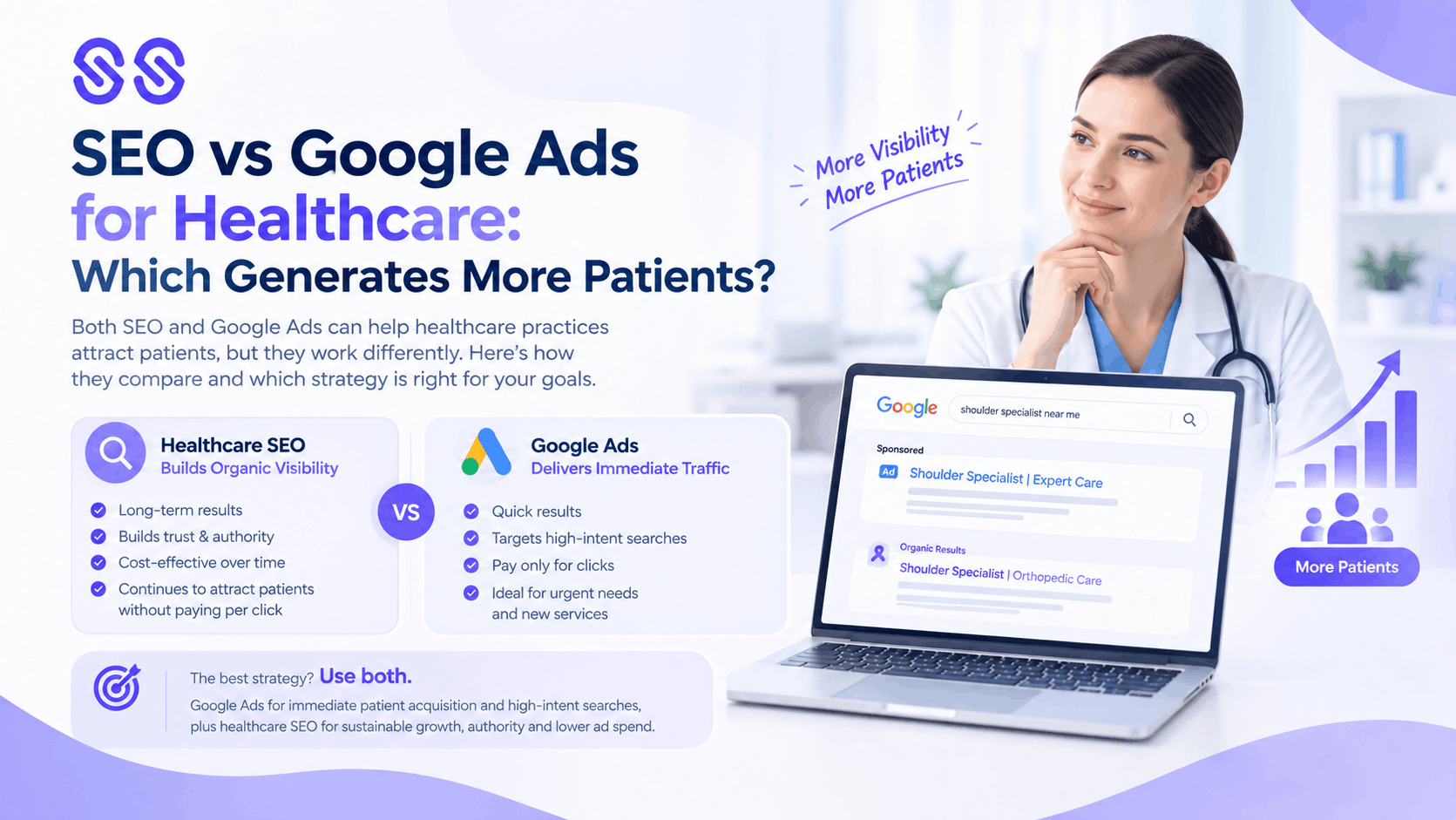
Healthcare SEO vs Google Ads
When comparing healthcare SEO vs Google Ads, neither channel is universally better for generating patients. Google Ads can produce targeted website visits and enquiries quickly because paid listings can appear when eligible users search for healthcare services. Healthcare SEO takes longer to build but can generate consistent organic visibility, establish trust, and continue attracting patients without paying for every click.
For most healthcare organisations, the strongest long-term strategy is not choosing between SEO and Google Ads. It is using both strategically: Google Ads for immediate patient acquisition and high-intent searches, and healthcare SEO for sustainable organic growth, authority, and lower dependence on advertising spend.
Introduction: SEO or Google Ads — Which Is Better for Healthcare?
Healthcare marketing has changed significantly. Patients no longer rely only on referrals or traditional advertising to find doctors, specialists, hospitals, and treatment providers.
Today, a patient may search:
- “shoulder specialist near me”
- “rotator cuff treatment”
- “shoulder surgeon”
- “best treatment for shoulder pain”
- “shoulder surgery recovery”
- “orthopedic specialist near me”
That search creates an opportunity for a healthcare organisation to appear in front of someone who may already have a specific healthcare need.
This is where the debate around healthcare SEO vs Google Ads becomes important.
Both channels can help generate patients, but they work differently.
SEO builds organic visibility over time. Google Ads provides paid visibility when a campaign is eligible and competitive for a particular search.
The right choice depends on your goals, budget, treatment type, competition, geographic market, and how quickly you need enquiries.
For a healthcare organisation such as Miami Shoulder Institute, the objective should not simply be increasing website traffic. The real objective is attracting relevant patients who are looking for appropriate medical information, evaluation, or treatment.
What Is Healthcare SEO?
Healthcare SEO is the process of improving a medical website so that its pages can appear more prominently in organic search results for relevant healthcare queries.
A strong healthcare SEO strategy may include:
- Keyword research
- Service-page optimisation
- Medical condition pages
- Location-based SEO
- Technical SEO
- Internal linking
- Helpful educational content
- Local SEO
- Structured data
- Expert-reviewed content
- Author and provider information
- Conversion optimisation
- Reputation and authority development
Unlike paid advertising, organic search visibility is not purchased on a per-click basis.
However, SEO requires ongoing investment in content, technical improvements, expertise, optimisation, and authority.
Google states that its systems are designed to prioritise helpful, reliable, people-first content rather than content created primarily to manipulate rankings. For healthcare websites, demonstrating expertise and providing trustworthy information is particularly important because healthcare falls within Google's YMYL topics.
What Are Google Ads for Healthcare?
Google Ads allows eligible advertisers to pay for advertising placements associated with relevant searches and other Google properties.
For healthcare organisations, this can be useful when a potential patient is actively searching for a service.
For example, a campaign might target searches related to:
- Shoulder specialist
- Shoulder surgeon
- Rotator cuff treatment
- Shoulder surgery
- Orthopedic consultation
- Shoulder pain treatment
A well-structured campaign can direct users to a relevant landing page rather than requiring them to discover the healthcare provider organically.
This makes Google Ads particularly attractive when the goal is immediate visibility.
However, healthcare advertising has additional considerations. Google applies specific healthcare and medicines advertising policies, and some healthcare categories require certification or have location-specific restrictions.
Therefore, healthcare organisations should always verify that their services, advertisements, landing pages, and targeting comply with applicable advertising requirements.
Healthcare SEO vs Google Ads: The Biggest Difference
The simplest way to understand the difference is this:
Google Ads buys visibility. SEO earns visibility.
With Google Ads, you generally pay when users interact with your advertising according to the campaign's billing model.
With SEO, you invest in improving the website and its authority so that relevant pages can earn organic search visibility.
This creates different advantages.
Factor
Healthcare SEO
Google Ads
Speed
Slower to build
Faster visibility
Traffic cost
No direct cost per organic click
Requires advertising budget
Long-term value
High potential
Depends on continued spend
Immediate leads
Usually slower initially
Can generate quickly
Trust building
Strong potential
Depends on ad and landing page
Content value
Very important
Helpful for landing pages
Geographic targeting
Strong with local SEO
Strong
Competition
Organic ranking competition
Auction competition
Scalability
Requires content and authority
Requires budget
Sustainability
Can continue after investment
Traffic generally declines when campaigns stop
The important point is that these channels should not be judged using the same timeframe.
Does Google Ads Generate Patients Faster Than SEO?
Usually, yes.
One of the biggest advantages of Google Ads is speed.
After a campaign is properly configured, approved, and eligible to run, ads can potentially begin receiving impressions and clicks much faster than a newly published page can build organic rankings.
This makes paid search particularly useful for:
- New practices
- Newly launched services
- New locations
- Time-sensitive campaigns
- Competitive treatment terms
- Testing patient demand
- Generating enquiries while SEO is developing
For example, if a new healthcare service has just launched, waiting months for organic visibility may not fit the business objective.
Google Ads can provide a faster route to visibility.
But speed does not automatically mean better patient acquisition.
A campaign can generate clicks without generating qualified enquiries.
That is why healthcare PPC should be measured beyond impressions and clicks.
Important metrics include:
- Qualified leads
- Appointment requests
- Phone calls
- Cost per qualified lead
- Conversion rate
- Treatment-specific enquiries
- Location-qualified enquiries
- Appointment completion rate
Does Healthcare SEO Generate Better Long-Term Results?
SEO can provide significant long-term value because successful organic pages can continue attracting search traffic after they are published.
Consider a healthcare website with strong pages covering:
- Treatment options
- Conditions
- Symptoms
- Procedures
- Recovery
- Frequently asked questions
- Patient concerns
- Location-specific services
These pages can collectively create an organic search footprint.
Instead of relying on one advertisement, the website can potentially appear for hundreds or thousands of relevant searches.
This is one of the biggest reasons healthcare SEO can be valuable for long-term patient acquisition.
However, ranking is never guaranteed.
Search algorithms change, competitors improve their websites, and patient search behaviour evolves.
Successful healthcare SEO therefore requires continuous optimisation rather than a one-time campaign.
SEO vs Google Ads: Which Has a Lower Cost Per Patient?
There is no universal answer.
Google Ads can have a predictable advertising budget, but the cost of clicks varies according to competition, location, keyword intent, and other campaign factors.
For healthcare services, highly commercial searches can be competitive.
SEO does not have a direct cost per organic click, but it still requires investment.
You may need resources for:
- SEO specialists
- Medical content
- Website development
- Technical SEO
- Local SEO
- Digital PR
- Link acquisition
- Content review
- Conversion optimisation
Therefore, comparing SEO and Google Ads purely on “cost per click” can be misleading.
A better measurement is:
Cost per qualified patient acquisition.
For example, if an advertising campaign generates 100 clicks but only one relevant patient enquiry, its performance may be weaker than an organic page generating 30 highly relevant visitors and five enquiries.
The quality of traffic matters more than traffic volume.
Which Is Better for High-Intent Healthcare Keywords?
Google Ads can be particularly useful for high-intent searches because advertisers can build campaigns around specific queries and landing pages.
Examples include:
- “shoulder surgeon”
- “shoulder surgery”
- “orthopedic shoulder specialist”
- “rotator cuff surgery”
- “shoulder specialist near me”
SEO can also target these searches through well-optimised service pages.
The strongest strategy is often to have both paid and organic visibility for commercially important searches where appropriate.
When users see a healthcare provider in both paid and organic results, the organisation can gain additional opportunities to capture attention.
However, paid advertising should never replace the underlying quality of the website.
Why Healthcare SEO Is More Than Ranking for Keywords
Modern healthcare SEO should not be reduced to inserting keywords into articles.
Google's guidance emphasises people-first content, original value, expertise, trustworthy information, and satisfying the user's search intent.
For healthcare websites, this means content should answer questions patients genuinely have.
For example, instead of creating a generic article targeting “shoulder pain,” a better content strategy could answer:
- What causes shoulder pain?
- When should shoulder pain be evaluated?
- Can a rotator cuff tear cause weakness?
- What tests may be used?
- When is surgery considered?
- What does shoulder surgery recovery involve?
This approach can support both SEO and patient education.
It also creates content that may be useful across traditional search, featured results, AI-generated search experiences, and other discovery platforms.
The Role of Local SEO in Patient Acquisition
For healthcare providers, location can be just as important as treatment relevance.
Patients frequently search for healthcare services using geographic modifiers such as:
- “shoulder specialist Miami”
- “shoulder surgeon near me”
- “orthopedic doctor Miami”
- “shoulder surgery Miami”
Local SEO helps a healthcare organisation become more visible for searches where geographic relevance matters.
Important local SEO elements include:
Google Business Profile
A complete and accurately maintained profile can help users discover the organisation through local search and Maps.
Location Pages
Relevant location pages can help communicate where services are provided and which patients the organisation serves.
Consistent Business Information
Name, address, phone information, and other business details should be accurate and consistent.
Reviews and Reputation
Patient reviews can influence how prospective patients perceive a healthcare organisation, although reviews should never be manipulated or fabricated.
Localised Service Content
Combining treatment information with legitimate geographic relevance can help users find the right service.
Can Google Ads and SEO Work Together?
Yes. In many cases, they work better together than separately.
Think of the strategy as two layers.
Layer 1: Google Ads
Use paid search to capture immediate demand.
Layer 2: SEO
Build long-term organic visibility around the same services and patient questions.
For example, a healthcare organisation may run Google Ads for a high-intent service while simultaneously developing an organic content cluster around that treatment.
The paid campaign provides immediate data.
The SEO campaign builds long-term visibility.
The two channels can inform each other.
How Google Ads Data Can Improve SEO
Paid search can provide useful information about:
- Which keywords generate enquiries
- Which services attract demand
- Which landing pages convert
- Which geographic areas respond
- Which messages attract attention
- Which search terms are commercially valuable
This information can help inform SEO priorities.
For example, if a specific treatment-related query consistently produces qualified enquiries through paid search, it may deserve stronger organic optimisation.
This does not mean simply copying advertisements into organic content.
Instead, the data can help identify genuine search intent.
How SEO Can Improve Google Ads
The relationship also works in reverse.
SEO can help identify:
- High-value topics
- Patient questions
- Treatment terminology
- Search intent
- Content gaps
- Strong-performing landing pages
These insights can improve paid campaign structure.
A well-developed SEO website can also provide better landing-page resources for paid traffic.
This is particularly useful in healthcare because patients often need more information before contacting a provider.
Which Strategy Should a Healthcare Organisation Choose?
The answer depends on the stage of the organisation.
Choose Google Ads First When:
You need leads quickly.
You are launching a new service.
You want to test demand.
Your organic rankings are currently weak.
You have a defined advertising budget.
You have strong conversion-focused landing pages.
Prioritise SEO When:
You want long-term organic growth.
Your website has limited organic visibility.
You want to build authority around treatments and conditions.
You want to reduce dependence on paid traffic over time.
You have valuable medical expertise that can be converted into useful content.
Use Both When:
You want immediate and long-term growth.
You compete in a highly competitive healthcare market.
You want to dominate important search opportunities.
You have enough resources to manage both channels properly.
For many established healthcare organisations, this combined approach can be the most practical.
What About AI Search and Healthcare SEO?
Healthcare search is increasingly influenced by AI-generated experiences and conversational search behaviour.
Patients may ask detailed questions instead of entering short keywords.
For example:
“What should I do if my shoulder pain has lasted three months and gets worse at night?”
A strong healthcare website should be capable of answering this type of question clearly.
That means modern SEO should incorporate:
- Direct answers
- Clear headings
- Structured information
- Question-based content
- Relevant entities and concepts
- Expert information
- Original insights
- Patient-friendly explanations
- Strong internal linking
- Clear author or reviewer information
Google's current guidance continues to emphasise helpful, reliable, people-first content and warns against creating content primarily to manipulate search rankings.
Therefore, the objective should not be writing content simply because a keyword has search volume.
The objective should be creating the best useful resource for the patient behind that search.
A Better Healthcare Patient Acquisition Strategy
Instead of asking:
“Should I choose SEO or Google Ads?”
A better question is:
“Which combination of channels can generate qualified patients at an acceptable acquisition cost while building long-term visibility?”
A practical strategy can look like this:
Phase 1: Research
Identify:
- High-intent services
- Treatment keywords
- Location searches
- Patient questions
- Competitor gaps
- Existing organic rankings
Phase 2: Conversion Foundation
Improve:
- Service pages
- Appointment CTAs
- Contact forms
- Phone visibility
- Mobile usability
- Page speed
- Trust signals
Phase 3: Google Ads
Launch carefully targeted campaigns around commercially valuable services.
Track actual conversions rather than simply clicks.
Phase 4: Healthcare SEO
Build comprehensive service pages and supporting educational content.
Optimise technical SEO, internal linking, local visibility, and content quality.
Phase 5: Measurement
Compare:
- Organic leads
- Paid leads
- Qualified leads
- Cost per lead
- Cost per patient
- Conversion rates
- Treatment-specific performance
- Geographic performance
This creates a data-driven acquisition system instead of treating SEO and advertising as isolated marketing activities.
SEO vs Google Ads: The Final Verdict
So, which generates more patients: healthcare SEO or Google Ads?
There is no universal winner.
Google Ads generally has the advantage for speed. It can put eligible healthcare services in front of relevant searchers quickly, making it useful when immediate patient acquisition is the priority.
Healthcare SEO generally has the advantage for long-term organic visibility. A strong website can build visibility across services, conditions, questions, and locations without requiring an advertising payment for every organic visit.
For a healthcare organisation focused on sustainable growth, relying exclusively on one channel can create unnecessary risk.
A more resilient strategy combines:
Google Ads + Healthcare SEO + Local SEO + High-quality medical content + Conversion optimisation.
Google Ads can capture existing demand today.
SEO can help build visibility for tomorrow.
And the website itself should turn that visibility into a clear, trustworthy patient journey.
Key Takeaways
- Healthcare SEO vs Google Ads is not necessarily an either-or decision.
- Google Ads can provide faster visibility and immediate campaign data.
- SEO generally requires more time but can create lasting organic visibility.
- Healthcare SEO should focus on helpful, trustworthy, people-first content.
- High-intent service pages are important for both organic and paid traffic.
- Local SEO is particularly important for location-based healthcare searches.
- Google Ads should be measured using qualified leads and patient acquisition, not just clicks.
- SEO performance should also be evaluated using leads and business outcomes, not only rankings.
- Paid search data can help identify valuable SEO opportunities.
- SEO insights can improve paid campaign targeting and landing pages.
- Healthcare advertising has additional policy considerations, so campaigns should be reviewed for compliance.
- For sustainable patient acquisition, combining SEO and paid search can often provide a stronger marketing foundation than relying on either channel alone.