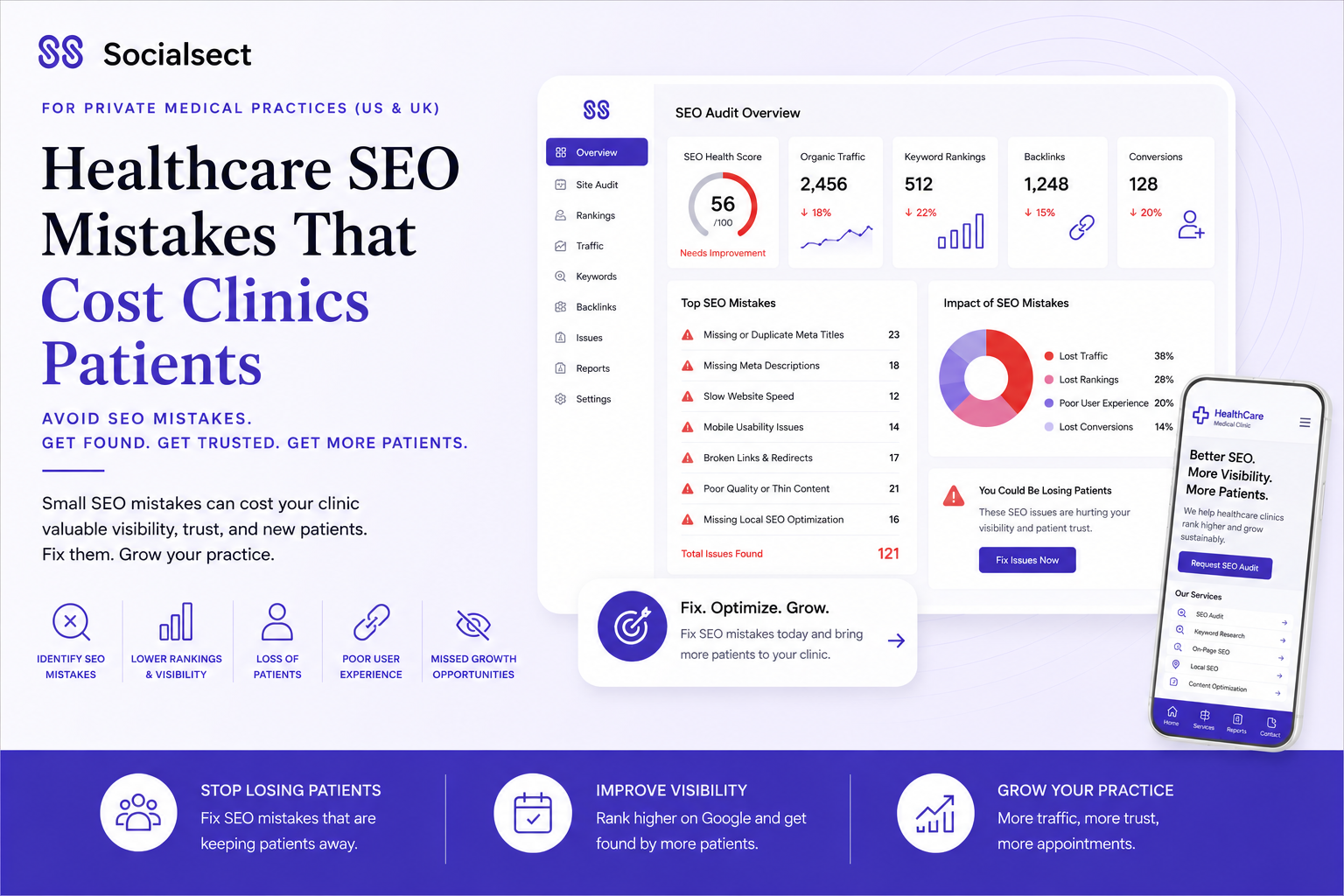
Many healthcare providers invest in websites, content, and digital marketing but still struggle to attract new patients online. In most cases, the problem isn't a lack of effort—it's a collection of overlooked SEO issues that reduce visibility, limit website traffic, and prevent clinics from reaching potential patients.
Common healthcare SEO mistakes can significantly impact search rankings, local visibility, patient trust, and appointment bookings. From technical website issues and poor local optimization to weak content strategies and outdated SEO practices, these mistakes often result in lost opportunities and lower patient acquisition.
At Socialsect, we help healthcare organizations identify and fix SEO problems that prevent sustainable growth. By understanding the most common medical SEO errors, clinics can improve online visibility, attract qualified traffic, and generate more patient inquiries.
Why Healthcare SEO Matters More Than Ever
Healthcare consumers increasingly use search engines to find:
- Doctors
- Specialists
- Clinics
- Treatment information
- Healthcare providers near them
Search behavior has changed dramatically over the last decade.
Today, patients often:
- Research symptoms
- Compare providers
- Read reviews
- Evaluate treatment options
- Visit multiple healthcare websites before making decisions
This means your online visibility directly influences patient acquisition.
A strong healthcare SEO strategy helps clinics appear when prospective patients are actively searching for healthcare services.
Unfortunately, many healthcare organizations unknowingly make SEO mistakes that reduce their visibility and cost them patients.
Mistake #1: Ignoring Local SEO
One of the most common clinic SEO problems is neglecting local optimization.
Most healthcare searches have local intent.
Examples include:
- Dentist near me
- Dermatologist in Chicago
- Orthopedic clinic London
- Fertility specialist Manchester
Without local SEO, clinics struggle to appear in:
- Google Maps
- Local Pack results
- Location-based searches
Local SEO should include:
Google Business Profile Optimization
Maintain accurate business information.
Local Landing Pages
Create pages for each location served.
Consistent Citations
Ensure clinic information remains consistent across directories.
Ignoring local SEO often leads to significant patient acquisition losses.
Mistake #2: Poor Medical Website SEO Structure
Many healthcare websites are not built with SEO in mind.
Weak medical website SEO structures often include:
- Confusing navigation
- Broken internal links
- Missing service pages
- Poor URL structures
- Duplicate content
These issues make it difficult for search engines to understand website content.
A properly structured healthcare website improves:
- Crawling
- Indexing
- User experience
- Search visibility
Website architecture plays a major role in long-term SEO success.
Mistake #3: Publishing Thin Content
Healthcare content must demonstrate expertise and authority.
Unfortunately, many clinics publish pages containing only a few paragraphs of generic information.
This is one of the most damaging medical SEO errors.
Thin content often:
- Provides limited value
- Fails to answer patient questions
- Struggles to rank
- Reduces trust
Instead, healthcare providers should create comprehensive content that addresses:
Symptoms
Explain conditions clearly.
Treatment Options
Provide detailed information.
Recovery Expectations
Help patients understand outcomes.
Frequently Asked Questions
Address common concerns directly.
Comprehensive content supports both SEO and patient education.
Mistake #4: Ignoring Mobile Optimization
Most healthcare searches now occur on mobile devices.
Patients frequently search while:
- Traveling
- At work
- At home
- Seeking immediate information
A poor mobile experience creates serious clinic SEO problems.
Common issues include:
- Slow loading speeds
- Difficult navigation
- Small text
- Poor form usability
Google prioritizes mobile-friendly websites, making optimization essential.
Mistake #5: Failing to Demonstrate EEAT
Healthcare websites fall under Google's Your Money or Your Life (YMYL) category.
This means search engines place greater emphasis on:
- Expertise
- Authority
- Trustworthiness
- Experience
Many clinics overlook these factors.
Strong EEAT signals include:
Provider Credentials
Show certifications and qualifications.
Author Information
Identify content contributors.
Patient Testimonials
Provide social proof.
Accurate Information
Maintain factual, trustworthy content.
Weak EEAT signals often result in lower rankings.
Mistake #6: Not Performing an SEO Audit for Clinics
Many healthcare providers never conduct a comprehensive SEO audit for clinics.
Without regular audits, problems often go unnoticed.
An SEO audit identifies:
- Technical issues
- Broken links
- Content gaps
- Indexing problems
- Local SEO weaknesses
- Performance issues
Regular audits help clinics identify opportunities and maintain competitive visibility.
At Socialsect, SEO audits often uncover significant issues limiting growth.
Mistake #7: Weak Keyword Targeting
Keyword research remains fundamental to SEO success.
Many clinics target broad or highly competitive terms while ignoring patient intent.
Examples of poor targeting:
- Healthcare
- Medical services
- Doctor
More effective keyword strategies focus on:
Service-Based Searches
- Dental implants
- Acne treatment
- IVF consultation
Local Searches
- Orthopedic surgeon Miami
- Fertility clinic Chicago
Question-Based Searches
- What causes hair loss?
- How long does IVF take?
Intent-driven keywords generate higher-quality traffic.
Mistake #8: Overlooking Healthcare Search Rankings Monitoring
Some clinics invest in SEO but never monitor results.
Tracking healthcare search rankings helps organizations understand:
- Keyword performance
- Traffic trends
- Visibility improvements
- Competitive positioning
Without monitoring, it becomes difficult to evaluate progress or identify opportunities.
SEO should always be measured through data-driven reporting.
Mistake #9: Poor Internal Linking
Internal links help search engines understand website structure.
Many healthcare websites lack strategic internal linking.
Effective internal linking:
- Distributes authority
- Improves navigation
- Enhances crawlability
- Supports user journeys
Examples include linking:
- Service pages
- Treatment guides
- Blog content
- Location pages
A strong internal linking strategy improves SEO performance and user experience.
Mistake #10: Ignoring Patient Reviews
Reviews influence both local rankings and patient decisions.
Many clinics fail to actively manage patient feedback.
Benefits of reviews include:
Improved Local SEO
Google values review signals.
Increased Trust
Patients rely heavily on reviews.
Better Conversion Rates
Strong reviews encourage appointments.
Review generation should be part of every healthcare SEO strategy.
Mistake #11: Technical SEO Neglect
Technical issues often undermine otherwise strong websites.
Common problems include:
Slow Website Speed
Impacts rankings and engagement.
Broken Pages
Create poor user experiences.
Missing Schema Markup
Limits search engine understanding.
Indexing Errors
Prevent content from appearing in search results.
Technical SEO provides the foundation for visibility.
Mistake #12: Poor Healthcare Content Marketing
Content remains one of the most powerful SEO tools.
However, many healthcare organizations publish content without strategy.
Common healthcare digital marketing mistakes include:
- Inconsistent publishing
- Generic topics
- Weak keyword targeting
- Limited patient focus
Effective healthcare content should:
- Address patient concerns
- Demonstrate expertise
- Support SEO goals
- Encourage engagement
Strategic content marketing supports both rankings and trust.
Mistake #13: Ignoring AI Search Optimization
Search behavior is evolving rapidly.
Patients increasingly interact with:
- Google AI Overviews
- Voice assistants
- AI-powered search engines
- Large language models
Healthcare websites that ignore AI optimization risk losing visibility.
AEO and AI optimization strategies include:
Direct Answers
Provide concise responses to common questions.
Structured Content
Use clear headings and organization.
FAQ Sections
Address patient concerns directly.
Comprehensive Coverage
Provide authoritative information.
AI-friendly content improves discoverability.
Building a Winning Healthcare SEO Strategy
A successful healthcare SEO strategy combines multiple elements:
Local SEO
Improve geographic visibility.
Technical SEO
Ensure website health.
Content Marketing
Publish authoritative information.
Reputation Management
Build patient trust.
Conversion Optimization
Increase appointment bookings.
AI Optimization
Prepare for future search trends.
A holistic strategy generates sustainable results.
Why Healthcare Organizations Choose Socialsect
At Socialsect, we help healthcare providers identify and resolve the issues limiting online growth.
Our expertise includes:
- Healthcare SEO strategy
- Medical website SEO
- SEO audit for clinics
- Healthcare content marketing
- Local SEO optimization
- Technical SEO
- Healthcare search rankings improvement
- Conversion optimization
- AI-ready healthcare content
Our goal is to help clinics attract more patients through sustainable organic growth.
The Future of Healthcare SEO
Healthcare SEO will continue evolving through:
- AI-driven search
- Enhanced local search experiences
- Voice search adoption
- Personalized search results
- Increased emphasis on trust signals
Healthcare providers that adapt early will maintain a competitive advantage.
Conclusion
Many healthcare organizations lose valuable patient opportunities because of avoidable SEO mistakes.
From weak local optimization and poor content to technical issues and inadequate trust signals, these healthcare SEO mistakes can significantly impact visibility and patient acquisition.
By addressing common medical SEO errors, improving website performance, conducting regular audits, and implementing a comprehensive healthcare SEO strategy, clinics can improve rankings, attract qualified traffic, and generate more appointments.
At Socialsect, we help healthcare providers transform SEO challenges into growth opportunities through strategic optimization and data-driven digital marketing solutions.