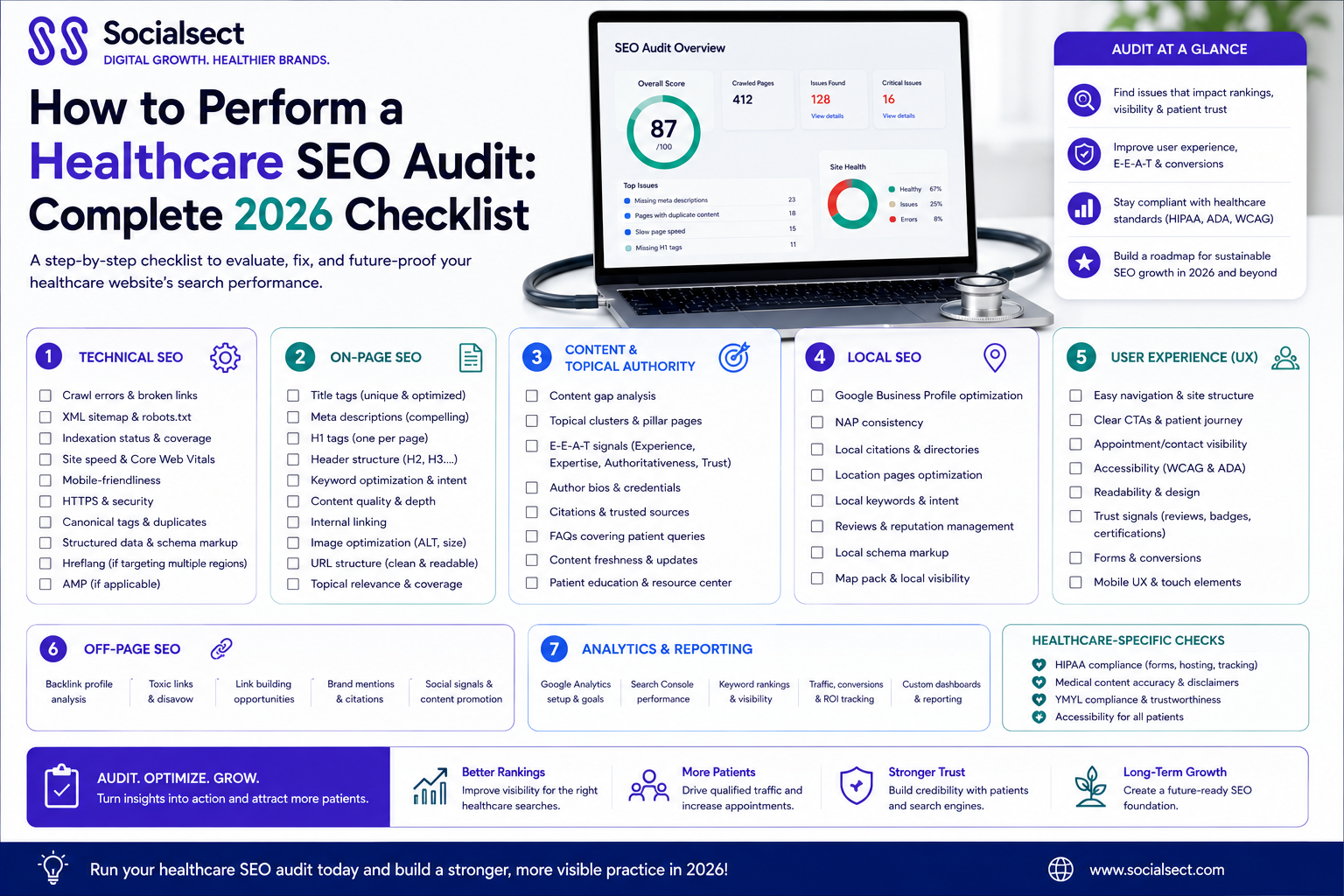
A healthcare website can have excellent medical services, experienced physicians, and a strong reputation—but still struggle to generate organic traffic and patient enquiries if its SEO foundation is weak.
Broken links, poor indexing, duplicate pages, slow loading times, weak medical content, inaccurate location information, and unclear conversion paths can all limit search visibility.
This is why a regular healthcare SEO audit should be an essential part of any medical practice, clinic, hospital, or healthcare group's digital marketing strategy.
A healthcare SEO audit goes beyond checking keyword rankings.
In 2026, healthcare organizations need to evaluate technical SEO, content quality, medical expertise, local search visibility, AI-powered search readiness, website experience, backlinks, and patient acquisition.
This complete checklist explains how to audit a healthcare website systematically and identify the issues that may be preventing stronger organic performance.
What Is a Healthcare SEO Audit?
A healthcare SEO audit is a comprehensive evaluation of a medical website's search engine visibility, technical health, content quality, authority, user experience, and conversion performance.
The objective is to identify:
- Technical SEO problems
- Indexing issues
- Content gaps
- Duplicate content
- Weak service pages
- Poor internal linking
- Local SEO problems
- EEAT weaknesses
- Website performance issues
- Backlink risks
- Conversion barriers
A professional audit should finish with an actionable roadmap rather than simply a list of problems.
The most important question is:
Which issues should be fixed first to improve search visibility and patient acquisition?
Why Healthcare Websites Need Specialized SEO Audits
Healthcare SEO is different from many other industries.
People use medical websites to research conditions, treatments, procedures, and healthcare providers.
This makes accuracy and trust particularly important.
A healthcare SEO audit should therefore evaluate not only technical performance but also:
- Medical accuracy
- Physician expertise
- Content authorship
- Medical review
- Patient safety
- Trust signals
- Service information
- Local practice information
A website can technically rank well and still provide a poor patient experience.
A good audit evaluates both.
Healthcare SEO Audit Checklist for 2026
A comprehensive audit should cover the following areas:
Technical SEO
Website architecture
Indexation
Keyword targeting
Search intent
Healthcare content
EEAT
Physician profiles
Internal linking
Local SEO
Google Business Profile
Multi-location SEO
Website performance
Mobile usability
Structured data
Backlinks
Reputation
AI search readiness
Conversion optimization
Analytics and tracking
Let's examine each area.
1. Check Website Crawlability
Search engines need to access your website before they can properly evaluate its pages.
During a healthcare SEO audit, check:
- robots.txt
- XML sitemap
- HTTP status codes
- Crawl errors
- Redirects
- Orphan pages
- Blocked resources
- JavaScript rendering
- Internal links
Make sure important healthcare pages are not accidentally blocked.
For example, a practice should verify that its:
- Service pages
- Physician pages
- Location pages
- Condition pages
- Blog articles
can be discovered and crawled.
2. Review Indexation
Not every website URL needs to be indexed.
The objective is to ensure that valuable pages are indexed while unnecessary or duplicate pages are controlled appropriately.
Review Google Search Console for:
- Indexed pages
- Excluded pages
- Crawled but currently not indexed URLs
- Duplicate URLs
- Canonical issues
- Redirect issues
- Server errors
Pay particular attention to important commercial pages that are not appearing in Google's index.
3. Check Canonical Tags
Canonical tags help communicate the preferred version of a URL when multiple versions of similar content exist.
Review whether important pages have appropriate canonical implementation.
Look for:
- Incorrect canonical URLs
- Canonicals pointing to redirects
- Canonicals pointing to unrelated pages
- Conflicting canonical signals
- Missing canonical implementation where needed
This is particularly important for large healthcare websites with many service, location, and provider URLs.
4. Review Website Architecture
A healthcare website should be easy for both patients and search engines to understand.
A logical structure might look like:
Home
→ Specialties
→ Conditions
→ Treatments
→ Physicians
→ Locations
→ Resources
→ Contact
Important pages should not be buried several clicks deep.
Good architecture also makes internal linking easier.
5. Audit Healthcare Keywords
Keyword research remains an important part of a healthcare SEO audit.
However, do not simply count keywords.
Evaluate whether keywords are mapped to the right pages.
For example:
"cardiologist"
may belong to a specialty or physician page.
"heart failure treatment"
may belong to a condition or treatment resource.
"cardiologist in Miami"
may require a local landing page.
Check for:
- Keyword cannibalization
- Missing commercial keywords
- Missing informational topics
- Irrelevant keywords
- Poor keyword-to-page mapping
6. Analyze Search Intent
A page should satisfy the intent behind the query.
For example:
Someone searching:
"knee replacement recovery time"
likely wants educational information.
Someone searching:
"knee replacement surgeon near me"
has stronger provider-related intent.
Someone searching:
"knee replacement consultation"
may be much closer to conversion.
Your content should reflect these differences.
7. Audit Medical Content Quality
Review the quality of important healthcare pages.
Ask:
- Is the information accurate?
- Is it current?
- Does it answer the patient's question?
- Is it easy to understand?
- Does it contain meaningful detail?
- Does it avoid unsupported claims?
- Is it written for the intended audience?
- Does it provide a useful next step?
Avoid evaluating content only by word count.
A 1,500-word article is not automatically better than a 900-word article.
Useful information beats unnecessary length.
8. Check EEAT Signals
EEAT—Experience, Expertise, Authoritativeness, and Trustworthiness—is particularly relevant to healthcare content.
Review whether the website clearly communicates:
- Who wrote the content
- Who medically reviewed it
- Physician qualifications
- Professional experience
- Specialty information
- Practice credentials
- Relevant references
Where appropriate, medical content should be reviewed by a qualified professional.
Do not create artificial credentials or misleading claims.
9. Audit Physician Profiles
Physician pages can be valuable SEO and patient-trust assets.
Check whether each profile includes:
- Full name
- Specialty
- Credentials
- Education
- Certifications
- Professional memberships
- Clinical interests
- Experience
- Locations
- Appointment information
Link physicians to relevant services and conditions where appropriate.
For example:
Dr. Smith → Cardiology → Heart Failure → Cardiac Testing → Location
This creates useful connections across the website.
10. Audit Service Pages
Service pages are often among the highest-value pages on a healthcare website.
Check whether each major service has a dedicated, useful page.
A strong service page should explain:
- What the service is
- Who may benefit
- How it works
- What patients can expect
- Relevant preparation
- Recovery information where applicable
- Risks or considerations
- Physician information
- Location information
- Appointment options
Avoid pages that contain nothing more than a few paragraphs and a contact button.
11. Check Internal Linking
Internal links help users discover related information and help search engines understand relationships between pages.
For example:
Back Pain
→ Sciatica
→ Herniated Disc
→ Spinal Stenosis
→ Spine Specialist
→ Spine Surgery
Make sure important pages receive relevant internal links.
Also look for orphan pages that have no meaningful internal links pointing toward them.
12. Perform a Local SEO Audit
Local SEO is critical for medical practices because healthcare is strongly location-dependent.
Review:
- Google Business Profile
- Business name
- Address
- Phone number
- Opening hours
- Services
- Categories
- Website URL
- Reviews
- Location pages
Make sure information is accurate and consistent.
13. Audit Multi-Location SEO
Healthcare groups with multiple offices need an additional layer of analysis.
Check whether each location has:
- Unique content
- Accurate address
- Local phone number where appropriate
- Relevant physicians
- Available services
- Directions
- Office information
- Local internal links
Avoid publishing dozens of near-identical location pages with only the city name changed.
14. Review Website Speed
Website performance affects both user experience and search performance.
Review:
- Largest Contentful Paint
- Interaction responsiveness
- Cumulative Layout Shift
- Server response time
- Image sizes
- JavaScript
- CSS
- Third-party scripts
Healthcare websites often contain large images, videos, appointment tools, analytics scripts, and third-party integrations.
These should be reviewed carefully.
15. Check Mobile Experience
Many patients discover healthcare providers on mobile devices.
During your audit, test:
- Navigation
- Font size
- Buttons
- Forms
- Appointment CTAs
- Phone links
- Page loading
- Pop-ups
- Sticky elements
A patient should be able to call or request an appointment without struggling with the interface.
16. Review Structured Data
Structured data can help search engines understand certain information on a website.
Depending on the site and content, appropriate structured data may include:
- Organization
- LocalBusiness
- MedicalClinic
- Physician
- Article
- BreadcrumbList
Structured data should accurately represent visible information and follow applicable search engine guidelines.
It should not be used to create misleading claims.
17. Audit Backlinks
A healthcare SEO audit should include an authority and backlink review.
Analyze:
- Referring domains
- Relevant industry links
- Medical directories
- Local citations
- Anchor text
- Lost backlinks
- Suspicious patterns
- Clearly manipulative links
Quality and relevance matter more than simply having thousands of backlinks.
Do not pursue links solely for volume.
18. Review Healthcare Reputation
Online reputation can influence whether a potential patient chooses your practice.
Review:
- Google reviews
- Healthcare directories
- Physician profiles
- Brand mentions
- Public complaints
- Review response practices
Never fabricate reviews.
Instead, develop ethical processes for encouraging genuine patient feedback where permitted.
19. Audit AI Search Readiness
AI-powered search is becoming another part of the search journey.
Healthcare organizations should review whether their website provides:
- Clear answers
- Accurate medical information
- Expert authorship
- Comprehensive topic coverage
- Strong internal linking
- Well-structured content
- Transparent practice information
The objective is not to manipulate AI systems.
It is to create a website that is genuinely useful and understandable.
20. Check Conversion Tracking
An SEO audit should not end with rankings.
Make sure you can measure:
- Appointment requests
- Phone calls
- Contact forms
- Consultation requests
- Location clicks
- Online booking
- Lead sources
For healthcare organizations, organic traffic is valuable only when it contributes to meaningful outcomes.
Healthcare SEO Audit: Tools You Can Use
A comprehensive audit can combine several tools.
Google Search Console
Useful for:
- Indexing
- Search performance
- Queries
- Pages
- Search visibility
Google Analytics
Useful for:
- Traffic
- Engagement
- Conversions
- Acquisition channels
Google Business Profile
Useful for:
- Local visibility
- Calls
- Directions
- Website actions
Crawling Tools
Useful for:
- Broken links
- Redirects
- Metadata
- Canonicals
- Indexability
- Internal linking
PageSpeed Tools
Useful for:
- Performance
- Core Web Vitals
- Mobile experience
The exact toolset can vary depending on the size and complexity of the healthcare website.
Healthcare SEO Audit Priority Matrix
Not every SEO issue deserves immediate attention.
Use a simple prioritization framework:
Priority
Examples
Critical
Noindex on important pages, major indexation problems, website errors
High
Weak service pages, major technical issues, poor local SEO
Medium
Internal linking, metadata, content gaps
Low
Minor formatting or optimization opportunities
Start with issues that can materially affect visibility or patient acquisition.
Common Healthcare SEO Audit Mistakes
Auditing Only Keywords
SEO is much broader than rankings.
Ignoring Technical SEO
Great content cannot compensate for serious indexation problems.
Ignoring EEAT
Medical websites need strong trust and expertise signals.
Focusing Only on Traffic
Qualified appointments are more important than traffic volume.
Treating Every Page Equally
Prioritize high-value services, locations, conditions, and physician pages.
Creating More Content Before Fixing Existing Problems
Fix technical and content weaknesses before scaling publishing.
Complete Healthcare SEO Audit Checklist
Use this checklist when auditing a medical website:
Technical SEO
- Crawlability checked
- Robots.txt reviewed
- XML sitemap reviewed
- Indexation checked
- Canonicals verified
- Redirects checked
- 404 errors identified
- Broken links identified
- Mobile usability tested
- Core Web Vitals reviewed
Content
- Keyword mapping completed
- Search intent reviewed
- Service pages audited
- Condition pages audited
- Blog content reviewed
- Duplicate content identified
- Thin pages identified
- Content gaps identified
- Outdated content identified
EEAT
- Authors identified
- Medical reviewers identified where appropriate
- Physician credentials visible
- Expertise demonstrated
- Trust signals reviewed
- References checked
Local SEO
- Google Business Profile reviewed
- NAP information checked
- Location pages audited
- Reviews reviewed
- Local service information verified
Authority
- Backlinks analyzed
- Referring domains reviewed
- Toxic or manipulative patterns investigated
- Relevant authority opportunities identified
Conversion
- Appointment CTAs reviewed
- Phone tracking checked
- Forms tested
- Booking process tested
- Conversion tracking verified
How Often Should You Perform a Healthcare SEO Audit?
A full audit does not necessarily need to happen every month.
A practical approach is:
Comprehensive audit: Once or twice per year
Technical monitoring: Ongoing
Content review: Regularly
Local SEO monitoring: Monthly
Performance reporting: Monthly
Major website changes: Audit immediately after implementation
Large healthcare groups may require more frequent monitoring because they often manage hundreds or thousands of URLs.
How Socialsect Can Help With a Healthcare SEO Audit
At Socialsect, we approach a healthcare SEO audit as a business-focused diagnostic process.
Our audit framework can examine:
- Technical SEO
- Healthcare content
- EEAT
- Keyword strategy
- Search intent
- Local SEO
- Multi-location SEO
- Physician profiles
- Service pages
- Internal linking
- Website performance
- Structured data
- Backlinks
- AI search readiness
- Conversion tracking
The goal is not simply to produce a long spreadsheet of SEO errors.
The goal is to identify the issues that matter most, prioritize them, and create a practical roadmap for improving organic visibility and patient acquisition.
Final Thoughts
A successful healthcare SEO audit should tell you more than whether your website ranks for a particular keyword.
It should reveal whether your website is:
Technically accessible → Topically relevant → Medically trustworthy → Locally visible → User-friendly → Conversion-ready
Healthcare SEO in 2026 requires this broader perspective.
Search engines are becoming more sophisticated, patients are becoming more informed, and AI-powered search is changing how people discover healthcare information.
The fundamentals remain important—but they need to work together.
Start with technical SEO.
Strengthen your medical content.
Demonstrate genuine expertise.
Improve local visibility.
Build logical topic clusters.
Make the website easier to use.
And measure SEO success through qualified patient outcomes, not rankings alone.
That is how a healthcare SEO audit becomes a growth tool rather than just an SEO checklist.