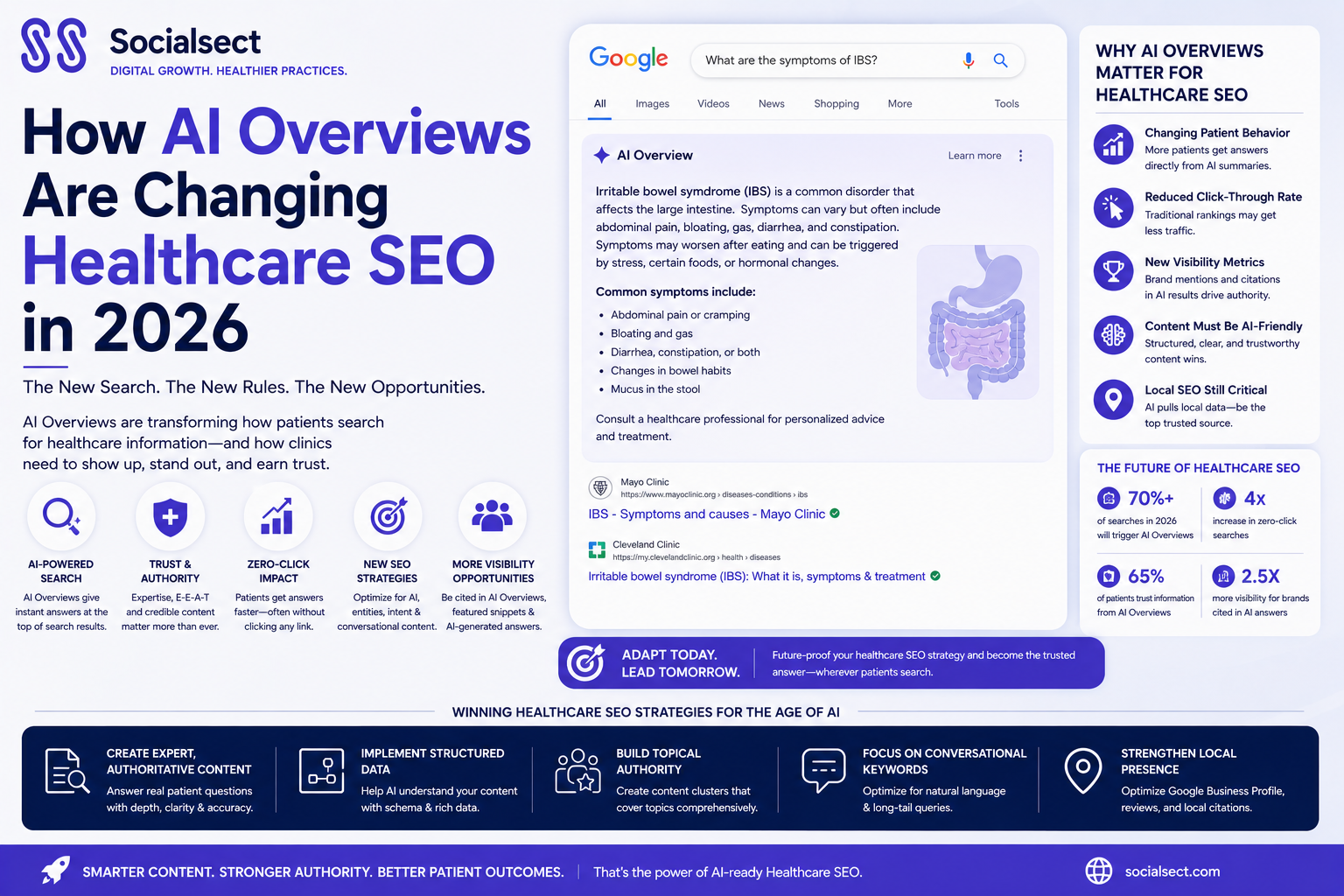
Google Search is changing how people discover and evaluate healthcare information.
For years, healthcare SEO focused primarily on traditional organic rankings, featured snippets, local results, Google Business Profiles, and website traffic. In 2026, healthcare organizations must also consider how their content can be discovered, interpreted, and cited within AI-powered search experiences.
Google's AI Overviews and AI Mode can synthesize information from multiple web sources and provide users with a more detailed answer directly within Search. Importantly, Google states that its generative AI search features are grounded in its core Search systems and retrieved web content. This means tr aditional SEO remains important rather than becoming obsolete.
For healthcare organizations, this shift is particularly important because medical searches involve trust, accuracy, expertise, and potentially high-stakes decisions.
This guide explains what healthcare SEO AI Overviews means for clinics, hospitals, healthcare groups, specialists, and medical brands—and how organizations can prepare their SEO strategy for AI-powered search in 2026.
What Are AI Overviews?
AI Overviews are AI-generated responses that can appear within Google Search for certain queries.
Instead of requiring a user to open multiple search results and manually combine information, Google can provide an overview that synthesizes relevant information and includes links to supporting webpages.
AI Overviews are part of Google's broader evolution toward more conversational and exploratory search experiences.
For healthcare searches, a user might search:
- What are the symptoms of sleep apnea?
- When should I see a cardiologist?
- What causes chronic back pain?
- What is the recovery time after cataract surgery?
- How is a torn meniscus treated?
- What should I ask a dermatologist?
The search experience can potentially provide an AI-generated summary followed by supporting sources.
This changes the competitive environment because visibility is no longer limited to the traditional list of blue links.
What Healthcare SEO AI Overviews Means for Medical Websites
The rise of AI search does not mean healthcare organizations should abandon traditional SEO.
Google's current guidance explicitly says that SEO remains relevant because its generative AI features rely on core Search ranking and quality systems to retrieve relevant pages.
Instead, healthcare SEO needs to become more comprehensive.
A modern strategy should consider:
- Traditional organic rankings
- AI Overview visibility
- AI Mode visibility
- Local search
- Google Business Profile visibility
- Patient-focused content
- Expert-led healthcare content
- Technical SEO
- Structured information
- Website experience
- Conversion performance
The objective is to create content that is useful enough to rank, trustworthy enough to be cited, and comprehensive enough to answer the patient's underlying question.
Why AI Overviews Matter More for Healthcare
Healthcare is different from many other industries because patients need reliable information.
A poorly researched article about a consumer product may result in a bad purchase decision.
Incorrect healthcare information can have much more serious consequences.
That makes credibility particularly important.
Healthcare organizations should demonstrate:
- Clinical expertise
- Accurate medical information
- Physician credentials
- Transparent authorship
- Reliable references
- Appropriate medical review
- Updated information
- Clear patient guidance
This is closely connected to Google's emphasis on helpful, reliable, people-first content and its broader quality systems.
For healthcare brands, AI search should therefore be treated as an extension of an existing trust-building SEO strategy—not as a shortcut around it.
AI Overviews Are Changing Search Intent
Traditional SEO often begins with a keyword.
AI-powered search is increasingly about understanding the broader intent behind a question.
Consider the search:
"knee pain treatment"
A traditional keyword strategy might create a page optimized around that phrase.
A more comprehensive healthcare SEO strategy considers the related questions a patient may have:
- What causes knee pain?
- When should knee pain be evaluated?
- What treatments are available?
- Can physical therapy help?
- When is surgery considered?
- What happens during an orthopedic consultation?
- Which specialist treats persistent knee pain?
AI-powered search can explore related concepts and questions when generating responses.
Google describes this process in its documentation as "query fan-out," where related searches can be generated to retrieve additional information relevant to the original question.
This means healthcare content should address the topic and patient intent, not simply repeat an exact keyword.
Create Comprehensive Healthcare Content
One of the biggest opportunities in healthcare SEO AI Overviews is creating content that goes beyond generic explanations.
Instead of publishing a short article saying:
"Back pain can have many causes."
A stronger page can explain:
- Common causes
- Warning signs
- When to seek medical evaluation
- Diagnostic approaches
- Conservative treatments
- Specialist evaluation
- Surgical considerations
- Recovery expectations
- Frequently asked questions
The content should still be easy to scan.
Use:
- Descriptive headings
- Short paragraphs
- Lists
- Tables where appropriate
- FAQs
- Clear definitions
- Relevant internal links
Comprehensive does not mean unnecessarily long.
The goal is to answer the user's question completely and clearly.
EEAT Becomes Even More Important
Experience, Expertise, Authoritativeness, and Trustworthiness—commonly referred to as EEAT—should be central to healthcare SEO.
Experience
Healthcare websites should demonstrate practical understanding of patient concerns.
Content should address real questions patients ask before consultations, procedures, and treatments.
Expertise
Identify the medical professionals behind your content.
Include:
- Physician name
- Credentials
- Specialty
- Professional experience
- Areas of expertise
- Relevant qualifications
Authoritativeness
Develop authority through:
- High-quality medical content
- Expert contributors
- Appropriate citations
- Relevant healthcare resources
- Strong specialty pages
- Reputable external references
Trustworthiness
Make your organization easy to verify.
Provide:
- Accurate contact details
- Physical locations
- Physician profiles
- Privacy information
- Appointment information
- Editorial policies
- Content review dates where appropriate
For healthcare websites, trust is not just an SEO consideration. It is part of the patient experience.
Expert-Reviewed Content for AI Search
Healthcare organizations should consider adding clear editorial processes to important medical content.
A strong workflow may include:
Research → Medical writing → Expert review → Fact checking → SEO review → Publication → Periodic update
For example, a page about a surgical procedure should ideally be reviewed by an appropriately qualified medical professional.
A visible author and reviewer structure can help users understand who created and reviewed the information.
This also strengthens the overall credibility of the website.
Build Topic Clusters Instead of Isolated Articles
AI-powered search makes topical depth increasingly valuable.
Healthcare websites should organize content around specialties and treatment areas.
For example, an orthopedic clinic could build a knee health cluster:
Knee Pain
→ Causes of knee pain→ Knee arthritis→ Meniscus injuries→ ACL injuries→ Knee replacement→ Physical therapy→ Knee injections→ Recovery guides→ When to see an orthopedic specialist
These pages should be connected through logical internal links.
This creates a structured knowledge environment for users and search engines.
Technical SEO Still Matters
One of the biggest misconceptions about AI search is that technical SEO has become less important.
Google's current guidance says the opposite: pages need to meet Search technical requirements and be indexed and eligible to appear in Search to be considered for generative AI features.
Healthcare websites should therefore maintain strong technical foundations.
Important areas include:
- Crawlability
- Indexation
- XML sitemaps
- Canonical URLs
- Internal linking
- Mobile usability
- Page speed
- Core Web Vitals
- JavaScript rendering
- HTTPS
- Structured data
- Clean URL architecture
For large hospital networks and multi-location healthcare organizations, technical problems can affect thousands of pages.
Structured Data and AI Search
Structured data helps search engines understand information on a webpage.
Healthcare organizations can use appropriate structured data where supported and relevant.
Examples may include:
- Organization
- LocalBusiness
- Physician
- MedicalClinic
- Article
- BreadcrumbList
However, structured data should not be viewed as a special "AI Overview hack."
Google's guidance emphasizes that structured data should accurately represent visible page content and comply with its relevant guidelines.
The priority should always be accurate, useful information.
Local Healthcare SEO in the AI Search Era
AI search does not eliminate local search.
Patients still need to know:
- Where the clinic is located
- Which physicians practice there
- What services are available
- When the clinic is open
- How to contact the organization
- How to book an appointment
This makes local SEO for healthcare increasingly important.
Healthcare organizations should maintain accurate:
- Google Business Profiles
- Clinic location pages
- Address information
- Phone numbers
- Opening hours
- Service information
- Reviews
For multi-location organizations, every location should have a unique and useful digital presence.
AI Search and Healthcare Patient Acquisition
Visibility alone is not the goal.
The ultimate objective of healthcare SEO should be meaningful patient engagement and acquisition.
A patient may discover your clinic through an AI-generated search result, visit your website, read a treatment page, review physician credentials, and then schedule an appointment.
This means healthcare websites should optimize for the complete journey:
AI/Search Discovery → Website Visit → Trust → Education → Conversion
Conversion elements should include:
- Clear appointment CTAs
- Phone numbers
- Online booking
- Consultation forms
- Physician profiles
- Location information
- Treatment information
Google has also advised site owners to consider the value of visits beyond clicks, including conversions and other meaningful engagement outcomes.
Don't Optimize for AI by Creating More Low-Quality Content
The emergence of AI search may tempt businesses to produce hundreds of automatically generated pages.
This is risky.
Google's current guidance emphasizes unique, helpful, people-first content and warns against creating large amounts of content primarily to manipulate rankings or generative AI results.
Healthcare organizations should avoid:
- Mass-produced generic articles
- Keyword-swapped city pages
- Repetitive treatment pages
- Unsupported medical claims
- AI-generated content without meaningful review
- Fake expertise
- Artificial mentions intended to manipulate visibility
More content is not automatically better.
Better content is better.
AI Content Can Assist—but Expertise Must Lead
AI tools can help healthcare marketing teams with research, outlining, editing, and content organization.
However, healthcare content requires careful human oversight.
Google's guidance states that generative AI can be useful for research and structure, but content still needs to satisfy Search Essentials and spam policies.
For healthcare organizations, a responsible workflow is:
Identify the real patient question.
Research reliable medical sources.
Create an evidence-based outline.
Develop original content.
Add expert input.
Fact-check medical claims.
Optimize the page for search.
Review the content periodically.
This produces content that provides genuine value rather than simply attempting to satisfy an algorithm.
How to Measure AI Overview Visibility
One of the most important developments for SEO professionals in 2026 is improved measurement.
Google announced new Search Console reports for generative AI visibility in June 2026. These reports can provide information about impressions, pages, countries, devices, and dates for visibility within generative AI features in Search and Discover, with rollout beginning to a subset of websites.
This gives healthcare SEO teams another layer of performance analysis.
Track:
- AI-generated search visibility
- Pages appearing in generative AI features
- Organic impressions
- Organic clicks
- Search queries
- Local performance
- Appointment conversions
- Phone calls
- Lead generation
The most important metric remains business impact.
A Practical Healthcare SEO Strategy for AI Overviews
Healthcare organizations can prepare their websites with a structured approach.
Step 1: Audit Existing Content
Identify:
- Thin pages
- Outdated medical information
- Duplicate content
- Weak service pages
- Missing physician information
- Poor internal linking
Step 2: Strengthen Core Service Pages
Create detailed pages for your most important:
- Specialties
- Treatments
- Conditions
- Locations
- Physicians
Step 3: Build Topic Clusters
Connect related content around major healthcare topics.
Step 4: Improve EEAT
Add qualified authors, reviewers, credentials, references, and transparent editorial information.
Step 5: Fix Technical SEO
Ensure important pages can be crawled, indexed, rendered, and understood.
Step 6: Improve Local Visibility
Optimize location pages and business profiles.
Step 7: Improve Conversion Paths
Make appointment booking and enquiries simple.
Step 8: Measure Results
Use Google Search Console, analytics, call tracking, CRM data, and available generative AI performance reporting.
What Healthcare Brands Should Stop Doing
The AI search era makes several outdated SEO approaches even less useful.
Healthcare organizations should avoid relying on:
- Keyword stuffing
- Exact-match keyword repetition
- Generic AI content at scale
- Duplicate city pages
- Thin service pages
- Unverified medical claims
- Fake reviews
- Artificial backlinks
- "AI Overview hacks"
- Guaranteed AI search rankings
Google explicitly recommends focusing on foundational SEO and useful, unique content rather than attempting to manipulate AI search systems through specialized hacks.
The Future of Healthcare SEO in 2026
Healthcare SEO is moving from a narrow ranking-focused discipline toward a broader digital visibility strategy.
The strongest healthcare websites will not simply target keywords.
They will build trusted digital resources that help patients understand:
- Their symptoms
- Their conditions
- Their treatment options
- Their specialist choices
- Their local healthcare options
- Their next steps
AI Overviews may change how users discover information, but the underlying requirement remains remarkably familiar: provide useful, accurate, accessible, trustworthy information.
For healthcare brands, this means investing in the fundamentals while adapting to new search experiences.
How Socialsect Can Help With Healthcare SEO AI Overviews
At Socialsect, we approach AI-era healthcare SEO as an evolution of strong search marketing—not as a replacement for SEO.
Our strategy can include:
- Healthcare SEO audits
- Technical SEO
- Healthcare content strategy
- EEAT optimization
- Topic cluster development
- Local SEO
- Multi-location SEO
- Physician SEO
- Healthcare website optimization
- Conversion optimization
- Search Console analysis
- AI search visibility monitoring
- Healthcare digital marketing
We focus on creating useful, trustworthy content that can perform across traditional search and emerging AI-powered search experiences.
Final Thoughts
Healthcare SEO AI Overviews is not about finding a shortcut to appear in Google's AI-generated answers.
It is about building a website that deserves to be discovered, understood, referenced, and visited.
In 2026, healthcare organizations should continue investing in technical SEO, high-quality content, local search, physician expertise, strong website architecture, and conversion optimization.
At the same time, they should monitor how AI-powered search is changing discovery and measure visibility using the tools becoming available through Google Search Console.
The healthcare brands best positioned for the future will be those that combine search expertise with genuine clinical credibility.
Build for patients first. Build for search second. Build for long-term trust always—with Socialsect.