Healthcare search has become significantly more competitive. Patients are using Google and AI-powered search tools to find doctors, compare clinics, research treatments, check symptoms, and decide where to book an appointment.
For healthcare organizations, simply having a website is no longer enough.
Your website needs to be technically healthy, locally visible, medically trustworthy, useful to patients, and optimized around the services people are actually searching for.
That creates an important strategic question:
Should you hire a healthcare SEO agency or build an in-house SEO team?
There is no universal answer.
A small private practice may not need a full-time SEO department. A large hospital group with dozens of locations may benefit from dedicated internal marketing resources. Some organizations may find that a hybrid model delivers the best balance of internal control and external expertise.
The right decision depends on your website, specialty, competition, locations, internal resources, budget, and growth objectives.
This guide compares a healthcare SEO agency vs an in-house team and explains what doctors, clinics, medical practices, and healthcare groups should consider before making a decision.
What Does a Healthcare SEO Agency Do?
A healthcare SEO agency specializes in improving the organic search visibility of healthcare organizations.
Depending on the engagement, a healthcare SEO agency may handle:
- Healthcare keyword research
- Technical SEO
- On-page SEO
- Healthcare content strategy
- Medical content optimization
- Local SEO
- Google Business Profile optimization
- Physician profile optimization
- Service-page optimization
- Internal linking
- Entity SEO
- E-E-A-T improvements
- Healthcare website audits
- Conversion optimization
- Search performance reporting
- AI search optimization
The important difference between a general SEO provider and a healthcare-focused SEO agency is specialization.
Healthcare websites require an approach that recognizes the importance of accuracy, expertise, trust, patient intent, and responsible medical communication.
What Is an In-House Healthcare SEO Team?
An in-house SEO team consists of employees working directly for the healthcare organization.
Depending on the organization's size, this might include:
- SEO manager
- Content strategist
- SEO specialist
- Content writer
- Digital marketing manager
- Web developer
- Analytics specialist
Large healthcare organizations may eventually build a substantial internal marketing department.
An in-house team offers direct access to internal stakeholders and can develop deep knowledge of the organization's services, physicians, patients, and business priorities.
However, building the right team requires recruitment, salaries, training, software, management, and ongoing professional development.
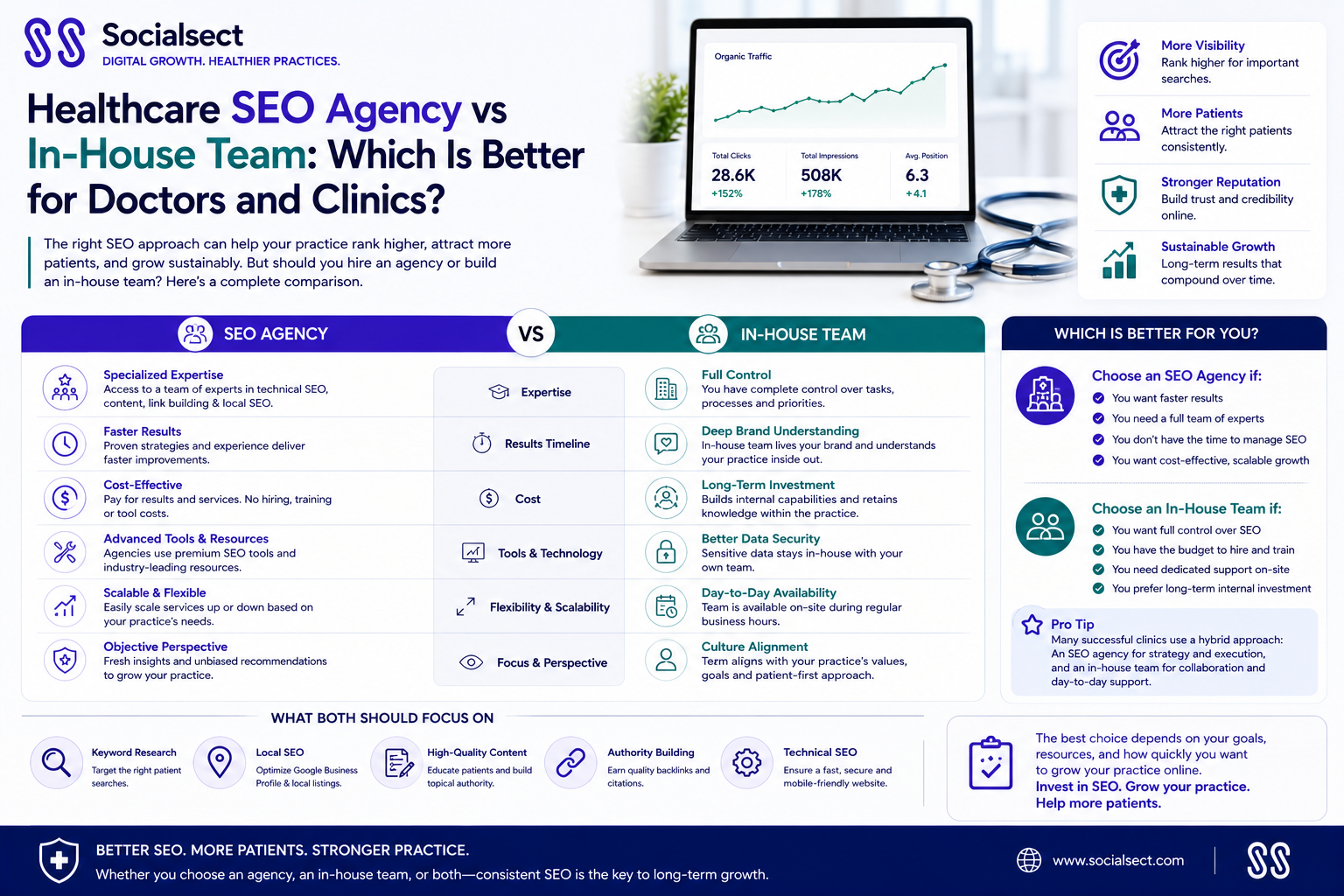
Healthcare SEO Agency vs In-House: Quick Comparison
Factor
Healthcare SEO Agency
In-House SEO Team
Healthcare SEO expertise
Often immediately available
Must be recruited or developed
Hiring requirement
Minimal
Significant
Scalability
Usually easier
Requires additional hiring
Healthcare specialists
Can provide access to specialists
May require multiple hires
Tools
Agency may already have them
Organization pays for tools
Industry experience
Can bring cross-client experience
Deep knowledge of one organization
Internal communication
Requires coordination
Direct access
Flexibility
Often high
Depends on team size
Management
Agency-managed
Organization-managed
Best fit
Small to mid-sized and growth-focused organizations
Large organizations with substantial internal resources
The comparison is not simply about which option is cheaper.
It is about which model gives the organization the capabilities it needs to achieve its growth objectives.
When Should a Clinic Hire a Healthcare SEO Agency?
For many clinics and medical practices, an agency can be the more practical option.
You Don't Have an SEO Specialist
If your marketing team consists primarily of:
- Practice managers
- Social media staff
- General marketers
- Administrative employees
you may not have the technical expertise required for healthcare SEO.
An agency can provide specialized knowledge without requiring the organization to build an entire SEO department.
Your Website Isn't Generating Enough Organic Leads
If your website receives traffic but produces few inquiries, the problem may not simply be rankings.
Potential issues can include:
- Poor search intent targeting
- Weak service pages
- Poor conversion paths
- Slow website performance
- Weak calls to action
- Lack of local optimization
- Insufficient content
- Poor internal linking
A healthcare SEO agency can analyze the entire organic acquisition funnel rather than focusing exclusively on rankings.
You Need Results Across Multiple SEO Areas
Healthcare SEO is multidisciplinary.
One person may understand keyword research but lack advanced technical SEO skills.
Another may be a strong writer but have little experience with local search.
A specialized agency can bring different capabilities together.
When Does an In-House Team Make Sense?
An in-house team can be highly valuable for larger healthcare organizations.
Large Healthcare Groups
Organizations with:
- Multiple locations
- Multiple specialties
- Large content libraries
- Dedicated marketing departments
- Complex websites
may benefit from internal SEO leadership.
Strong Internal Marketing Infrastructure
If the organization already has:
- Developers
- Writers
- Designers
- Analytics specialists
- Marketing managers
SEO can potentially be integrated into the existing team.
Need for Constant Internal Collaboration
Large healthcare organizations may have complex approval processes.
An internal team can communicate directly with:
- Physicians
- Operations
- Compliance
- Marketing
- IT
- Leadership
This can simplify certain workflows.
The Hidden Cost of Building an In-House SEO Team
At first glance, hiring one SEO employee may seem more cost-effective than working with an agency.
But an effective internal operation often requires more than one person.
Consider the resources involved:
SEO Specialist
Responsible for strategy, research, optimization, and reporting.
Content Specialist
Creates and updates healthcare content.
Technical SEO Support
Handles technical website issues.
Developer
Implements website changes.
Designer
Improves UX and landing pages.
Analytics Specialist
Measures traffic, conversions, and performance.
SEO Tools
The team may also need subscriptions for:
- Keyword research
- Competitive research
- Technical auditing
- Rank tracking
- Content analysis
- Analytics
The actual investment can therefore become considerably larger than the salary of one SEO employee.
The Expertise Advantage of a Healthcare SEO Agency
A healthcare SEO agency can work across multiple healthcare projects and markets.
That experience can expose the team to:
- Different specialties
- Different competitive environments
- Different website platforms
- Different patient search behaviors
- Different technical challenges
- Different local SEO markets
This broader experience can be useful when developing strategies for competitive healthcare markets.
However, agencies should still demonstrate genuine healthcare experience rather than simply claiming specialization.
E-E-A-T: A Critical Healthcare SEO Consideration
Healthcare content needs a particularly strong focus on trust.
Google's guidance emphasizes the importance of creating helpful, reliable information, especially for topics where accuracy matters.
A healthcare SEO strategy should therefore consider:
Experience
Does the content demonstrate appropriate practical understanding?
Expertise
Is the information created or reviewed by people with relevant knowledge?
Authoritativeness
Does the organization demonstrate legitimate authority?
Trustworthiness
Can patients understand who is responsible for the information and whether the claims are supported?
An agency should have a clear process for handling medical content responsibly.
That may include:
- Qualified authors
- Medical review
- Physician bios
- Author credentials
- References
- Editorial policies
- Updated information
The exact approach depends on the organization and content type.
Healthcare SEO Agency vs General SEO Agency
This is another important distinction.
A general SEO agency may understand:
- Technical SEO
- Keywords
- Link building
- Content
- Analytics
But healthcare SEO introduces additional considerations.
A healthcare-focused provider should understand:
- Patient search intent
- Medical terminology
- Healthcare content quality
- Physician entities
- Local healthcare SEO
- Healthcare E-E-A-T
- Sensitive medical topics
- Healthcare conversion journeys
The agency should also understand that ranking a medical article is not the same as generating a qualified patient.
What Should a Healthcare SEO Agency Include?
Before hiring an agency, ask what is actually included.
A comprehensive healthcare SEO service may cover:
Technical SEO
- Crawling
- Indexation
- Site architecture
- Page speed
- Mobile usability
- Canonicalization
- XML sitemaps
- Structured data
On-Page SEO
- Titles
- Headings
- Metadata
- Content structure
- Internal linking
- Search intent optimization
Healthcare Content
- Service pages
- Treatment pages
- Condition content
- Physician profiles
- Educational articles
- FAQs
Local SEO
- Google Business Profile
- Location pages
- Local content
- Business information consistency
- Local authority
E-E-A-T
- Author profiles
- Physician credentials
- Medical review
- References
- Trust signals
Conversion Optimization
- Appointment CTAs
- Contact forms
- Phone conversion paths
- Service-page UX
- Landing-page optimization
Don't Judge an Agency by Keyword Rankings Alone
Rankings matter, but they aren't the final business objective.
A healthcare organization should monitor:
- Organic impressions
- Organic traffic
- High-intent rankings
- Qualified visitors
- Phone calls
- Appointment requests
- Consultation requests
- Lead quality
- Conversion rates
For example, ranking first for a low-intent informational query may generate considerable traffic but very few patients.
Ranking well for a relevant treatment or specialist search can have much greater commercial value.
Can an In-House Team Outperform an Agency?
Absolutely.
An excellent internal team with strong healthcare knowledge, adequate resources, and effective leadership can outperform an agency.
The question is whether the organization can build and maintain that capability.
An internal team needs:
- Strong hiring
- Leadership
- Training
- SEO tools
- Technical support
- Content resources
- Analytics
- Continuous learning
SEO changes continuously, so the team must keep up with evolving search systems, technical standards, content expectations, and AI-powered search.
The Hybrid Healthcare SEO Model
For many growing healthcare organizations, a hybrid model can be especially effective.
The internal team maintains:
- Brand knowledge
- Physician relationships
- Patient insights
- Business priorities
- Internal approvals
The agency supports:
- SEO strategy
- Technical SEO
- Keyword research
- Content strategy
- Local SEO
- Entity SEO
- AI search optimization
- Competitive analysis
- Reporting
This model allows the healthcare organization to retain internal control while accessing specialized SEO expertise.
How to Decide Which Model Is Right for Your Clinic
Ask these questions.
How Large Is Your Website?
A 30-page practice website and a 5,000-page healthcare network have completely different SEO requirements.
How Competitive Is Your Specialty?
Competing for a highly searched medical specialty in a major city may require substantially more resources.
How Many Locations Do You Operate?
Multi-location healthcare SEO requires additional planning and management.
Do You Have Technical Resources?
SEO recommendations are only useful if someone can implement them.
Do You Have Healthcare Content Expertise?
Medical content needs appropriate subject-matter knowledge and quality control.
How Quickly Do You Want to Scale?
An agency can often add resources without the organization having to recruit several new employees.
What Is Your Long-Term Strategy?
A large healthcare group may eventually benefit from building internal SEO leadership even if it uses an agency for specialized execution.
Questions to Ask a Healthcare SEO Agency Before Hiring
Before signing a contract, ask:
What Healthcare Organizations Have You Worked With?
Look for relevant experience rather than generic SEO case studies.
How Do You Approach Medical Content?
Ask about authorship, review, references, and quality control.
What Will You Optimize First?
A good strategy should begin with an audit and prioritization rather than immediately publishing dozens of articles.
How Do You Measure Patient Acquisition?
The agency should connect SEO activity with meaningful business outcomes.
How Do You Handle Local SEO?
This is especially important for clinics dependent on local patients.
How Do You Approach AI Search?
Ask how the agency approaches AI-powered search without making unrealistic promises about guaranteed citations or rankings.
What Does Reporting Include?
Reports should provide actionable insights rather than simply listing keyword positions.
How Socialsect Approaches Healthcare SEO
At Socialsect, healthcare SEO is approached as a combination of search visibility, authority, patient intent, and conversion strategy.
The objective isn't simply to increase the number of keywords ranking on Google.
A healthcare SEO strategy should connect:
Search demand → Relevant content → Organic visibility → Patient engagement → Appointment action
Depending on the organization's needs, the strategy can include:
- Healthcare SEO
- Technical SEO
- Local SEO
- Healthcare content strategy
- E-E-A-T optimization
- Entity SEO
- Physician SEO
- Service-page optimization
- AI search optimization
- Conversion optimization
- Competitive analysis
- Performance reporting
For smaller practices, this can provide access to specialized capabilities without building a large internal team.
For larger healthcare organizations, Socialsect can also complement an existing marketing department with specialized SEO strategy and execution.
Final Verdict: Healthcare SEO Agency or In-House?
There is no one-size-fits-all answer.
Choose an Agency When:
- You don't have specialist SEO talent.
- You want access to multiple SEO capabilities.
- You need to scale quickly.
- You operate a small or mid-sized practice.
- Your website needs significant optimization.
- You want specialized healthcare SEO experience.
Consider In-House When:
- You have a large healthcare organization.
- You already have a mature marketing team.
- You need constant internal collaboration.
- You have resources for SEO, content, development, and analytics.
- You want to build long-term internal SEO expertise.
Consider a Hybrid Model When:
- You have internal marketing resources but need specialist SEO expertise.
- You operate multiple locations.
- Your website is technically complex.
- You want strategic leadership while keeping brand knowledge in-house.
Ultimately, the question isn't simply:
"Which is cheaper?"
The better question is:
"Which model can consistently produce the expertise, execution, and accountability required to turn healthcare search visibility into sustainable patient acquisition?"
For many doctors and clinics, a specialized healthcare SEO agency can provide that capability without the overhead of building a complete internal SEO department.
For larger healthcare organizations, an internal team or hybrid model may offer greater long-term scalability.
The right choice is the one that matches your organization's size, competitive environment, internal capabilities, and growth goals.