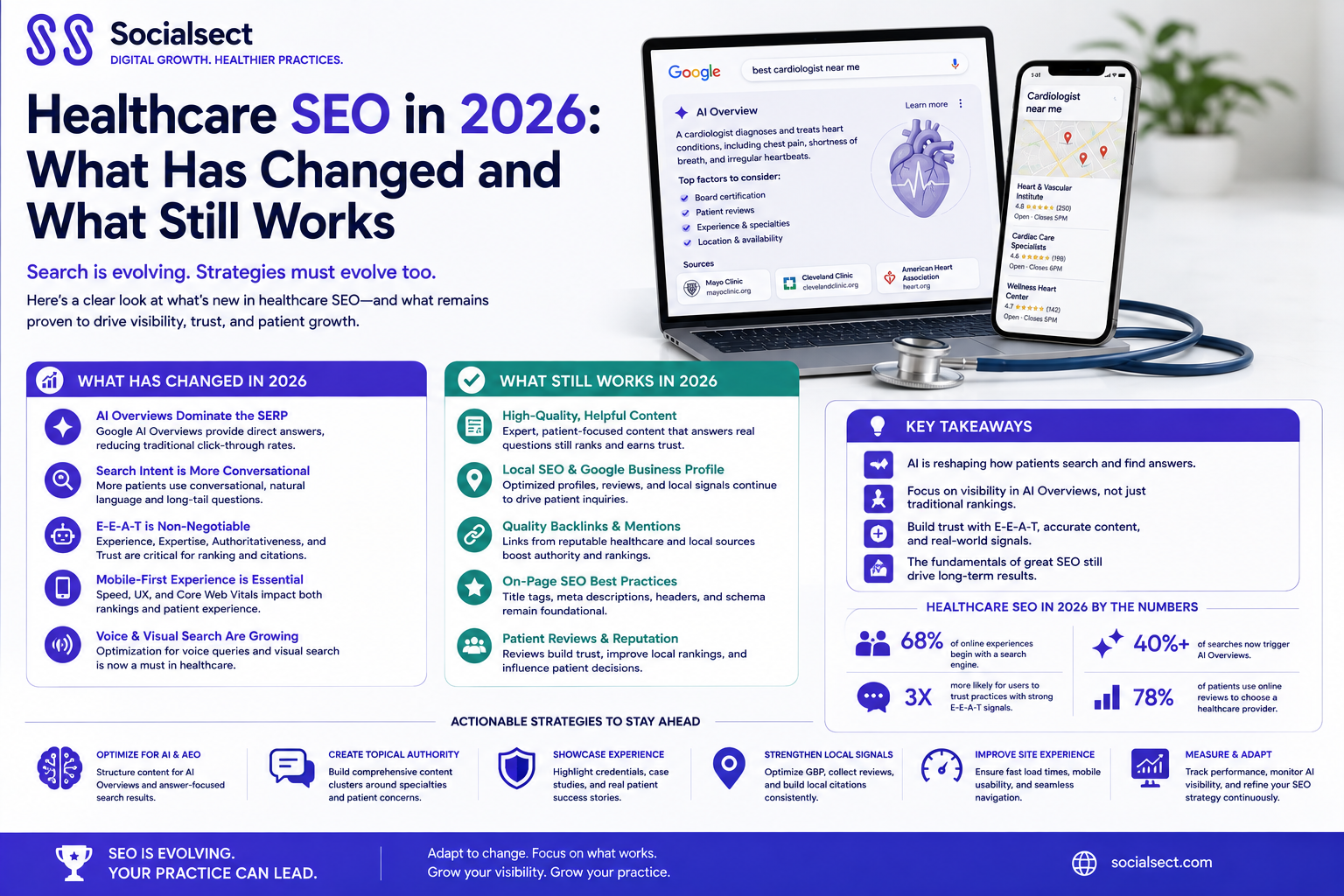
Healthcare search is evolving faster than ever.
Patients are using Google, AI-powered search experiences, maps, reviews, social platforms, and conversational tools to research symptoms, treatments, doctors, and healthcare providers. At the same time, search engines are becoming better at understanding search intent, context, entities, content quality, and the relationships between topics.
For medical practices, hospitals, specialty clinics, healthcare groups, and healthcare brands, this raises an important question:
What actually works in healthcare SEO 2026?
The answer is not to abandon everything that worked before.
Technical SEO still matters. Helpful content still matters. Local SEO still matters. Physician expertise still matters. A strong website still matters.
What has changed is how these elements need to work together.
Modern healthcare SEO is moving away from keyword-focused publishing toward a broader strategy based on patient intent, medical expertise, topical authority, technical accessibility, local relevance, AI search visibility, and measurable patient acquisition.
This guide explains what has changed in healthcare SEO 2026, what still works, what healthcare organizations should stop doing, and how to build a search strategy that can remain effective as search continues to evolve.
What Is Different About Healthcare SEO in 2026?
Traditional SEO was often viewed as a simple process:
Keyword → Content → Ranking → Traffic
That model is incomplete today.
A more realistic healthcare SEO journey is:
Patient Intent → Useful Content → Search Visibility → Trust → Website Engagement → Patient Acquisition
Search engines increasingly attempt to understand what users actually want rather than simply matching exact words on a webpage.
At the same time, AI-powered search experiences can summarize information and provide users with answers without requiring them to visit multiple websites.
This means healthcare brands need to optimize for more than traditional rankings.
A modern strategy should consider:
- Organic search
- AI-powered search
- Local search
- Search intent
- EEAT
- Medical content quality
- Technical SEO
- Physician authority
- Patient experience
- Conversion optimization
What Still Works in Healthcare SEO 2026?
Despite all the changes, many foundational SEO principles remain highly effective.
1. Helpful, Original Content
One of the most important principles in healthcare SEO 2026 is creating content that genuinely helps patients.
A healthcare article should answer the question behind the search.
For example, instead of creating a generic page targeting:
"back pain treatment"
build a resource explaining:
- Common causes of back pain
- Warning signs
- When evaluation may be appropriate
- Conservative treatment options
- Physical therapy
- Diagnostic approaches
- When specialist care may be considered
- Surgical options
- Recovery expectations
- Frequently asked questions
The objective is not to make a page artificially long.
The objective is to make it genuinely useful.
2. EEAT Is Still Essential for Healthcare
Healthcare is a trust-sensitive industry.
Patients need confidence that the information they read is accurate and that the people behind it have appropriate expertise.
This makes Experience, Expertise, Authoritativeness, and Trustworthiness (EEAT) particularly important.
Healthcare websites should clearly communicate:
- Physician credentials
- Medical specialties
- Professional experience
- Areas of clinical focus
- Relevant qualifications
- Content authorship
- Medical review where appropriate
A medical article should not simply look authoritative.
The expertise behind it should be genuine.
3. Physician-Led Content
One major opportunity for healthcare organizations is putting qualified professionals closer to the center of their content strategy.
Instead of publishing anonymous medical articles, practices can identify:
Author: Dr. [Name]
Specialty: [Medical Specialty]
Medical Reviewer: Dr. [Name]
Credentials: [Relevant Credentials]
This creates transparency for patients.
Physician profiles should also be connected to relevant treatments, conditions, and services.
For example:
Orthopedic Surgeon → Knee Replacement → Knee Arthritis → Treatment Guide
This creates a stronger relationship between clinical expertise and website content.
What Has Changed: Search Is More Conversational
Patients increasingly search using complete questions.
Instead of:
"ACL injury"
a user may search:
"How long does it take to recover from an ACL injury?"
Instead of:
"cataract surgery"
they may search:
"What should I expect during cataract surgery recovery?"
This makes question-focused content increasingly valuable.
Healthcare websites should identify the questions patients ask throughout the decision-making process.
Useful formats include:
- FAQs
- Definitions
- Step-by-step guides
- Treatment explanations
- Comparison pages
- Recovery guides
- "When should I see a specialist?" content
AI Search Is Changing Healthcare Discovery
AI-powered search experiences are becoming another part of the patient research journey.
A patient may ask an AI-powered search system about:
- Symptoms
- Treatment options
- Specialists
- Procedures
- Recovery
- Healthcare providers
The system may synthesize information from multiple sources.
For healthcare brands, this makes authority and content quality increasingly important.
However, healthcare organizations should not think of AI search as a completely separate SEO discipline.
Strong technical SEO, useful content, expertise, and authority remain the foundation.
Traditional Rankings Are Not the Only KPI
Healthcare SEO 2026 requires a broader approach to measurement.
Rankings and organic traffic remain useful.
But healthcare organizations should also track:
- Qualified leads
- Appointment requests
- Phone calls
- Consultation bookings
- Local actions
- Conversion rates
- Cost per acquisition
- Revenue by service
- Patient acquisition by location
A page ranking in position one is not necessarily valuable if it generates no meaningful patient engagement.
The real objective is:
Search visibility → Qualified patient → Appointment → Business growth
Local SEO Still Works Extremely Well
Healthcare is inherently local.
Patients typically need providers they can physically visit.
Searches such as:
- Cardiologist near me
- Orthopedic surgeon in Miami
- Dentist near me
- Dermatologist in New York
- IVF clinic near me
- Spine specialist in Chicago
continue to demonstrate strong local intent.
This makes local SEO an essential component of healthcare SEO 2026.
Healthcare practices should optimize:
- Google Business Profile
- Location pages
- Physician locations
- Services
- Contact information
- Opening hours
- Reviews
- Local citations
Multi-Location Healthcare SEO Has Become More Complex
Healthcare groups with multiple locations face additional SEO challenges.
A clinic with offices in:
- New York
- Los Angeles
- Miami
- Chicago
should not simply publish four identical pages with different city names.
Each location page should provide genuinely useful information about:
- Location
- Physicians
- Services
- Office hours
- Parking
- Nearby areas
- Patient access
- Appointment information
This creates a better experience for both patients and search engines.
Technical SEO Still Matters
Technical SEO may receive less attention than AI search, but it remains foundational.
A healthcare website needs to be accessible to search engines.
Important areas include:
- Crawlability
- Indexability
- XML sitemaps
- Canonical tags
- Internal linking
- HTTPS
- Mobile usability
- Page speed
- Core Web Vitals
- JavaScript rendering
- Redirects
- Broken links
A technically poor website can undermine even excellent content.
Website Speed Still Matters
Patients are unlikely to wait indefinitely for a healthcare website to load.
Slow websites can create:
- Higher abandonment
- Poor user experience
- Lower engagement
- Reduced conversion opportunities
Healthcare websites should review:
- Image optimization
- JavaScript
- CSS
- Third-party scripts
- Server response times
- Caching
- Content delivery
- Mobile performance
Performance optimization should be considered part of both SEO and patient experience.
Search Intent Is More Important Than Exact-Match Keywords
Keyword research remains valuable, but modern SEO should not depend on repeating the same phrase.
Consider:
"knee replacement"
A patient searching this term could be looking for:
- What knee replacement is
- Cost
- Recovery time
- Risks
- Surgeons
- Alternatives
- Hospital information
- Preparation instructions
A strong page should understand the broader intent behind the query.
This is why semantic relevance and comprehensive topical coverage matter.
Topic Clusters Still Work
A topic cluster organizes related content around a central subject.
For a cardiology practice, a heart disease cluster could include:
Heart Disease
→ Symptoms → Risk Factors → Diagnosis → Treatment → Prevention → Heart Failure → Cholesterol → Blood Pressure → Cardiac Testing → Cardiologist Consultation
These pages can link naturally to one another.
This helps patients navigate the subject while building broader topical coverage.
What Healthcare Brands Should Stop Doing in 2026
Not every traditional SEO tactic deserves to survive.
Keyword Stuffing
Repeating a keyword unnaturally does not create better healthcare content.
Mass AI Content
Publishing hundreds of low-value AI-generated pages can create a poor user experience.
Duplicate City Pages
Replacing a city name on an otherwise identical page is not a strong local strategy.
Anonymous Medical Content
Important medical information should have appropriate authorship and review.
Thin Service Pages
A service page should provide useful information, not just a keyword and a contact button.
Fake Expertise
Never invent medical credentials, experience, authors, or reviews.
Manipulative Backlinks
Healthcare organizations should prioritize relevant, credible authority rather than low-quality link volume.
AI Content: What Is Safe and Useful?
AI can be helpful in healthcare marketing.
It can assist with:
- Content research
- Outlining
- Topic clustering
- Editing
- Summarization
- Content calendars
- Internal linking suggestions
But healthcare content requires human oversight.
A responsible workflow is:
Research → Draft → Medical Review → Fact Check → SEO Review → Publish → Monitor → Update
The final content should reflect genuine expertise and provide useful information.
AI should make the workflow more efficient—not replace medical judgment.
Healthcare SEO 2026 Requires Better Content Architecture
Content quality is not enough if patients cannot find it.
Healthcare websites should have a logical architecture.
For example:
Home
→ Specialties
→ Conditions
→ Treatments
→ Physicians
→ Locations
→ Resources
→ Contact
Internal links should connect related pages naturally.
A patient researching a treatment should easily be able to find:
- The relevant specialist
- The relevant location
- Related conditions
- Recovery information
- Appointment options
Build Better Medical Service Pages
Healthcare practices should prioritize their most commercially important services.
A strong service page should cover:
What Is the Treatment?
Provide a clear explanation.
Who May Need It?
Explain appropriate considerations without making individual medical diagnoses.
How Does It Work?
Describe the process clearly.
What Can Patients Expect?
Explain consultation, treatment, and recovery where appropriate.
Who Provides the Service?
Link to qualified physicians.
Where Is It Available?
Provide relevant location information.
What Is the Next Step?
Include an appropriate appointment CTA.
Healthcare Reviews Still Matter
Patient reviews can influence healthcare decisions.
However, practices should never manufacture reviews or manipulate patient feedback.
Focus on providing excellent patient experiences and making it easy for patients to leave genuine feedback where permitted.
Reviews can support:
- Local visibility
- Patient trust
- Practice reputation
- Conversion rates
Reputation management should therefore be integrated into healthcare SEO rather than treated as an unrelated activity.
Build a Strong Healthcare Brand
Search visibility is increasingly connected to brand recognition.
Patients may encounter your practice through:
- AI search
- Maps
- Social media
- Directories
- Physician profiles
- Healthcare articles
Your brand information should remain consistent.
Maintain accurate:
- Practice name
- Physician names
- Locations
- Services
- Contact information
- Specialty information
Consistency makes it easier for patients and digital systems to understand who you are.
How to Build a Healthcare SEO Strategy in 2026
A practical healthcare SEO 2026 strategy can follow this framework.
Step 1: Technical Audit
Identify crawlability, indexation, performance, and architecture issues.
Step 2: Keyword and Intent Research
Map keywords to actual patient intent.
Step 3: Content Audit
Identify outdated, thin, duplicate, and underperforming content.
Step 4: Build Core Pages
Strengthen:
- Specialty pages
- Treatment pages
- Condition pages
- Physician pages
- Location pages
Step 5: Develop Topic Clusters
Create supporting content around important medical topics.
Step 6: Improve EEAT
Add genuine expert authorship, medical review, credentials, and trustworthy references.
Step 7: Strengthen Local SEO
Optimize locations, profiles, reviews, and local information.
Step 8: Improve Conversion
Make appointment requests, calls, and consultations easy.
Step 9: Monitor AI Search
Track emerging AI-powered search visibility alongside traditional SEO metrics.
Step 10: Continuously Update
Healthcare SEO is not a one-time project.
Healthcare SEO 2026: What Still Works vs What Has Changed
SEO Area
2026 Direction
Technical SEO
Still essential
Helpful content
Still essential
Keyword research
Still useful, but intent matters more
EEAT
Critical for healthcare
Local SEO
Highly important
Physician profiles
Increasingly valuable
Topic clusters
Strong strategy
AI search optimization
Growing importance
Keyword stuffing
Outdated
Duplicate location pages
Poor strategy
Mass AI content
Risky and low-value
Conversion optimization
Essential
Patient acquisition
Core business metric
Why Socialsect for Healthcare SEO 2026?
At Socialsect, we approach healthcare SEO as a complete digital growth strategy rather than a simple ranking exercise.
Our healthcare SEO approach can include:
- Technical SEO
- Healthcare content strategy
- EEAT optimization
- Local SEO
- Physician SEO
- Multi-location SEO
- AI search optimization
- Topic cluster development
- Healthcare website optimization
- Conversion optimization
- Patient acquisition strategy
- SEO performance analysis
The objective is to build a healthcare website that attracts the right audience, answers patient questions, establishes trust, and generates measurable business results.
Final Thoughts: What Really Works in Healthcare SEO 2026?
The biggest change in healthcare SEO is not that everything has become different.
It is that SEO has become more holistic.
Keywords still matter.
Technical SEO still matters.
Local SEO still matters.
Content still matters.
But successful healthcare brands need to combine these fundamentals with:
- Patient intent
- Medical expertise
- EEAT
- Topical authority
- AI search visibility
- Local relevance
- Website performance
- Conversion optimization
The healthcare organizations most likely to succeed in 2026 will not be those publishing the most content.
They will be the organizations producing the most useful, trustworthy, expert-led information while creating a technically strong and patient-friendly digital experience.
That is the foundation of sustainable healthcare SEO 2026.