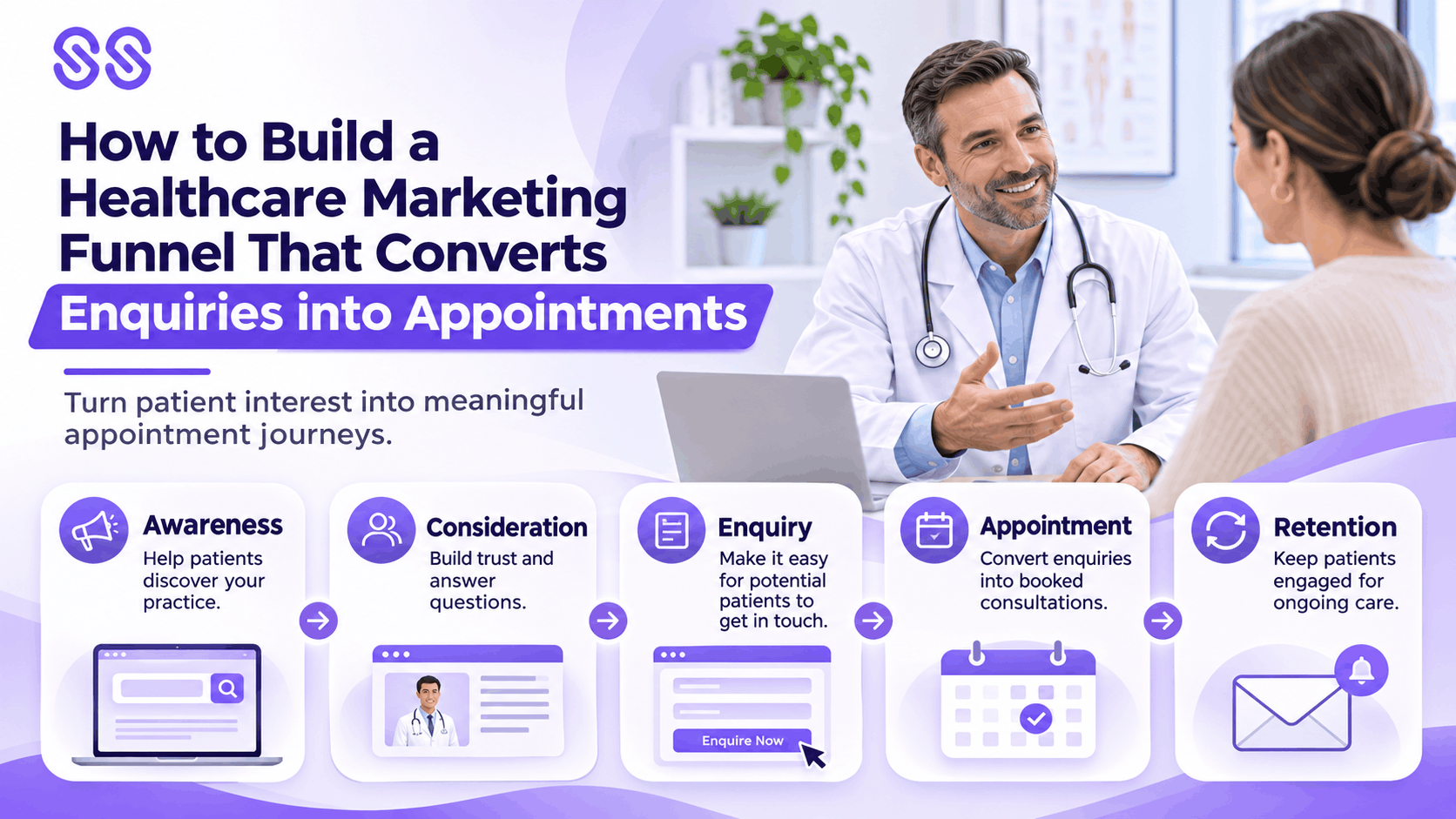
Generating enquiries is an important part of healthcare marketing, but enquiries alone do not guarantee appointment bookings. A hospital may receive calls from prospective patients, a clinic may generate website form submissions, and a specialist practice may attract traffic through Google Search. Yet, if these interactions do not progress towards consultations, the marketing strategy may not be delivering its full potential.
This is where a healthcare marketing funnel becomes valuable. It provides a structured way to guide prospective patients from discovering a healthcare provider to understanding its services, making an enquiry, and booking an appointment.
Unlike a traditional sales funnel, a healthcare funnel must account for patient trust, clinical sensitivity, privacy, and the time people may need to make healthcare decisions. The objective is not to pressure people into choosing a treatment. It is to provide relevant information, remove unnecessary barriers, and help them access appropriate care.
In this guide, we explain how to build a patient acquisition funnel, improve medical practice lead nurturing, and create a healthcare conversion funnel that connects marketing performance with appointment outcomes.
What Is a Healthcare Marketing Funnel?
A healthcare marketing funnel is a framework that describes how prospective patients discover, evaluate, and engage with a healthcare provider before booking an appointment.
It connects marketing channels, website content, enquiry management, and booking processes into a coordinated journey.
For example, someone searching for a dermatologist may discover a clinic through Google, visit its dermatology service page, review the clinician's qualifications, and submit an enquiry. The clinic then responds to questions, explains the consultation process, and helps the person schedule an appointment if they choose to proceed.
Each interaction supports a different stage of the patient journey.
Also Read more - SEO Services for Dermatologists in Los Angeles, CA
Why Healthcare Providers Need a Patient Acquisition Funnel
Without a structured funnel, marketing activities often operate independently. SEO generates website traffic, paid advertising attracts clicks, social media creates awareness, and reception teams handle enquiries without a shared process for measuring outcomes.
A patient acquisition funnel connects these activities and helps healthcare providers understand where potential patients stop progressing.
A well-planned funnel can help clinics and hospitals:
- Attract people searching for relevant healthcare services.
- Provide useful information before patients make contact.
- Improve the quality and management of enquiries.
- Reduce avoidable delays in the booking process.
- Identify marketing channels that generate suitable appointments.
- Measure conversion performance beyond clicks and website traffic.
The result is a more measurable and coordinated approach to patient acquisition.
The 5 Stages of a Healthcare Marketing Funnel
A practical healthcare marketing funnel can be divided into five stages: awareness, consideration, enquiry, appointment conversion, and retention.
<text color="secondary" size="sm">The stages below are a planning framework. Actual patient journeys may involve repeat visits, referrals, direct calls, or movement between stages.</text>
Stage 1: Awareness — Help Patients Discover Your Practice
The first stage is about making your clinic, hospital, or healthcare service visible to the people who may need it.
Prospective patients may discover your organisation through organic search, local search results, paid advertising, social media, referrals, or educational content.
Your marketing should match the way people search for information. Some may look for a specific specialist, while others may search for symptoms, available services, or healthcare providers in their area.
Effective strategies include:
- Healthcare SEO: Optimise service pages and useful educational content for relevant search queries.
- Local SEO: Maintain accurate business information and strengthen visibility for relevant local searches.
- Paid search campaigns: Target appropriate service-related keywords and align advertisements with the landing pages.
- Educational content: Answer common questions in clear, clinically responsible language.
- Social media marketing: Share relevant healthcare information and updates that support awareness and trust.
At this stage, focus on attracting relevant visitors rather than maximising traffic without considering intent.
For example, a clinic offering physiotherapy services may create a dedicated page explaining its services, consultation process, location, and appointment options. This helps people understand whether the clinic is relevant to their needs.
Stage 2: Consideration — Build Trust and Answer Questions
Once visitors discover your practice, they need enough reliable information to decide whether they want to contact you.
Healthcare decisions can involve concerns about expertise, treatment suitability, costs, appointment availability, and the overall experience. If your website does not address these concerns, visitors may leave without making an enquiry.
Your website should provide accurate, accessible information that helps people understand your services.
Focus on the following elements:
- Detailed but easy-to-understand service pages.
- Accurate clinician profiles and professional credentials.
- Transparent consultation and pricing information where available.
- Frequently asked questions addressing common administrative concerns.
- Clinic location, opening hours, and contact details.
- Clear explanations of what happens during an initial consultation.
Educational content can also support consideration. A hospital may publish an article explaining when someone should seek medical advice for a particular concern, while a specialist clinic may explain the consultation process for a specific service.
Content should be evidence-informed, regularly reviewed where necessary, and clear about when individual medical advice is required.
The goal is to help prospective patients make informed decisions without using exaggerated claims or unnecessary pressure.
Stage 3: Enquiry — Make It Easy to Contact Your Clinic
The enquiry stage begins when a prospective patient takes action, such as calling your clinic, submitting a form, sending a WhatsApp message, or requesting an appointment.
A common problem is that healthcare websites attract visitors but make contacting the practice unnecessarily difficult.
For example, a visitor may reach a service page but struggle to find a booking button, encounter a long form, or discover that the phone number is difficult to use on a mobile device.
To improve enquiry generation:
- Place clear calls to action on important service pages.
- Make phone numbers clickable on mobile devices.
- Keep enquiry forms short and relevant.
- Offer appropriate contact methods based on your workflow.
- Explain what happens after someone submits a request.
- Test forms, links, and booking systems regularly.
Calls to action should reflect the action a visitor can actually take. Options such as “Book an Appointment,” “Request a Consultation,” and “Contact Our Team” can work when they accurately describe the next step.
Track enquiries by source where possible, while maintaining appropriate privacy safeguards. This allows you to understand which channels are generating genuine interest.
Stage 4: Appointment Conversion — Turn Suitable Enquiries into Bookings
An enquiry does not automatically become an appointment. Prospective patients may have additional questions, need to check their availability, or require clarification about consultation fees and booking procedures.
This stage depends on the quality of your enquiry management process as well as your marketing.
Key actions include:
- Responding to enquiries within a defined, realistic timeframe.
- Assigning responsibility for calls, forms, and messages.
- Providing accurate answers to administrative questions.
- Following up appropriately when a prospective patient has requested further information.
- Offering clear appointment options and explaining the booking process.
- Recording whether enquiries become confirmed appointments.
Your reception team should know when to direct clinical questions to a qualified healthcare professional. Staff should not make unsupported clinical promises or pressure people to choose a service.
A well-managed process makes it easier for interested patients to understand their options and arrange a consultation when appropriate.
How to Calculate Your Appointment Conversion Rate
You can measure the performance of this stage using a simple calculation:
Appointment conversion rate = (Eligible enquiries that become confirmed appointments ÷ Total eligible enquiries) × 100
For example, if your clinic receives 150 eligible enquiries in a month and 30 result in confirmed appointments, the conversion rate is 20%.
This figure should be interpreted alongside enquiry quality, appointment attendance, service type, and lead source. Use a consistent definition of an eligible enquiry so comparisons remain meaningful.
Stage 5: Retention — Support the Patient Relationship
The patient journey does not necessarily end when an appointment is booked or attended. Depending on the type of service, people may need follow-up appointments, ongoing care, or information about future visits.
Retention strategies should support continuity of care rather than encourage unnecessary treatment or appointments.
Appropriate activities may include:
- Sending booking confirmations and reminders.
- Providing relevant preparation instructions.
- Sharing follow-up information recommended by the clinical team.
- Making rescheduling straightforward.
- Collecting feedback through suitable, privacy-conscious processes.
- Communicating about future services only where appropriate and permitted.
For healthcare organisations, retention must be aligned with clinical need, patient preferences, consent, and applicable privacy requirements.
How to Build a Healthcare Marketing Funnel Step by Step
Understanding the stages is only the beginning. To implement a practical medical marketing funnel, your clinic needs a clear plan for content, campaigns, enquiry handling, and measurement.
Step 1: Define Your Target Audience and Services
Start by identifying the services you want to promote and the people you aim to reach.
A multi-specialty hospital may need separate funnels for cardiology, orthopaedics, fertility care, and other departments because each service can involve different search behaviour, decision-making needs, and booking processes.
Similarly, a specialist clinic should build its strategy around the actual services it offers rather than using a generic healthcare message for every audience.
Define your target service, location, relevant search intent, and the action you want visitors to take.
Step 2: Map the Patient Journey
Document the main routes through which prospective patients discover and contact your practice.
A typical journey might look like this:
Google Search → Service Page → Enquiry Form → Follow-Up → Appointment Booking
However, a patient might instead find the clinic through a referral, call directly, or book through an online scheduling system.
Identify the most common paths and the points where people encounter friction. This gives you a practical basis for deciding which pages, processes, or communication steps need improvement.
Step 3: Create Content for Every Funnel Stage
One of the most common healthcare marketing mistakes is publishing content without a clear purpose.
Every page or campaign should support a defined stage of the patient journey.
Funnel Stage
Content or Asset
Primary Goal
Awareness
Educational blogs, local SEO pages, service-related search campaigns
Reach relevant audiences
Consideration
Service pages, clinician profiles, FAQs, consultation information
Build trust and answer questions
Enquiry
Landing pages, contact forms, click-to-call links
Encourage relevant enquiries
Appointment conversion
Enquiry workflows, booking pages, administrative follow-up
Help suitable enquiries become bookings
Retention
Appointment reminders, relevant follow-up communication
Support attendance and continuity of care
For example, a blog answering a common patient question may attract informational traffic. A related service page can then explain the clinic's offering and provide a clear route to contacting the team.
The connection between content and the next appropriate step is what makes the funnel work as a system.
Read More - orthopedic seo company los angeles
Step 4: Align Paid Advertising with Landing Pages
Paid advertising can generate enquiries quickly, but results depend on how well campaigns match user intent and the booking experience.
A campaign promoting a particular consultation should direct visitors to a relevant page rather than a generic homepage where they must search for the service themselves.
Review keyword relevance, audience targeting, ad messaging, landing page content, and the ease of contacting your clinic.
Avoid making guaranteed treatment outcomes or unsupported claims. Healthcare advertisements should follow the applicable platform policies and local healthcare advertising regulations.
Measure campaign performance using meaningful outcomes such as qualified enquiries and confirmed appointments, not just clicks.
Step 5: Develop a Medical Practice Lead Nurturing Process
Not every prospective patient is ready to book immediately. Some need clarification or time to consider their options.
A medical practice lead nurturing process helps your team respond consistently to these enquiries without creating unnecessary pressure.
A basic workflow may include:
Acknowledge the enquiry through the appropriate channel.
Respond to the questions raised and provide accurate administrative information.
Explain the available booking options.
Follow up when appropriate and in accordance with the person's preferences and applicable requirements.
Record the outcome so the team knows whether further action is needed.
Use a CRM or clinic management system where suitable. Limit access to patient information and collect only the data required for the intended purpose.
Nurturing should be helpful, relevant, and respectful. Avoid excessive messaging or using sensitive health information for marketing without a valid legal basis and any required consent.
Step 6: Improve the Booking Experience
Review the entire booking process from the patient's perspective.
Can someone find your contact details quickly? Is it clear whether an appointment request has been received? Does the clinic explain how bookings are confirmed? Are the forms easy to complete on a mobile phone?
Address the most significant friction points first.
You can test different form layouts, calls to action, or booking flows, provided the changes remain accessible, accurate, and compliant. Evaluate the impact on completed bookings and lead quality rather than relying only on engagement metrics.
Step 7: Measure and Optimise the Funnel
A healthcare conversion funnel should be reviewed regularly. The purpose of measurement is to identify where improvements are needed and determine whether changes produce meaningful results.
Track relevant indicators at each stage, including website traffic, service-page engagement, enquiry volume, response times, qualified enquiries, confirmed bookings, and attendance.
Use analytics and CRM data carefully. Healthcare-related tracking can involve sensitive information, so configure measurement tools to avoid unnecessary disclosure of personal or health data.
Review the results by service, campaign, and location where the data is sufficient and comparisons are fair.
Also Read About - Conversion-Focused Landing Pages for Healthcare Clinics
Key Metrics to Track in Your Healthcare Conversion Funnel
The right metrics help you distinguish between a marketing problem and an enquiry-management problem.
Metric
What It Measures
Relevant website traffic
Visits from audiences likely to need your services
Service-page conversion rate
The proportion of service-page visitors who complete a defined action
Enquiry volume
The number of calls, forms, messages, or appointment requests received
Qualified enquiry rate
The proportion of enquiries relevant to the services offered
First-response time
How quickly your team responds
Appointment conversion rate
The proportion of eligible enquiries that become confirmed appointments
Appointment attendance rate
The proportion of booked appointments attended
Cost per qualified enquiry
Marketing cost relative to suitable enquiries
Cost per booked appointment
Marketing cost relative to confirmed bookings
Each metric should have a consistent definition. For instance, a service-page conversion rate may count form submissions or calls, whereas appointment conversion measures the later step from enquiry to booking.
Comparing these metrics helps reveal where the funnel needs attention.
If traffic is high but enquiries are low, review page relevance, trust signals, and calls to action. If enquiries are strong but bookings are weak, investigate response times, follow-up, booking friction, and lead suitability.
Common Healthcare Marketing Funnel Mistakes to Avoid
Even a well-designed funnel can underperform when important details are overlooked.
Focusing on Lead Volume Instead of Lead Quality
More enquiries do not automatically mean more appointments. Broad targeting and unclear campaign messaging can attract people who are not looking for the services your clinic provides.
Evaluate whether enquiries are suitable and whether they progress to bookings.
Using the Same Message for Every Service
Different departments and specialties may have different patient concerns and decision-making needs. Use relevant service pages and messaging rather than sending every visitor to the same generic landing page.
Ignoring Enquiries After They Arrive
Marketing performance can suffer when enquiries remain unanswered or follow-up responsibilities are unclear. Ensure your team has a documented process for managing new contacts and recording outcomes.
Treating Website Traffic as the Final Goal
Traffic and engagement are useful indicators, but they do not prove that the funnel is generating appointments. Connect marketing reporting with booking outcomes wherever this can be done appropriately and reliably.
Neglecting Privacy and Healthcare Advertising Requirements
Avoid sending identifiable patient details or sensitive health information to advertising platforms without appropriate legal authority and safeguards. Review consent, data retention, access controls, and applicable privacy and healthcare marketing rules.
Trust and compliance should be built into the funnel from the start, not added after campaigns are launched.
How Socialsect Can Help Build a Healthcare Marketing Funnel
A successful healthcare marketing funnel requires more than individual campaigns. It needs a connected strategy that links search visibility, useful content, conversion-focused website experiences, enquiry management, and performance measurement.
Socialsect supports healthcare businesses through healthcare SEO, local SEO, paid campaign optimisation, service landing pages, content strategy, and conversion-focused website improvements.
The process begins by understanding your services, audience, existing traffic, enquiry sources, and booking journey. From there, opportunities can be prioritised according to their potential impact and the evidence available.
For a clinic that attracts website traffic but receives few enquiries, the priority may be service-page clarity and conversion optimisation. For a hospital that receives many enquiries but few confirmed appointments, the focus may instead be enquiry tracking, campaign quality, and the booking process.
The right approach depends on the organisation's current performance and operational capacity. By connecting marketing activity with meaningful outcomes, healthcare providers can make more informed decisions about how to attract and support prospective patients.
Conclusion
A healthcare marketing funnel helps clinics and hospitals understand how prospective patients move from discovering their services to making an appointment. It also reveals why some marketing efforts generate traffic and enquiries without producing the expected booking outcomes.
The most effective approach connects every stage: relevant visibility, trustworthy information, straightforward enquiry options, consistent follow-up, and a smooth appointment process.
Start by mapping your current patient journey and measuring where people stop progressing. Improve the areas with the clearest evidence of friction, then review whether those changes lead to more suitable enquiries and confirmed appointments.
With a structured, patient-centred strategy, healthcare providers can make their marketing more measurable, improve the enquiry experience, and build a more sustainable approach to patient acquisition.