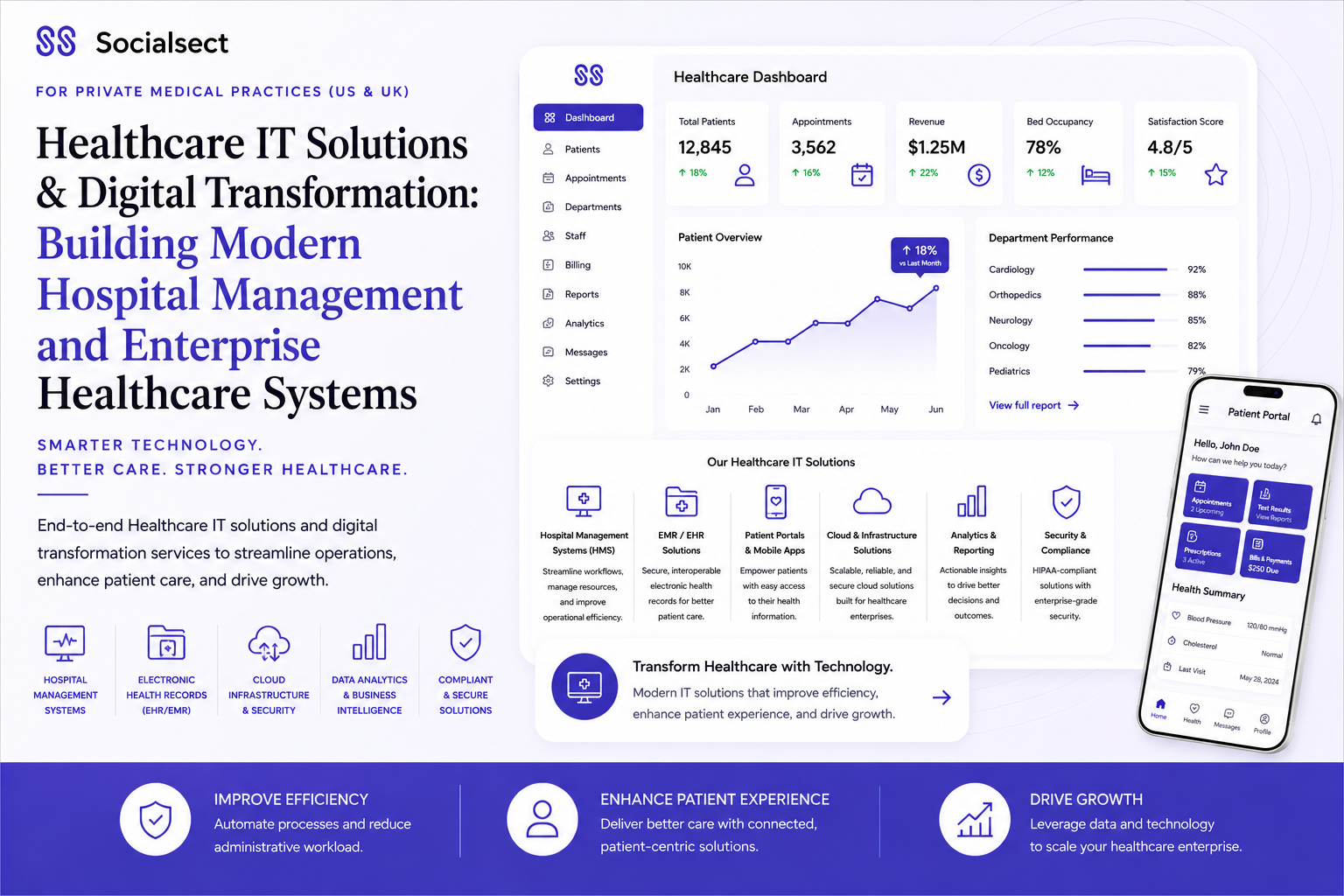
Healthcare organizations are under increasing pressure to improve patient outcomes, reduce operational inefficiencies, manage growing volumes of healthcare data, and deliver seamless patient experiences. Traditional processes and disconnected systems can no longer support the demands of modern healthcare delivery.
This is where healthcare IT solutions play a critical role. From advanced hospital management systems and healthcare CRM systems to enterprise-level software platforms and healthcare automation technologies, digital transformation is reshaping how healthcare organizations operate.
Modern healthcare providers are investing in healthcare digital transformation initiatives that connect clinical, administrative, financial, and patient-facing operations into a unified ecosystem. These integrated systems improve efficiency, strengthen decision-making, enhance patient satisfaction, and support long-term organizational growth.
At Socialsect, we help healthcare organizations implement technology-driven solutions that modernize healthcare operations and prepare them for the future of digital healthcare.
Understanding Healthcare Digital Transformation
Healthcare digital transformation refers to the strategic adoption of digital technologies to improve healthcare delivery, operational efficiency, and patient engagement.
It goes beyond simply replacing paper-based processes.
Digital transformation involves:
- Modernizing infrastructure
- Automating workflows
- Integrating healthcare systems
- Enhancing data accessibility
- Improving patient experiences
- Supporting data-driven decisions
Healthcare organizations that embrace digital transformation are better positioned to adapt to changing patient expectations and industry demands.
Why Healthcare IT Solutions Matter
Healthcare providers manage complex operations that involve multiple departments, stakeholders, and workflows.
Without modern systems, organizations often face challenges such as:
- Administrative inefficiencies
- Data silos
- Communication gaps
- Scheduling conflicts
- Compliance risks
- Resource management issues
Comprehensive healthcare IT solutions help solve these problems by creating connected digital environments that streamline healthcare delivery.
Benefits include:
- Improved operational efficiency
- Better patient outcomes
- Enhanced collaboration
- Increased scalability
- Reduced costs
- Improved compliance management
Hospital Management Systems: The Core of Healthcare Operations
One of the most important components of digital healthcare infrastructure is a modern hospital management system.
These systems centralize hospital operations and support multiple departments through a single platform.
Typical modules include:
Patient Registration
Managing patient information and demographics.
Appointment Scheduling
Coordinating provider availability and patient visits.
Billing and Revenue Management
Handling payments, insurance processing, and financial reporting.
Pharmacy Management
Tracking medication inventory and dispensing processes.
Laboratory Management
Managing test requests, results, and reporting.
Clinical Documentation
Maintaining patient records and treatment histories.
Modern hospital management systems improve operational visibility and reduce administrative burdens.
Healthcare CRM Systems for Better Patient Engagement
Patient expectations continue to evolve.
Healthcare providers now compete on both clinical excellence and patient experience.
Healthcare CRM systems help organizations strengthen patient relationships through personalized communication and engagement.
CRM platforms can support:
- Appointment reminders
- Follow-up communication
- Patient segmentation
- Referral management
- Marketing automation
- Feedback collection
Benefits include:
- Improved patient retention
- Better communication
- Increased patient satisfaction
- Higher appointment attendance rates
Healthcare CRM technology plays a key role in modern patient engagement strategies.
Healthcare Software Systems for End-to-End Operations
Healthcare organizations rely on multiple processes that must work together efficiently.
Comprehensive healthcare software systems provide centralized solutions for managing:
- Clinical workflows
- Administrative tasks
- Financial operations
- Human resources
- Patient communications
- Compliance requirements
Integrated software platforms eliminate data silos and improve coordination across departments.
Healthcare Automation Software: Improving Efficiency
Manual processes consume valuable time and resources.
Healthcare automation software helps organizations streamline repetitive tasks while reducing human error.
Common automation applications include:
Appointment Reminders
Automated notifications reduce missed appointments.
Billing Processes
Automated invoicing and payment workflows improve efficiency.
Patient Intake
Digital forms simplify registration processes.
Workflow Management
Task automation improves staff productivity.
By automating routine operations, healthcare providers can focus more on patient care.
Clinic Management Systems for Growing Healthcare Practices
Not every healthcare organization operates at the scale of a hospital.
Many clinics require solutions specifically designed for outpatient environments.
Clinic management systems provide tools for:
- Appointment scheduling
- Patient record management
- Billing
- Staff coordination
- Reporting and analytics
These systems help clinics improve efficiency while maintaining high standards of patient care.
Integrated Healthcare Systems: Connecting the Entire Ecosystem
Healthcare organizations often use multiple software platforms.
Without proper integration, information becomes fragmented across systems.
Integrated healthcare systems connect:
- Electronic health records
- Billing systems
- Patient portals
- CRM platforms
- Laboratory systems
- Pharmacy systems
Benefits include:
Better Data Accessibility
Healthcare professionals gain access to complete patient information.
Improved Coordination
Departments can collaborate more effectively.
Reduced Duplication
Data only needs to be entered once.
Enhanced Patient Experiences
Patients receive more consistent care across touchpoints.
Integration is a fundamental component of successful digital transformation initiatives.
Healthcare Operations Software for Organizational Excellence
Managing healthcare operations requires visibility across multiple business functions.
Healthcare operations software helps organizations monitor and optimize:
- Resource allocation
- Staffing
- Financial performance
- Workflow efficiency
- Service delivery
Advanced analytics capabilities provide valuable insights that support strategic decision-making.
Healthcare leaders increasingly rely on these systems to improve performance and achieve organizational goals.
Medical Database Systems: Managing Critical Healthcare Data
Healthcare organizations generate large amounts of sensitive information every day.
Medical database systems provide the infrastructure needed to store, organize, and manage healthcare data securely.
Key requirements include:
- Data integrity
- Security
- Accessibility
- Scalability
- Compliance
Well-designed database systems support clinical operations, reporting, analytics, and patient care initiatives.
As healthcare data volumes continue to grow, robust database architecture becomes increasingly important.
Enterprise Healthcare Software for Large Healthcare Networks
Large healthcare organizations require solutions that can support complex operations across multiple facilities.
Enterprise healthcare software provides centralized management capabilities for:
- Multi-location healthcare providers
- Hospital networks
- Healthcare groups
- Enterprise medical organizations
Enterprise solutions often include:
- Advanced reporting
- Workflow automation
- Resource management
- Financial systems
- Compliance management
- Patient engagement tools
These platforms help large organizations operate efficiently while maintaining consistency across locations.
Healthcare ERP Development: Unifying Healthcare Operations
Enterprise Resource Planning technology is becoming increasingly important in healthcare.
Healthcare ERP development focuses on creating systems that integrate core organizational functions into a unified platform.
Healthcare ERP solutions often include:
Financial Management
Budgeting, accounting, and revenue management.
Human Resources
Staff scheduling, payroll, and workforce management.
Procurement
Inventory and supply chain management.
Compliance Management
Supporting regulatory requirements and audits.
By centralizing operations, healthcare ERP platforms improve visibility and operational efficiency.
AI and the Future of Healthcare IT Solutions
Artificial intelligence is rapidly becoming a key component of healthcare technology.
Modern healthcare systems increasingly incorporate:
- Predictive analytics
- Intelligent automation
- Clinical decision support
- Patient engagement tools
- Resource optimization
AI-powered technologies help healthcare organizations make faster and more informed decisions.
As AI adoption increases, healthcare providers will continue investing in smarter and more adaptive systems.
AEO and LLM Optimization for Healthcare Technology Content
Healthcare technology companies must optimize content for modern search experiences.
Answer Engine Optimization (AEO) focuses on providing direct, authoritative answers to user questions.
Examples include:
What is a hospital management system?
A hospital management system is software that helps healthcare organizations manage clinical, administrative, financial, and operational processes through a centralized platform.
What are healthcare CRM systems?
Healthcare CRM systems help providers manage patient communication, engagement, scheduling, and relationship management activities.
LLM optimization ensures content is:
- Structured clearly
- Factually accurate
- Easy to interpret by AI systems
- Comprehensive and authoritative
This improves discoverability across AI-powered search environments.
Building Trust Through EEAT Principles
Healthcare technology decisions often involve significant investments.
Organizations seek providers they can trust.
Strong EEAT signals include:
Experience
Demonstrating successful healthcare technology implementations.
Expertise
Showing healthcare and software development knowledge.
Authoritativeness
Establishing leadership in healthcare IT.
Trustworthiness
Prioritizing compliance, security, transparency, and reliability.
Healthcare organizations increasingly evaluate vendors based on these criteria.
Why Healthcare Organizations Choose Socialsect
At Socialsect, we help healthcare organizations modernize operations through innovative technology solutions.
Our expertise includes:
- Healthcare IT solutions
- Healthcare CRM systems
- Hospital management systems
- Healthcare software systems
- Healthcare automation software
- Clinic management systems
- Integrated healthcare systems
- Healthcare operations software
- Medical database systems
- Enterprise healthcare software
- Healthcare ERP development
We focus on creating scalable, secure, and future-ready solutions that support both operational excellence and patient-centered care.
The Future of Healthcare Digital Transformation
Healthcare technology will continue evolving at a rapid pace.
Future innovations will likely include:
- AI-driven healthcare operations
- Advanced predictive analytics
- Intelligent automation
- Real-time interoperability
- Personalized patient experiences
- Smart healthcare ecosystems
Organizations that invest in digital transformation today will be better positioned to compete and thrive in tomorrow's healthcare landscape.
Conclusion
Modern healthcare organizations require more than standalone software applications. They need connected, intelligent, and scalable systems that support every aspect of healthcare delivery.
From hospital management systems and healthcare CRM systems to advanced healthcare ERP development and enterprise-wide digital transformation initiatives, technology is reshaping the future of healthcare.
By investing in comprehensive healthcare IT solutions, healthcare organizations can improve efficiency, strengthen patient engagement, optimize operations, and support long-term growth.
At Socialsect, we help healthcare providers build the digital foundation necessary for success in an increasingly connected healthcare environment.