Healthcare content has changed significantly.
A few years ago, many healthcare organizations approached content marketing by identifying keywords, writing an article around each keyword, and publishing as frequently as possible.
That approach is no longer enough.
In 2026, successful healthcare websites need more than a large collection of blog posts. They need depth, expertise, organization, accuracy, and authority.
Patients want reliable answers to increasingly specific questions. Search engines are becoming better at understanding topics and relationships between concepts. AI-powered search experiences can synthesize information from multiple sources. Healthcare organizations are also competing not only for rankings but for trust.
This is why a strong healthcare content strategy should focus on building topical authority.
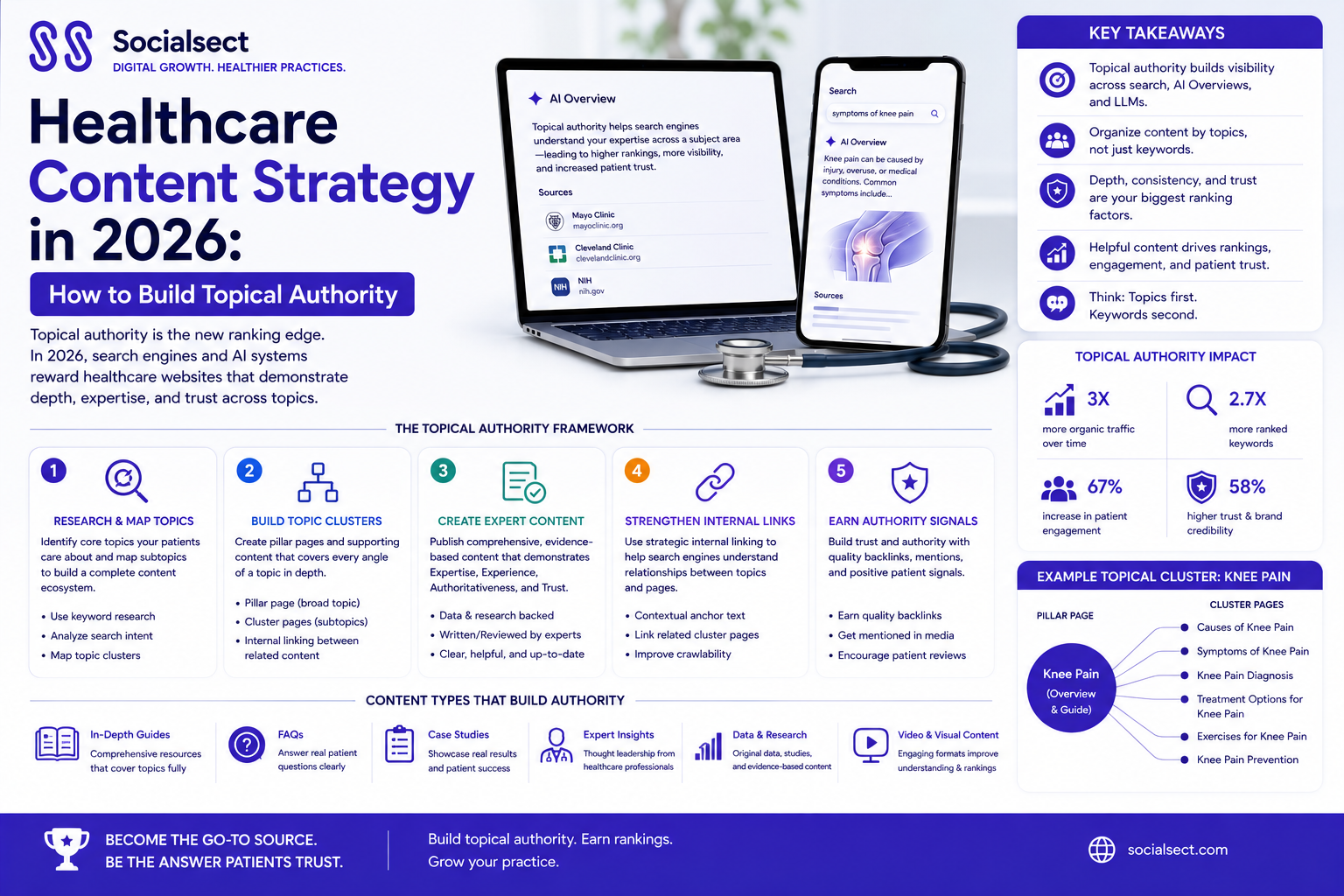
Topical authority means demonstrating comprehensive knowledge around the healthcare subjects that matter to your audience. Instead of publishing disconnected articles, your website becomes a structured resource covering conditions, treatments, specialists, symptoms, procedures, locations, and patient questions.
For healthcare practices, hospitals, specialty clinics, and healthcare groups, this approach can support organic search visibility, AI search visibility, local discovery, and patient acquisition.
What Is a Healthcare Content Strategy?
A healthcare content strategy is a structured plan for creating, organizing, optimizing, publishing, and maintaining healthcare content to meet both patient needs and business objectives.
It determines:
- What content you should create
- Who the content is for
- Which topics deserve priority
- What search intent each page addresses
- Which physicians or experts should contribute
- How pages should connect
- How content should be reviewed
- How performance should be measured
A strong strategy does not begin with:
"How many blogs can we publish this month?"
It begins with:
"What information do our patients need, and how can our organization become a trusted resource for it?"
That difference can significantly improve the quality of healthcare content.
Why Topical Authority Matters in Healthcare
Imagine a patient searching for information about knee pain.
A website with one article about knee pain provides limited context.
Another website may have an entire resource covering:
- Knee pain causes
- Knee arthritis
- Meniscus tears
- ACL injuries
- Knee replacement
- Physical therapy
- Knee injections
- Diagnostic imaging
- Surgery recovery
- When to see an orthopedic specialist
The second website demonstrates much greater topical depth.
This is the foundation of topical authority.
It does not mean publishing content simply to increase the number of URLs.
It means covering a subject comprehensively and logically.
Healthcare Content Strategy and EEAT
Healthcare content requires a higher level of trust than many other industries.
Patients may use medical content to make decisions about symptoms, treatments, procedures, and healthcare providers.
That makes Experience, Expertise, Authoritativeness, and Trustworthiness (EEAT) a central part of an effective healthcare content strategy.
Experience
Content should address practical patient concerns.
Expertise
Medical topics should be created or reviewed by appropriately qualified professionals where necessary.
Authoritativeness
Healthcare organizations should build credibility through expert content, reliable references, professional profiles, and comprehensive topic coverage.
Trustworthiness
The website should provide accurate and transparent information about:
- Physicians
- Credentials
- Services
- Locations
- Contact information
- Content authorship
- Medical review processes
Never manufacture expertise.
If content is medically reviewed, identify the reviewer accurately.
Build Content Around Patient Search Intent
Keyword volume alone should not determine your content calendar.
The same keyword can represent different intentions.
For example:
"cataract surgery"
could mean that the user wants to:
- Understand the procedure
- Learn about risks
- Find out how long recovery takes
- Compare treatment options
- Find a cataract surgeon
- Book an appointment
Your healthcare content strategy should address these different stages.
A useful framework is:
Informational Intent
The patient wants to understand a condition or treatment.
Investigational Intent
The patient is researching options.
Commercial Intent
The patient is comparing providers or treatments.
Transactional Intent
The patient is ready to contact or book a provider.
A complete content strategy should support the entire journey.
Create Healthcare Topic Clusters
Topic clusters are one of the strongest ways to build topical authority.
A topic cluster consists of:
Pillar Page + Supporting Pages + Internal Links
For example, a dermatology clinic could create a pillar page around:
Acne Treatment
Supporting pages might include:
- Adult acne
- Hormonal acne
- Acne scars
- Cystic acne
- Acne medication
- Chemical peels
- Acne treatment for teenagers
- When to see a dermatologist
- Acne prevention
Each page should link naturally to relevant related content.
This gives patients multiple paths to useful information while creating a more organized content ecosystem.
Build Content Hubs Around Your Core Services
Healthcare organizations should identify their most important specialties and services.
For example, an orthopedic practice might build content hubs around:
Shoulder
- Shoulder pain
- Rotator cuff tears
- Shoulder instability
- Frozen shoulder
- Shoulder replacement
- Shoulder surgery recovery
Knee
- Knee pain
- ACL injuries
- Meniscus tears
- Knee arthritis
- Knee replacement
- Sports injuries
Hip
- Hip pain
- Hip arthritis
- Hip replacement
- Hip labral tears
- Hip surgery recovery
This approach is far more strategic than publishing unrelated medical articles.
Create Content for Every Stage of the Patient Journey
A strong healthcare content strategy should not focus only on informational traffic.
Build content for the entire patient journey.
Awareness
Examples:
- What causes shoulder pain?
- What are common migraine symptoms?
- What is high blood pressure?
Consideration
Examples:
- When should you see a specialist?
- Physical therapy vs surgery
- Treatment options for knee arthritis
Decision
Examples:
- Questions to ask a spine surgeon
- What to expect during a consultation
- How to choose a specialist
Conversion
Examples:
- Physician profiles
- Service pages
- Location pages
- Appointment pages
This creates a natural connection between content marketing and patient acquisition.
Physician Expertise Should Be Part of the Strategy
Healthcare organizations have an important advantage that many industries do not: access to subject-matter experts.
Doctors can contribute to:
- Articles
- Interviews
- FAQs
- Treatment guides
- Videos
- Expert commentary
- Physician profiles
This expertise can make content more useful and credible.
Instead of producing anonymous content about cardiology, for example, a cardiology practice can develop resources connected to its qualified cardiologists.
The website can then connect:
Doctor → Specialty → Condition → Treatment → Location
This creates a stronger information architecture.
Develop Strong Physician Profiles
Physician profiles should not be treated as simple biography pages.
A comprehensive profile can include:
- Full name
- Specialty
- Credentials
- Education
- Certifications
- Professional memberships
- Clinical interests
- Experience
- Publications
- Areas of focus
- Locations
- Appointment information
Where appropriate, connect the physician profile to relevant treatment and condition pages.
This helps patients understand the relationship between professional expertise and services.
Content Quality Matters More Than Content Volume
One of the biggest mistakes healthcare organizations make is measuring success by publishing frequency.
Publishing 30 weak articles is not necessarily better than publishing 8 comprehensive resources.
Before publishing a new page, ask:
Does this content provide something genuinely useful?
Check whether it:
- Answers the search intent
- Adds original value
- Uses reliable information
- Demonstrates expertise
- Is easy to read
- Provides appropriate references
- Connects to related content
- Gives patients a useful next step
If the answer is no, the page may not deserve to exist.
Update Existing Healthcare Content
A successful healthcare content strategy should include content maintenance.
Medical information can change.
Search intent can change.
Competitors can publish better resources.
Your own services can change.
Review important content periodically for:
- Outdated statistics
- Old medical terminology
- Broken links
- Incorrect physician information
- Outdated treatment information
- Missing questions
- Weak internal links
- Poor search performance
Where appropriate, show a content review or update date.
Do not update content simply to change the date.
Make meaningful improvements.
Use FAQs Strategically
FAQs can help address specific patient questions.
Good healthcare FAQ questions might include:
- When should I see a specialist?
- How is this condition diagnosed?
- How long does recovery take?
- What treatment options are available?
- What happens during the consultation?
- What should I bring to my appointment?
The answers should be medically responsible and useful.
Avoid creating FAQs solely because you want to insert more keywords.
Healthcare Content and AI Search
AI-powered search is changing how users consume information.
Patients may ask conversational questions and receive synthesized answers.
This makes content structure and authority increasingly important.
Healthcare organizations should create content that is:
- Clear
- Comprehensive
- Factually accurate
- Expert-supported
- Well organized
- Easy to understand
A strong content strategy should support traditional SEO and emerging AI-powered search rather than treating them as completely separate disciplines.
Optimize Content for AEO
Answer Engine Optimization, or AEO, focuses on providing clear answers to questions.
Healthcare websites can incorporate AEO principles into existing content.
For example:
What is a rotator cuff tear?
Begin with a concise explanation before providing deeper detail.
Then explain:
- Causes
- Symptoms
- Diagnosis
- Treatment
- Recovery
- When to seek specialist care
This structure helps users quickly find the information they need.
Local Content Should Be Part of the Strategy
Healthcare decisions are often location-dependent.
Patients may search:
- Dermatologist in New York
- Cardiologist near me
- Orthopedic surgeon in Miami
- IVF clinic in Los Angeles
Local SEO should therefore be integrated into the broader healthcare content strategy.
Create useful location pages containing:
- Services
- Physicians
- Address
- Office hours
- Nearby areas
- Patient information
- Appointment options
Avoid mass-producing identical city pages.
Every location page should provide genuine local value.
Build a Content Gap Analysis
Before creating new content, analyze what already exists.
A healthcare content gap analysis should identify:
Missing Topics
Important patient questions your website does not currently answer.
Weak Pages
Pages with little depth or poor performance.
Outdated Content
Information that needs review.
Competitor Gaps
Topics competitors cover better.
Internal Linking Gaps
Important pages that are poorly connected.
Commercial Gaps
Services that lack strong supporting content.
This prevents your content team from publishing randomly.
Create a Healthcare Content Calendar
A content calendar should connect topics to business priorities.
For example:
Content Type
Purpose
Service Page
Patient acquisition
Condition Guide
Informational visibility
Treatment Guide
Consideration
Physician Profile
Trust
Location Page
Local SEO
FAQ
Patient questions
Expert Article
Authority
Case Study
Evidence and credibility
This makes the content program measurable.
Measure Healthcare Content Performance
Traffic is useful, but it should not be the only metric.
Track:
- Organic impressions
- Organic clicks
- Rankings
- Search visibility
- Engagement
- Internal link clicks
- Leads
- Phone calls
- Appointment requests
- Consultation bookings
- Conversion rate
For healthcare organizations, the most valuable question is:
Does this content contribute to qualified patient acquisition?
A page receiving 500 highly relevant visits may be more valuable than a page receiving 10,000 visitors with no healthcare intent.
Common Healthcare Content Strategy Mistakes
1. Publishing Without a Topic Plan
Random articles rarely create meaningful topical authority.
2. Focusing Only on Search Volume
A high-volume keyword is not automatically a high-value healthcare topic.
3. Ignoring Medical Expertise
Anonymous healthcare content can weaken trust.
4. Creating Thin Service Pages
Commercial pages need useful information, not just keywords and CTAs.
5. Publishing Duplicate Location Content
Every location should have a genuine reason to exist.
6. Ignoring Existing Content
Sometimes improving an existing resource is more valuable than creating another article.
7. Overusing AI
AI can assist content production, but it should not replace expert oversight.
A Step-by-Step Healthcare Content Strategy for 2026
Step 1: Define Your Healthcare Audience
Identify:
- Patients
- Caregivers
- Referring professionals
- Local audiences
- Existing patients
Step 2: Identify Your Core Services
Determine which specialties and treatments matter most to the organization.
Step 3: Map Patient Intent
Understand what users search before choosing your services.
Step 4: Build Topic Clusters
Organize content around major conditions, treatments, and specialties.
Step 5: Create Pillar Pages
Develop comprehensive pages for important subjects.
Step 6: Build Supporting Content
Answer specific patient questions.
Step 7: Add Expert Review
Use qualified medical professionals where appropriate.
Step 8: Strengthen Internal Links
Connect related topics logically.
Step 9: Optimize for Search and AI Discovery
Use strong SEO fundamentals, clear answers, structured information, and useful content.
Step 10: Measure and Improve
Review performance and update your strategy based on real results.
How Socialsect Can Help With Healthcare Content Strategy
At Socialsect, we approach healthcare content as a strategic growth asset rather than a publishing task.
Our healthcare content strategy can include:
- Healthcare content audits
- Keyword and intent research
- Topic cluster development
- Healthcare SEO
- EEAT optimization
- Physician content strategy
- Service page optimization
- Condition content
- Local SEO content
- AEO optimization
- AI search optimization
- Internal linking
- Content refreshes
- Conversion optimization
The goal is to build a healthcare content ecosystem that helps patients find reliable answers and helps healthcare organizations generate qualified opportunities.
The Future of Healthcare Content Strategy
The future of healthcare content will not belong to organizations that simply publish the most articles.
It will belong to organizations that become trusted resources within their specialties.
That requires a combination of:
Expertise + Accuracy + Topical Depth + Technical SEO + Patient Intent + Trust
A strong healthcare content strategy should answer the questions patients have today while building a foundation for the questions they will ask tomorrow.
Instead of creating isolated pages, build connected resources.
Instead of focusing only on keywords, focus on intent.
Instead of publishing more, publish better.
Instead of hiding expertise behind generic content, put qualified healthcare professionals at the center of your information strategy.
And instead of measuring success only through traffic, connect content performance to meaningful patient outcomes.
That is how healthcare organizations can build topical authority in 2026.