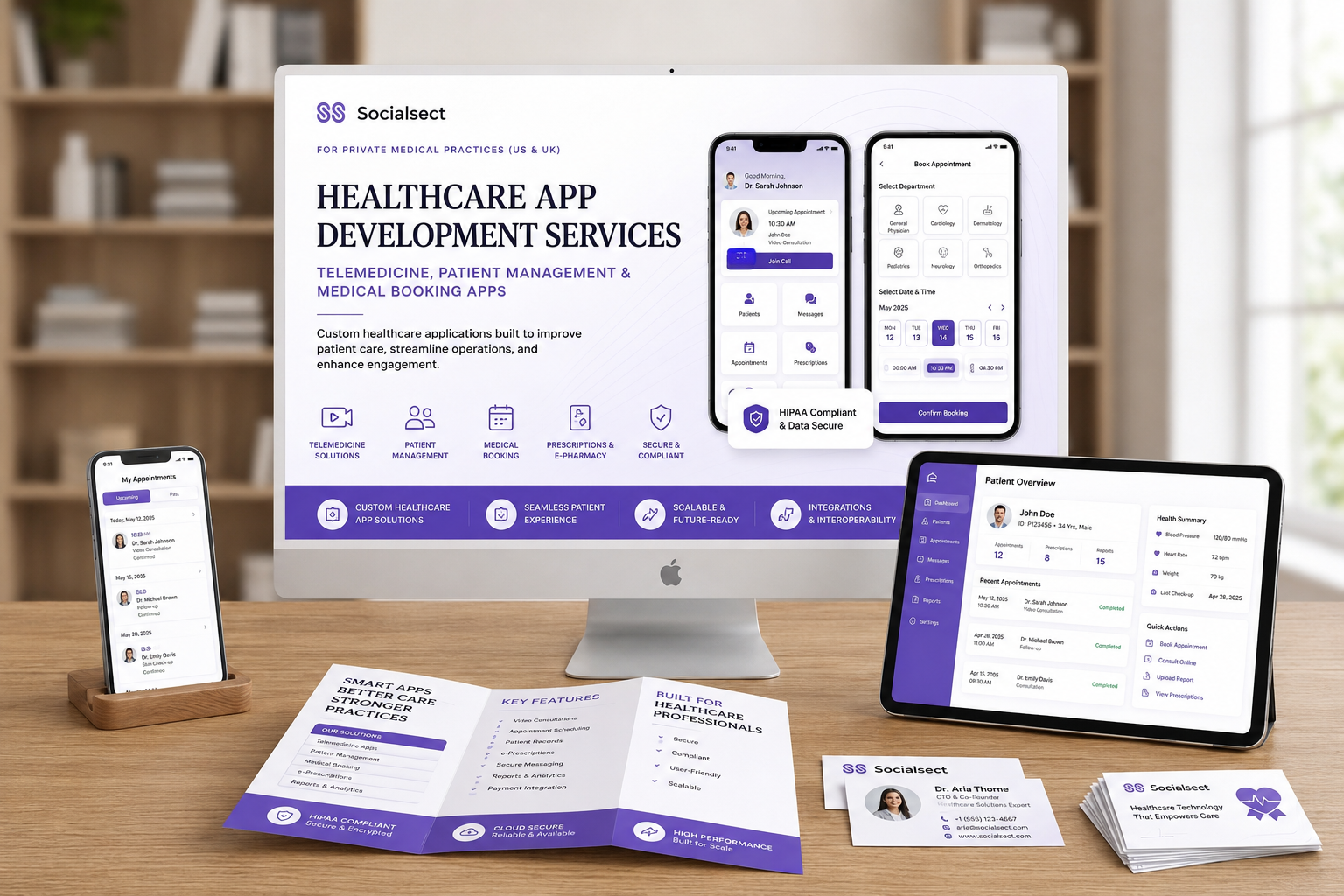
Healthcare is becoming increasingly digital, with patients expecting convenient access to medical services through mobile applications. From telemedicine consultations and doctor appointment scheduling to patient records management and healthcare communication tools, mobile technology is transforming the way healthcare organizations operate.
Professional healthcare app development enables clinics, hospitals, healthcare startups, and medical providers to improve patient engagement, streamline operations, and enhance healthcare accessibility. Whether it's telemedicine app development, a patient management app, or a fully customized healthcare platform, healthcare applications are now a critical part of modern patient care.
At Socialsect, we help healthcare organizations build secure, scalable, and user-friendly applications that improve healthcare delivery while meeting industry compliance requirements.
Why Healthcare Apps Are Transforming Modern Healthcare
Patients today expect healthcare experiences that match the convenience of other digital services.
Instead of waiting on hold or visiting clinics for routine tasks, patients increasingly prefer mobile solutions for:
- Appointment scheduling
- Virtual consultations
- Prescription management
- Medical record access
- Health monitoring
- Secure communication
Healthcare providers benefit as well through:
- Improved efficiency
- Reduced administrative burden
- Better patient retention
- Enhanced communication
- Increased operational scalability
This growing demand has made healthcare app development one of the fastest-growing areas in healthcare technology.
What Is Healthcare App Development?
Healthcare app development involves creating software applications specifically designed for healthcare providers, medical organizations, and patients.
These applications can support various healthcare functions, including:
- Telemedicine
- Patient engagement
- Appointment management
- Electronic health records
- Remote monitoring
- Billing and payments
- Internal clinic operations
Professional healthcare app developers understand both technical requirements and healthcare workflows, ensuring applications meet user needs while maintaining security and compliance.
Types of Healthcare Apps Healthcare Organizations Need
Telemedicine Applications
One of the most rapidly growing sectors in healthcare technology is telemedicine app development.
Telemedicine platforms allow healthcare providers to:
- Conduct virtual consultations
- Share medical documents
- Monitor patients remotely
- Provide follow-up care
Patients benefit from:
- Reduced travel time
- Improved healthcare access
- Faster consultations
- Increased convenience
Modern telemedicine applications often include:
- Video conferencing
- Appointment scheduling
- Prescription management
- Secure messaging
- Patient records access
Patient Management Applications
A well-designed patient management app helps healthcare providers streamline daily operations.
Features may include:
- Patient registration
- Medical history management
- Appointment tracking
- Treatment records
- Communication tools
- Follow-up reminders
These systems improve operational efficiency while enhancing patient experiences.
Doctor Appointment Booking Apps
Patients increasingly expect digital appointment scheduling.
Doctor appointment app development focuses on creating platforms that allow users to:
- Search providers
- View availability
- Book appointments
- Receive reminders
- Manage cancellations
These applications reduce administrative workload while improving patient convenience.
Medical Booking Apps
A modern medical booking app goes beyond basic scheduling.
Advanced booking platforms often include:
- Multi-location support
- Telehealth scheduling
- Provider selection
- Insurance integration
- Payment processing
- Automated notifications
These solutions help healthcare providers optimize appointment management.
The Importance of HIPAA-Compliant App Development
Healthcare applications handle sensitive patient information.
As a result, compliance is a critical consideration.
HIPAA compliant app development ensures healthcare applications meet strict security and privacy requirements.
Important compliance measures include:
- Data encryption
- Secure authentication
- Access controls
- Audit logging
- Secure data storage
- Protected communication channels
Healthcare organizations must prioritize compliance to protect patient information and reduce legal risks.
Features Every Healthcare App Should Include
Secure User Authentication
Healthcare applications should use:
- Multi-factor authentication
- Role-based access control
- Secure login systems
Security is essential when handling patient data.
Appointment Management
Appointment scheduling remains one of the most valuable healthcare app features.
Patients appreciate:
- Real-time availability
- Easy booking
- Automated reminders
- Rescheduling options
This functionality improves both patient satisfaction and clinic efficiency.
Electronic Health Records Integration
Modern healthcare applications often connect with electronic health record systems.
Benefits include:
- Improved provider access
- Better continuity of care
- Reduced administrative duplication
- Enhanced patient experiences
Push Notifications
Notifications help improve engagement.
Examples include:
- Appointment reminders
- Prescription alerts
- Follow-up requests
- Health updates
Strategic notifications help increase patient adherence and communication.
Telehealth Functionality
Virtual care capabilities have become a standard expectation.
A successful telemedicine solution should support:
- Video consultations
- File sharing
- Messaging
- Virtual follow-ups
This functionality is a core component of modern telemedicine app development.
Healthcare Android App Development vs Cross-Platform Development
Healthcare organizations often ask whether they should develop Android-specific apps or cross-platform solutions.
Healthcare Android App Development
Advantages include:
- Strong Android performance
- Access to Android-specific features
- Large global user base
Cross-Platform Development
Advantages include:
- Faster development
- Lower costs
- Single codebase
- Simultaneous iOS and Android deployment
The right approach depends on business goals, budget, and target users.
Professional healthcare app developers evaluate these factors before recommending a solution.
Custom Medical Apps for Specialized Healthcare Needs
Every healthcare organization has unique requirements.
Generic software may not always address specific workflows.
Custom medical apps provide tailored solutions for:
- Hospitals
- Clinics
- Telemedicine providers
- Diagnostic centers
- Specialty practices
- Healthcare startups
Custom development ensures the application aligns with operational objectives and patient expectations.
Healthcare Software Company vs Generic Development Agency
Healthcare software development requires specialized expertise.
A dedicated healthcare software company understands:
- Regulatory requirements
- Patient privacy concerns
- Healthcare workflows
- Medical terminology
- Compliance standards
This expertise reduces development risks while improving product quality.
General software agencies may lack the healthcare-specific knowledge necessary for successful project delivery.
Clinic Mobile App Development for Better Patient Engagement
Healthcare providers increasingly invest in clinic mobile app development to strengthen patient relationships.
Clinic apps can support:
- Appointment booking
- Telehealth consultations
- Patient education
- Medical records access
- Billing management
- Secure communication
These tools improve convenience while enhancing patient loyalty.
AI, AEO, and LLM Optimization in Healthcare Applications
Healthcare technology continues to evolve with artificial intelligence.
Modern healthcare applications increasingly incorporate:
- AI chat assistants
- Automated scheduling
- Symptom assessment tools
- Patient engagement automation
- Predictive healthcare insights
For websites and application content, AEO (Answer Engine Optimization) and LLM optimization have become increasingly important.
Applications should provide:
- Structured content
- Direct answers
- Accessible information
- Clear navigation
This improves discoverability in AI-powered search environments.
Building Trust Through EEAT Principles
Healthcare applications must establish trust.
Google's EEAT framework remains highly relevant.
Experience
Showcase real healthcare expertise and successful implementations.
Expertise
Highlight medical knowledge and technical capabilities.
Authoritativeness
Demonstrate leadership within healthcare technology.
Trustworthiness
Prioritize compliance, security, and transparency.
Healthcare organizations are more likely to adopt solutions from providers that clearly demonstrate these qualities.
Common Mistakes in Healthcare App Development
Avoid these common pitfalls:
Ignoring Compliance Requirements
Security and privacy must be addressed from the beginning.
Poor User Experience
Complex interfaces reduce adoption rates.
Limited Scalability
Applications should support future growth.
Weak Integration Capabilities
Healthcare systems often require seamless interoperability.
Inadequate Testing
Healthcare applications must undergo rigorous testing before launch.
Why Healthcare Organizations Choose Socialsect
At Socialsect, we specialize in healthcare-focused technology solutions designed to improve patient experiences and operational efficiency.
Our expertise includes:
- Healthcare app development
- Telemedicine app development
- Doctor appointment app development
- Patient management systems
- Healthcare Android app development
- HIPAA compliant app development
- Medical booking app development
- Clinic mobile app development
- Custom medical apps
We combine healthcare knowledge, user-centered design, and advanced technology to create applications that support long-term growth.
The Future of Healthcare App Development
Healthcare technology adoption continues to accelerate worldwide.
Future healthcare applications will increasingly integrate:
- Artificial intelligence
- Remote patient monitoring
- Wearable device connectivity
- Predictive analytics
- Advanced telemedicine capabilities
Organizations investing in digital healthcare solutions today are positioning themselves for long-term success.
Conclusion
Healthcare applications have become essential tools for improving patient engagement, operational efficiency, and healthcare accessibility.
Whether you're seeking telemedicine app development, a patient management app, a medical booking app, or fully custom medical apps, choosing the right development partner is critical.
Professional healthcare app development helps healthcare organizations deliver better patient experiences while maintaining security, compliance, and scalability.
At Socialsect, we help healthcare providers build innovative digital solutions that support modern healthcare delivery and future growth.