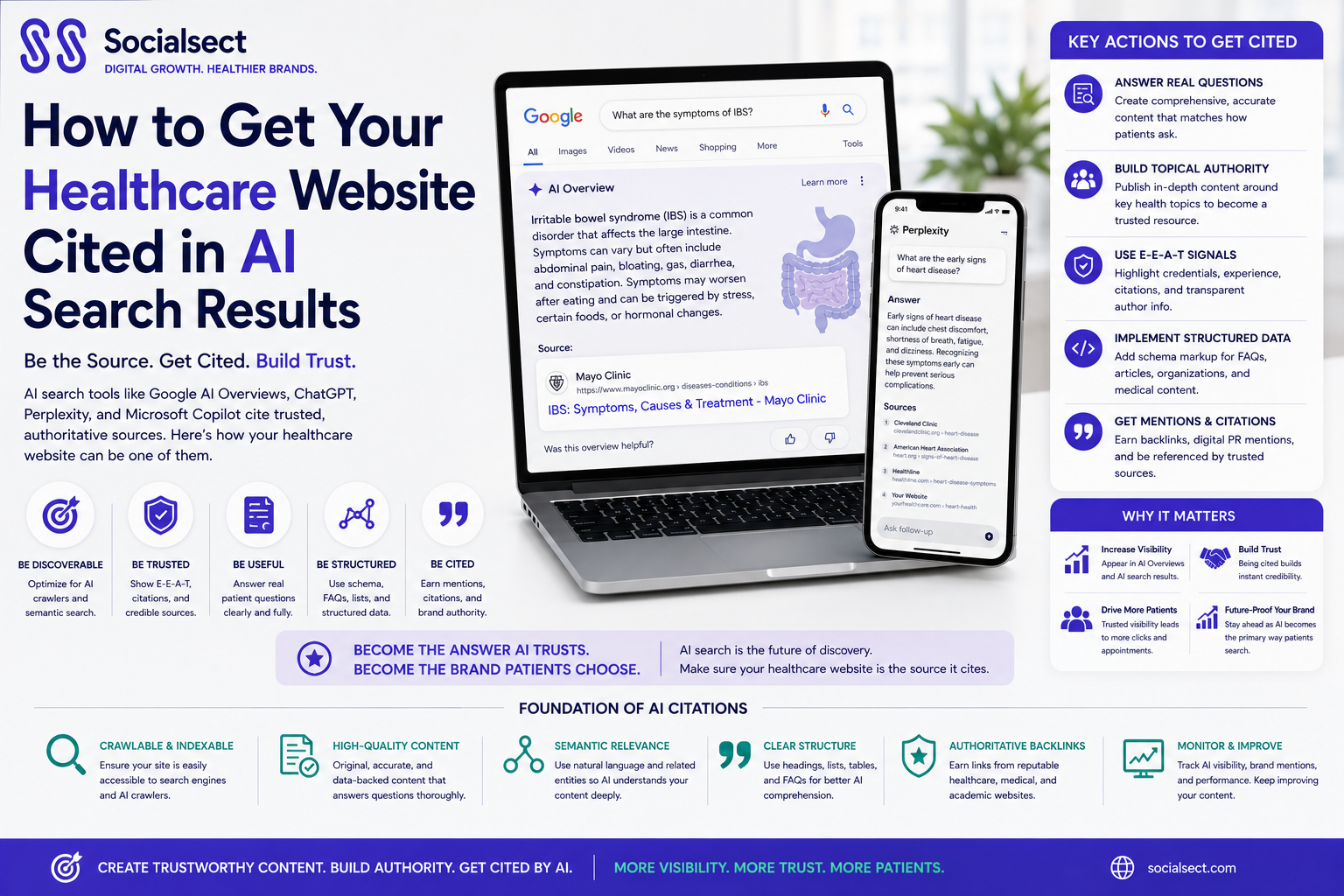
Healthcare search is entering a new phase.
Patients are no longer relying only on traditional Google search results to research doctors, treatments, conditions, clinics, and healthcare services. AI-powered search experiences can now summarize information, answer follow-up questions, compare options, and direct users toward relevant sources.
For healthcare organizations, this creates a new opportunity: getting your website cited or referenced within AI search results.
But appearing in AI-generated answers is not simply a matter of adding keywords or publishing hundreds of AI-written articles. Healthcare is a trust-sensitive industry, and search systems need reliable information they can understand and evaluate.
This is where healthcare AI search optimization becomes important.
Healthcare AI search optimization combines traditional SEO, high-quality content, technical accessibility, topical authority, expert information, structured information, local SEO, and strong trust signals.
The objective is to build a healthcare website that search engines and AI-powered systems can understand as a useful, credible source.
At Socialsect, we help healthcare organizations develop search strategies designed for traditional search and emerging AI-powered discovery.
What Is Healthcare AI Search Optimization?
Healthcare AI search optimization is the process of improving a healthcare website's content, structure, authority, and technical accessibility so it can be more effectively discovered, understood, and potentially referenced by AI-powered search experiences.
This includes optimizing:
- Healthcare service pages
- Medical condition content
- Treatment guides
- Physician profiles
- Location pages
- FAQs
- Educational resources
- Organization information
- Internal linking
- Structured data
- Technical SEO
The approach is broader than traditional keyword optimization.
Instead of asking only:
"What keyword should this page rank for?"
healthcare brands should also ask:
"Does this page provide reliable information that clearly answers the patient's question?"
That change in thinking is fundamental to modern healthcare search.
Why AI Search Matters for Healthcare
Patients often conduct extensive research before choosing a healthcare provider.
A patient may ask:
- What does a cardiologist treat?
- What are the symptoms of sleep apnea?
- Is knee replacement surgery necessary?
- How long does cataract surgery recovery take?
- What causes chronic back pain?
- Which specialist treats varicose veins?
- What should I ask before choosing an IVF clinic?
AI-powered search can provide a synthesized response to these questions and may reference websites that support the information.
That means your website can potentially influence patients before they ever visit your homepage.
Instead of competing only for a traditional organic ranking, healthcare organizations need to build a reputation as reliable sources of information.
How AI Search Selects Information
There is no guaranteed formula for getting cited by an AI search system.
Different platforms use different technologies and retrieval systems, and their behaviour can change over time.
However, healthcare organizations can improve their foundations by making information:
- Clear
- Accurate
- Relevant
- Accessible
- Well structured
- Expert-supported
- Consistent
- Comprehensive
Traditional SEO remains important because AI search experiences still need to discover and retrieve information from the web.
This means healthcare AI search optimization starts with excellent SEO fundamentals.
1. Create High-Quality Healthcare Content
The first step is creating content worth referencing.
A healthcare website should answer genuine patient questions rather than simply producing pages around keywords.
For example, instead of publishing a thin article titled:
"Knee Pain Treatment"
create a comprehensive resource covering:
- Common causes of knee pain
- Symptoms
- When medical evaluation may be appropriate
- Diagnostic approaches
- Conservative treatment options
- Physical therapy
- Medication considerations
- Surgical options
- Recovery considerations
- Frequently asked questions
This gives the page greater informational value.
The goal should be depth without unnecessary filler.
2. Demonstrate Medical Expertise
Healthcare content needs credible expertise.
Every important medical page should make it clear who is responsible for the information.
Consider including:
- Author name
- Medical credentials
- Specialty
- Professional experience
- Medical reviewer
- Review date
- Relevant professional qualifications
For example:
Written by: Dr. [Name], [Specialty]
Medically reviewed by: Dr. [Name], [Credential]
This helps patients understand where the information comes from.
Do not create fictional authors, reviewers, credentials, or clinical experience.
Trust cannot be manufactured.
3. Strengthen EEAT
A major component of healthcare AI search optimization is demonstrating Experience, Expertise, Authoritativeness, and Trustworthiness.
Experience
Content should address practical questions patients genuinely face.
Expertise
Show qualified healthcare professionals behind relevant medical information.
Authoritativeness
Build authority through comprehensive content, professional expertise, reputable references, and strong topical coverage.
Trustworthiness
Maintain accurate information about:
- Physicians
- Locations
- Services
- Contact details
- Credentials
- Policies
For healthcare websites, trust should be visible throughout the patient journey.
4. Answer Specific Patient Questions
AI search is highly conversational.
Patients may ask complete questions rather than short keywords.
Your content should therefore include question-based sections such as:
What causes chronic shoulder pain?
When should you see an orthopedic specialist?
How is cataract surgery performed?
How long does physical therapy take?
What happens during a colonoscopy?
What are common symptoms of sleep apnea?
Give a clear answer first, followed by supporting details.
This structure helps both patients and search systems understand the information.
5. Build Topic Clusters
One article rarely establishes authority around an entire healthcare topic.
A stronger approach is building topic clusters.
For example, a dermatology clinic could create a central acne resource supported by pages covering:
- Adult acne
- Hormonal acne
- Acne scars
- Acne treatment
- Prescription acne treatments
- Chemical peels
- When to see a dermatologist
- Acne FAQs
Each page can link naturally to related resources.
This creates a connected information architecture.
It also demonstrates that your website covers the subject comprehensively.
6. Create Strong Healthcare Service Pages
Do not focus exclusively on blogs.
Service pages can be some of the most commercially valuable assets on a healthcare website.
A strong service page should explain:
- What the treatment is
- Who may benefit
- How it works
- What evaluation involves
- Potential benefits
- Risks or considerations
- Recovery expectations
- Relevant specialists
- Where the service is available
- How to request an appointment
Avoid making absolute promises such as "guaranteed results" unless they are genuinely supported and appropriate.
7. Develop Detailed Physician Profiles
Physician profiles are important for both patients and healthcare organizations.
A useful profile can include:
- Full name
- Medical specialty
- Credentials
- Education
- Certifications
- Clinical interests
- Professional memberships
- Areas of expertise
- Publications where relevant
- Languages spoken
- Practice locations
Strong physician profiles help connect expertise with the services and medical topics covered on the website.
8. Improve Internal Linking
Internal linking helps search engines understand relationships between pages.
For example:
A cardiology page can link to:
Cardiology → Heart Disease → Diagnostic Testing → Cardiologist Profile → Location → Appointment
An orthopedic website might use:
Knee Pain → Meniscus Tear → Treatment → Orthopedic Surgeon → Clinic Location → Appointment
This creates logical pathways for both users and crawlers.
Avoid adding links simply to increase link counts.
Each internal link should help users understand the subject or take a logical next step.
9. Use Structured Data Correctly
Structured data can help search engines interpret information about a webpage and organization.
Depending on the page, healthcare organizations may consider appropriate structured data such as:
- Organization
- LocalBusiness
- MedicalClinic
- Physician
- Article
- BreadcrumbList
Structured data should accurately represent information visible on the page and follow applicable search engine guidelines.
It should not be treated as a way to force AI systems to cite a website.
The underlying information still needs to be useful and trustworthy.
10. Make Your Website Technically Accessible
AI search optimization cannot compensate for fundamental technical problems.
Important technical SEO areas include:
- Crawlability
- Indexability
- XML sitemaps
- Canonical URLs
- Mobile usability
- HTTPS
- Page speed
- Core Web Vitals
- JavaScript rendering
- Internal linking
- Redirect management
- Broken links
If important healthcare pages cannot be properly crawled or indexed, their chances of being discovered are reduced.
For large healthcare organizations, technical SEO becomes even more important because problems can affect hundreds or thousands of URLs.
11. Keep Healthcare Information Accurate and Current
Healthcare information can become outdated.
Treatment approaches, recommendations, terminology, and clinical guidance can change.
Review important content periodically.
Consider displaying:
Last reviewed: [Date]
where appropriate.
Medical content should be reviewed by an appropriately qualified professional when necessary.
Avoid leaving outdated information live simply because the page generates traffic.
In healthcare, accuracy should take priority over traffic.
12. Use Reliable Sources
Healthcare content should be supported by trustworthy information.
Depending on the subject, appropriate sources may include:
- Government health agencies
- Medical associations
- Academic institutions
- Peer-reviewed research
- Recognized clinical organizations
- Established healthcare institutions
Do not cite sources simply to make an article appear authoritative.
References should genuinely support the claims being made.
13. Strengthen Local Healthcare SEO
Many healthcare searches have local intent.
Patients may ask:
"Who is the best dermatologist near me?"
or:
"Cardiologist near [city]"
This makes local SEO an important part of healthcare AI search optimization.
Maintain accurate:
- Google Business Profile information
- Clinic addresses
- Phone numbers
- Opening hours
- Services
- Location pages
- Physician locations
Encourage genuine patient reviews while following applicable policies and protecting patient privacy.
14. Maintain Consistent Brand Information
AI systems rely on information from multiple sources.
Healthcare organizations should therefore maintain consistency across:
- Website
- Physician profiles
- Business listings
- Professional directories
- Healthcare directories
- Social profiles
- Organization pages
Important information should match wherever possible.
For example, inconsistent clinic addresses or physician names can create confusion for users and digital systems.
15. Create Original Healthcare Resources
One way to strengthen authority is by publishing original information.
Healthcare organizations can create:
- Research summaries
- Patient education guides
- Expert interviews
- Original statistics
- Clinical explainers
- Treatment resources
- Physician insights
- Community health resources
Original material can differentiate your website from competitors that simply rewrite the same general information.
AI Search Optimization Is Not About Keyword Stuffing
One of the biggest mistakes healthcare brands can make is trying to manipulate AI search with excessive keyword repetition.
For example, repeating:
"healthcare AI search optimization"
throughout every paragraph does not make a page more authoritative.
Instead, use natural language and cover the topic comprehensively.
Related concepts may include:
- AI search
- Generative search
- Healthcare SEO
- Answer engines
- Search visibility
- AI-generated answers
- Medical content
- Search intent
- Topical authority
Semantic relevance is more valuable than awkward repetition.
AI Content Requires Human Oversight
AI tools can help healthcare marketing teams with:
- Research organization
- Content outlines
- Editing
- Summarization
- Brainstorming
- Content planning
However, healthcare content should not simply be generated and published without review.
A responsible workflow is:
Research → Draft → Expert Review → Fact Check → SEO Review → Publish → Monitor → Update
This is particularly important when content discusses diagnosis, treatment, medications, surgery, risks, or clinical recommendations.
AI should support expertise—not pretend to replace it.
What Healthcare Websites Should Avoid
If you want your website to become a credible source in AI search, avoid practices that undermine quality.
Avoid Mass-Produced Pages
Creating hundreds of pages with minimal original value can create a poor user experience.
Avoid Fake Expertise
Never invent medical authors, credentials, or reviews.
Avoid Unsupported Claims
Do not make exaggerated medical claims without evidence.
Avoid Duplicate Location Pages
Changing only the city name does not create useful local content.
Avoid Keyword Stuffing
Write naturally for patients.
Avoid Fake Reviews
Reviews should represent genuine patient experiences.
Avoid Outdated Information
Healthcare content should be reviewed and updated appropriately.
How to Build a Healthcare AI Search Optimization Strategy
A practical strategy can be divided into six stages.
Stage 1: Technical Audit
Review crawlability, indexation, performance, structured data, and site architecture.
Stage 2: Content Audit
Identify:
- Thin content
- Outdated pages
- Duplicate content
- Missing service pages
- Weak physician profiles
- Content gaps
Stage 3: Patient Intent Research
Identify the questions patients ask before choosing a healthcare provider.
Stage 4: Authority Development
Build expert-led content and topic clusters.
Stage 5: Local Visibility
Optimize locations, physicians, services, and business information.
Stage 6: Measurement
Track:
- Organic visibility
- Search impressions
- Clicks
- Rankings
- AI search visibility where measurable
- Website engagement
- Leads
- Calls
- Appointment requests
How to Measure AI Search Visibility
AI search measurement is still evolving.
Healthcare organizations should avoid relying on a single metric or assuming that a mention automatically produces a patient.
Instead, monitor a combination of:
- Organic search visibility
- AI search appearances where available
- Brand mentions
- Referral traffic
- Search impressions
- Click-through rates
- Local actions
- Phone calls
- Appointment requests
- Lead quality
The ultimate objective is not simply being cited.
It is being discovered by the right patient and giving that patient enough confidence to take the next step.
Why Socialsect for Healthcare AI Search Optimization?
At Socialsect, we approach AI search as an extension of a strong healthcare SEO strategy.
Our approach can include:
- Healthcare AI search optimization
- Technical SEO
- Healthcare content strategy
- EEAT optimization
- Topic cluster development
- Local SEO
- Physician SEO
- Enterprise healthcare SEO
- Healthcare website optimization
- Conversion optimization
- Content audits
- Search performance analysis
We focus on building healthcare websites that are useful to patients, understandable to search engines, and supported by credible expertise.
The Future of Healthcare AI Search Optimization
AI-powered search will continue to change how patients discover healthcare information.
But the fundamental principles remain the same.
Healthcare organizations need to provide:
Accurate information. Expert knowledge. Clear answers. Strong technical foundations. Useful patient experiences. Trustworthy sources.
Getting cited in AI search should be treated as an outcome of building a genuinely authoritative healthcare resource—not as an isolated SEO trick.
The healthcare organizations that invest in expert-led content, technical quality, topical authority, local visibility, and patient-focused information will be better positioned as search continues to evolve.
With healthcare AI search optimization, the goal is not to manipulate AI systems.
The goal is to make your healthcare website one of the most useful and trustworthy resources available for the questions your patients are asking.