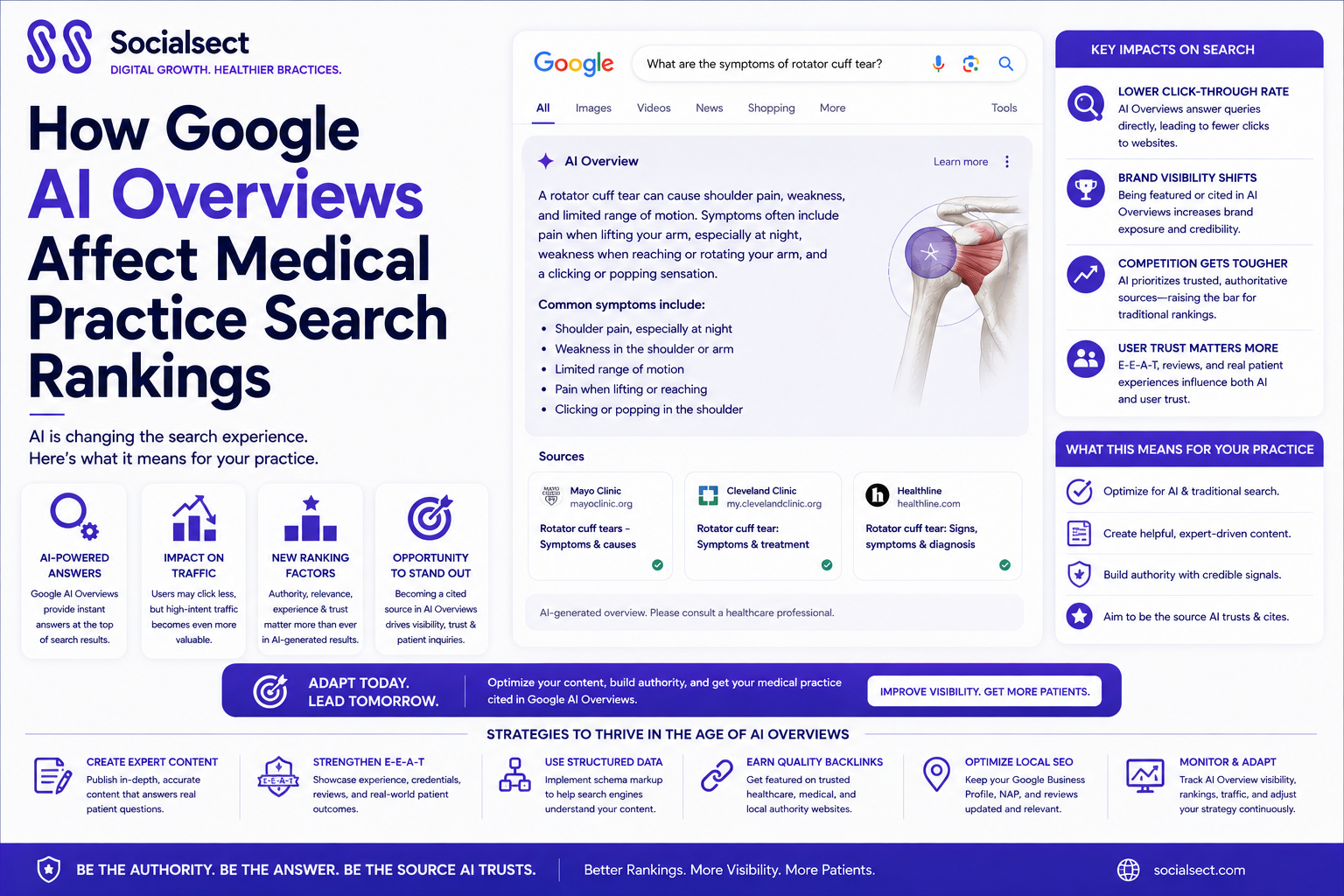
Google Search is changing how patients discover medical practices, physicians, treatments, and healthcare information.
For years, medical practices primarily competed for traditional organic rankings. A practice might optimize its website for searches such as "cardiologist near me," "orthopedic surgeon in Miami," or "dermatologist for acne treatment" and measure success through rankings, impressions, clicks, phone calls, and appointment requests.
Today, Google's AI-powered search experiences are adding another layer to that journey.
Google AI Overviews healthcare searches can provide users with an AI-generated summary directly within the search experience, alongside links to supporting web sources. This means patients may receive useful information before deciding which traditional search result to click.
For medical practices, this creates both an opportunity and a challenge.
The opportunity is greater visibility across new search experiences. The challenge is that traditional rankings alone may no longer tell the entire story.
A strong healthcare SEO strategy in 2026 therefore needs to account for traditional search, AI-generated answers, local visibility, medical expertise, content quality, and patient conversion.
What Are Google AI Overviews?
Google AI Overviews are AI-generated summaries that can appear in Google Search for eligible queries.
Instead of displaying only a conventional list of links, Google may provide a synthesized response and supporting links that allow users to explore the information further.
For healthcare searches, patients might ask:
- What causes chronic back pain?
- What does a neurologist treat?
- How long does cataract surgery recovery take?
- What are the symptoms of sleep apnea?
- When should I see a cardiologist?
- What treatments are available for varicose veins?
These questions can involve multiple concepts and sources.
AI-powered search can help users explore those concepts more conversationally.
Google's documentation explains that AI search features are supported by its underlying Search systems, meaning traditional SEO fundamentals continue to matter.
How Google AI Overviews Healthcare Search Is Different
Traditional search often follows this pattern:
Query → Search Results → Website → Information
AI-powered search can create a different experience:
Question → AI Overview → Supporting Sources → Further Exploration → Website
This changes how medical practices should think about visibility.
A practice does not necessarily need to abandon its traditional SEO strategy.
Instead, it needs to make its website useful across both experiences.
That means optimizing for:
- Traditional organic search
- AI-powered search
- Local search
- Patient questions
- Physician discovery
- Treatment research
- Appointment conversion
Do AI Overviews Replace Traditional Medical Search Rankings?
No.
This is one of the most important points medical practices should understand.
AI Overviews do not mean traditional SEO is dead.
Search engines still need to discover, crawl, index, retrieve, and evaluate web pages.
Google's guidance for AI search emphasizes that existing SEO fundamentals remain relevant.
For medical practices, this means continuing to invest in:
- Technical SEO
- Quality content
- Internal linking
- Local SEO
- Physician profiles
- Service pages
- Website usability
- Structured data
- Page performance
AI search should be considered another layer of search visibility rather than a replacement for SEO.
Why Google AI Overviews Matter to Medical Practices
Healthcare decisions are often research-driven.
A patient may not immediately book an appointment after the first search.
Instead, the journey might look like:
Symptom Search → Condition Research → Treatment Research → Specialist Search → Practice Comparison → Appointment
AI Overviews can become part of the early research stages.
For example, someone experiencing shoulder pain might initially search:
"Why does my shoulder hurt when I raise my arm?"
After researching possible causes, they may search:
"rotator cuff specialist near me."
Eventually, they may visit a specific practice website.
This means medical practices need content that supports the entire patient journey—not only commercial keywords.
The Importance of Healthcare EEAT
Medical websites operate in a trust-sensitive environment.
Patients need to know whether the information they are reading is accurate and whether the organization providing it is qualified to deliver care.
This makes Experience, Expertise, Authoritativeness, and Trustworthiness (EEAT) especially important to healthcare content strategy.
A medical practice should clearly communicate:
- Physician credentials
- Medical specialties
- Professional experience
- Areas of clinical focus
- Relevant certifications
- Practice locations
- Treatment expertise
- Appropriate medical references
Content should also have clear authorship and, where appropriate, medical review.
For example:
Written by: Dr. [Name], [Specialty]
Medically reviewed by: Dr. [Name], [Credentials]
This gives patients additional context about the expertise behind the information.
Create Content That Answers Patient Questions
One of the most practical responses to Google AI Overviews healthcare is to create genuinely useful content.
Patients increasingly search using complete questions.
Examples include:
What are the early symptoms of arthritis?
When should I see a spine specialist for back pain?
How long does physical therapy take after surgery?
What happens during a colonoscopy?
What is the recovery time after cataract surgery?
When is knee replacement considered?
These questions can be incorporated naturally into:
- Service pages
- Condition pages
- Treatment guides
- Educational articles
- FAQs
The answer should be clear, medically responsible, and supported by relevant context.
Build Comprehensive Medical Service Pages
Medical practices should not depend entirely on blog content.
Service pages are often among the most important pages for patient acquisition.
A strong service page should explain:
- What the treatment or service is
- Who may benefit
- Why evaluation may be necessary
- How the process works
- What patients can expect
- Potential risks and considerations
- Recovery information where relevant
- Which physician provides the service
- Where the service is offered
- How to request an appointment
For example, an orthopedic practice could develop comprehensive pages for:
- Rotator cuff treatment
- Knee replacement
- Sports injuries
- Shoulder surgery
- Hip replacement
- Fracture care
Each page should provide meaningful information rather than simply repeating keywords.
Google AI Overviews and Local SEO
Local search remains extremely important for medical practices.
Patients generally need healthcare providers they can physically access.
Searches may include:
- Dermatologist near me
- Cardiologist in Chicago
- Spine surgeon in New York
- IVF clinic near me
- Dentist in Miami
- Orthopedic surgeon near me
This makes local SEO a critical part of a Google AI Overviews healthcare strategy.
Medical practices should maintain accurate:
- Google Business Profile information
- Address
- Phone number
- Opening hours
- Services
- Physician information
- Location pages
The information should remain consistent across relevant online platforms.
Create Strong Location Pages
Multi-location medical practices have another challenge.
A healthcare group with offices in several cities should create useful location pages rather than duplicate one page repeatedly.
A useful location page can include:
- Clinic address
- Services available
- Physicians practicing there
- Parking information
- Office hours
- Nearby areas served
- Appointment information
- Unique local information
Avoid creating pages where only the city name changes.
A location page should genuinely help someone deciding whether that practice is convenient and relevant.
Physician Profiles Are More Important Than Ever
Patients do not simply choose websites.
They choose doctors.
That means physician profiles should be comprehensive.
A strong physician profile can include:
- Full name
- Specialty
- Credentials
- Education
- Certifications
- Clinical interests
- Professional experience
- Publications
- Professional memberships
- Languages
- Practice locations
- Appointment options
The physician profile should also connect naturally to relevant services and educational content.
For example:
Dr. Smith → Cardiology → Heart Failure → Diagnostic Testing → Chicago Location
This creates a clear relationship between professional expertise and the services offered.
Technical SEO Still Supports AI Search
Medical practices should not overlook technical SEO while adapting to AI search.
Important areas include:
- Crawlability
- Indexation
- XML sitemaps
- Canonical URLs
- Mobile usability
- HTTPS
- Page speed
- Core Web Vitals
- JavaScript rendering
- Internal linking
- Redirects
- Broken links
If important medical pages cannot be properly accessed or indexed, they may have limited visibility in search.
For large healthcare organizations, technical SEO becomes particularly important because a single structural problem can affect hundreds or thousands of URLs.
Use Structured Data Correctly
Structured data can help search engines understand information represented on webpages.
Depending on the content, healthcare websites may use appropriate structured data for:
- Organization
- LocalBusiness
- MedicalClinic
- Physician
- Article
- BreadcrumbList
Structured data should accurately represent visible page information and comply with applicable search engine guidelines.
It should not be treated as a guaranteed method for earning an AI Overview citation.
The underlying content still needs to be useful, accurate, and trustworthy.
Don't Write Content Just for AI Overviews
The emergence of AI search can create a dangerous temptation.
Some businesses may try to publish hundreds of pages designed solely to appear in AI-generated answers.
This is not a sustainable strategy.
Medical practices should avoid:
- Mass-produced low-value articles
- Keyword stuffing
- Duplicate city pages
- Unsupported medical claims
- Fake medical expertise
- Unreviewed medical content
- Automatically generated pages with little original value
The better strategy is simple:
Create the best answer for the patient's question.
Then make that answer technically accessible and easy to understand.
AI-Assisted Healthcare Content Needs Human Oversight
AI tools can be useful for healthcare marketing teams.
They can help with:
- Research organization
- Content outlines
- Topic discovery
- Editing
- Content planning
- Summarization
However, medical content should be carefully reviewed.
A responsible workflow is:
Research → Draft → Medical Review → Fact Check → SEO Review → Publish → Update
This becomes especially important for pages discussing:
- Symptoms
- Diagnoses
- Medications
- Surgical procedures
- Risks
- Treatment recommendations
- Recovery
AI should support healthcare expertise, not fabricate it.
Build Topic Clusters Around Medical Conditions
A medical practice can strengthen its search visibility by building interconnected topic clusters.
For example, a spine practice could build a back pain cluster:
Back Pain
→ Causes of Back Pain → Herniated Disc → Spinal Stenosis → Sciatica → Back Pain Treatment → Physical Therapy → Spine Surgery → Recovery After Spine Surgery → When to See a Spine Specialist
These pages should be linked logically.
This helps users navigate related information and establishes broader topical coverage.
Optimize for the Entire Patient Journey
A successful medical SEO strategy should not stop when someone reaches the website.
The website needs to help patients move from research to action.
A typical journey could be:
AI/Search Discovery
↓
Educational Content
↓
Treatment or Condition Page
↓
Physician Profile
↓
Location Information
↓
Appointment Request
The website should make every stage clear.
Include visible calls to action such as:
- Schedule an appointment
- Request a consultation
- Call the practice
- Find a location
- Meet the physician
The CTA should be relevant to the patient's intent.
How to Measure the Impact of Google AI Overviews
Traditional SEO metrics remain valuable.
Medical practices should monitor:
- Organic impressions
- Organic clicks
- Keyword visibility
- Search rankings
- Local rankings
- Google Business Profile actions
- Website traffic
- Phone calls
- Appointment requests
- Lead quality
AI search adds another consideration: visibility within generative search experiences.
Google has been expanding reporting and measurement capabilities for generative AI search, although availability and reporting details can evolve.
Therefore, medical practices should avoid relying on a single "AI ranking" metric.
Business outcomes matter more.
A Practical Google AI Overviews Healthcare Strategy
Medical practices can prepare with the following framework.
Step 1: Audit Your Website
Review:
- Technical SEO
- Indexation
- Content quality
- Physician profiles
- Service pages
- Location pages
- Internal linking
Step 2: Identify Patient Questions
Research what patients ask about your specialties, conditions, and treatments.
Step 3: Strengthen Medical Content
Create comprehensive, accurate, patient-focused resources.
Step 4: Add Expertise Signals
Clearly communicate physician credentials and content review processes.
Step 5: Build Topic Clusters
Develop connected content around important conditions and services.
Step 6: Strengthen Local SEO
Make location and practice information accurate and useful.
Step 7: Improve Conversion Paths
Make appointment requests, calls, and consultations easy.
Step 8: Monitor Search Performance
Measure traditional organic visibility alongside emerging AI search visibility.
Google AI Overviews Healthcare: What Medical Practices Should Do Now
Medical practices do not need a completely separate website for AI search.
Instead, strengthen the website you already have.
Prioritize:
1. Technical health
Make important pages crawlable and indexable.
2. Medical expertise
Show who is responsible for your content.
3. Patient-focused content
Answer real questions clearly.
4. Topical authority
Build comprehensive resources around important conditions and treatments.
5. Local visibility
Maintain accurate information for every practice location.
6. Conversion optimization
Make it easy for patients to contact the practice.
7. Content maintenance
Review important medical content regularly.
How Socialsect Helps Medical Practices Adapt to AI Search
At Socialsect, we approach Google AI Overviews healthcare visibility as part of a broader healthcare SEO strategy.
Our approach can include:
- Healthcare SEO audits
- Technical SEO
- Medical content strategy
- EEAT optimization
- Physician SEO
- Local SEO
- Multi-location SEO
- Healthcare website optimization
- Topic cluster development
- Conversion optimization
- Search performance analysis
- AI search optimization
The goal is not to chase individual AI features.
The goal is to build a healthcare website that is useful to patients, understandable to search engines, and supported by credible expertise.
Final Thoughts
Google AI Overviews are changing how patients discover and consume healthcare information.
But medical practices should not interpret this as the end of traditional SEO.
Instead, Google AI Overviews healthcare should be viewed as another evolution in the search journey.
The practices best positioned for this environment will continue investing in strong SEO fundamentals while improving the quality, depth, expertise, and usability of their websites.
The winning strategy is not:
"How can we manipulate AI to mention our practice?"
It is:
"How can we become one of the most useful and trustworthy sources for the questions our patients are asking?"
That approach benefits traditional search, AI-powered search, local discovery, and—most importantly—the patient.