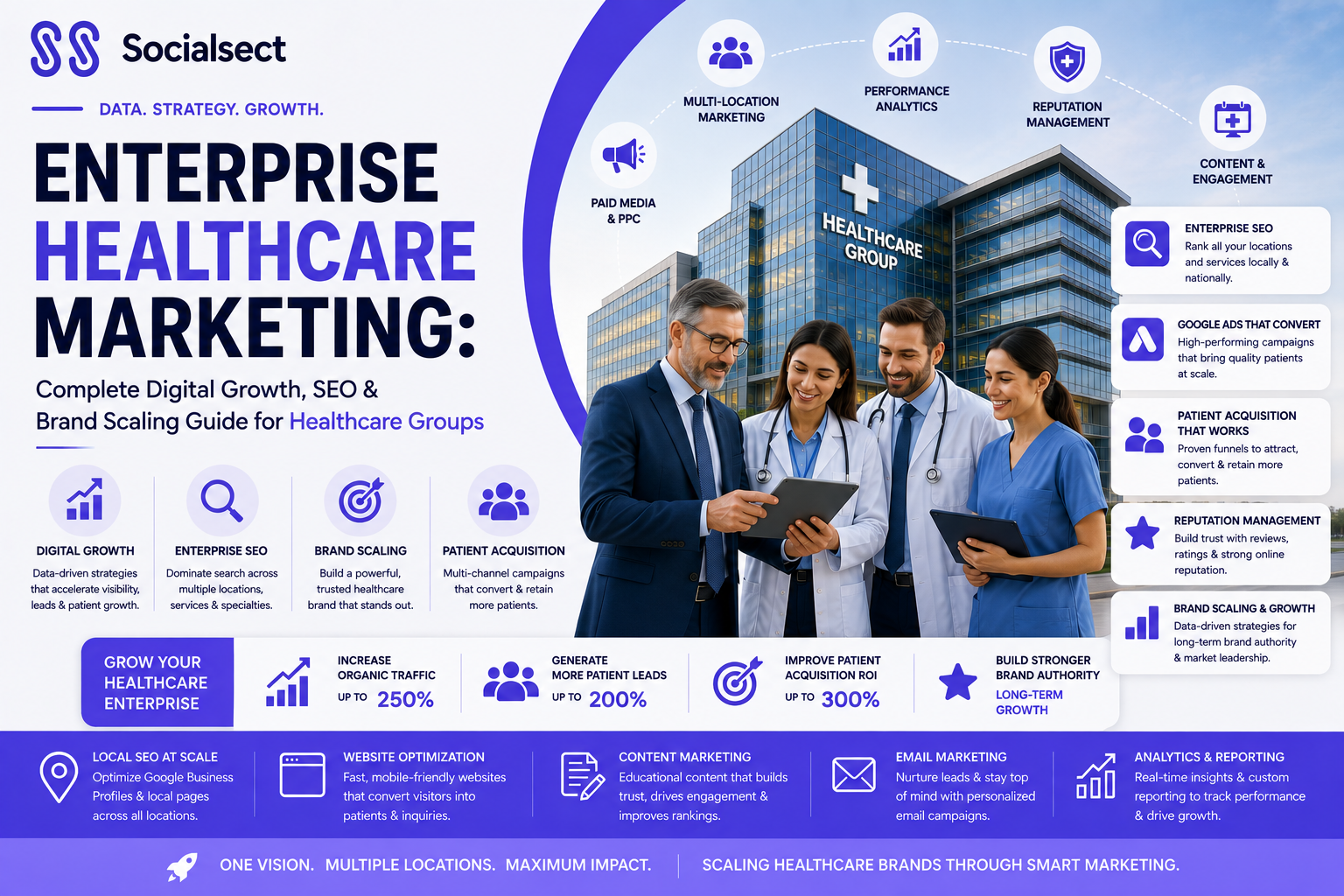
Healthcare organizations operating across multiple locations, specialties, brands, or markets face a different set of marketing challenges than independent medical practices.
A single clinic can often manage its SEO, website, advertising, and reputation locally. A healthcare group with dozens or hundreds of locations needs a centralized strategy that can maintain brand consistency while allowing every location to compete effectively in its local market.
This is where enterprise healthcare marketing becomes essential.
Healthcare groups need marketing systems that can scale alongside acquisitions, new locations, specialty expansion, and changing patient expectations. They also need strong technical infrastructure, centralized data, consistent brand positioning, and localized patient acquisition.
At Socialsect, we help healthcare organizations build scalable digital growth systems combining enterprise healthcare SEO, content strategy, local SEO, paid advertising, website optimization, brand management, and conversion optimization.
Our approach is designed for healthcare groups, hospital networks, multi-location clinic operators, specialty platforms, healthcare investors, and organizations undergoing expansion or digital transformation.
Why Enterprise Healthcare Marketing Matters
Healthcare consumers increasingly research providers online before making an appointment.
They compare:
- Healthcare providers
- Clinic locations
- Physician credentials
- Patient reviews
- Treatments
- Insurance information
- Appointment availability
- Healthcare brands
For a healthcare group, this creates both an opportunity and a challenge.
Every location needs to be visible locally, while the overall organization needs to maintain a consistent brand.
A successful enterprise strategy connects these two objectives.
It creates a digital ecosystem where:
Corporate authority + specialty authority + local visibility + patient experience = scalable healthcare growth
Enterprise Healthcare SEO
Enterprise healthcare SEO is the foundation of scalable organic growth for large healthcare organizations.
Unlike traditional SEO, enterprise SEO must manage hundreds or thousands of URLs, locations, services, physicians, specialties, and content assets.
A scalable strategy includes:
- Technical SEO
- Location SEO
- Specialty SEO
- Physician SEO
- Content architecture
- Internal linking
- Schema markup
- Local SEO
- Enterprise keyword research
- Conversion optimization
- Performance reporting
Each location should have the opportunity to rank for relevant searches while benefiting from the authority of the overall healthcare organization.
Healthcare Digital Transformation
Digital transformation is changing how healthcare organizations attract and engage patients.
Effective healthcare digital transformation connects marketing, technology, patient experience, data, and operations.
A modern healthcare marketing ecosystem may integrate:
- Website platforms
- CRM systems
- Appointment systems
- Analytics
- Call tracking
- Marketing automation
- Patient communication
- Reputation management
- Search marketing
The objective isn't simply to adopt new technology.
The objective is to create a connected digital patient journey.
From the first Google search to appointment booking and ongoing communication, every interaction should be measurable and optimized.
Healthcare Growth Strategy
A scalable healthcare growth strategy should be based on measurable business objectives rather than traffic alone.
Important growth metrics include:
- Qualified organic traffic
- Appointment requests
- Phone calls
- Consultation bookings
- Cost per acquisition
- Conversion rate
- Location-level performance
- Patient lifetime value
The strategy should identify which specialties, services, locations, and patient segments represent the strongest growth opportunities.
This allows healthcare organizations to prioritize marketing investment where it can create the greatest impact.
Healthcare Acquisition Marketing
Effective healthcare acquisition marketing focuses on attracting patients who are actively searching for healthcare services.
The strategy can combine:
- Organic search
- Google Ads
- Local SEO
- Content marketing
- Social media
- Reputation management
- Conversion optimization
Search intent should guide campaign development.
For example, a patient searching for "orthopedic clinic near me" has a different intent from someone searching "what causes knee pain?"
Both searches matter, but they require different content and conversion strategies.
Enterprise Medical Marketing
Large healthcare organizations require a coordinated enterprise medical marketing strategy.
Marketing teams need to balance corporate priorities with individual specialty requirements.
A healthcare group may simultaneously market:
- Cardiology
- Orthopedics
- Dermatology
- Gastroenterology
- Neurology
- Women's health
- General practice
- Physiotherapy
Each specialty needs its own keyword strategy, content ecosystem, landing pages, and patient acquisition campaigns.
At the same time, the overall organization must maintain consistent messaging and brand standards.
Healthcare M&A Marketing
Healthcare mergers and acquisitions can create significant marketing opportunities—but they can also create SEO and branding risks.
Healthcare M&A marketing should begin before or immediately after a transaction with a structured digital audit.
Important areas include:
- Website consolidation
- Domain strategy
- Redirect mapping
- Brand architecture
- Location pages
- Google Business Profiles
- Citation management
- Backlink preservation
- Content migration
- Technical SEO
- Reputation management
When healthcare organizations acquire existing practices, their existing search equity should be protected wherever possible.
Poorly managed migrations can result in broken URLs, lost rankings, duplicate content, and reduced organic traffic.
A structured M&A marketing plan helps preserve digital value while integrating the acquired organization into the broader healthcare network.
Healthcare Brand Scaling
As healthcare organizations expand, healthcare brand scaling becomes increasingly important.
A scalable healthcare brand should establish clear standards for:
- Visual identity
- Messaging
- Tone of voice
- Patient communication
- Website design
- Physician profiles
- Content
- Social media
- Local listings
Centralized brand guidelines help ensure that every location delivers a consistent experience without making every location's marketing identical.
The strongest approach combines centralized standards with localized execution.
Healthcare Expansion Marketing
Opening new clinics requires more than putting up a sign and launching a website page.
Effective healthcare expansion marketing should begin before the new location opens.
A launch strategy can include:
Pre-Launch
- Keyword research
- Location page creation
- Local citation planning
- Google Business Profile preparation
- Competitor analysis
- Paid search planning
Launch
- Local SEO
- Google Ads
- Content marketing
- Community outreach
- Reputation strategy
Post-Launch
- Review generation
- Local link acquisition
- Content expansion
- Conversion optimization
- Performance monitoring
This creates digital visibility while the new clinic establishes its local presence.
Healthcare Investment Marketing
Healthcare organizations backed by investors need marketing systems that demonstrate measurable performance.
Healthcare investment marketing should connect marketing activity with business outcomes.
Instead of reporting only:
- Impressions
- Clicks
- Rankings
- Traffic
enterprise teams should also monitor:
- Leads
- Appointments
- Cost per acquisition
- Revenue opportunities
- Location performance
- Marketing ROI
This creates greater visibility into how marketing contributes to organizational growth.
Healthcare Network SEO
Organizations with multiple hospitals, clinics, or specialty centers need a structured healthcare network SEO strategy.
Each location should have unique, useful information such as:
- Address
- Phone number
- Opening hours
- Available services
- Physicians
- Directions
- Local FAQs
- Appointment options
- Reviews
Location pages should not simply duplicate the same content with different city names.
Unique local information helps create stronger pages for both users and search engines.
Healthcare Operations Marketing
Marketing and operations cannot operate independently at enterprise scale.
Healthcare operations marketing connects marketing promises with the actual patient experience.
For example, if marketing generates a large number of appointment requests but the clinic responds slowly, conversion rates suffer.
Enterprise marketing should therefore consider:
- Call handling
- Appointment availability
- Lead response times
- Online booking
- CRM workflows
- Patient communication
- Location capacity
Marketing performance improves when operational processes support the patient journey.
Healthcare Portfolio Marketing
Healthcare organizations managing multiple brands or specialties can benefit from healthcare portfolio marketing.
A portfolio strategy determines:
- Which brands need independent positioning
- Which services should share authority
- Which locations require additional investment
- Which specialties have growth potential
- How brands should link to each other
This prevents internal competition between healthcare brands while creating opportunities for cross-referrals.
Hospital Group Marketing
Large hospital networks need a unified approach to digital visibility.
Effective hospital group marketing combines:
- Enterprise SEO
- Local SEO
- Physician marketing
- Specialty content
- Google Ads
- Reputation management
- Brand strategy
- Patient education
Each hospital should maintain strong local visibility while benefiting from the authority and resources of the broader group.
Multi Clinic Healthcare Marketing
Multi clinic healthcare marketing requires centralized planning with location-level execution.
Every clinic should have:
- A dedicated location page
- Local SEO strategy
- Google Business Profile
- Local reviews
- Location-specific service information
- Conversion tracking
At the group level, marketing teams can centralize:
- Keyword research
- Content production
- Technical SEO
- Brand guidelines
- Analytics
- Reporting
This model provides consistency without sacrificing local relevance.
Private Equity Clinic Branding
Healthcare organizations backed by private equity often operate multiple practices or acquire additional locations.
Private equity clinic branding requires careful consideration of both the existing practice reputation and the future group identity.
A successful branding strategy can preserve valuable local recognition while gradually introducing the broader healthcare group's identity.
Important considerations include:
- Brand architecture
- Naming conventions
- Website structure
- Physician positioning
- Local reputation
- Patient communication
- Digital migration
The goal is to create a stronger combined brand without unnecessarily damaging existing patient trust.
Private Equity Healthcare Marketing
Private equity healthcare marketing should be designed around scalable growth and measurable performance.
Marketing infrastructure should support:
- New acquisitions
- Geographic expansion
- New specialties
- Brand integration
- Organic growth
- Paid acquisition
- Patient retention
A centralized marketing framework allows the organization to replicate successful strategies across newly acquired practices.
EEAT for Enterprise Healthcare Websites
Healthcare websites fall within Google's Your Money or Your Life (YMYL) category, making Experience, Expertise, Authoritativeness, and Trustworthiness (EEAT) particularly important.
Enterprise healthcare websites should clearly demonstrate clinical expertise.
Experience
Provide practical, patient-focused information developed around real healthcare questions.
Expertise
Showcase:
- Physician credentials
- Certifications
- Specializations
- Professional memberships
- Clinical experience
Authoritativeness
Build authority through:
- Comprehensive specialty pages
- Expert-reviewed content
- High-quality healthcare resources
- Relevant professional references
- Strong internal linking
Trustworthiness
Make important information easy to verify.
Include:
- Physician identities
- Clinic locations
- Contact information
- Privacy policies
- Appointment information
- Clear editorial standards
Medical content should be accurate, current, transparent, and written for patient understanding.
Enterprise Healthcare Content Strategy
Content should be organized into scalable topic clusters.
For example:
Cardiology
→ Heart disease→ Hypertension→ Arrhythmia→ Heart failure→ Cardiac testing
Orthopedics
→ Joint pain→ Knee conditions→ Hip conditions→ Sports injuries→ Orthopedic surgery
This structure allows healthcare organizations to establish topical authority while creating useful resources for patients.
Technical SEO for Healthcare Groups
Technical SEO becomes increasingly important as the website grows.
Enterprise websites should regularly monitor:
- Indexation
- Crawlability
- Canonicals
- Redirects
- XML sitemaps
- Duplicate content
- Broken links
- Page speed
- Core Web Vitals
- Structured data
- JavaScript rendering
A technical issue affecting one template can potentially affect hundreds of pages.
That is why enterprise healthcare SEO requires continuous technical monitoring.
Google Ads for Enterprise Healthcare Organizations
Paid search can complement organic growth by providing immediate visibility.
Enterprise campaigns can be organized by:
- Location
- Specialty
- Treatment
- Physician
- Patient intent
Conversion tracking should measure meaningful actions such as:
- Phone calls
- Appointment requests
- Consultation forms
- Online bookings
This makes it easier to allocate budgets toward locations and specialties producing the strongest results.
Why Socialsect Is the Right Enterprise Healthcare Marketing Partner
At Socialsect, we understand that enterprise healthcare marketing is not simply about generating website traffic.
It is about building a scalable digital infrastructure that supports patient acquisition and organizational growth.
Our services include:
- Enterprise healthcare SEO
- Technical SEO
- Local SEO
- Multi-location SEO
- Healthcare content strategy
- Google Ads
- Website development
- Conversion optimization
- Healthcare brand strategy
- Reputation management
- Analytics and reporting
We build strategies that can scale with your organization rather than requiring a completely new marketing system every time you add a clinic.
Build a Scalable Healthcare Growth Engine with Socialsect
Enterprise healthcare organizations need marketing systems capable of supporting continuous growth.
By combining enterprise healthcare SEO, healthcare digital transformation, a measurable healthcare growth strategy, healthcare acquisition marketing, enterprise medical marketing, healthcare M&A marketing, healthcare brand scaling, healthcare expansion marketing, healthcare investment marketing, healthcare network SEO, healthcare operations marketing, healthcare portfolio marketing, hospital group marketing, multi clinic healthcare marketing, private equity clinic branding, and private equity healthcare marketing, healthcare organizations can create a stronger and more scalable digital presence.
The goal is not simply to rank more pages.
The goal is to build a digital growth engine that helps every location, specialty, and brand attract qualified patients while maintaining trust and consistency.
Partner with Socialsect to develop an enterprise healthcare marketing strategy built for sustainable digital growth, scalable patient acquisition, and long-term brand value.