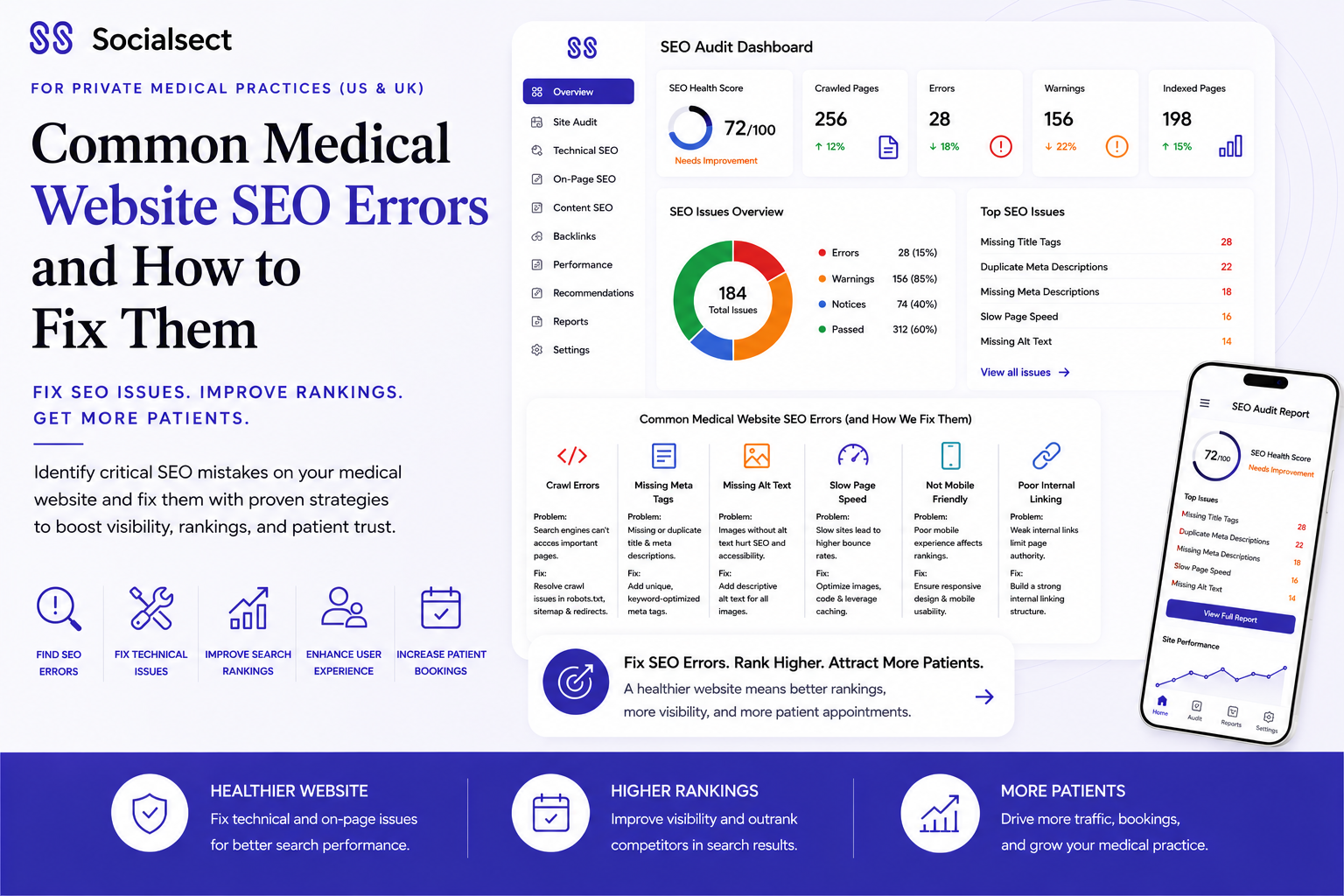
A healthcare website can offer outstanding medical services, experienced doctors, and excellent patient care, yet still struggle to attract patients online because of poor SEO. Search engines have become the primary way patients discover healthcare providers, making medical website SEO one of the most important factors in digital patient acquisition.
Many clinics, hospitals, dental practices, and specialist healthcare providers unknowingly make SEO mistakes that limit their visibility in Google Search, Google Maps, and AI-powered search experiences. These issues range from technical problems and poor website architecture to weak content and ineffective local optimization.
The good news is that most SEO issues are fixable. A structured healthcare SEO audit, combined with strong technical optimization and patient-focused content, can significantly improve medical search rankings, increase organic traffic, and generate more appointment requests.
At Socialsect, we help healthcare organizations identify SEO problems, implement proven solutions, and build websites designed for long-term organic growth.
Why Medical Website SEO Matters
The majority of patients now begin their healthcare journey online.
They search for:
- Orthopedic surgeon near me
- Dentist in Chicago
- Dermatologist London
- Fertility clinic
- Plastic surgeon consultation
- Eye specialist
If your website does not appear prominently in search results, potential patients may never discover your practice.
Strong medical website SEO improves:
- Organic visibility
- Local rankings
- Website traffic
- Patient trust
- Appointment bookings
SEO has become one of the highest ROI marketing channels for healthcare businesses.
What Is Medical Website SEO?
Medical website SEO is the process of optimizing healthcare websites so they rank higher in search engines for relevant medical searches.
It includes:
- Technical SEO
- Local SEO
- Content optimization
- Website performance
- Internal linking
- Schema markup
- User experience
- AI-ready content
The objective is to make your website easier for both search engines and patients to understand.
Why a Healthcare SEO Audit Is Essential
Before improving rankings, you must identify existing issues.
A healthcare SEO audit evaluates every factor affecting search performance.
A complete audit typically reviews:
- Indexation
- Technical errors
- Website speed
- Mobile usability
- Keyword optimization
- Internal linking
- Backlinks
- Content quality
- Local SEO
- Core Web Vitals
Regular audits help identify problems before they affect rankings.
Medical SEO Error #1: Ignoring Search Intent
One of the biggest SEO mistakes is creating content that doesn't match what patients are searching for.
For example, a patient searching:
"Knee replacement recovery"
expects educational information—not a generic homepage.
To fix this:
- Research patient search intent
- Create dedicated treatment pages
- Answer common questions
- Match content to user needs
Relevant content improves rankings and engagement.
Medical SEO Error #2: Poor Keyword Optimization
Many healthcare websites either overuse keywords or fail to target them properly.
Instead of keyword stuffing, use:
- Primary keyword naturally
- Supporting semantic keywords
- Location modifiers where relevant
- Patient-friendly language
Balanced optimization improves readability and search visibility.
Medical SEO Error #3: Weak Technical SEO
Technical SEO for healthcare forms the foundation of every successful website.
Common technical issues include:
- Broken links
- Duplicate pages
- Crawl errors
- Missing XML sitemap
- Poor URL structure
- Indexing problems
Technical issues prevent search engines from understanding your website.
Fixing these often leads to measurable ranking improvements.
Medical SEO Error #4: Slow Website Speed
Patients expect healthcare websites to load quickly.
Slow websites increase:
- Bounce rates
- Abandoned sessions
- Lost appointments
Improve performance through:
Image Optimization
Compress large images.
Caching
Improve repeat visits.
Code Minification
Reduce unnecessary scripts.
Better Hosting
Improve server response time.
Fast websites improve SEO and patient experience.
Medical SEO Error #5: Poor Mobile Experience
Most healthcare searches happen on smartphones.
Unfortunately, many medical websites still provide poor mobile experiences.
A mobile-friendly website should include:
- Responsive design
- Easy navigation
- Fast loading
- Click-to-call functionality
- Mobile-friendly booking forms
Mobile usability is a ranking factor and a major conversion driver.
Medical SEO Error #6: Weak Healthcare Website Optimization
Healthcare website optimization goes beyond SEO.
Your website should provide:
- Clear navigation
- Fast loading
- Strong CTAs
- Accessible content
- Secure browsing
- Excellent UX
Optimization improves both search rankings and patient satisfaction.
Medical SEO Error #7: Missing Local SEO
Healthcare is inherently local.
Patients search for providers near them.
Ignoring local SEO means losing valuable traffic.
Improve local SEO by:
- Optimizing Google Business Profile
- Building location pages
- Earning patient reviews
- Maintaining NAP consistency
- Creating local content
Local SEO significantly improves appointment bookings.
Medical SEO Error #8: Thin or Generic Content
Many clinic websites contain only a few paragraphs about each service.
Thin pages rarely rank well.
Create comprehensive pages covering:
- Symptoms
- Treatment options
- Recovery
- Risks
- FAQs
- Benefits
- When to seek medical care
Detailed content improves authority and rankings.
Medical SEO Error #9: Ignoring Internal Linking
Internal links help search engines understand your website.
They also guide patients toward relevant information.
Examples:
Treatment pages → Doctor profiles
Doctor profiles → Appointment page
Blogs → Treatment pages
Strong internal linking distributes authority throughout the site.
Medical SEO Error #10: Poor Metadata
Title tags and meta descriptions strongly influence click-through rates.
Effective metadata should:
- Include primary keywords
- Clearly describe the page
- Encourage clicks
- Stay within recommended length
Optimized metadata improves visibility and traffic.
Medical SEO Error #11: Ignoring Core Web Vitals
Google measures real-world user experience through Core Web Vitals.
Important metrics include:
Largest Contentful Paint (LCP)
Measures loading speed.
Interaction to Next Paint (INP)
Measures responsiveness.
Cumulative Layout Shift (CLS)
Measures visual stability.
Strong Core Web Vitals improve rankings and usability.
Medical SEO Error #12: No Structured Data
Healthcare websites should implement schema markup to help search engines understand content.
Useful schema includes:
- MedicalOrganization
- Physician
- MedicalClinic
- FAQ
- Breadcrumb
- Article
Structured data improves eligibility for rich search results.
Healthcare SEO Best Practices
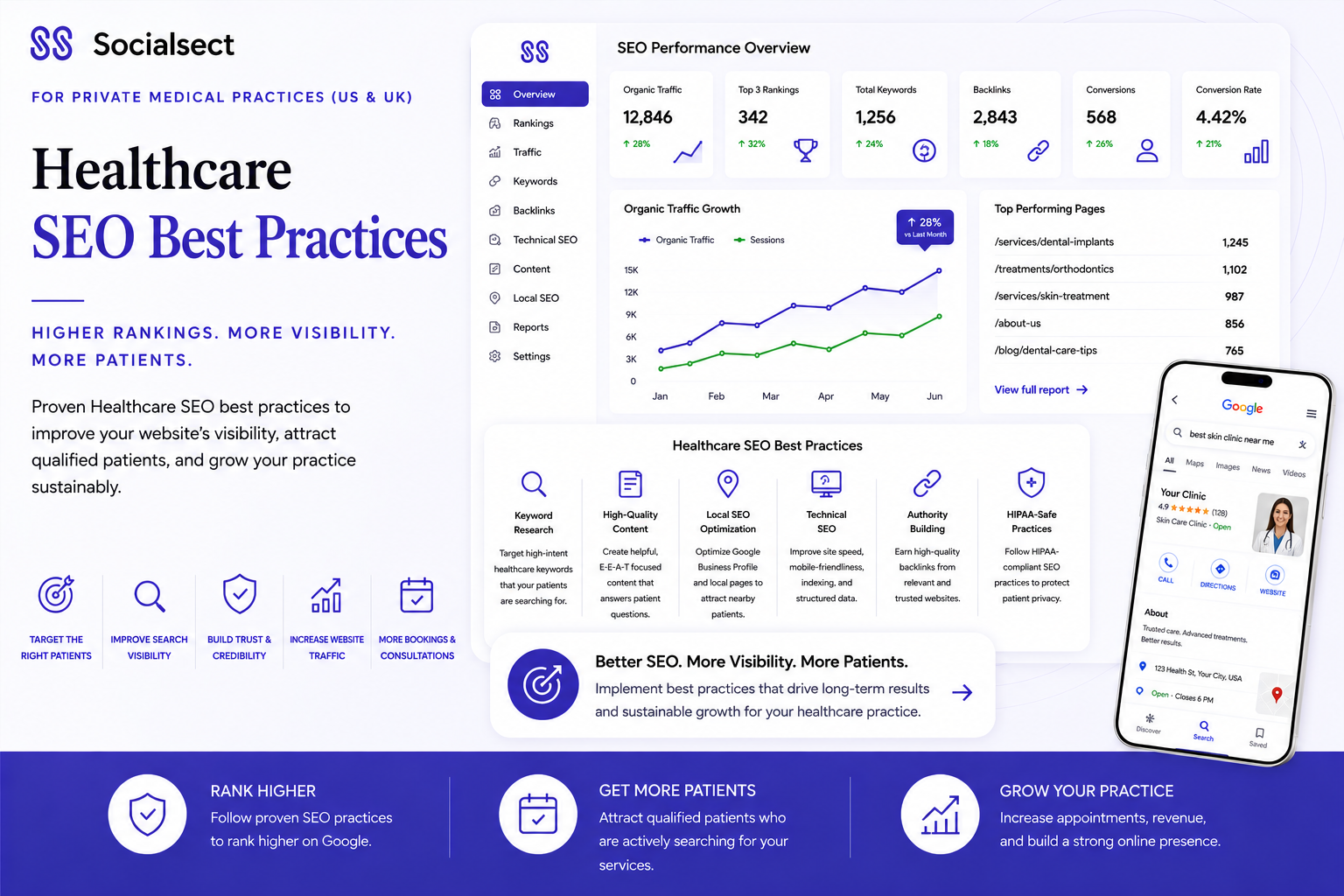
Successful websites follow consistent healthcare SEO best practices including:
Publish High-Quality Content
Answer patient questions thoroughly.
Optimize for Mobile
Prioritize smartphone users.
Improve Website Speed
Enhance user experience.
Build Local Authority
Focus on Google Business Profile.
Earn Reviews
Strengthen trust signals.
Monitor Performance
Track rankings and conversions.
SEO is an ongoing process—not a one-time task.
Clinic SEO Fixes That Deliver Quick Wins
Some clinic SEO fixes can produce noticeable improvements quickly.
Examples include:
- Updating title tags
- Compressing images
- Fixing broken links
- Improving internal links
- Optimizing Google Business Profile
- Updating outdated content
Quick improvements often boost visibility within weeks.
AI Search and the Future of Medical SEO
Search is evolving rapidly.
Patients increasingly receive answers through:
- Google AI Overviews
- Voice assistants
- AI-powered search
- Large language models
To remain competitive, healthcare websites should:
- Structure content clearly
- Answer patient questions directly
- Build topical authority
- Demonstrate expertise
- Use semantic optimization
AI-ready websites will outperform outdated SEO strategies.
EEAT and Healthcare SEO
Healthcare is a YMYL category, meaning trust is essential.
Google evaluates:
Experience
Demonstrate real-world medical expertise.
Expertise
Highlight qualified professionals.
Authoritativeness
Build industry recognition.
Trustworthiness
Provide accurate, transparent information.
Strong EEAT improves rankings and patient confidence.
Why Healthcare Organizations Choose Socialsect
At Socialsect, we specialize in performance-driven healthcare SEO.
Our services include:
- Medical website SEO
- Healthcare SEO audit
- Technical SEO for healthcare
- Healthcare website optimization
- Medical search rankings improvement
- Healthcare SEO best practices
- Clinic SEO fixes
- AI-ready content optimization
- Local SEO
- Conversion optimization
We help healthcare providers build websites that rank higher, attract qualified patients, and support long-term digital growth.
Conclusion
Even the best healthcare providers can lose patients online if their websites suffer from preventable SEO issues. From technical errors and poor content to weak local optimization and slow performance, these problems limit visibility and reduce patient acquisition.
A structured healthcare SEO audit, combined with ongoing technical SEO for healthcare, better healthcare website optimization, and adherence to healthcare SEO best practices, creates a strong foundation for long-term organic growth.
By addressing common medical SEO errors and implementing strategic clinic SEO fixes, healthcare organizations can improve medical search rankings, strengthen patient trust, and generate more appointment requests.
At Socialsect, we help healthcare businesses transform underperforming websites into high-ranking, conversion-focused digital assets.